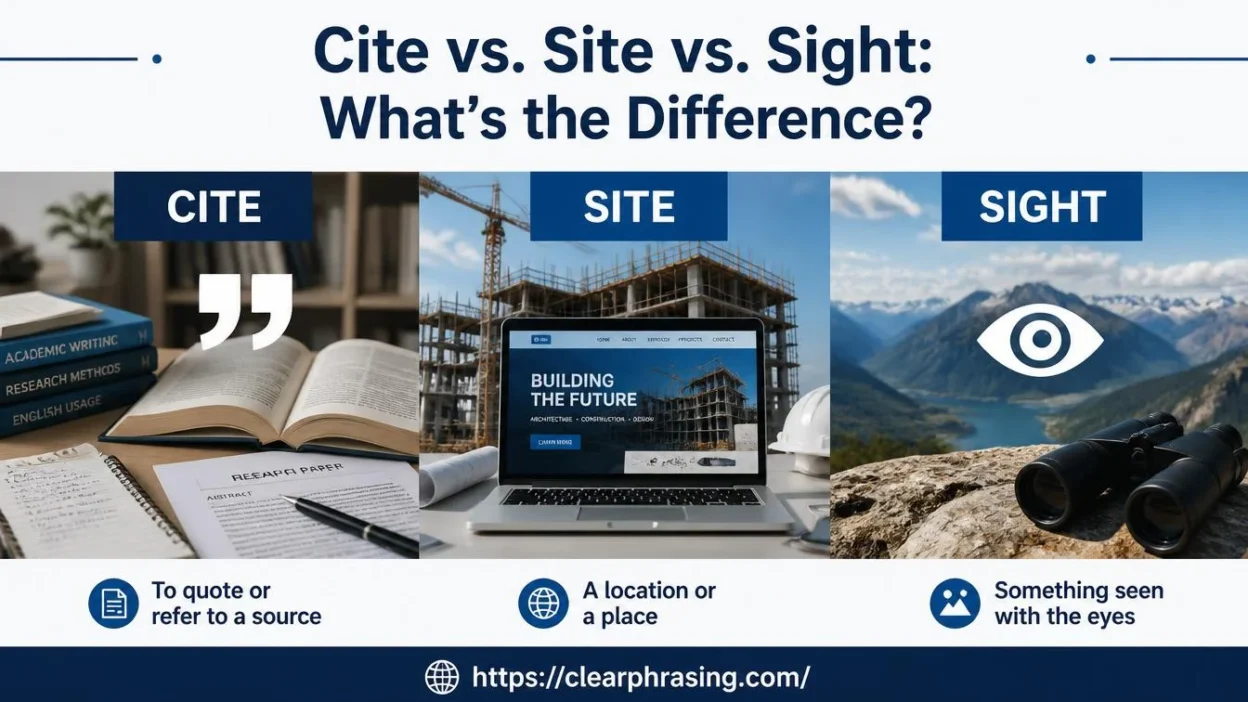
Cite vs. Site vs. Sight: What’s the Difference? helps English learners avoid confusion by explaining these homophones with simple examples clearly.
From my years of teaching English, I have noticed that many people become confused because these words sound alike and share identical pronunciation, yet they have different spellings, meanings, and usage. Students often accidentally mix cite, site, and sight in writing, emails, school assignments, social media captions, and everyday conversations because they all sound the same.
The difference becomes much easier to understand when you remember that cite is a verb used to point out, mention, commend, or provide authoritative proof by quoting or drawing upon a source. Sight is a noun connected with vision, an object that comes into view, or something you view, while site refers to a specific place, location, building, monument, or where an event occurred.
Choosing the correct word improves communication in everyday life, whether you are speaking, studying for exams, creating content online, sending work emails, or writing professionally in academics and business communication.
If you have trouble choosing, think about the meaning first. It is about a source, example, commendation, or proof, choose cite. If it relates to vision, a view, or an object, use sight. If it describes a specific place or location, use site. This habit helps you avoid confusion, notice similar spelling, recognize incorrect uses, build confidence and clarity, and makes understanding every term more important for accurate writing.
Quick Answer
The simplest way to remember the difference between cite, site, and sight is to focus on what each word represents.
| Word | Meaning | Part of Speech | Example |
| Cite | To reference, quote, or acknowledge a source or evidence | Verb | Always cite your sources in academic writing. |
| Site | A physical or digital location | Noun | The new office site is downtown. |
| Sight | The ability to see or something visible | Noun (sometimes verb) | The mountain was a breathtaking sight. |
Here’s the quick summary:
- Cite = Reference a source.
- Site = A place or location.
- Sight = Vision or something you can see.
Although they sound exactly the same, these words have completely different meanings. The key to choosing the correct one is understanding the context of your sentence.
Read More: Two Persons vs Two People: Which Is Correct?
What Does “Cite” Mean?
Definition
The word cite means to quote, reference, mention, or acknowledge a source of information, evidence, or authority. You’ll commonly encounter it in academic writing, journalism, legal documents, research papers, and professional reports.
Whenever you include facts, statistics, ideas, or direct quotations from another source, you should cite where that information came from. Proper citations give credit to the original author, strengthen your arguments, and allow readers to verify your sources.
Outside academia, the word also appears in legal and professional settings. Attorneys cite previous court rulings to support legal arguments, while journalists cite official statements and reports to improve accuracy and credibility.
Common Uses of “Cite”
People use cite in many situations, including:
- Referencing books, journals, or websites
- Supporting an argument with evidence
- Quoting experts
- Mentioning research findings
- Acknowledging another author’s work
- Referring to laws or court decisions
- Backing up claims with reliable data
In every case, the goal is the same: to point readers toward the original source of information.
Examples of “Cite” in Sentences
Here are several examples of the word cite used correctly:
- Always cite your sources when writing a research paper.
- The professor asked students to cite at least five peer-reviewed articles.
- The lawyer cited several previous court decisions during the trial.
- Journalists should cite official sources before publishing breaking news.
- The report cites government statistics collected over the last decade.
- Scientists must cite earlier studies when building on existing research.
Common Phrases Using “Cite”
You’ll often come across these expressions:
- Cite your sources
- Cite evidence
- Cite an example
- Cite a reference
- Cite a study
- Proper citation
- Citation format
- In-text citation
Quick Tip: If your sentence involves giving credit, supporting an argument, or referring to another source, cite is almost certainly the correct word.
What Does “Site” Mean?
Definition
The word site refers to a specific place or location, whether it’s physical or digital. While many people associate the word with websites today, its meaning extends far beyond the internet.
A site can be a construction area, a historic landmark, an archaeological excavation, a campsite, or even an online destination. The common thread is that site always identifies a location.
Common Types of Sites
The word site appears in many everyday contexts. Here are some of the most common examples.
Construction Site
A construction site is an area where workers build, renovate, or demolish structures.
Example:
- The construction site remained closed because of severe weather.
Archaeological Site
An archaeological site contains historical artifacts, ruins, or evidence of ancient civilizations.
Example:
- Researchers discovered pottery fragments at the archaeological site.
Campsite
A campsite is a designated place where people camp using tents or recreational vehicles.
Example:
- Our campsite overlooked a peaceful mountain lake.
Website
A website is a collection of web pages stored at an online location.
Example:
- Visit our website to learn more about our services.
Job Site
A job site is an online platform where employers post vacancies and job seekers search for employment opportunities.
Example:
- She found her current position through a leading job site.
Examples of “Site” in Sentences
The following examples show how site is used in different contexts.
- Engineers inspected the construction site before work began.
- The city selected a new site for the public library.
- Thousands of tourists visit the historical site every year.
- The company launched its redesigned website this morning.
- Workers completed the cleanup at the industrial site.
- The hospital plans to build a second medical site on the west side of town.
Common Expressions with “Site”
You’ll frequently hear phrases such as:
- Construction site
- Historic site
- Launch site
- Mining site
- Building site
- Job site
- Campsite
- Website
- Project site
Quick Tip: If you can point to it on a map—or visit it online—you’re probably talking about a site.
What Does “Sight” Mean?
Definition
The word sight relates to vision or the act of seeing. It can refer to your ability to see, something visible, or a memorable view that captures your attention.
Sight is one of the five human senses, making it an essential part of how we experience the world. The word also appears in many common expressions that describe noticing or observing something.
Common Meanings of “Sight”
Depending on the context, sight can have several related meanings.
The Ability to See
Sight often refers to the physical sense of vision.
Example:
- Regular eye examinations help protect your sight.
Something Visible
Sight can describe anything that is seen.
Example:
- The snow-covered mountains were an unforgettable sight.
A Beautiful or Remarkable View
Many people use the word when describing scenery, landmarks, or memorable experiences.
Example:
- Watching the northern lights was an incredible sight.
Examples of “Sight” in Sentences
Here are several examples that demonstrate correct usage.
- She gradually regained her sight after surgery.
- We caught sight of a family of deer near the forest.
- The city skyline at sunset was a spectacular sight.
- Losing sight in one eye affects depth perception.
- The Grand Canyon is an awe-inspiring sight for first-time visitors.
- The rescue team finally came into sight after several hours.
Common Expressions with “Sight”
Some of the most familiar expressions include:
- At first sight
- Catch sight of
- In sight
- Out of sight
- Within sight
- Lose sight of
- Love at first sight
Quick Tip: If your sentence involves eyes, vision, or something that can be seen, sight is the word you need.
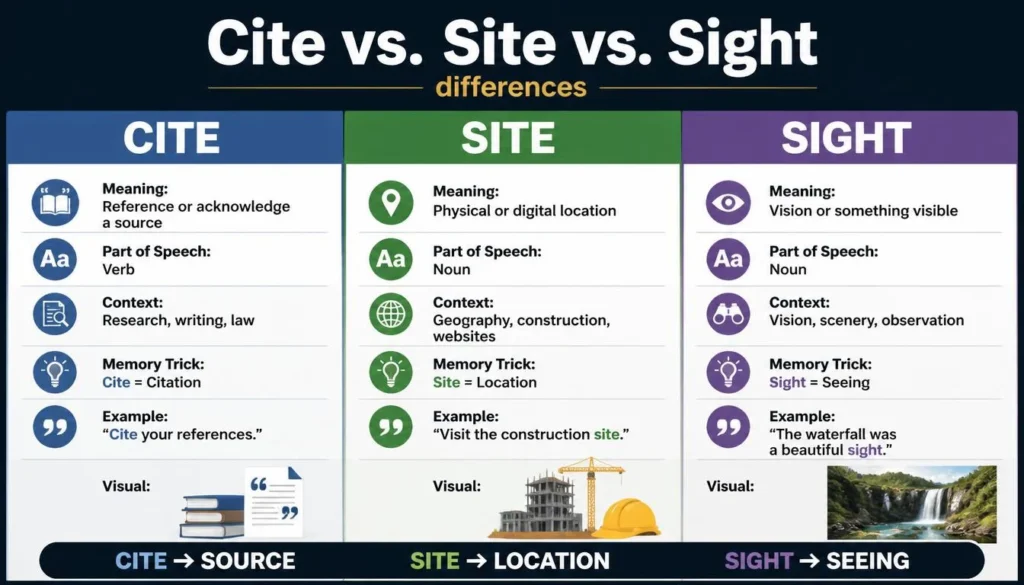
Side-by-Side Comparison
Although these words sound identical, their meanings couldn’t be more different. The table below highlights the key distinctions.
| Feature | Cite | Site | Sight |
| Primary Meaning | Reference or acknowledge a source | A physical or digital location | Vision or something visible |
| Part of Speech | Verb | Noun | Noun (occasionally verb) |
| Common Context | Research, writing, law | Geography, construction, websites | Vision, scenery, observation |
| Memory Trick | Cite = Citation | Site = Location | Sight = Seeing |
| Example | Cite your references. | Visit the construction site. | The waterfall was a beautiful sight. |
A simple way to remember them is to think about the subject of your sentence. If you’re talking about information, use cite and you’re referring to a place, use site. If you’re discussing vision or something you can see, choose sight.
Why Are Cite, Site, and Sight Commonly Confused?
The biggest reason these words cause confusion is that they’re homophones. Homophones are words that share the same pronunciation but have different meanings and spellings.
English contains hundreds of homophones because many words evolved from different languages while keeping similar sounds. As a result, writers often rely on context rather than pronunciation to determine the correct spelling.
Other common homophones include:
- There, Their, and They’re
- To, Too, and Two
- Your and You’re
- Brake and Break
- Pair and Pear
- Peak, Peek, and Pique
Since cite, site, and sight all sound exactly alike, listening alone won’t tell you which spelling is correct. You must understand the meaning of the sentence.
Why Context Matters
Context is the easiest way to choose the correct word.
Imagine these three sentences:
- Please cite your sources before submitting the report.
- The company purchased a new site for its headquarters.
- The sunset over the ocean was a breathtaking sight.
Each sentence uses the same pronunciation but communicates a completely different idea. Changing even one of these words would make the sentence incorrect.
That’s why understanding context is more valuable than simply memorizing spellings. Once you associate cite with references, site with locations, and sight with vision, you’ll rarely confuse them again.
How to Remember the Difference
Remember Cite
Think of the word citation. Both words begin with “cit,” making it easy to connect cite with references, sources, and evidence.
Memory Trick:
Cite → Citation → Source
Remember Site
A site is simply a place. Whether it’s a construction site, campsite, or website, the word always refers to a location.
Memory Trick:
Site → Place
Remember Sight
The word sight relates to seeing. Notice that sight contains “gh,” just like light. Light helps you see, making this a useful way to remember the correct spelling.
Memory Trick:
Sight → Seeing → Eyes
By linking each word to a simple idea—references, locations, and vision—you can quickly identify the correct spelling without second-guessing yourself.
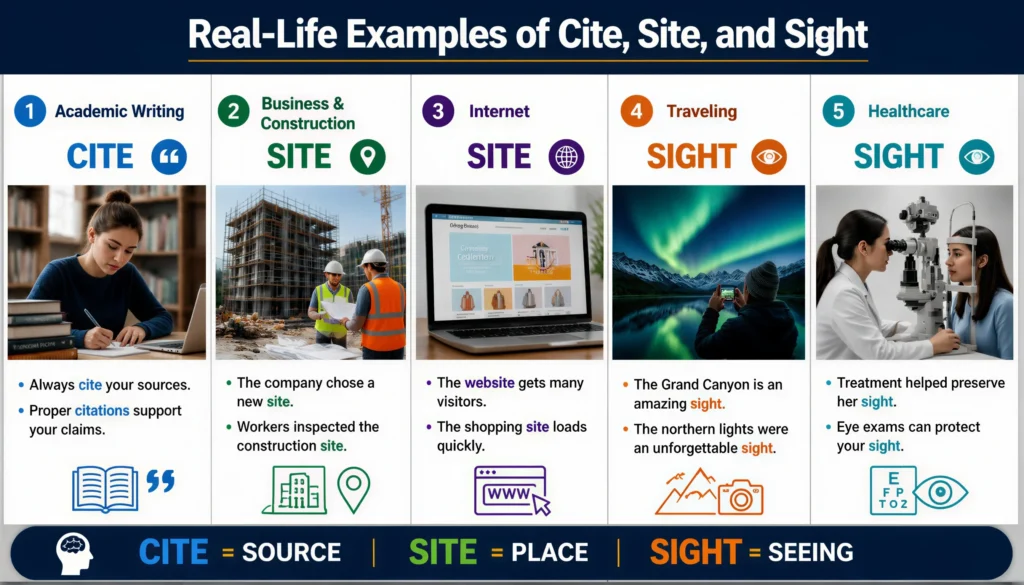
Real-Life Examples of Cite, Site, and Sight
One of the best ways to master commonly confused words is to see them in everyday situations. The examples below show how cite, site, and sight naturally fit into different contexts.
In Academic Writing
When writing essays, research papers, or dissertations, you’ll often need to cite the information you use.
Examples:
- Always cite your sources to avoid plagiarism.
- The student cited five peer-reviewed journals in her literature review.
- Every quotation in the report includes a proper citation.
Why it matters: Proper citations strengthen your credibility and allow readers to verify your claims.
In Business and Construction
Companies frequently refer to a site when discussing locations for offices, warehouses, or construction projects.
Examples:
- The company selected a new site for its distribution center.
- Safety inspections take place every week at the construction site.
- Engineers surveyed the proposed building site before construction began.
On the Internet
The word site also appears in digital environments.
Examples:
- The company’s website receives thousands of visitors every day.
- The shopping site offers free shipping on orders over $50.
- Users reported that the site loaded much faster after the redesign.
While Traveling
Many famous landmarks are described as unforgettable sights.
Examples:
- The Grand Canyon is an incredible sight.
- Watching the northern lights was the highlight of our trip.
- The cherry blossoms created a beautiful sight throughout the city.
In Healthcare
Medical professionals often use sight when discussing vision.
Examples:
- Early treatment helped preserve the patient’s sight.
- Eye exams can detect conditions that threaten your sight.
- Wearing protective eyewear reduces the risk of losing sight.
My Personal Experience
In my 15 years of teaching English, I’ve found that cite, site, and sight often trip up even learners who have strong vocabulary skills.
The pronunciation gives them no clue because all three words sound identical. During writing practice, I’ve noticed that students usually recognize the intended meaning when they read a sentence, yet they hesitate when they have to choose the spelling themselves.
I often ask them to pause and identify whether they’re referring to a source, a place, or something connected with vision. That small habit has made a noticeable difference in their accuracy. I’ve also seen learners become much more confident when they connect cite with references, site with locations, and sight with seeing.
For me, this is a good reminder that learning English isn’t only about memorizing spellings; understanding how a word functions in real communication makes the choice much easier.
Common Mistakes People Make
Because these words sound identical, writers often substitute one for another. Here are some of the most common mistakes and their corrections.
Using “Site” Instead of “Cite”
❌ Incorrect
Please site your references.
✅ Correct
Please cite your references.
Why? You’re referring to sources, not a location.
Using “Sight” Instead of “Site”
❌ Incorrect
We visited a historical sight.
✅ Correct
We visited a historical site.
Why? A historical location is a site, not something related to vision.
Using “Cite” Instead of “Sight”
❌ Incorrect
The sunset was a beautiful cite.
✅ Correct
The sunset was a beautiful sight.
Why? You’re describing something you can see.
Assuming They Are Interchangeable
Some writers believe that because the words sound alike, any spelling will work. That’s never the case.
Each word has its own meaning, and using the wrong one changes the sentence completely.
Key Insights:
- Cite is a verb used for referring to a source, evidence, quotation, or authority.
- Site is a noun that means a specific place or location, including a website or construction area.
- Sight is mainly a noun connected with vision or something visible.
- These three words are homophones: they have the same pronunciation but different spellings and meanings.
- Context determines which spelling you need. Think about whether you mean a source, place, or vision.
- The easiest memory trick is: Cite = Citation, Site = Place, Sight = Seeing.
- Using the correct word improves clarity and accuracy in academic, professional, and everyday writing.
Practice Sentences
Test your understanding by choosing cite, site, or sight to complete each sentence.
- Always ________ your sources in a research paper.
- The construction ________ will open next month.
- We caught ________ of a rainbow after the storm.
- The lawyer will ________ previous court decisions.
- That castle is a famous tourist ________.
- Regular eye exams help protect your ________.
- Scientists must ________ reliable evidence.
- The archaeological ________ contains ancient artifacts.
- The fireworks were an amazing ________.
- Remember to ________ every source you quote.
Answer Key
- Cite
- Site
- Sight
- Cite
- Site
- Sight
- Cite
- Site
- Sight
- Cite
Mini Quiz
Choose the correct answer for each question.
Question 1
Which word means to reference a source?
A. Site
B. Sight
C. Cite
Answer: C. Cite
Question 2
Which word refers to a location?
A. Cite
B. Site
C. Sight
Answer: B. Site
Question 3
Which sentence is correct?
A. Please site your references.
B. Please sight your references.
C. Please cite your references.
Answer: C. Please cite your references.
Question 4
Which sentence uses the correct spelling?
A. (1st Option) The waterfall was a beautiful cite.
B. (2nd Option) The waterfall was a beautiful site.
C. (3rd Option) The waterfall was a beautiful sight.
Answer: C. The waterfall was a beautiful sight.
Question 5
Which word belongs in this sentence?
“The company purchased a new ________ for its headquarters.”
A. Cite
B. Site
C. Sight
Answer: B. Site
If you answered all five correctly, you’ve mastered one of English’s most commonly confused word groups.
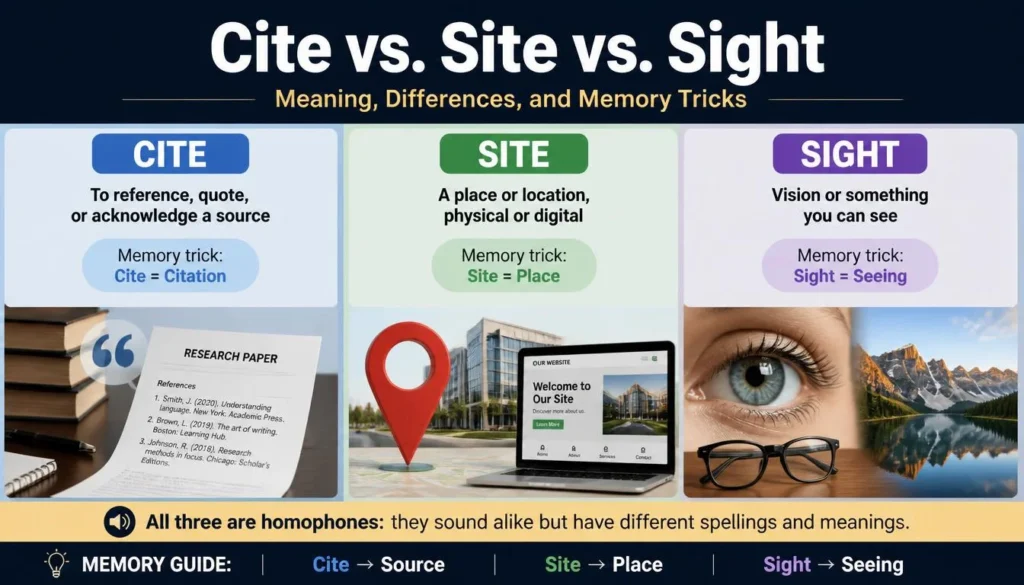
Quick Revision:
| Word | Meaning | Easy Memory Trick |
|---|---|---|
| Cite | To reference, quote, or acknowledge a source | Cite = Citation |
| Site | A place or location, physical or digital | Site = Place |
| Sight | Vision or something you can see | Sight = Seeing |
Remember:
- Cite → source/reference
- Site → place/location
- Sight → vision/something visible
All three are homophones, so they sound alike but have different spellings and meanings.
FAQs
Q1. Is Cite the Same as Site?
No. Cite means to quote or refer to a source, while site means a place or location.
Q2. What Does Sight Mean?
Sight refers to vision or something that you see with your eyes.
Q3. How Do I Remember the Difference Between Cite, Site, and Sight?
Think of cite for citations, site for locations, and sight for vision.
Q4. Why Do People Confuse Cite, Site, and Sight?
They are homophones, so they have the same pronunciation but different spellings and meanings.
Q5. Is “Please Site Your Sources” Correct?
No. The correct sentence is “Please cite your sources.”
Q6. When Should I Use Site?
Use site when referring to a specific place, location, building, construction area, or website.
Q7. When Should I Use Sight?
Use sight when talking about vision, seeing something, or something that comes into view.
Q8. Can Cite, Site, and Sight Be Used as Different Parts of Speech?
Yes. Cite is mainly a verb, while site and sight are most commonly nouns.
Q9. Is It Important to Learn the Difference Between Cite, Site, and Sight?
Yes. Using the correct word improves writing, speaking, academic work, and professional communication.
Q10. What Is the Easiest Way to Avoid Mixing Up Cite, Site, and Sight?
Focus on the meaning first. Once you know whether you’re talking about a source, a place, or vision, choosing the correct word becomes easy.
Conclusion
Understanding the difference between cite, site, and sight is easier once you focus on their meanings instead of their pronunciation. Although these words sound exactly the same, each serves a unique purpose. Cite refers to referencing a source, site means a place or location, and sight relates to vision or something you see. Choosing the correct word makes your writing more accurate, professional, and easier for readers to understand.
Whether you’re writing a research paper, describing a construction site, talking about a beautiful sight, or learning English grammar, using these words correctly will help you communicate with confidence. Keep the simple memory trick in mind Cite = Citation, Site = Place, Sight = Seeing and with regular practice, you’ll never confuse these commonly mixed-up words again.

Ayesha Siddiqa is an English specialist and professional content writer at ClearPhrasing.com. She is passionate about making the English language easy to understand through clear, accurate, and engaging content. Her expertise includes English grammar, spelling, vocabulary, punctuation, word usage, and writing techniques.
At ClearPhrasing.com, Ayesha creates well-researched, reader-friendly articles designed to help students, professionals, writers, and English learners strengthen their language skills. She focuses on providing practical explanations, real-world examples, and up-to-date guidance that readers can confidently apply in everyday communication.
Committed to accuracy and clarity, Ayesha ensures that every article meets high editorial standards and delivers reliable, easy-to-follow information that empowers readers to write and communicate with confidence.