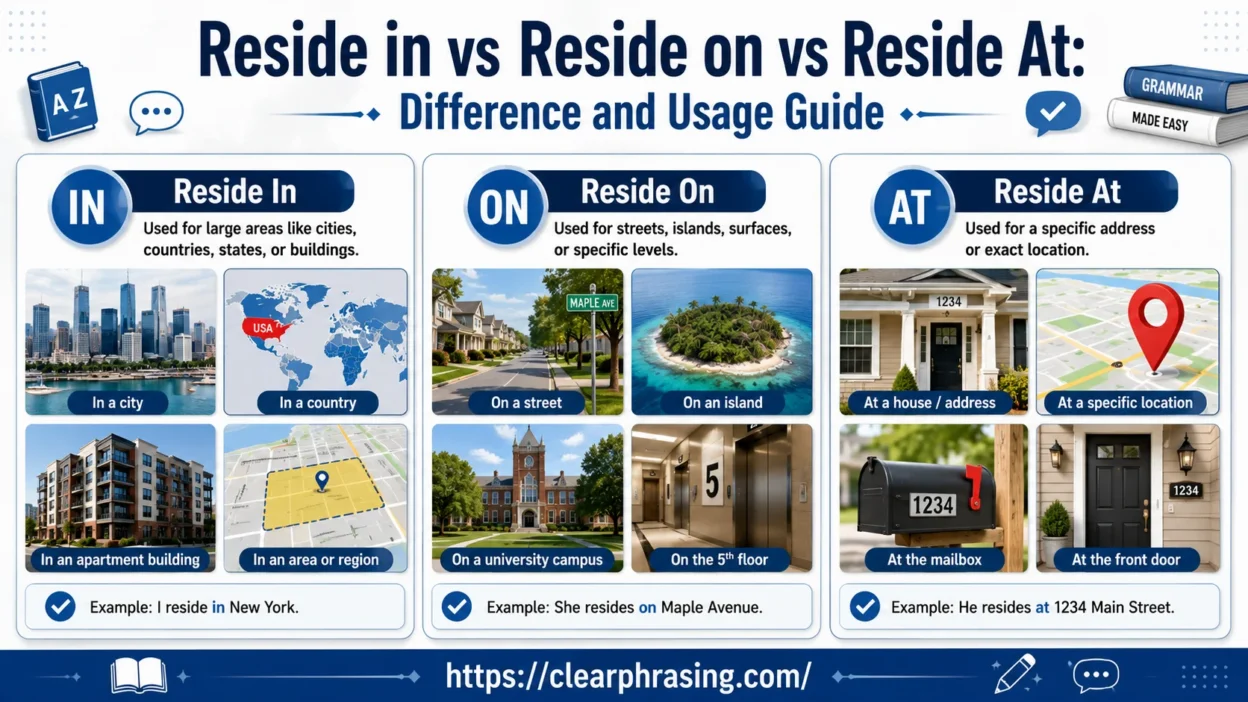
Reside in vs Reside on vs Reside At: Difference and Usage Guide helps you choose the correct preposition for every place with clear usage and context.
The difference between Reside in, Reside on, and Reside at depends on spatial context, location, and place reference. Reside in is used for a larger area, city, or New York. Reside on fits a street, Elm Street, or an island, while Reside at points to a specific location, building location, address, specific addresses, or 123 Main St. From my experience teaching English grammar, students improve communication, clarity, and language expression when they understand these rules.
Thinking about residence, living place, legal address, official residence, or permanent residence also helps in legal matters, taxes, and voting, making every sentence more natural and accurate.
Quick Answer
The easiest way to remember these expressions is to think about the type of location you are describing.
| Phrase | Use It For | Example |
| Reside in | Countries, states, cities, neighborhoods, buildings, rooms | She resides in Chicago. |
| Reside on | Streets, avenues, islands, campuses, floors | They reside on Pine Street. |
| Reside at | Exact addresses or specific locations | He resides at 421 Park Avenue. |
Simple rule:
- In = inside a larger area
- On = on a street, island, or surface-like location
- At = one exact point or address
If you’re unsure, ask yourself one question:
Am I talking about an area, a named location, or a precise address?
The answer usually tells you which preposition to choose.
What Does “Reside” Mean?
The verb reside means to live somewhere permanently or for a long period of time. It is more formal than the word live and often appears in legal, official, or professional writing.
For example:
- She resides in Florida.
- They reside at 98 Lincoln Avenue.
- The ambassador resides in the capital city.
Although these sentences sound natural in official contexts, most native speakers would simply say:
- She lives in Florida.
- They live at 98 Lincoln Avenue.
That’s why you’ll often see reside on:
- Immigration applications
- Visa documents
- Government forms
- Legal contracts
- Insurance paperwork
- Business records
- Court documents
Reside vs. Live
Both verbs describe where someone lives, but they aren’t always used in the same situations.
| Reside | Live |
| Formal | Informal |
| Legal documents | Daily conversation |
| Government forms | Speaking with friends |
| Professional writing | Casual writing |
| Official records | Social media |
Why Do Official Documents Prefer “Reside”?
Official documents need precise language. The word reside sounds more formal and emphasizes a person’s legal or permanent place of residence rather than a temporary stay.
For example:
- Applicants must reside in the state for six months before applying.
- The witness currently resides at the listed address.
Using live wouldn’t be incorrect, but reside matches the formal tone expected in legal writing.
When to Use Reside In
Use “Reside In” for Larger Areas
The preposition in refers to being inside an area or enclosed place. Whenever you’re talking about countries, cities, states, or neighborhoods, reside in is almost always the correct choice.
Think of it this way:
1.You are inside a city.
2.You are inside a country.
3.You are inside a building.
That’s why English uses in.
Use “Reside In” With
- Countries
- States
- Provinces
- Cities
- Towns
- Villages
- Neighborhoods
- Districts
- Buildings
- Apartments
- Houses
- Hotels
- Dormitories
- Rooms
Examples
- She resides in California.
- They reside in Canada.
- My grandparents reside in a quiet village.
- The family resides in an apartment downtown.
- Several students reside in the university dormitory.
- He resides in a historic home.
- Many diplomats reside in Washington, D.C.
- The professor resides in the faculty housing complex.
- They reside in the same neighborhood.
- She currently resides in Europe.
Notice that every example refers to an enclosed place or geographic area.
Why “Reside In” Makes Sense
Imagine placing a pin inside a map.
1.You’re inside Texas.
2.You’re inside London.
3.You’re inside an apartment.
That idea of being enclosed explains why English naturally chooses in.
Common Places That Use “Reside In”
| Place | Correct Example |
| Country | He resides in Japan. |
| State | She resides in Arizona. |
| City | They reside in Boston. |
| Village | We reside in a small village. |
| Apartment | I reside in Apartment 12B. |
| House | They reside in a beautiful home. |
| Hotel | Guests reside in the hotel during renovations. |
Common Mistakes
Many learners mistakenly use at with cities.
❌ She resides at Chicago.
✅ She resides in Chicago.
Another common mistake is using on with countries.
❌ They reside on Canada.
✅ They reside in Canada.
Remember, cities, countries, and states are areas, not points or surfaces.
Real-Life Example
Imagine you’re completing a passport application.
The form asks:
Country where you currently reside
The correct response is:
“I currently reside in the United States.”
Using at or on would sound unnatural because a country is a large geographic area.
Business Example
A company profile may read:
The company’s CEO resides in Seattle and manages international operations from the headquarters.
This sentence sounds professional because reside fits the formal business context.
Legal Example
A court document may state:
The defendant resides in Orange County.
Again, in works because a county is a defined geographic area.
When to Use Reside On
Many English learners assume on only refers to physical surfaces. In reality, English also uses on with certain named locations, especially streets, roads, and islands.
This is why you hear native speakers say:
- I live on Elm Street.
- She lives on Fifth Avenue.
- They reside on the island.
The same grammar rule applies when using reside.
Use “Reside On” With
- Streets
- Roads
- Avenues
- Boulevards
- Lanes
- Islands
- Campuses
- Farms
- Ranches
- Floors of buildings
- Ships
Examples
- They reside on Maple Street.
- She resides on Oak Avenue.
- His family resides on a small island.
- The professor resides on campus.
- Several employees reside on the tenth floor.
- The captain resides on the ship during long voyages.
- Farmers reside on the property year-round.
- They reside on the ranch with their family.
- Many students reside on campus during their first year.
- She resides on the upper floor of the building.
Why Does English Use “On” for Streets?
Think of a street as a long line.
Homes sit on that line rather than inside it. That’s why English developed expressions like on Main Street, on King Road, and on Baker Street. The same pattern applies whether you use live or reside.
Streets That Require “On”
| Street Type | Example |
| Street | He resides on Cherry Street. |
| Avenue | She resides on Madison Avenue. |
| Boulevard | They reside on Sunset Boulevard. |
| Road | We reside on Pine Road. |
| Lane | My aunt resides on Willow Lane. |
| Drive | He resides on Oak Drive. |
Using “Reside On” With Islands
English also uses on for islands because people think of them as land surfaces.
Examples include:
- They reside on Hawaii’s Big Island.
- She resides on Martha’s Vineyard.
- The family resides on a remote island.
- Researchers reside on the island throughout the summer.
Using “Reside On” With Campuses
Universities often distinguish between students who live in campus housing and those who live elsewhere.
Examples:
- Freshmen must reside on campus during their first year.
- Faculty members may reside on campus housing.
- Several graduate students reside on campus.
Using “Reside On” With Floors
Buildings also follow this pattern.
Examples:
- The director resides on the top floor.
- Several residents reside on the second floor.
- Security staff reside on the ground floor.
Common Mistakes
Many learners write:
❌ He resides in Main Street.
✅ He resides on Main Street.
Likewise:
❌ They reside at Long Island.
✅ They reside on Long Island.
Helpful Memory Trick
1.Imagine standing on a road.
2.Imagine standing on an island.
3.Imagine studying on campus.
Whenever you picture yourself standing on the place, on usually becomes the correct preposition.
Reside In vs. Reside On: Quick Comparison
| Situation | Correct Phrase | Example |
| Country | Reside in | She resides in Mexico. |
| State | Reside in | He resides in Nevada. |
| City | Reside in | They reside in Dallas. |
| Neighborhood | Reside in | We reside in Midtown. |
| Apartment | Reside in | She resides in Apartment 5A. |
| Street | Reside on | He resides on Birch Street. |
| Avenue | Reside on | They reside on Grant Avenue. |
| Island | Reside on | She resides on Catalina Island. |
| Campus | Reside on | Students reside on campus. |
| Floor | Reside on | He resides on the fifth floor. |
The key difference is simple:
- Use reside in when talking about an area or enclosed place.
- Use reside on when referring to streets, islands, campuses, floors, and similar named locations.
When to Use Reside At
The preposition at refers to a specific point or exact location. Use reside at when you want to identify one precise place, such as a complete street address or a clearly defined location. While reside in describes a larger area and reside on refers to streets or similar places, reside at points to one exact destination.
Think about a map. A country contains states, a state contains cities, and a city contains streets. Once you reach a specific house number or building, you’ve reached a single point. That’s when at becomes the correct choice.
Use “Reside At” With
- Complete street addresses
- Exact property numbers
- Specific buildings
- Official residences
- Clearly identified locations
- Mailing addresses
Examples
- She resides at 125 Maple Avenue.
- They reside at 450 Oak Street.
- The ambassador resides at the official residence.
- He resides at Apartment 6B, 200 River Road.
- The family resides at 15 Green Lane.
- The witness resides at the address listed in the report.
- Our manager resides at 89 Westwood Drive.
- She resides at the same address as her parents.
- The director resides at the governor’s residence.
- The applicant resides at 17 Lake View Court.
Why Does English Use “At”?
The preposition at identifies one exact point.
For example:
- In Texas → a large area
- On Pine Street → a named street
- At 210 Pine Street → one exact address
As the location becomes more specific, the preposition changes accordingly.
Common Mistakes
Incorrect:
- He resides at Chicago.
- She resides at California.
- They reside at Europe.
Correct:
- He resides in Chicago.
- She resides in California.
- They reside in Europe.
Another common mistake is writing:
❌ She resides in 45 Main Street.
The correct sentence is:
✅ She resides at 45 Main Street.
Reside In vs. Reside On vs. Reside At: Side-by-Side Comparison
Understanding the location you’re describing makes choosing the correct preposition much easier.
| Location | Correct Phrase | Example |
| Country | Reside in | She resides in Canada. |
| State | Reside in | He resides in Texas. |
| City | Reside in | They reside in Seattle. |
| Neighborhood | Reside in | We reside in Brookside. |
| Building | Reside in | She resides in the apartment building. |
| Street | Reside on | He resides on King Street. |
| Avenue | Reside on | They reside on Madison Avenue. |
| Island | Reside on | She resides on Maui. |
| Campus | Reside on | Students reside on campus. |
| Floor | Reside on | He resides on the seventh floor. |
| Exact Address | Reside at | She resides at 400 Hill Road. |
| Property Number | Reside at | They reside at 85 Lake Drive. |
The Three-Step Rule
If you only remember one rule, make it this one.
- In = Area
- On = Street, island, campus, or similar location
- At = Exact point
This simple formula works in nearly every situation.
The Grammar Rule Behind These Prepositions
English prepositions reflect how people picture locations in their minds.
In Shows an Enclosed Area
Use in for places you can imagine being inside.
Examples:
- in Canada
- in Boston
- in a neighborhood
- in an apartment
On Shows a Surface or Named Route
Use on for places viewed as surfaces or lines.
Examples:
- on Maple Street
- on campus
- on the island
- on the fifth floor
At Shows One Exact Point
Use at for precise locations.
Examples:
- at 220 Park Avenue
- at the entrance
- at the address listed
- at the residence
Once you understand these mental images, choosing the correct preposition becomes much easier.
Can You Say “Reside in an Address”?
No.
An address identifies one exact location, so English uses at, not in.
Incorrect:
- She resides in 45 Lake Road.
Correct:
- She resides at 45 Lake Road.
Can You Say “Reside on an Address”?
No.
An address is a specific point rather than a street in general.
Correct:
- He resides on Elm Street.
- He resides at 225 Elm Street.
The first sentence tells you which street he lives on.
The second tells you the exact property.
Can You Say “Reside At a City”?
No.
Cities are large geographic areas, so English uses in.
Correct:
- She resides in Miami.
Incorrect:
- She resides at Miami.
Reside vs. Live
Both verbs describe where someone lives, but they fit different situations.
Everyday Conversation
Native speakers usually choose live.
Examples:
- I live in Chicago.
- We live on Oak Street.
- She lives at 42 Pine Drive.
These expressions sound natural in daily conversation.
Formal Writing
Official writing often prefers reside.
Examples:
- The applicant resides in New Jersey.
- The witness resides at the stated address.
- The employee resides on university property.
Comparison Table
| Situation | Better Choice |
| Daily conversation | Live |
| Government forms | Reside |
| Court documents | Reside |
| Business contracts | Reside |
| Immigration forms | Reside |
| Friendly emails | Live |
| Academic writing | Either |
Quick Tip: If you’re talking with friends, use live. If you’re completing official paperwork, reside is usually the better choice.
Common Mistakes English Learners Make
Using At With Cities
❌ She resides at Boston.
✅ She resides in Boston.
Using In With Streets
❌ He resides in Maple Street.
✅ He resides on Maple Street.
Using On With Countries
❌ They reside on Canada.
✅ They reside in Canada.
Using At With States
❌ She resides at Florida.
✅ She resides in Florida.
Overusing “Reside”
Many learners think reside always sounds better because it’s formal.
Instead of saying:
I reside in Dallas with my family.
Most native speakers simply say:
I live in Dallas with my family.
Choose reside only when the context is formal.
American vs. British English
The grammar rules for these expressions are the same in American and British English.
Both varieties use:
- reside in London
- reside on Baker Street
- reside at 20 High Street
The only noticeable differences involve spelling and address formatting rather than preposition choice.
Memory Tricks to Never Forget
Remember In
Imagine yourself inside a city, state, or country.
Remember On
Imagine standing on a street, island, or campus.
Remember At
Picture a GPS pin marking one exact location.
If you remember these three images, you’ll rarely choose the wrong preposition.
Real-Life Examples
Everyday Conversation
- We live on Cedar Street.
- My sister lives in Boston.
- My grandparents live at 25 River Road.
Business English
- The CEO resides in New York.
- Several executives reside on the company campus.
- The chairman resides at the official residence.
Legal Documents
- The defendant resides at the address listed below.
- The petitioner resides in Cook County.
- The witness resides on government property.
Government Forms
Many forms ask questions such as:
- Country of residence
- State where you reside
- Current residential address
Using the correct preposition helps your writing sound accurate and professional.
Practice Quiz
She resides ___ Texas.
A. at
B. in
C. on
Answer: B
They reside ___ Lincoln Street.
A. on
B. at
C. in
Answer: A
He resides ___ 350 Maple Drive.
A. in
B. on
C. at
Answer: C
We reside ___ Canada.
A. at
B. in
C. on
Answer: B
Students reside ___ campus.
A. on
B. in
C. at
Answer: A
The ambassador resides ___ the capital city.
A. in
B. on
C. at
Answer: A
She resides ___ 18 Oak Lane.
A. on
B. at
C. in
Answer: B
They reside ___ the second floor.
A. on
B. in
C. at
Answer: A
My aunt resides ___ a small village.
A. on
B. in
C. at
Answer: B
He resides ___ Birch Avenue.
A. in
B. at
C. on
Answer: C
Read More: By vs. Through: Difference and When Should You Use Each?
FAQs
Q1. What is the difference between reside in, reside on, and reside at?
Reside in is used for larger places like countries, states, and cities. Reside on is used for streets or islands, while reside at refers to a specific address or building.
Q2. Is reside in more common than reside at?
Yes. Reside in is commonly used when talking about cities, countries, or regions. Reside at is mainly used for official or exact addresses.
Q3. Can I use reside on for a city?
No. Reside on is not used for cities. It is usually used for streets, roads, avenues, or islands.
Q4. Is reside more formal than live?
Yes. Reside is a formal word often found in legal, academic, and official documents, while live is more common in everyday conversation.
Q5. When should I use reside at?
Use reside at when referring to a complete address, a specific building, or a clearly identified location.
Q6. Why do people confuse these three expressions?
They all describe where someone lives, but each one follows a different rule based on the type of location being mentioned.
Q7. Is it correct to say “I reside on Elm Street”?
Yes. That sentence is correct because Elm Street is a street, and reside on is the proper choice.
Q8. Can reside in be used for a country?
Yes. You can say, “They reside in Canada,” because countries, states, and cities take reside in.
Q9. Are these expressions important in formal writing?
Yes. Using the correct preposition improves clarity and makes business, legal, and academic writing more accurate.
Q10. How can I remember the correct usage?
Think of the size of the location. Use reside in for large areas, reside on for streets and islands, and reside at for exact addresses or buildings.
Conclusion
Understanding the difference between reside in, reside on, and reside at is easier when you focus on the type of location being described. Reside in works for larger places such as cities and countries, reside on is used for streets and islands, and reside at refers to a specific address or building. Choosing the right preposition makes your writing clearer and more accurate.
From my experience teaching English, this is one of the grammar topics that becomes simple with regular practice. Reading real examples and using these expressions in your own sentences will help you remember them naturally. Over time, you’ll choose the correct phrase with confidence and communicate more clearly in both everyday and formal English.

Mehwish Imtiaz is an English specialist and professional blog writer at ClearPhrasing.com. She specializes in grammar, spelling, vocabulary, punctuation, and writing improvement. With a strong passion for clear communication and language education, she creates reader-friendly articles that help students, professionals, and English learners understand complex language topics with ease.
Her writing focuses on accuracy, simplicity, and practical usage, ensuring that every article provides clear explanations and real-world examples. At ClearPhrasing.com, Mehwish is committed to publishing well-researched, original content that helps readers write more confidently and communicate more effectively in everyday and professional English.