“I Totally Agree” vs. “I Completely Agree”: Meaning and Difference can confuse learners because both phrases express full agreement.
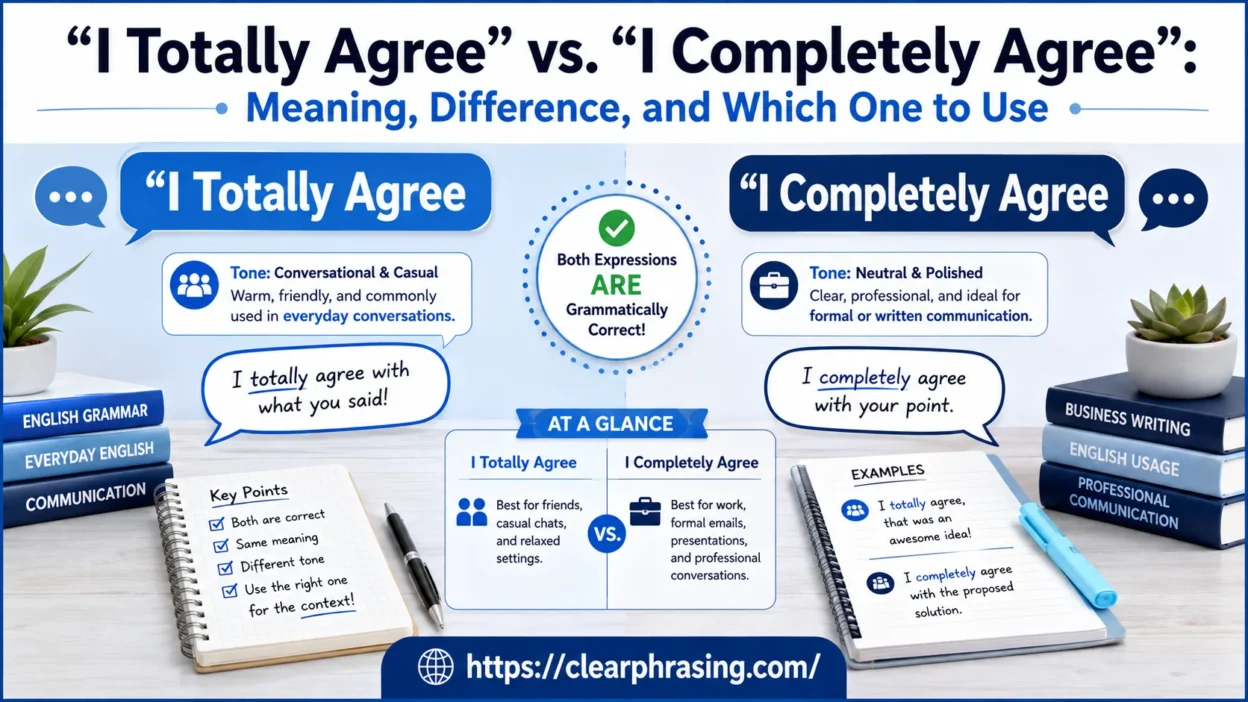
However, their tone can differ slightly. “I totally agree” sounds more casual, personal, and conversational, so it fits everyday conversations, chats, and informal communication. “I completely agree” sounds slightly more formal and works well in emails, meetings, academic discussions, and professional writing. Both are correct English phrases, and neither is automatically stronger or more correct.
As an English teacher, I’ve noticed that learners often focus on grammar instead of context and usage. The key is knowing when to use each expression. Totally emphasizes how strongly you feel, while completely emphasizes complete agreement. Consider the situation, tone, and level of formality before choosing your expression.
Quick Answer:
“I totally agree” and “I completely agree” are both correct.
They usually have the same basic meaning:
I agree with you completely.
The main difference is tone, not grammar.
- I totally agree. → casual, conversational, enthusiastic
- I completely agree. → neutral, polished, slightly more formal
- I agree. → simple and neutral
- I absolutely agree. → very strong agreement
- I couldn’t agree more. → extremely strong agreement
| Expression | Meaning | Tone | Best Used For |
| I agree. | I share your opinion. | Neutral | General situations |
| I totally agree. | I agree completely. | Conversational | Casual conversations |
| I completely agree. | I agree fully. | Neutral/polished | Professional and general contexts |
| I absolutely agree. | I strongly agree. | Emphatic | Strong reactions |
| I couldn’t agree more. | I agree as strongly as possible. | Very emphatic | Discussions and conversations |
So, if you’re talking to a friend, “I totally agree” may sound especially natural.
If you’re responding to a colleague’s recommendation, “I completely agree” may fit better.
Neither one is automatically more correct.
What Does “I Totally Agree” Mean?
“I totally agree” means that you agree completely with someone or something.
The word totally strengthens the verb agree. It tells the listener that your agreement isn’t partial.
For example:
I totally agree with you.
This means:
I agree with you completely.
You could use the phrase when agreeing with:
- someone’s opinion
- a suggestion
- a decision
- an argument
- a statement
- an observation
- a recommendation
- a personal viewpoint
Examples of “I Totally Agree”
- I totally agree with you.
- I totally agree with your point.
- I totally agree with that idea.
- I totally agree that we need more time.
- I totally agree with your suggestion.
- I totally agree. Let’s do it.
Consider this everyday conversation:
“We should leave early because traffic will be terrible.”
“I totally agree.”
The response sounds relaxed and natural.
Now imagine someone saying:
“I totally agree! That’s exactly what I was thinking.”
Here, totally adds even more enthusiasm. The speaker isn’t merely agreeing. They’re strongly identifying with the other person’s point.
Is “I Totally Agree” Grammatically Correct?
Yes. “I totally agree” is grammatically correct.
Its structure is simple:
I + totally + agree
- I = subject
- totally = adverb
- agree = verb
One mistake English learners sometimes make is adding am before agree.
| Correct | Incorrect |
| I totally agree. | I am totally agree. |
| I completely agree. | I am completely agree. |
| I totally agree with you. | I am totally agree with you. |
The reason is simple: agree is already a verb.
You don’t say:
I am agree with you. ❌
You say:
I agree with you. ✅
The same rule applies when you add an adverb:
I agree totally with you✅
I agree completely with you ✅
There’s no need for am.
What Does “I Completely Agree” Mean?
“I completely agree” also means that you agree fully.
The word completely emphasizes that your agreement has no meaningful reservation.
For example:
I completely agree with your recommendation.
The speaker isn’t saying, “Your recommendation is partly correct.”
They’re expressing full agreement.
Examples of “I Completely Agree”
- I completely agree with you.
- I completely agree with your point.
- I completely agree with that conclusion.
- I completely agree with your recommendation.
- I completely agree that we need a different approach.
- I completely agree with the main argument.
This phrase works well in ordinary conversation too.
For example:
“You should talk to her before making a final decision.”
“I completely agree.”
That doesn’t sound stiff. It’s perfectly natural.
However, completely often gives the sentence a slightly more measured feel than totally.
“Totally” vs. “Completely”: What’s the Real Difference?
Here’s the key point:
The difference between “totally” and “completely” is usually about tone rather than meaning.
Both words can express the idea of something being full, whole, or absolute.
That’s why these sentences normally communicate the same message:
I totally agree with you.
I completely agree with you.
If you replace one with the other, the basic meaning doesn’t change.
What changes is the feel.
“Totally” Sounds More Conversational
Totally often feels more relaxed and spontaneous.
For example:
“That movie was way too long.”
“I totally agree.”
The response sounds like something you’d naturally say to a friend.
It can also sound enthusiastic:
“We need to fix this before tomorrow.”
“I totally agree!”
The word adds energy to the response.
“Completely” Sounds More Neutral
Completely usually sounds a little more measured.
For example:
“I completely agree with your assessment.”
This sentence would fit naturally in a professional conversation.
You could also use it with a friend:
“I completely agree. We should go now.”
So completely isn’t formal-only.
It’s simply more neutral and flexible when you want your language to sound polished.
Side-by-Side Comparison
| Feature | Totally | Completely |
| Basic meaning | Fully | Fully |
| Correct with “agree” | Yes | Yes |
| Casual conversation | Very natural | Very natural |
| Conversational feel | Strong | Moderate |
| Professional communication | Fine | Excellent |
| Formal contexts | Possible | Often preferred |
| Adds emphasis | Yes | Yes |
| Changes the basic meaning | Usually no | Usually no |
These aren’t strict rules. Think of them as natural usage preferences.
When Should You Use “I Totally Agree”?
Use “I Totally Agree” in Casual Conversations
When you’re talking with friends, classmates, family members, or people you know well, “I totally agree” sounds natural.
For example:
“We should get coffee before class.”
“I totally agree.”
Or:
“That restaurant is seriously overpriced.”
“I totally agree.”
The expression fits the informal setting.
Use It When You Want Enthusiasm
If you want your agreement to sound energetic, totally can do the job.
Compare:
I agree.
with:
I totally agree!
The second sentence feels stronger and more animated.
You can think of totally as adding a little extra punch.
For example:
“That was the best decision we could have made.”
“I totally agree!”
The speaker isn’t simply acknowledging the statement. They’re showing strong support.
Use It in Casual Messages
“I totally agree” works naturally in:
- text messages
- group chats
- social media comments
- casual emails
- online conversations
- friendly discussions
For example:
I totally agree with your point. We should give this another try.
There’s no grammatical problem with using it in these settings.
When Should You Use “I Completely Agree”?
Use “I Completely Agree” in Professional Communication
If you’re responding to a colleague, manager, client, or business partner, “I completely agree” often sounds polished without being overly formal.
For example:
I completely agree with your recommendation. We should review the proposal before Friday.
Or:
I completely agree that customer feedback should guide our next step.
The expression communicates strong agreement while maintaining a professional tone.
Use It in Academic Discussions
“I completely agree” can also work well when discussing an argument or interpretation.
For example:
I completely agree with this interpretation of the results.
Or:
I completely agree that the study requires additional evidence.
However, strong academic writing should do more than announce agreement.
Instead of:
I completely agree with the author.
you can write:
I completely agree with the author’s argument that early intervention can improve long-term outcomes.
The second version gives the reader useful information.
It tells them exactly what you agree with.
“I Totally Agree With You” vs. “I Completely Agree With You”
Both phrases are correct:
I totally agree with you.
I completely agree with you.
The structure agree with + person is standard.
Examples include:
- I agree with you.
- I totally agree with Sarah.
- I completely agree with my manager.
- We agree with the teacher.
Adding with you makes the target of your agreement clear.
Compare:
I completely agree.
with:
I completely agree with you.
If the context is obvious, the shorter version works perfectly.
If several people are discussing different opinions, adding with you can make your meaning clearer.
Common Structures With “Agree”
Learning these patterns will help you use both expressions correctly.
Agree With a Person
Use:
agree with + person
Examples:
- I totally agree with you.
- I completely agree with her.
- We agree with our teacher.
Agree With an Opinion or Idea
You can also agree with an idea, opinion, or argument.
Examples:
- I agree with your point.
- I completely agree with that argument.
- I totally agree with this idea.
Agree That + Clause
Use agree that before a complete statement.
Examples:
- I agree that the plan needs improvement.
- I completely agree that we need more time.
- I totally agree that this approach is more practical.
Agree On Something
Use agree on when people reach the same decision or share agreement about a particular matter.
Examples:
- We agree on the main issue.
- They completely agree on the basic principles.
- The teams agreed on the final terms.
Agree About Something
Use agree about when talking about an issue or subject.
Examples:
- We agree about the need for change.
- They don’t agree about the best solution.
Choosing the right structure matters just as much as choosing between totally and completely.
Real-Life Comparison: Which One Sounds Better?
Context can make the distinction much easier to understand.
| Situation | Natural Choice | Example |
| Talking with a friend | I totally agree. | “I totally agree. That movie was too long.” |
| Casual text | I totally agree. | “I totally agree with you!” |
| Friendly discussion | Either | “I completely agree.” |
| Workplace meeting | I completely agree. | “I completely agree with that recommendation.” |
| Professional email | I completely agree. | “I completely agree with your assessment.” |
| Academic discussion | I completely agree. | “I completely agree with this interpretation.” |
| Excited reaction | I totally agree! | “I totally agree! That’s exactly what I meant.” |
Again, these are guidelines rather than rigid grammar rules.
You can use “I totally agree” at work.
You can use “I completely agree” with friends.
The context simply affects how each expression sounds.
Case Study: Same Agreement, Different Tone
Imagine a team discussing a weekly meeting schedule.
One person says:
“Friday afternoon isn’t convenient for everyone.”
A colleague responds:
“I totally agree. We should move it to Tuesday.”
The response sounds conversational and spontaneous.
Now imagine the same situation during a formal meeting:
“Friday afternoon isn’t convenient for everyone.”
“I completely agree with that assessment. Tuesday would probably work better for the team.”
The second response sounds more measured and professional.
Notice something important: both people completely agree.
Their level of agreement hasn’t changed.
Only the tone of the response has changed.
That’s why it’s misleading to say that totally is wrong in formal English or that completely is always formal.
Neither claim is accurate.
Are “Totally” and “Completely” Always Interchangeable?
No.
Although the two words work almost interchangeably with agree, they aren’t perfect substitutes in every English sentence.
For example:
The building was completely destroyed.
This is a very natural sentence.
You might also hear:
The building was totally destroyed.
The second sentence can work, but the wording has a slightly different feel.
The same principle applies elsewhere.
Two words can have very similar dictionary meanings while still differing in collocation, tone, frequency, or context.
For “I totally agree” and “I completely agree,” however, the overlap is extremely strong.
“I Agree” vs. “I Totally Agree” vs. “I Completely Agree”
These three expressions are useful to compare.
“I Agree”
I agree with your point.
This is direct and neutral.
It doesn’t add extra emphasis.
“I Totally Agree”
I totally agree with your point.
This emphasizes your agreement and often sounds conversational.
“I Completely Agree”
I completely agree with your point.
This also emphasizes full agreement but often sounds more measured.
A useful way to remember the difference is:
I agree → I totally/completely agree → I couldn’t agree more
This isn’t a strict scale. It’s simply a helpful guide for choosing the level of emphasis you want.
What If You Only Partly Agree?
Here’s an important point: don’t use completely or totally if you only agree with part of an idea.
Suppose someone says:
“We should cancel the project because the first phase failed.”
You might agree that the first phase failed without agreeing that the entire project should be canceled.
Instead of saying:
I completely agree.
you could say:
- I partly agree.
- I agree to some extent.
- I agree with you up to a point.
- I see your point, but…
- I agree with the first part of your argument.
- I agree with the general idea, but…
For example:
I agree with your main point, but I don’t think canceling the project is the best solution.
That’s much more precise.
Good communication isn’t about sounding stronger. It’s about saying exactly what you mean.
Strong Alternatives to “I Totally Agree” and “I Completely Agree”
Sometimes repeating agree can make your writing sound predictable. Fortunately, English gives you several alternatives.
| Expression | Strength | Tone |
| I agree. | Moderate | Neutral |
| I definitely agree. | Strong | Confident |
| I absolutely agree. | Very strong | Emphatic |
| I fully agree. | Strong | Neutral/formal |
| I entirely agree. | Strong | Formal |
| I wholeheartedly agree. | Very strong | Personal |
| I couldn’t agree more. | Extremely strong | Emphatic |
“I Absolutely Agree”
I absolutely agree with your point.
This shows very strong support.
“I Fully Agree”
I fully agree with your recommendation.
This works particularly well in professional communication.
“I Wholeheartedly Agree”
I wholeheartedly agree with this proposal.
This suggests strong personal support or conviction.
“I Couldn’t Agree More”
I couldn’t agree more.
This is a powerful expression of agreement.
It means that you agree as strongly as possible.
For example:
“We need to invest more in employee training.”
“I couldn’t agree more.”
That’s stronger than a plain “I agree.”
Common Mistakes to Avoid
“I Am Totally Agree”
❌ I am totally agree.
✅ I totally agree.
Agree already functions as the main verb.
“I Am Completely Agree”
❌ I am completely agree.
✅ I completely agree.
Don’t insert am before the base verb.
“I Totally Agreed” When You Mean Now
Compare:
I totally agree with you.
This expresses your current opinion.
Now compare:
I totally agreed with you yesterday.
This describes agreement in the past.
The difference is verb tense, not the choice between totally and completely.
Claiming Complete Agreement When You Don’t Have It
If you disagree with part of an argument, avoid saying:
I completely agree with everything you said.
Instead, qualify your response:
I agree with most of your points, but I have concerns about the final recommendation.
This sounds more thoughtful and honest.
Which Is Better for Formal Writing?
When you need to choose between the two for a professional email, report, presentation, or formal discussion, “I completely agree” is usually the safer choice.
For example:
I completely agree with your assessment of the proposal.
It sounds professional without becoming unnecessarily stiff.
Compare:
I totally agree with your assessment of the proposal.
This is still grammatically correct. However, totally gives the sentence a more conversational flavor.
In academic writing, you can make your sentence even stronger by explaining exactly what you support:
I completely agree with the author’s conclusion that the policy requires further review.
That’s more informative than simply saying:
I completely agree with the author.
The reader learns your actual position instead of just hearing that you agree.
Which Is Better for Casual Conversation?
For casual conversation, “I totally agree” often sounds especially natural.
For example:
“We should grab coffee before we start.”
“I totally agree.”
It feels quick, friendly, and spontaneous.
Still, there’s nothing unusual about saying:
“I completely agree.”
English speakers use both expressions in ordinary conversation.
So don’t worry that completely sounds too formal for everyday speech.
It doesn’t.
A Simple Decision Guide
When you’re unsure which expression to use, this quick guide can help.
1.Choose “I Totally Agree” When:
- you’re having a casual conversation
- you’re talking with friends
- you want to sound enthusiastic
- you’re responding to an informal opinion
- you’re writing a casual message
- you want a spontaneous tone
2.Choose “I Completely Agree” When:
- you’re writing a professional email
- you’re participating in a formal discussion
- you’re responding to a colleague
- you’re discussing an academic argument
- you want a neutral, polished tone
- you want strong agreement without sounding overly casual
3.Choose “I Agree” When:
- you don’t need extra emphasis
- the context already makes your position clear
- you want a direct and simple response
4.Choose “I Couldn’t Agree More” When:
- you want extremely strong agreement
- you strongly support someone’s point
- an emphatic response fits the conversation
Read More: Guise vs. Guys: Meaning, Difference, and Correct Usage
FAQs
Is “I totally agree” correct English?
Yes, “I totally agree” is completely correct and natural English. People commonly use it in everyday conversations, chats, and other informal situations. It clearly shows that you strongly agree with what someone has said.
Is “I completely agree” grammatically correct?
Yes, “I completely agree” is also grammatically correct. It expresses full agreement and works in both casual and formal situations. You can use it in conversations, emails, meetings, and professional communication.
What’s the difference between “I totally agree” and “I completely agree”?
Both expressions mean that you agree 100% with someone. The main difference involves tone and context. “I totally agree” often sounds more casual and conversational, while “I completely agree” can sound slightly more formal or measured.
Which sounds more natural: “I totally agree” or “I completely agree”?
Both sound natural to native English speakers. Your choice depends on the situation and your personal speaking style. “I totally agree” is especially common in relaxed conversations, while “I completely agree” fits comfortably into more formal communication.
Can I use “I totally agree” in formal writing?
You can, but it may sound somewhat conversational depending on the context. In academic or professional writing, “I completely agree” may sound more polished. Still, neither phrase is grammatically wrong.
Is “I completely agree” stronger than “I totally agree”?
Not really. Both expressions communicate complete agreement. The difference is mostly stylistic rather than one phrase expressing a greater level of agreement than the other.
Can “totally” and “completely” be used interchangeably?
In these two expressions, they can usually replace each other without changing the basic meaning. However, they can create slightly different impressions. “Totally” often feels more informal, while “completely” can sound more neutral or formal.
Which phrase should English learners use?
English learners can confidently use either phrase. If you’re having a casual conversation, “I totally agree” is a natural choice. For a workplace email, academic discussion, or formal setting, “I completely agree” may be a safer option.
Can I say “I totally agree with you”?
Yes. “I totally agree with you” is a common and natural expression. It directly tells another person that you share their opinion or viewpoint. You can use it when responding to an idea, statement, suggestion, or argument.
Should I avoid “I totally agree” in professional communication?
You don’t have to avoid it completely. However, professional communication often benefits from a slightly more neutral tone. “I completely agree” may fit better when you want your writing to sound polished, clear, and professional.
Conclusion
“I totally agree” and “I completely agree” are both correct expressions that communicate full agreement. The real difference lies in tone, context, and formality, rather than grammar or meaning. “I totally agree” often feels relaxed and personal, making it a great choice for everyday conversations. “I completely agree” has a more neutral or formal feel, so it works particularly well in professional, academic, and written situations.
As an English teacher, I’ve found that learners often search for one “correct” answer when both options work. Instead of memorizing a strict rule, pay attention to the situation and the impression you want to create. Once you understand that small distinction, you can choose either expression naturally and communicate your agreement with greater confidence.

Shamsa Kanwal is an English specialist and content writer at ClearPhrasing.com, where she helps readers navigate the English language with confidence. She enjoys breaking down grammar rules, spelling differences, vocabulary, and everyday writing challenges into simple, practical lessons that anyone can understand.
Her writing is focused on making learning approachable rather than overwhelming. Whether she’s explaining commonly confused words, punctuation rules, or grammar concepts, Shamsa believes that clear explanations and real-life examples are the key to effective learning.
Every article she writes is carefully researched, fact-checked, and edited to ensure it is accurate, easy to read, and genuinely helpful. Her goal is to create trustworthy resources that enable students, professionals, writers, and English learners to improve their communication skills and write with greater clarity.
Through her work at ClearPhrasing.com, Shamsa is committed to making English learning simpler, more practical, and accessible for readers around the world.