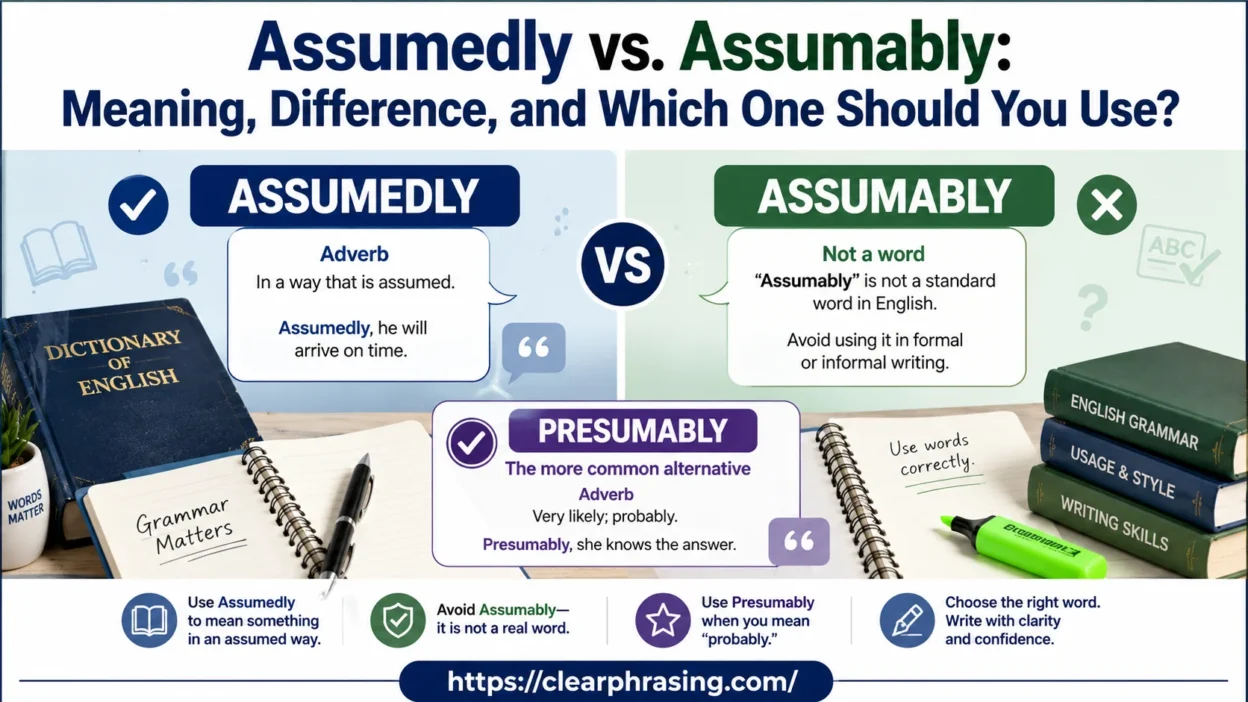
Assumedly vs. Assumably: Meaning, Difference, and Usage can confuse people because these adverbs have similar meanings, spelling, and pronunciation.
Yet, they have a subtle distinction in context. Assumedly means something is generally accepted, taken for granted, or accepted as true without proof or explicit confirmation. Assumably suggests something is reasonably inferred from available information, creating a stronger logical deduction.
In my English teaching experience, students often mix up these words because they sound similar. Understanding this important distinction can improve your writing and English skills.
For example, someone is assumedly coming to a party when you believe they will arrive, even without solid evidence. Someone is assumably attending a concert because their love for music provides a basis for your guess. The idea seems probable or likely, although you may remain unsure.
These twins aren’t always interchangeable, so details, examples, and context matter. If something is accepted without proof, use assumedly; when evidence supports your judgment, assumably is more suitable.
Quick Answer:
Assumedly and assumably are both valid adverbs, but they aren’t equally common or natural in everyday English.
Assumedly means something is taken as assumed or supposed. Assumably means something can be assumed or is presumably the case. The meanings overlap considerably, so the difference isn’t a neat grammatical rule that lets you use one form in every situation.
For most readers, presumably will sound more natural when you mean “probably,” “as one may reasonably suppose,” or “based on what can reasonably be assumed.” Dictionary.com defines presumably as meaning “by assuming reasonably; probably.”
| Word | Basic meaning | How natural it sounds |
| Assumedly | As assumed or supposed | Uncommon but established |
| Assumably | As may be assumed | Very uncommon |
| Presumably | Probably; as one reasonably supposes | Common and natural |
So, if you’re choosing a word for an email, article, essay, or conversation, presumably is often the safest choice.
Assumedly Meaning
Assumedly is an adverb meaning as assumed, as supposed, or on the basis of an assumption.
The word comes from assumed, which can mean “taken for granted” or “supposed.” Dictionary sources list assumedly as a derived adverb of assumed.
Consider this sentence:
Assumedly, the manager already knows about the change.
The speaker isn’t saying that the manager definitely knows. Instead, the speaker treats that knowledge as an assumption.
You could also write:
The manager is assumedly aware of the new policy.
Here, the adverb qualifies the statement. It tells the reader that the manager’s awareness is being treated as an assumption rather than established fact.
Examples of Assumedly
- Assumedly, the students have received the updated schedule.
- Assumedly, the company knew about the problem before the announcement.
- The missing documents were assumedly stored in the old office.
- Assumedly, she understood the instructions before beginning the task.
- The decision was assumedly based on the available evidence.
These examples share one important feature: the statement depends on an assumption.
That’s different from making a firm factual claim. Compare:
The manager knows about the change.
with:
The manager assumedly knows about the change.
The first sentence presents knowledge as fact. The second introduces uncertainty.
Assumably Meaning
Assumably is an adverb related to assumable, which means capable of being assumed. Dictionary.com explicitly lists assumably as an adverbial form of assumable.
In practical terms, assumably can mean as may be assumed or presumably.
For example:
Assumably, the company will announce the results tomorrow.
The writer suggests that the announcement is a reasonable assumption.
Another example is:
The figures are assumably accurate.
This means the figures can reasonably be treated as accurate, although the writer isn’t presenting that accuracy as completely confirmed.
Examples of Assumably
- Assumably, the team has completed the first stage.
- The information is assumably based on official records.
- Assumably, they knew about the deadline.
- The figures are assumably correct.
- Assumably, the committee will review the proposal next week.
These sentences are understandable. However, there’s a catch: assumably is uncommon.
That matters because good writing isn’t only about grammatical possibility. It’s also about how easily your reader understands the sentence. A technically acceptable word can still make a sentence feel unnecessarily stiff.
The Main Difference
The simplest way to understand assumedly vs. assumably is to look at the words behind them.
Assumedly comes from assumed.
Assumably comes from assumable.
That creates a slight difference in emphasis. Assumedly tends to focus on something that is already being treated as an assumption. Assumably points more toward something that may reasonably be assumed.
Still, don’t turn that distinction into a hard-and-fast rule. Actual English usage allows considerable overlap.
| Feature | Assumedly | Assumably |
| Related form | Assumed | Assumable |
| Part of speech | Adverb | Adverb |
| Core idea | As assumed or supposed | As may be assumed |
| Meaning overlap | High | High |
| Familiarity | Uncommon | Very uncommon |
| Best use | When emphasizing an assumption | When meaning “presumably” or “as may be assumed” |
Think of the difference as a shade of meaning, not a brick wall.
If you need absolute precision, choose a clearer expression that directly states what you mean.
Are Assumedly and Assumably Both Correct?
Yes. Both forms are established words.
The important distinction is between correctness and common usage.
Dictionary.com lists assumedly under the word forms of assumed. It also lists assumably as an adverb derived from assumable.
That means you shouldn’t automatically mark assumably as a spelling error.
However, a reader might pause when encountering it because it isn’t a familiar everyday word. That’s why a sentence such as:
Assumably, the package will arrive tomorrow.
may feel less natural than:
Presumably, the package will arrive tomorrow.
Both communicate an assumption. The second simply sounds more familiar to most readers.
This distinction is especially important in professional writing. You don’t earn extra points for making a reader stop and decode an unusual adverb.
Is Assumedly a Real Word?
Yes. Assumedly is a real English word.
It functions as an adverb and relates directly to the adjective assumed, which can mean “taken for granted” or “supposed.”
Its unusual appearance can make people suspicious of it. English has plenty of words that look as though someone assembled them five minutes ago, though. Assumedly happens to be one of those words.
For example:
Assumedly, the researchers considered several possible explanations.
The word tells readers that the statement rests on an assumption.
If you want a more familiar alternative, however, you could write:
Presumably, the researchers considered several possible explanations.
Or, when clarity matters more than brevity:
We can assume that the researchers considered several possible explanations.
The last version is particularly useful when you want to make the reasoning explicit.
Is Assumably a Real Word?
Yes. Assumably is also an established word.
Its connection is slightly different. Dictionary.com lists assumably under assumable, an adjective meaning “capable of being assumed.”
The formation makes sense:
assume → assumable → assumably
The problem isn’t formation. The problem is frequency and familiarity.
Most readers encounter assume, assumption, assumed, and presumably much more often. As a result, assumably can feel unusual even when the sentence is understandable.
For most general writing, presumably or a direct phrase such as can reasonably be assumed will usually communicate the idea more smoothly.
Assumedly vs. Assumably vs. Presumably
This is where the practical answer becomes clearer.
Presumably is the familiar member of this group. It means probably or by assuming reasonably.
Consider these versions:
Assumedly, the store is closed.
Assumably, the store is closed.
Presumably, the store is closed.
The first two are possible, but the third sounds much more natural to most modern readers.
Comparison Table
| Word | Meaning | Tone | Typical usefulness |
| Assumedly | As assumed or supposed | Formal and uncommon | Limited |
| Assumably | As may be assumed | Rare and formal | Very limited |
| Presumably | Probably; reasonably supposed | Neutral and familiar | High |
| Probably | Likely to be true | Everyday | Very high |
| Supposedly | According to an assumption or claim | Neutral | High |
| Apparently | Based on appearances or available information | Neutral | High |
There’s also a subtle difference between presumably and apparently.
Presumably points toward a reasonable assumption. Apparently usually points toward how something appears based on available information. Dictionary.com defines apparently as “as far as can be known or supposed” and also uses it for something that appears to be the case.
So these aren’t always interchangeable.
When to Use Assumedly
Use assumedly when you specifically want to signal that something is being treated as an assumption.
For example:
Assumedly, the committee had access to the earlier report.
The statement doesn’t claim that the committee definitely had access. It presents that idea as an assumption.
It can work in:
- Analytical writing
- Formal discussion
- Academic-style prose
- Legal or policy discussions
- Explanations involving assumptions
However, don’t use it merely because it sounds sophisticated.
A sentence such as:
Assumedly, the customer wants the premium package.
may be perfectly understandable. Yet:
Presumably, the customer wants the premium package.
sounds smoother.
The second version gets out of the reader’s way. That’s often the better choice.
When to Use Assumably
Assumably can be used when you mean as may be assumed or presumably.
For example:
Assumably, the final decision will depend on the available evidence.
The sentence is grammatically understandable. Still, presumably would usually be the more natural choice:
Presumably, the final decision will depend on the available evidence.
Another clear alternative is:
We can reasonably assume that the final decision will depend on the available evidence.
That version is longer but leaves almost nothing open to interpretation.
So, when should you actually choose assumably?
Use it when the context calls for that exact wording and its uncommon tone doesn’t create a readability problem. Otherwise, a more familiar alternative usually wins.
Examples
Seeing the words side by side makes the difference easier to grasp.
| Assumedly | Assumably | More natural alternative |
| Assumedly, he knows about the change. | Assumably, he knows about the change. | Presumably, he knows about the change. |
| Assumedly, the report is accurate. | Assumably, the report is accurate. | Presumably, the report is accurate. |
| The team has assumedly finished the work. | The team has assumably finished the work. | The team has presumably finished the work. |
| Assumedly, they received the notice. | Assumably, they received the notice. | Presumably, they received the notice. |
The comparison reveals something important: meaning alone doesn’t determine the best word.
A good writer also considers rhythm, familiarity, tone, and reader expectations.
Grammar: What Part of Speech Are Assumedly and Assumably?
Both assumedly and assumably function as adverbs.
They can modify a complete statement rather than just a single verb.
For example:
Assumedly, the project has been completed.
Here, assumedly comments on the entire proposition.
You can also place such an adverb later in the sentence:
The project has, assumedly, been completed.
The commas show that the adverb acts as an inserted comment.
However, the most natural position for many sentence adverbs is at the beginning:
Presumably, the project has been completed.
This placement makes the writer’s level of certainty clear before the reader reaches the main claim.
Common Mistakes
Several mistakes cause confusion around these words.
Assuming Assumably Is Wrong
Its rarity doesn’t make it automatically incorrect. Dictionary.com lists assumably as an adverb under assumable.
Assuming Assumedly Is a Spelling Error
Assumedly is also established and appears as an adverbial form of assumed.
Creating a Strict Difference That Doesn’t Exist
It’s tempting to claim that assumedly always means one thing while assumably always means another. English doesn’t support such a tidy rule.
Their meanings overlap.
Choosing an Unusual Word Just to Sound Formal
Formal writing isn’t a contest for the strangest vocabulary.
If presumably communicates your point more naturally, use it.
Treating an Assumption as a Fact
This mistake is more important than the spelling issue itself.
Compare:
The company closed because sales fell.
with:
Presumably, the company closed because sales fell.
The second sentence signals uncertainty. That small word changes the level of confidence.
How to Choose the Right Word
A simple decision process can save you from unnecessary word-choice headaches.
Do you mean “as assumed” or “as supposed”?
→ Assumedly may fit.
Do you mean “as may be assumed”?
→ Assumably can fit, although it’s uncommon.
Do you mean “probably” or “as one reasonably supposes”?
→ Presumably is usually better.
Do you want everyday language?
→ Try probably, I assume, or it seems.
Do you need maximum clarity?
→ Write we can assume that… or it is reasonable to assume that…
This approach keeps the choice practical rather than turning a small vocabulary question into a maze.
Better Alternatives to Assumedly and Assumably
Sometimes the best solution is neither word.
Presumably
Use presumably when you mean that something is probably true based on a reasonable assumption.
Presumably, the manager has already approved the request.
Probably
Use probably for ordinary conversation and straightforward writing.
The manager has probably approved the request.
It’s simple. That’s a strength.
Supposedly
Use supposedly when you’re reporting something believed or claimed to be true without confirming it.
Supposedly, the manager approved the request yesterday.
This can sometimes carry a hint of skepticism.
Apparently
Use apparently when the conclusion comes from appearances or available information.
Apparently, the manager approved the request yesterday.
It Is Reasonable to Assume
This phrase works well when you want to explain the reasoning explicitly.
It is reasonable to assume that the manager approved the request.
It’s longer, but it provides a clear logical signal.
Assumedly vs. Assumably in Formal Writing
Formal writing often creates the temptation to choose longer or rarer words. Resist that temptation.
Suppose you’re writing a business report:
Assumably, the decline resulted from reduced demand.
The sentence isn’t necessarily wrong. Yet it sounds more unusual than necessary.
A cleaner version is:
Presumably, the decline resulted from reduced demand.
An even clearer version might be:
The decline presumably resulted from reduced demand.
Or, if the evidence matters:
Based on the available data, the decline likely resulted from reduced demand.
That last sentence gives the reader more information. It doesn’t simply announce an assumption.
Good formal writing isn’t about sounding complicated. It’s about making your reasoning easy to follow.
Assumedly vs. Assumably in Everyday English
Neither assumedly nor assumably belongs to the most common vocabulary of casual conversation.
If you’re chatting with a friend, you might say:
I assume she’s already home.
or:
She’s probably already home.
You probably wouldn’t say:
Assumably, she’s already home.
The latter sounds unusually formal.
That’s not a grammatical disaster. It’s simply a matter of register.
Words have social texture. Some fit naturally into conversation while others feel more at home in formal prose. Assumably sits toward the rare end of that spectrum.
Where Do Assumedly and Assumably Come From?
Both words ultimately connect to the verb assume.
The English verb assume dates to Middle English and comes through Anglo-French from Latin assūmere, meaning roughly “to take to” or “to take up.”
Today, assume has several meanings. One important sense is to take something for granted or accept it without proof. It can also mean taking on a responsibility, position, identity, or form.
From this family, English developed forms such as:
- assume
- assumed
- assumption
- assumable
- assumedly
- assumably
That family resemblance explains why the two adverbs look so similar.
Style and Tone
Word choice can subtly change the personality of a sentence.
Assumedly often feels formal and assumption-focused.
Assumably feels even rarer and can sound technical or slightly awkward to readers unfamiliar with it.
Presumably feels neutral and familiar.
Consider:
Assumedly, the client accepted the proposal.
This sounds formal.
Assumably, the client accepted the proposal.
This sounds even less familiar.
Presumably, the client accepted the proposal.
This sounds natural and polished.
The client probably accepted the proposal.
This sounds direct and conversational.
None of these choices exists in a vacuum. Your audience matters.
A Practical Case Study: Choosing the Best Word
Imagine that a company has announced that a major project will begin next month. The announcement doesn’t explicitly say whether the required permits have been approved.
You could write:
Assumedly, the permits have already been approved.
That tells readers you’re making an assumption.
You could also write:
Presumably, the permits have already been approved.
This sounds more natural and suggests a reasonable conclusion.
Or you could write:
The permits have probably already been approved.
That version works well for general readers.
Finally, if you have evidence:
The permits were likely approved because the company has already announced a start date.
Now you’ve shown the basis for the conclusion.
That final sentence is often the strongest choice because it doesn’t merely label the statement as an assumption. It explains why the conclusion seems reasonable.
Facts to Remember
- Assumedly is an established adverb related to assumed.
- Assumably is listed as the adverbial form of assumable.
- Both words can express an idea connected with assumption.
- Their meanings can overlap substantially.
- Assumably is much less familiar than presumably.
- Presumably means “by assuming reasonably” or “probably.”
- Probably is usually the simplest everyday alternative.
- Apparently emphasizes appearance or available information rather than assumption alone.
- A word can be valid without being the best stylistic choice for every audience.
- Clear wording usually beats unnecessarily rare vocabulary.
Read More: Tuff or Tough: Meaning, Difference, and Correct Usage
FAQs
1. Is “assumedly” a correct English word?
Yes, assumedly is a grammatically correct adverb. It describes something accepted as true without direct proof or confirmation.
2. Is “assumably” also correct?
Yes, assumably is also an adverb, although it’s less common. It usually suggests that something can be reasonably inferred from the information available.
3. What is the main difference between assumedly and assumably?
Assumedly focuses on accepting something as true, while assumably focuses more on making a reasonable inference. The difference is subtle but useful in precise writing.
4. Can I use assumedly and assumably interchangeably?
Not always. Although their meanings overlap, the context can make one word more appropriate than the other. Consider whether you’re making an assumption or drawing a conclusion from evidence.
5. Does assumedly mean “without proof”?
Generally, yes. Assumedly often indicates that someone accepts something as true without having explicit confirmation or solid evidence.
6. Does assumably indicate evidence?
It can. Assumably commonly suggests that something seems likely based on available information, circumstances, or reasonable evidence.
7. Which word is more common in everyday English?
Assumedly is generally more familiar to English readers. However, neither word appears frequently in casual conversation, where simpler expressions such as “presumably” or “I assume” may sound more natural.
8. Can assumably be replaced with presumably?
In many contexts, yes. Presumably is much more established and commonly used when you want to say that something is likely based on what you know.
9. How can I remember the difference?
Think of assumedly as “accepted without confirmation” and assumably as “reasonably inferred.” This simple distinction can help you choose the right word when writing.
10. Which word should I use in formal writing?
Choose the word that best matches your intended meaning. If you mean something is accepted without proof, assumedly may work; if you mean a reasonable inference, assumably may fit better.
Conclusion
Assumedly and assumably look and sound so alike that confusing them is completely understandable. Still, their subtle difference becomes clearer when you focus on how the assumption is formed. Assumedly usually presents something as accepted or taken for granted, while assumably points toward a conclusion drawn from available information.
The best way to use these words confidently is to pay attention to context rather than relying only on their similar appearance. When you’re simply accepting something without confirmation, assumedly can express that idea. When your statement comes from a reasonable inference, assumably can communicate that distinction.

Ayesha Siddiqa is an English specialist and professional content writer at ClearPhrasing.com. She is passionate about making the English language easy to understand through clear, accurate, and engaging content. Her expertise includes English grammar, spelling, vocabulary, punctuation, word usage, and writing techniques.
At ClearPhrasing.com, Ayesha creates well-researched, reader-friendly articles designed to help students, professionals, writers, and English learners strengthen their language skills. She focuses on providing practical explanations, real-world examples, and up-to-date guidance that readers can confidently apply in everyday communication.
Committed to accuracy and clarity, Ayesha ensures that every article meets high editorial standards and delivers reliable, easy-to-follow information that empowers readers to write and communicate with confidence.