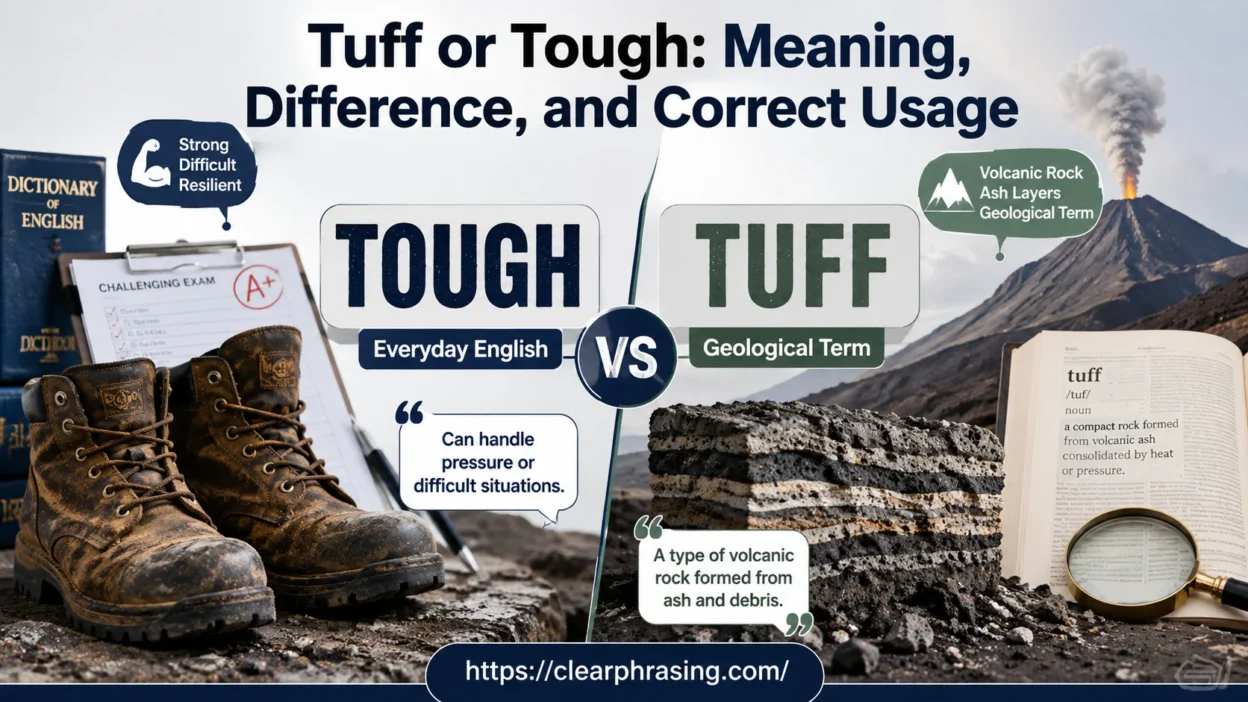
Tuff or Tough: Meaning, Difference, and Correct Usage explains why these similar-sounding words have different meanings.
Tough is an everyday adjective for something strong or durable, or someone who can handle difficult situations. A new phone case can be tough, while tuff is a geology noun for rock formed from volcanic ash. In my English teaching experience, I’ve seen these words cause quick slips in writing and speaking.
The difference becomes easier to remember with simple examples. Tuff is commonly used in geology, while tough works in everyday conversation. Companies may use tuff as an intentional spelling in a product name to build brand recognition or create a memorable identity. However, when you mean difficult, strong, or durable, spell it tough.
This right word choice keeps your writing clearer and correctly communicates your meaning.
Quick Answer
Tough is the standard spelling when you mean difficult, strong, durable, resilient, severe, or hard to deal with.
Tuff is a legitimate word when you’re talking about volcanic rock. It can also appear as an informal or slang spelling of tough, especially in casual online language. Cambridge lists the informal spelling tuff as a way of writing tough, while geological sources recognize tuff as a distinct rock term.
| Word | Main meaning | Typical use | Example |
| Tough | Difficult, strong, durable, resilient | Everyday and formal English | It was a tough decision. |
| Tuff | Volcanic rock | Geology and earth science | The cliff contains volcanic tuff. |
| Tuff | Informal spelling of tough | Slang, texting, social media | That design looks tuff. |
The simplest rule is this:
If you mean “difficult” or “strong,” use tough. If you mean volcanic rock, use tuff.
What Does Tough Mean?
The word tough has several related meanings. Its core idea usually involves difficulty, strength, resistance, or the ability to withstand pressure.
Cambridge lists tough as an adjective meaning strong or not easily broken. It also uses the word for difficult situations, strict rules, food that is difficult to eat, and people who can handle difficult circumstances.
Tough Means Difficult or Hard to Deal With
This is one of the most common meanings of tough.
You can describe something as tough when it requires considerable effort, patience, skill, or emotional strength.
For example:
- The final exam was tough.
- We faced a tough problem at work.
- She made a tough decision.
- It has been a tough year.
- That was a tough conversation.
Here, tough doesn’t mean physically strong. It means difficult to handle or accomplish.
Consider the difference between these two sentences:
- The box is tough.
- The assignment is tough.
The first sentence refers to physical durability. The second describes difficulty. Yet the same adjective works naturally in both situations.
Tough Means Strong or Durable
Tough can also describe something that resists damage.
You might call a material tough when it doesn’t break, tear, weaken, or wear out easily.
Examples include:
- tough plastic
- tough leather
- tough fabric
- tough shoes
- tough equipment
For example:
These hiking boots are tough enough for rocky trails.
The idea isn’t that the boots are difficult. Instead, they’re durable enough to withstand demanding conditions.
Tough Can Describe a Resilient Person
People can also be tough.
In this sense, the word suggests mental or emotional strength. A tough person can face pressure, setbacks, fear, or hardship without easily giving up.
Examples:
- She’s a tough competitor.
- He’s tough enough to handle criticism.
- You have to be tough when the pressure rises.
- The team showed a tough mentality after losing the first game.
This meaning doesn’t necessarily imply aggression. Someone can be emotionally tough without being harsh or unkind.
Tough Can Describe Strict Rules or Actions
Another important meaning appears when tough describes strictness.
For example:
- The school introduced tough rules.
- The government adopted tough regulations.
- The company took a tough position during negotiations.
- Police promised tougher enforcement.
Here, tough means strict, severe, or determined.
That makes phrases such as tough regulations, tough penalties, and tough restrictions common in formal writing.
Tough Can Describe Food
There’s another everyday use that learners sometimes overlook.
Food can be tough when it’s difficult to cut or chew.
For example:
The steak was too tough to cut easily.
You can also describe skins or other edible parts as tough:
This apple has a tough skin.
This meaning has nothing to do with slang or geology. It simply describes food that lacks tenderness. Cambridge includes this as a standard meaning of tough.
What Does Tuff Mean?
Here’s where the spelling comparison gets interesting.
Tuff has a legitimate scientific meaning. It isn’t merely a typo that someone accidentally created by removing the “gh” from tough.
Tuff as a Geological Term
In geology, tuff is a rock formed from volcanic material.
The U.S. Geological Survey describes tuff as consolidated pyroclastic rock. In simpler terms, explosive volcanic activity can eject ash, rock fragments, and mineral material into the air. After those materials accumulate and become hardened or compacted, they can form tuff.
A useful way to picture the process is:
Explosive eruption → volcanic ash and fragments → deposition → compaction or welding → tuff
Tuff can contain different volcanic components, including ash, mineral fragments, glass particles, and pieces of older volcanic rock. Some forms become welded when hot volcanic material settles and fuses together. The USGS specifically identifies welded tuff as a glass-rich pyroclastic rock hardened through the welding of glass shards.
This means the sentence below is completely correct:
The researchers examined a layer of volcanic tuff.
In that sentence, replacing tuff with tough would change the meaning completely.
Tuff as an Informal Spelling of Tough
There’s another use of tuff that has nothing to do with volcanoes.
In informal language, people sometimes write tuff as a stylized spelling of tough. Cambridge classifies this use as nonstandard informal English.
You may encounter it in:
- Text messages
- Social media posts
- Online comments
- Usernames
- Creative writing
- Informal branding
- Youth slang
For example:
That new design looks tuff.
In this context, the writer isn’t discussing volcanic rock. They’re deliberately using tuff as an informal spelling.
That distinction matters. A spelling can appear frequently online without becoming the standard spelling for formal English.
Key Differences
The pronunciation creates the first layer of confusion. Both words are pronounced /tʌf/ in English.
The spelling and meaning create the second.
| Feature | Tough | Tuff |
| Pronunciation | /tʌf/ | /tʌf/ |
| Standard everyday word | Yes | No, when used as a spelling of tough |
| Main meaning | Difficult, strong, durable, resilient | Volcanic rock |
| Informal use | Standard word | Can be informal spelling of tough |
| Formal writing | Appropriate | Use only when the geological meaning or official spelling requires it |
| Scientific use | General adjective | Geological noun |
| Example | It was a tough test. | The sample contains tuff. |
Think of the two words as sound-alike neighbors with different jobs.
They share a pronunciation, but context tells you which spelling belongs on the page.
When to Use Tough
When you’re writing ordinary English, tough is almost always the correct choice if you’re describing difficulty or strength.
Use Tough for Difficult Situations
Choose tough for situations that require effort or are unpleasant to handle.
- a tough exam
- a tough interview
- a tough decision
- a tough conversation
- a tough assignment
- a tough challenge
For example:
Choosing between the two offers was a tough decision.
Not:
Choosing between the two offers was a tuff decision.
The second version may appear in casual slang, but tough is the standard spelling.
Use Tough for Strong or Durable Things
Use tough when something can withstand damage or difficult conditions.
This phone case is surprisingly tough.
The manufacturer needs a tough material for outdoor equipment.
These work gloves are built to be tough.
Use Tough for Resilient People
Use tough when someone can cope with hardship or pressure.
She’s a tough athlete who rarely gives up.
He became tougher after years of difficult competition.
Notice the standard comparative form: tougher.
Use Tough in Formal Writing
If you’re writing an essay, report, business email, application, or academic paper, use tough when that is the intended meaning.
For example:
The company faced several tough decisions during the expansion.
There’s no reason to use the informal spelling tuff here.
When to Use Tuff
Tuff has two main contexts worth remembering.
Use Tuff for Volcanic Rock
When you’re writing about geology, volcanology, archaeology, geography, or earth science, tuff may be exactly the word you need.
Examples:
The valley contains thick deposits of volcanic tuff.
Scientists analyzed the mineral composition of the tuff.
The ancient structure was carved from volcanic tuff.
The USGS classifies tuff under volcanic and pyroclastic rocks and defines it as consolidated volcanic ash or related pyroclastic material.
Use Tuff as Intentional Informal Slang
In casual digital communication, you may see tuff used as a stylized spelling of tough.
For example:
That was tuff.
This new look is tuff.
Such spelling can communicate a particular online voice. However, the choice is stylistic rather than standard formal English.
If you’re writing for a teacher, employer, client, publication, or professional audience, tough is the safer choice when you mean difficult or strong.
Common Phrases
Some expressions make the correct spelling especially easy to identify.
Tough Day or Tuff Day?
Use tough day.
I had a tough day at work.
The phrase means a difficult or stressful day.
Tough Time or Tuff Time?
Use tough time in standard English.
She’s having a tough time adjusting to the new schedule.
Tough Decision or Tuff Decision?
The standard phrase is tough decision.
We had to make a tough decision.
Tough Guy or Tuff Guy?
Use tough guy in standard English.
He tries to act like a tough guy.
You might see tuff guy in a username, brand, lyric, or deliberately informal post. That doesn’t make it the standard spelling.
Tough Enough or Tuff Enough?
Use tough enough.
Are these boots tough enough for the trail?
Tuffer or Tougher?
The standard comparative form is tougher.
Correct:
This material is tougher than the old one.
Incorrect in standard English:
This material is tuffer than the old one.
Tuffest or Toughest?
The standard superlative is toughest.
That was the toughest exam I’ve taken this year.
The spelling follows tough, not tuff.
Tuff or Tough Example Sentences
Seeing the words in context is one of the fastest ways to understand the difference.
Examples With Tough
- The interview was tough, but she handled it well.
- We faced a tough decision.
- These boots are surprisingly tough.
- He’s a tough competitor.
- The company introduced tough safety standards.
- The meat was too tough to chew easily.
- It was a tough winter for local businesses.
Each sentence uses tough in a standard English sense recognized by major dictionaries.
Examples With Tuff
- The cliff contains volcanic tuff.
- Scientists studied the tuff layer.
- The ancient structure was built with volcanic tuff.
- The eruption produced deposits that later hardened into tuff.
- The phrase uses tuff as an intentional informal spelling of tough.
The first four examples involve geology. The final example involves informal language.
Common Mistakes
1: Writing Tuff When You Mean Difficult
❌ The exam was tuff.
✅ The exam was tough.
Unless you’re intentionally using slang, tuff isn’t the standard spelling for this meaning.
2: Assuming Tuff Is Always Wrong
❌ Tuff is always a misspelling.
That statement goes too far.
Tuff is a genuine geological term. Merriam-Webster defines it as a rock made from fine volcanic material, while the USGS classifies it as consolidated volcanic material.
3: Using Tuff in Formal Writing Because It Sounds the Same
Pronunciation doesn’t determine spelling.
English contains many words that sound alike but have different spellings and meanings. Tuff and tough are simply a particularly noticeable example.
4: Writing Tuffer Instead of Tougher
The standard comparative is tougher.
This fabric is tougher than cotton.
5: Writing Tuffest Instead of Toughest
The standard superlative is toughest.
That was the toughest part of the project.
Why Do Tuff and Tough Sound the Same?
The easiest answer is that English pronunciation doesn’t always preserve the clues found in spelling.
Tough contains the unusual letter combination -ough, which produces the /ʌf/ sound. The spelling can look complicated even though the pronunciation is short.
Tuff, meanwhile, represents that same sound with a much more straightforward spelling.
So you get:
tough → /tʌf/
tuff → /tʌf/
That shared sound explains why people sometimes confuse the words when writing.
The important point is that pronunciation alone can’t tell you which spelling to use. Meaning and context do that job.
A Simple Memory Trick
Don’t try to memorize a complicated rule. Ask yourself one question:
What am I talking about?
If you’re talking about difficulty, strength, durability, or resilience, choose tough.
If you’re talking about volcanic rock, choose tuff.
Try these examples:
The exam was ___.
Tough.
The material is ___.
Tough.
The volcanic deposit contains ___.
Tuff.
The researcher examined the ___ under a microscope.
Tuff.
The context acts like a road sign. Once you know what the sentence means, the spelling becomes much easier.
: A Practical Decision Guide
| If you mean… | Use |
| Difficult | tough |
| Hard to handle | tough |
| Strong | tough |
| Durable | tough |
| Resilient | tough |
| Strict or severe | tough |
| Difficult to chew | tough |
| Volcanic rock | tuff |
| An informal spelling of tough | tuff in suitable casual contexts |
There’s a useful distinction here between standard English and context-specific language.
A social media post may intentionally use tuff. A geology textbook may require tuff. A business report describing a difficult negotiation should use tough.
The audience matters.
Tuff vs. Tough in Formal and Informal English
| Context | Preferred spelling | Example |
| Academic writing | tough | The experiment presented a tough challenge. |
| Business writing | tough | The company faced a tough decision. |
| School assignment | tough | The final question was tough. |
| Everyday conversation | tough | That sounds tough. |
| Social media slang | tuff may appear | That outfit is tuff. |
| Geology | tuff | The sample contains volcanic tuff. |
| Official name or brand | Follow the official spelling | Use the registered or established form. |
This table captures the central rule: standard writing favors tough for the ordinary adjective, while tuff has specific legitimate uses.
Two Quick Case Studies:
Case Study: A Difficult Exam
Imagine a student writing:
The chemistry exam was really tuff.
The intended meaning is obvious. The student means that the exam was difficult.
For standard English, the sentence should read:
The chemistry exam was really tough.
Nothing about the exam involves volcanic rock. Therefore, tuff doesn’t fit the intended meaning.
Case Study: A Volcanic Rock Sample
Now consider a geology report:
The researchers collected a sample of volcanic tuff.
Here, tuff is exactly right.
The sentence describes a rock associated with volcanic material. Substituting tough would produce nonsense:
The researchers collected a sample of volcanic tough.
The spelling changes the meaning so dramatically that context immediately exposes the mistake.
Is Tuff a Correct Word?
Yes, but context matters.
If you’re asking whether tuff exists as an English word, the answer is clearly yes. It has a recognized geological meaning. Merriam-Webster defines it as a volcanic rock, and the USGS uses the term for consolidated pyroclastic material.
Cambridge also recognizes tuff as an informal way of writing tough.
However, that doesn’t mean you can replace tough with tuff in ordinary formal writing.
The distinction is simple:
- Tuff is correct for the geological noun.
- Tuff can work as deliberate informal spelling.
- Tough is correct for the standard adjective meaning difficult, strong, durable, or resilient.
Read More: “I Totally Agree” vs. “I Completely Agree”: Meaning and Difference
FAQs
Is “tuff” or “tough” the correct spelling?
Tough is the standard English spelling when you mean difficult, strong, durable, or able to withstand hardship. Tuff is a different word that refers to a type of volcanic rock.
What does “tuff” mean?
Tuff is a type of rock created from compacted volcanic ash and other volcanic material. It’s mainly used in geology rather than everyday English.
What does “tough” mean?
Tough can describe something strong, durable, or difficult to damage. It can also describe a person who handles challenging situations with courage and determination.
Are “tuff” and “tough” pronounced the same?
Yes, tuff and tough generally have the same pronunciation. Their spelling and meaning, however, are completely different, so context helps you identify the intended word.
Can I use “tuff” instead of “tough” in casual writing?
Usually, no. Tuff isn’t a casual replacement for tough in standard English, although businesses, brands, usernames, and product names may intentionally use the spelling.
Is “tuff” a real English word?
Yes, tuff is a legitimate English word. It has a specific geological meaning and refers to rock formed from volcanic ash or related volcanic material.
Why do people spell “tough” as “tuff”?
People may write tuff because both words sound alike. The spelling can also appear intentionally in brand names or informal contexts where someone wants a shorter or more distinctive form.
Which word should I use for a strong person?
Use tough when describing someone who is strong, brave, resilient, or capable of handling difficult circumstances. For example, you might say, “She’s a tough person who never gives up.”
Which word should I use for a durable product?
Use tough to describe a product that can withstand damage, pressure, or heavy use. You could say, “This phone case is tough enough to protect the device from everyday drops.”
How can I easily remember the difference between tuff and tough?
Think of tuff as the geology word connected with volcanic rock. For almost every everyday situation involving strength, difficulty, durability, or resilience, choose tough.
Conclusion
Tuff and tough may sound identical, but they serve very different purposes. Tuff belongs mainly to geology and describes volcanic rock, while tough is the everyday word for something strong, durable, difficult, or resilient. Remembering this distinction can help you avoid a common spelling mistake.
When you’re writing about a difficult situation, a strong person, or a durable product, choose tough. Save tuff for its geological meaning or for an intentional spelling in a brand or product name. Once you connect tuff with volcanic rock and tough with strength or difficulty, the difference becomes much easier to remember.

Mariam Asghar is an English specialist and professional content writer at ClearPhrasing.com. She is dedicated to helping readers improve their English through clear, practical, and easy-to-understand content. Her areas of expertise include grammar, spelling, vocabulary, punctuation, sentence structure, and effective writing.
At ClearPhrasing.com, Mariam writes comprehensive, well-researched articles that simplify complex language concepts for students, professionals, writers, and English learners. She believes that strong communication begins with a solid understanding of the English language and strives to make every lesson accessible and engaging.
With a strong commitment to quality, accuracy, and continuous learning, Mariam ensures that each article is carefully researched, thoroughly reviewed, and written to help readers communicate with greater confidence and clarity.