Pull One’s Punches: Meaning, Examples, and Correct Usage explains how this English phrase connects boxing with everyday communication.
In a boxing match, a fighter may use less than full force as restraint. In real life, a manager may give gentle feedback instead of being harsh or overly critical. This approach shows consideration, sensitivity, and careful communication.
The idiom also appears when someone has power or resources available but deliberately chooses to hold back. For example, a friend might choose words carefully to avoid hurting another person’s feelings.
In my English teaching experience, this expression often helps explain how honest feedback can remain respectful without losing its meaning.
Quick Answer:
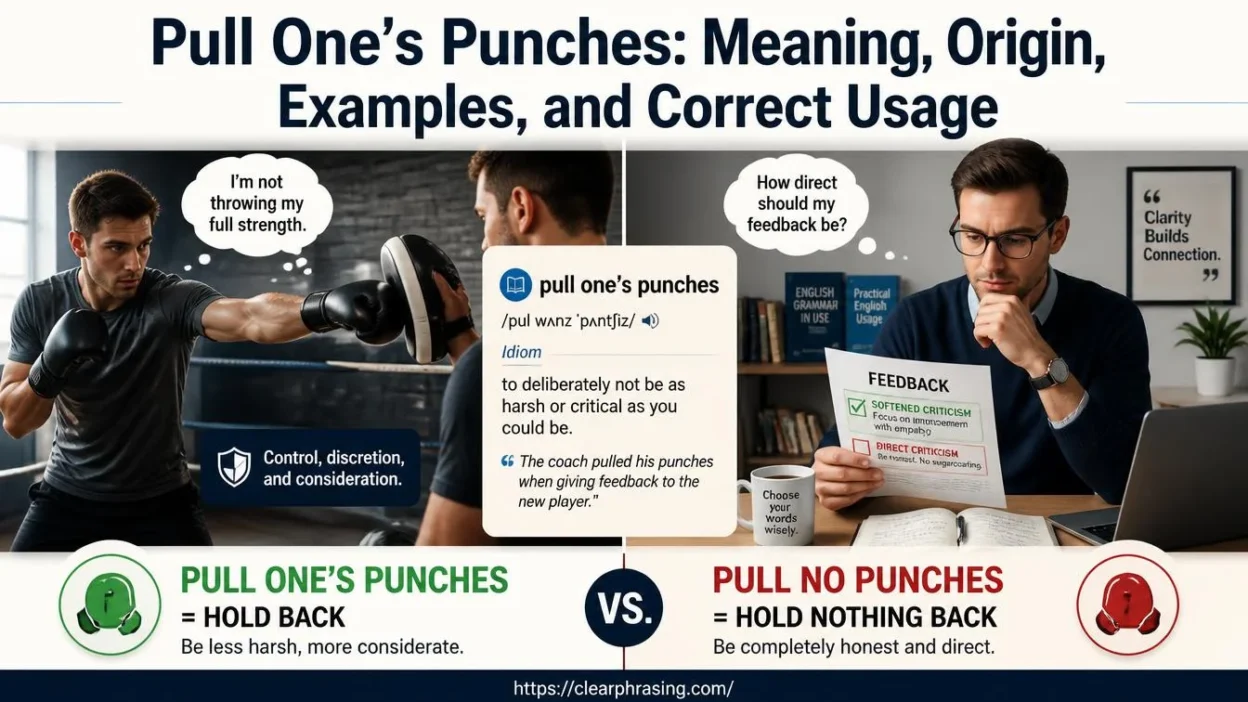
“Pull one’s punches” means to hold back or reduce the force, intensity, or impact of something. In everyday English, it often refers to criticism or opinions that someone deliberately makes less harsh.
For example:
- The reviewer pulled her punches when discussing the new restaurant.
- I asked for honest feedback, so don’t pull your punches.
- The boxer pulled his punches during the training session.
The phrase can have a literal boxing meaning or a figurative communication meaning. Collins defines the American English expression as delivering intentionally ineffective blows in boxing or criticizing someone in an intentionally mild or ineffective way.
Its negative form is more common in everyday conversation:
“Pull no punches” means to hold nothing back.
So, if someone says, “The critic pulled no punches,” they mean the critic gave a very direct and possibly harsh assessment.
What Does “Pull One’s Punches” Mean?
At its core, pull one’s punches means deliberately using less force than you could.
That idea applies directly to boxing. A fighter can control a punch instead of putting maximum power behind it. In ordinary conversation, however, the “punch” becomes an idea, criticism, opinion, or statement.
Imagine a manager reviewing an employee’s poor performance. The manager could say:
“This report is confusing, incomplete, and not ready for a client.”
Or the manager might soften the message:
“There are a few areas where the report could use some improvement.”
The second version pulls its punches. The speaker reduces the impact of the criticism.
That doesn’t necessarily make the speaker dishonest. Sometimes restraint protects a relationship or prevents unnecessary embarrassment. However, excessive restraint can also hide an important problem.
A Simple Definition of Pull One’s Punches
Pull one’s punches = to deliberately hold back force, criticism, effort, or intensity.
The key word is deliberately. The person has the ability to be stronger or more direct but chooses not to be.
Pull One’s Punches in a Sentence
- She pulled her punches because she didn’t want to hurt his feelings.
- The editor didn’t pull any punches when reviewing the manuscript.
- The coach told the fighters to pull their punches during practice.
- He usually pulls his punches when giving feedback to new employees.
What Is the Origin of “Pull One’s Punches”?
The expression has a straightforward connection to boxing.
When a boxer pulls a punch, the fighter reduces its force rather than allowing the blow to land with maximum power. This can happen during controlled practice or other situations where causing full damage isn’t the goal.
That physical meaning created a natural metaphor for communication.
A harsh criticism can feel like a punch. A softened criticism feels like a pulled punch.
The progression is easy to understand:
Physical punch → reduced force → reduced impact → softened criticism or action
Historical evidence shows that the boxing expression was already in use in the early 20th century. A Library of Congress newspaper record from 1909 contains an example describing a boxing instructor who had become accustomed to “pulling his punches.” Later examples show the expression moving beyond literal boxing into figurative writing and criticism.
One particularly useful early example appeared in a 1922 discussion of financial editorials. The writer described an editor whose final qualifications weakened an otherwise forceful argument and compared that effect to pulling punches. That example demonstrates that the figurative meaning was already developing in the early 1920s.
Dictionary sources place the broader idiomatic expression in the first half of the 20th century.
The Boxing Connection Explained
In boxing, a pulled punch doesn’t mean the fighter forgot how to punch.
The fighter chooses to reduce the impact.
That distinction carries over perfectly into figurative English. When someone pulls their punches during a review, they aren’t necessarily unable to criticize. They simply choose a milder approach.
This is why the expression works so well. The metaphor creates a vivid mental picture without requiring a long explanation.
What Does “Pull No Punches” Mean?
“Pull no punches” means to hold nothing back.
It usually describes someone who speaks directly, criticizes strongly, or takes an uncompromising approach.
For example:
The journalist pulled no punches when discussing the company’s failures.
This means the journalist didn’t soften the criticism.
Dictionary.com defines pull no punches as behaving without restraint or holding nothing back. It also traces the expression to the boxing sense of pulling a punch by hitting less hard than one could.
Pull One’s Punches vs. Pull No Punches
| Expression | Meaning | Example |
| Pull one’s punches | Hold back or soften something | She pulled her punches during the review. |
| Pull no punches | Hold nothing back | The critic pulled no punches. |
| Don’t pull your punches | Give a completely honest or direct response | Don’t pull your punches. Tell me what you really think. |
| Not pull any punches | Speak or act without restraint | He didn’t pull any punches during the interview. |
The difference is small in wording but huge in meaning.
Pull = restraint.
No pull = no restraint.
That simple contrast can prevent one of the most common mistakes with this idiom.
How to Use “Pull One’s Punches” in a Sentence
The expression works naturally in both literal and figurative contexts.
Its grammatical form changes according to the subject:
- I pull my punches.
- You pull your punches.
- He pulls his punches.
- She pulls her punches.
- We pull our punches.
- They pull their punches.
In negative sentences, you’ll often see any:
- I didn’t pull any punches.
- She doesn’t pull any punches.
- They didn’t pull any punches.
- The reviewer never pulls any punches.
Using “Pull One’s Punches” Literally
The literal meaning belongs to boxing and other combat-related situations.
Examples include:
- The fighters pulled their punches during the demonstration.
- He pulled his punches because they were practicing.
- The instructor told the students to pull their punches.
- She knew how to strike hard, but she pulled her punches during the drill.
In these examples, the phrase refers to physical force rather than criticism.
Using “Pull One’s Punches” Figuratively
The figurative meaning appears frequently in discussions about criticism, feedback, opinions, and difficult conversations.
Consider these examples:
- The reviewer pulled her punches because the restaurant owner was a friend.
- The editor didn’t pull any punches when evaluating the article.
- He pulled his punches during the interview.
- The report doesn’t pull any punches about the project’s weaknesses.
Here, nobody is actually throwing punches. The “punch” represents the impact of someone’s words or judgment.
Different Contexts
The idiom becomes more useful when you understand where people naturally use it.
Pull One’s Punches in Criticism and Reviews
Criticism provides one of the clearest figurative uses.
A reviewer may have serious objections to a movie, book, restaurant, product, or performance. Instead of stating every criticism directly, the reviewer may soften the language.
For example:
The review pulled its punches by calling the disappointing performance “a little uneven.”
The phrase suggests that the criticism could have been stronger.
On the other hand:
The review pulled no punches and described the performance as a complete failure.
That sentence signals much greater directness.
Pull One’s Punches in Workplace Communication
Workplace feedback often requires a balance between honesty and tact.
A supervisor might say:
“Your presentation needs more supporting evidence.”
That’s direct but professional.
A stronger statement could be:
“Your presentation wasn’t convincing because several major claims had no supporting evidence.”
If the supervisor avoids the second level of directness despite having a good reason to use it, the supervisor might be pulling their punches.
The phrase can therefore describe a useful choice or a communication weakness. Context decides which interpretation makes sense.
Pull One’s Punches in Arguments and Debates
Debates often involve strong opposing views. Someone may know a powerful counterargument but choose not to use it.
For example:
She had several stronger objections but pulled her punches during the debate.
The sentence suggests restraint.
By contrast:
He pulled no punches during the debate.
This means he presented his criticisms and arguments forcefully.
Pull One’s Punches in Journalism
Journalists and commentators sometimes use the expression to describe unusually direct reporting or criticism.
A headline might say:
The columnist pulls no punches in his assessment of the new policy.
The expression tells readers to expect a blunt, forceful evaluation.
It doesn’t necessarily mean the writer is wrong. It describes the writer’s approach and tone.
Pull One’s Punches in Personal Conversations
Personal conversations can make the idiom especially meaningful.
Suppose a friend asks whether their new business idea makes sense. You see serious problems but don’t want to discourage them.
You might say:
“There are a few things you could reconsider.”
You’ve probably pulled your punches.
If you instead say:
“The idea has major problems that you need to fix before investing money.”
You’ve been much more direct.
Neither approach is automatically better. Good communication depends on the situation, the relationship, and the purpose of the conversation.
Pull One’s Punches vs. Hold Back
Hold back has a broader meaning than pull one’s punches.
You can hold back your emotions, money, information, physical effort, or reaction. The expression doesn’t necessarily involve criticism.
Pull one’s punches, however, usually suggests that someone deliberately reduces the force or impact of an action, statement, or criticism.
| Expression | Meaning | Example |
| Pull one’s punches | Reduce force or impact | The critic pulled her punches. |
| Hold back | Restrain yourself generally | He held back his opinion. |
| Soften | Make something less harsh | She softened her criticism. |
| Go easy on someone | Treat someone less harshly | The coach went easy on the beginner. |
These expressions overlap, but they aren’t perfect substitutes.
Pull One’s Punches vs. Go Easy on Someone
Go easy on someone focuses on how you treat another person.
For example:
Go easy on him. It’s his first day.
That sentence means you should avoid being too harsh.
Pull your punches emphasizes restraint in what you say or do.
For example:
The interviewer didn’t pull any punches.
That sentence focuses on the interviewer’s direct and forceful questioning.
The difference is subtle, but it matters when you want precise wording.
Common Mistakes With “Pull One’s Punches”
Even native speakers sometimes use boxing idioms loosely. English learners face an additional challenge because the literal wording can suggest the wrong meaning.
Mistake: Thinking “Pull” Means Hit Harder
A pulled punch isn’t a stronger punch.
It is a less forceful punch.
The word pull suggests drawing the punch back instead of allowing the full force to land.
Mistake: Confusing “Pull One’s Punches” With “Pull No Punches”
This is the biggest trap.
Compare:
- She pulled her punches. → She held back.
- She pulled no punches. → She held nothing back.
Those meanings move in opposite directions.
Mistake: Using the Wrong Possessive
The phrase uses a possessive that agrees with the subject.
Correct:
- He pulled his punches.
- She pulled her punches.
- They pulled their punches.
Incorrect:
- She pulled his punches.
- They pulled her punches.
The grammar is simple once you identify who is doing the action.
Mistake: Assuming the Idiom Always Refers to Fighting
Modern usage often has nothing to do with boxing.
You can pull punches in:
- criticism
- interviews
- reviews
- debates
- negotiations
- workplace feedback
- personal conversations
- public commentary
The figurative meaning is now well established. Collins specifically recognizes the informal sense of restraining criticism or actions.
Is “Pull One’s Punches” Positive or Negative?
The idiom itself isn’t automatically positive or negative.
Context determines the judgment.
Pulling your punches can be thoughtful. A teacher may soften criticism so a student doesn’t lose confidence. A manager may choose tactful wording during a sensitive conversation.
However, restraint can also become a problem.
If a doctor, manager, editor, or advisor avoids mentioning a serious issue simply to prevent discomfort, the softened message may do more harm than good.
Consider these two situations:
Helpful restraint:
The coach pulled his punches when correcting the beginner’s first mistakes.
Unhelpful restraint:
The manager pulled her punches and never told the employee that the work failed to meet basic requirements.
The same idiom can describe very different choices.
When Should You Use “Pull One’s Punches”?
Use the expression when you want to emphasize deliberate restraint.
It works particularly well when discussing:
- criticism
- reviews
- honest feedback
- debates
- interviews
- difficult conversations
- physical training
- strong opinions
- forceful actions
For example:
Don’t pull your punches. I want your honest opinion.
This sounds natural because the speaker specifically asks the other person to stop softening their response.
When Should You Avoid “Pull One’s Punches”?
The expression is generally informal. Collins labels the figurative American English usage informal.
That doesn’t make it incorrect in professional writing. It simply means that a more neutral expression may work better in highly formal or technical contexts.
Instead of:
The committee pulled its punches when discussing the proposal.
You could write:
The committee moderated its criticism of the proposal.
Other alternatives include:
- hold back
- soften one’s criticism
- moderate one’s response
- reduce the intensity
- restrain one’s comments
- avoid direct criticism
Choose the idiom when you want a conversational, vivid tone. Choose a neutral alternative when precision and formality matter more.
A Practical Example
Imagine an editor reviewing a weak article.
The editor has three possible approaches.
| Approach | Example | Effect |
| Very soft | A few sections could be improved. | May hide serious problems |
| Balanced | The article has useful ideas, but several sections need clearer evidence. | Honest and constructive |
| No punches pulled | The article lacks evidence and repeats the same points without adding useful information. | Direct and forceful |
The first response may pull too many punches.
The third may pull no punches.
The middle response often works best when the goal is improvement rather than confrontation.
That distinction captures the practical value of the idiom. Directness and kindness don’t have to be enemies.
Quick Comparison With Similar Expressions
| Phrase | Meaning | Tone |
| Pull one’s punches | Hold back force or criticism | Restrained |
| Pull no punches | Hold nothing back | Direct |
| Hold back | Restrain yourself | Neutral |
| Go easy on someone | Treat someone less harshly | Gentle |
| Soften the blow | Make bad news easier to accept | Tactful |
| Speak frankly | Speak honestly and directly | Neutral to direct |
| Lay it on the line | State something openly and clearly | Direct |
| Tell it like it is | Speak bluntly and honestly | Informal |
This comparison shows why pull one’s punches has a distinct flavor. It doesn’t merely mean being polite. It suggests that a person could have been stronger but deliberately chose restraint.
Pull One’s Punches: Easy Memory Trick
Think of an actual boxer.
A full-force punch lands with maximum impact.
A pulled punch reduces that impact.
Now transfer that picture to language:
Pulled punch → less impact → softer criticism
Then remember the opposite:
No pulled punch → full impact → direct criticism
So:
Pull your punches = hold back.
Pull no punches = hold nothing back.
Once you picture the boxing ring, the meaning becomes much easier to remember.
Read More: However or How Ever: Meaning, Difference, and Usage
FAQs
FAQs About Pull One’s Punches
What does “pull one’s punches” mean?
“Pull one’s punches” means to hold back instead of using your full strength, force, or criticism. In everyday English, it often means being less harsh than you could be.
Where does the phrase “pull one’s punches” come from?
The phrase comes from boxing. A boxer who pulls a punch deliberately reduces its force instead of hitting an opponent with full power.
Is “pull one’s punches” literal or figurative?
It can be both. Literally, it refers to reducing the force of a punch. Figuratively, it describes holding back criticism, honesty, effort, or force in a situation.
What is an example of pulling your punches?
A manager might notice several serious mistakes in an employee’s work but give gentle feedback rather than harsh criticism. The manager is pulling their punches.
Does pulling your punches mean being dishonest?
Not necessarily. You can still be honest while choosing softer words. The expression usually suggests that someone deliberately avoids being as forceful or direct as they could be.
What is the difference between “pull one’s punches” and “roll with the punches”?
“Pull one’s punches” means holding back your force or criticism. “Roll with the punches” means adapting to difficulties and handling problems without becoming overwhelmed.
Can you use “pull one’s punches” in professional communication?
Yes. It works well when discussing feedback, negotiations, criticism, or workplace conversations. For example, a supervisor may pull their punches when discussing an employee’s poor performance.
Is “pull no punches” the opposite of “pull one’s punches”?
In many contexts, yes. Pull no punches means speaking or acting without holding back, while pull one’s punches suggests deliberately reducing your force or criticism.
Is “pull one’s punches” common in everyday English?
Yes. Native speakers use it in conversations about criticism, arguments, negotiations, sports, and difficult situations. Its meaning is usually clear from the context.
Can “pull one’s punches” have a positive meaning?
It can. Showing restraint may prevent unnecessary hurt, especially when dealing with sensitive situations. However, too much restraint can sometimes make feedback unclear or less useful.
Conclusion
Pull one’s punches is a vivid English idiom that brings a boxing image into everyday communication. Instead of using full force, a person chooses restraint. That idea works beyond the boxing ring, especially when someone gives criticism, handles conflict, or discusses a sensitive issue.
The expression also highlights an important communication skill: being honest without being unnecessarily harsh. Whether you’re talking about workplace feedback, personal relationships, or delicate negotiations, knowing when to hold back can make your words more effective sometimes more humane.

Shamsa Kanwal is an English specialist and content writer at ClearPhrasing.com, where she helps readers navigate the English language with confidence. She enjoys breaking down grammar rules, spelling differences, vocabulary, and everyday writing challenges into simple, practical lessons that anyone can understand.
Her writing is focused on making learning approachable rather than overwhelming. Whether she’s explaining commonly confused words, punctuation rules, or grammar concepts, Shamsa believes that clear explanations and real-life examples are the key to effective learning.
Every article she writes is carefully researched, fact-checked, and edited to ensure it is accurate, easy to read, and genuinely helpful. Her goal is to create trustworthy resources that enable students, professionals, writers, and English learners to improve their communication skills and write with greater clarity.
Through her work at ClearPhrasing.com, Shamsa is committed to making English learning simpler, more practical, and accessible for readers around the world.