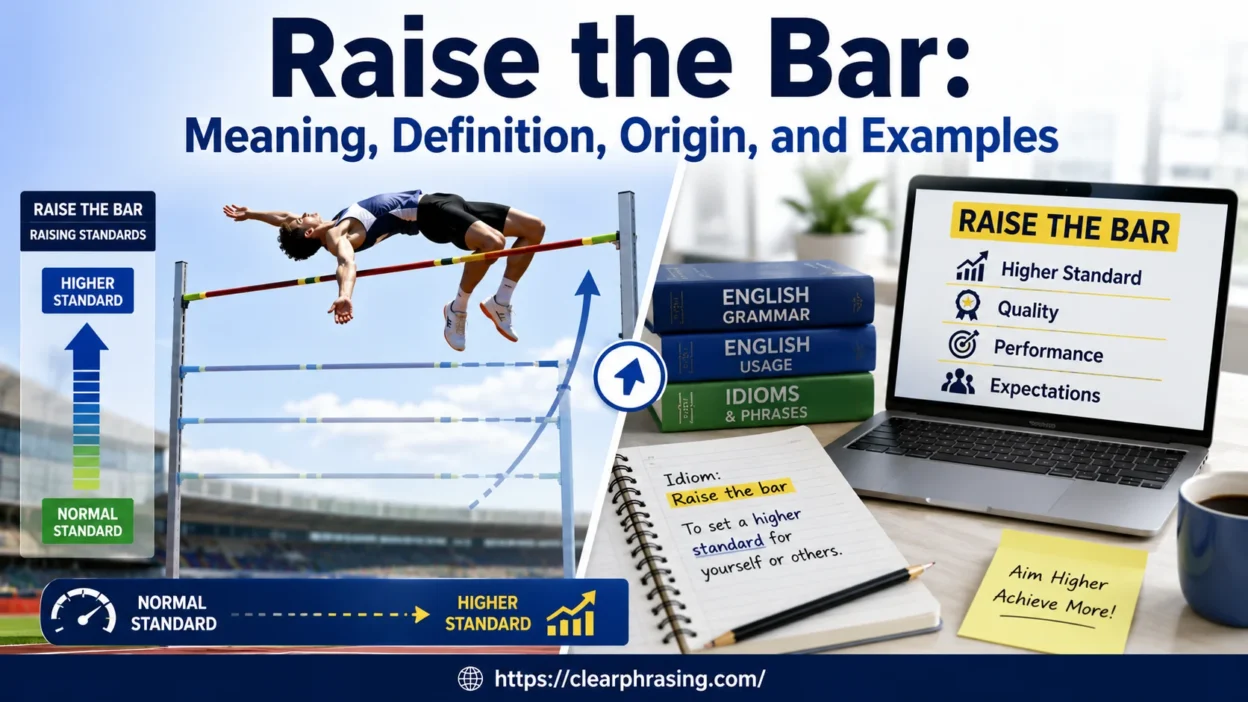
Raise the Bar: Meaning, Definition, and Examples explains an idiom that means set standards higher, set new goals, and exceeding expectations.
In sports, a high jumper must jump higher when the bar goes up. This requires training, hard work, and improvement. A coach may encourage athletes to train harder, improve performance, and achieve better results. The same idea applies to school, work, and everyday life, where higher standards, higher expectations, goals, and progress can lead to achievement and excellence.
A teacher might raise the bar for science fair projects, asking students to create more creative projects than last year. Students can set standards, accept a challenge, and improve quality through learning and education. The phrase also suits a competitive setting, English learning, and athletic performance. When you move the bar higher, you keep pushing past your previous level.
This approach supports quality improvement, performance improvement, and better results. Setting goals helps you do better, especially when learning new things.
Quick Answer:
“Raise the bar” means to set a higher standard of quality, performance, achievement, or expectation.
In simple terms, when you raise the bar, you make the expected level higher than it was before. Merriam-Webster defines the phrase as “to set a higher standard,” while Cambridge Dictionary explains it as setting a higher standard by doing something very well.
For example:
The new software raised the bar for data security.
This means the software introduced a higher level of security that other products may now need to match.
The phrase can also describe personal improvement:
She raised the bar for herself after completing the course.
Here, the comparison isn’t necessarily with other people. She simply established a higher standard for her own future performance.
What Does “Raise the Bar” Mean in English?
The idiom raise the bar refers to increasing a standard or expectation. The “bar” represents the level that someone must reach. When you raise it, reaching that level becomes more demanding.
The expression can apply to several kinds of standards:
- Quality: producing something better than previous work
- Performance: achieving stronger results
- Expectations: requiring more from yourself or others
- Achievement: reaching a more difficult goal
- Professional standards: improving how a service or task gets performed
- Innovation: creating something that changes what people expect
Consider this sentence:
The restaurant raised the bar for customer service.
The restaurant didn’t merely provide customer service. Its performance established a higher benchmark that other restaurants might now try to reach.
That distinction matters. Improvement means something became better. Raising the bar means that improvement creates a higher standard.
Meaning in Simple Words
If you want the shortest possible explanation, think of it this way:
Raise the bar = expect or achieve a higher level than before.
Imagine a competition in which the best score is 80. Someone earns 95. Suddenly, 80 no longer looks exceptional. The new achievement has changed the benchmark.
That’s the basic idea behind the idiom.
What Is the Literal Meaning Behind “Raise the Bar”?
The expression creates a clear physical image. Picture a high-jump competition. An athlete tries to clear a horizontal bar. Once competitors successfully clear one height, officials can move the bar higher.
The next attempt becomes harder.
That physical action provides the metaphor behind the modern expression. A higher bar represents a higher challenge or standard. The figurative meaning then extends beyond athletics to almost any situation involving quality or achievement.
Sources on idiom history commonly connect the expression with high jump and pole vault terminology, where athletes attempt to clear a bar placed at increasing heights.
How the Athletic Image Became a Figurative Expression
The idea is easy to visualize:
A higher physical bar → a harder challenge → a higher achievement → a higher standard
That progression explains why the idiom works so well in everyday English. You don’t need to know anything about track and field to understand it.
For example:
The latest electric vehicle raised the bar for charging efficiency.
There isn’t an actual bar involved. The sentence uses the athletic image to say that the vehicle established a more demanding standard.
How to Use “Raise the Bar” in a Sentence
The phrase functions as a verb phrase. You can change raise to fit the tense and subject.
Common forms include:
- raise the bar
- raises the bar
- raised the bar
- raising the bar
- has raised the bar
- will raise the bar
The expression often appears with for when you identify the person, group, product, or field affected by the new standard.
“Raise the Bar for” Someone or Something
The pattern is:
raise the bar for + person, group, product, or field
Examples:
The new training program raised the bar for professional development.
Her performance raised the bar for everyone on the team.
This device raises the bar for portable technology.
The word for identifies who or what now faces the higher standard.
“Raise the Bar in” a Field
You can also use in to identify the area where the improvement occurs.
Examples:
The company raised the bar in customer service.
The athlete raised the bar in competitive swimming.
The school raised the bar in academic achievement.
In these examples, in points to the broader field or activity.
“Raise the Bar for Yourself”
The idiom doesn’t require competition with another person.
You can raise the bar for yourself by setting a more ambitious goal or demanding better work from yourself.
After winning the local competition, Maya raised the bar for herself.
He raised the bar for his next project instead of repeating the same approach.
This use highlights personal growth rather than rivalry.
Raise the Bar Examples in Different Contexts
The meaning stays consistent even though the context changes. Here are practical examples that show how naturally the idiom works in different areas.
At Work
Professional environments often use the expression when discussing performance and standards.
Her attention to detail raised the bar for the entire department.
The new manager raised the bar for workplace communication.
The team raised the bar by completing the project ahead of schedule without sacrificing quality.
In these examples, the phrase suggests that previous performance now looks less impressive by comparison.
Raise the Bar in Business
Businesses frequently use the idiom when discussing products, services, competition, and innovation.
The company raised the bar for online customer support.
The new product raised the bar for durability in its category.
Their delivery system has raised the bar for convenience.
The expression works particularly well when one company’s performance creates a new benchmark for competitors.
Raise the Bar in Education
Education provides another natural setting for the idiom.
The new curriculum raised the bar for student research projects.
Her presentation raised the bar for the rest of the class.
The school raised the bar by introducing stronger writing standards.
The phrase can describe students, teachers, schools, courses, assignments, or academic expectations.
Sports
Sports offer the most obvious connection to the literal meaning.
The athlete raised the bar with a record-breaking performance.
The team raised the bar for defensive play this season.
Her training routine has raised the bar for competitors.
Here, the metaphor feels especially natural because sports already involve measurable standards and competition.
Technology
Technology changes quickly, so people often use the idiom when a new product or service introduces a significant improvement.
The new camera raised the bar for low-light photography.
The update raises the bar for mobile security.
That laptop raised the bar for battery performance.
The phrase works best when the improvement is substantial enough to create a meaningful comparison.
Personal Goals
You can also use the expression when discussing individual achievement.
Finishing the marathon raised the bar for his future goals.
She raised the bar for herself by aiming for a higher score.
After mastering the basics, he raised the bar and tackled more advanced material.
This version emphasizes ambition, discipline, and continued improvement.
Raise the Bar vs. Set the Bar
These two expressions look similar because they deal with standards. However, they describe different stages.
Set the bar means to establish a standard.
Raise the bar means to increase an existing standard.
| Expression | Meaning | Example |
| Set the bar | Establish a standard | Her first project set the bar high. |
| Raise the bar | Establish a higher standard | Her second project raised the bar even further. |
| Lower the bar | Reduce a standard | The new policy lowered the bar for entry. |
Think of set the bar as placing the marker on the wall. Raise the bar means moving that marker higher.
When to Use “Set the Bar”
Use set the bar when someone establishes the level that others will use for comparison.
The original design set the bar for simplicity.
This sentence says the design established a strong standard.
When to Use “Raise the Bar”
Use raise the bar when something pushes that standard higher.
The redesigned model raised the bar for simplicity and efficiency.
The newer model didn’t simply meet the old standard. It moved the benchmark upward.
Can You Use Both Expressions Together?
Absolutely.
The first team set the bar high, but the second team raised the bar even further.
This sentence demonstrates the difference perfectly. One action establishes the benchmark. The other makes the benchmark more demanding.
Raise the Bar vs. Raise the Standard
These expressions have almost the same basic meaning, but their style differs.
Raise the bar is an idiom. It creates a vivid image and often sounds more energetic.
Raise the standard is more literal and direct.
Compare these sentences:
The company raised the bar for customer service.
The company raised its customer service standards.
Both are correct. The first sounds more idiomatic and expressive. The second states the idea more literally.
For formal policies, technical documents, or highly precise academic writing, a literal phrase can sometimes communicate the idea more directly. In everyday writing, journalism, business communication, and general articles, raise the bar is perfectly natural.
Synonyms for “Raise the Bar”
Several expressions can communicate a similar idea. However, their meanings aren’t always identical.
| Alternative | Main idea | Tone |
| Set a higher standard | Establish a better benchmark | Neutral |
| Raise expectations | Demand stronger results | Neutral |
| Set a new standard | Create a benchmark others may follow | Neutral |
| Step it up | Improve effort or performance | Informal |
| Take it to the next level | Improve something substantially | Conversational |
| Go above and beyond | Do more than expected | Positive |
| Push the envelope | Move beyond usual limits | Informal |
For example, go above and beyond focuses on exceptional effort. Raise the bar focuses on the higher standard created by that effort.
Likewise, step it up usually means improving your performance. It doesn’t necessarily imply that you have established a new benchmark for everyone else.
What Is the Opposite of “Raise the Bar”?
The most direct opposite is lower the bar.
Lower the bar means to reduce the standard or expectation.
The organization lowered the bar for entry-level applicants.
This means applicants no longer need to meet the previous level of requirements.
Oxford Learner’s Dictionaries lists lower the bar as setting a new, lower standard of quality or performance and identifies raise the bar as its opposite.
Don’t confuse lower the bar with fall short.
- Raise the bar = increase the standard.
- Lower the bar = decrease the standard.
- Fall short = fail to reach the standard.
These expressions describe three different actions or outcomes.
Common Mistakes
The idiom looks simple, but a few misunderstandings can lead to awkward usage.
Using It When Something Simply Changes
Not every change raises the bar.
The company changed its logo.
That statement doesn’t automatically mean the company raised its standards.
To use raise the bar, the change should involve a meaningful improvement in quality, performance, achievement, or expectations.
Confusing It With “Set the Bar”
Remember the timeline:
First, someone sets the bar. Then someone can raise it.
If a person establishes the original benchmark, use set the bar.
If someone creates a higher benchmark, use raise the bar.
Assuming It Always Means Competition
Competition often appears in contexts involving the phrase, but it isn’t required.
I raised the bar for myself this year.
This sentence doesn’t compare the speaker with anyone else.
The standard can be entirely personal.
Using the Idiom in Every Formal Sentence
An idiom can make writing lively, but repetition quickly becomes tiring.
In highly formal writing, alternatives such as increase the required standard, establish a higher performance threshold, or set a higher standard may offer greater precision.
Good writing isn’t about using the fanciest phrase available. It’s about choosing the phrase that fits the situation.
Is “Raise the Bar” Formal or Informal?
Raise the bar is a widely understood English idiom. It can appear in everyday speech, professional writing, journalism, business communication, and general informational writing.
Its tone usually feels neutral to positive.
| Context | Suitable wording |
| Casual conversation | Raise the bar |
| General writing | Raise the bar |
| Business communication | Raise the bar / set a higher standard |
| Academic writing | Set a higher standard |
| Technical documentation | Increase the required standard |
The best choice depends on the level of precision your audience expects.
For example, a manager might naturally say:
We need to raise the bar for customer service.
A formal policy might instead say:
The organization will increase its customer service standards.
Neither version is wrong. The context determines which one sounds most appropriate.
Can “Raise the Bar” Have a Negative Meaning?
The expression usually has a positive meaning because it suggests improvement. However, context can give it a negative or critical edge.
Consider:
The manager keeps raising the bar without giving employees more resources.
Here, raising standards isn’t presented as a good thing. The sentence suggests that expectations have become difficult or unreasonable.
This illustrates an important feature of idioms: the surrounding context shapes the attitude.
The phrase itself means a higher standard. The writer decides whether that higher standard sounds inspiring, demanding, unfair, or unrealistic.
Grammar and Forms of “Raise the Bar”
Because raise is a regular verb, you can use the idiom in several grammatical forms.
| Form | Example |
| Present | They raise the bar every year. |
| Third-person singular | She raises the bar with every project. |
| Past | The new design raised the bar. |
| Present participle | The company is raising the bar. |
| Present perfect | The team has raised the bar. |
| Future | The new product will raise the bar. |
The noun bar remains singular because it belongs to the fixed idiomatic expression.
The phrase also works with different subjects:
The athlete raised the bar.
The company raised the bar.
Their results raised the bar.
You can raise the bar for yourself.
The grammatical flexibility makes the idiom useful in both speech and writing.
20 “Raise the Bar” Examples in Sentences
Work and Business
- Her leadership raised the bar for the entire department.
- The company raised the bar for employee training.
- Their customer service raises the bar for competitors.
- The new policy raised the bar for workplace safety.
- His attention to detail has raised the bar for the team.
Education
- The new curriculum raised the bar for academic writing.
- Her research project raised the bar for the entire class.
- The teacher raised the bar by introducing more challenging assignments.
Sports
- The runner raised the bar with a record-breaking performance.
- The championship raised the bar for competitive standards.
- Her performance raised the bar for future competitors.
Technology and Products
- The new phone raised the bar for battery life.
- This software raises the bar for data protection.
- The redesigned interface raised the bar for usability.
- The latest camera has raised the bar for image quality.
Personal Goals
- After reaching her target, she raised the bar for herself.
- He raised the bar by setting a more ambitious goal.
- Completing the course raised the bar for his next challenge.
Everyday English
- That performance really raised the bar for the rest of the group.
- Your last project was excellent, but this one raised the bar again.
These examples show that raise the bar can describe a person, product, service, achievement, standard, or personal goal.
A Simple Way to Remember “Raise the Bar”
If you struggle to remember the meaning, picture a high-jump athlete.
The bar sits at one height.
The athlete clears it.
Then the bar moves higher.
The next attempt requires greater ability.
That is exactly what raise the bar means figuratively:
Higher bar = higher standard = greater expectations.
This mental picture also helps you distinguish the expression from set the bar. Setting the bar establishes the benchmark. Raising it moves the benchmark upward.
Read More: All Of or All: Meaning, Difference, and Correct Usage
FAQs
What does “raise the bar” mean?
“Raise the bar” means to set a higher standard than before. It suggests improving quality, performance, effort, or expectations.
Is “raise the bar” an idiom?
Yes. “Raise the bar” is a common English idiom. You use it when someone increases the standard that others must meet.
How do you use “raise the bar” in a sentence?
You can say, “The new manager raised the bar for customer service.” This means the manager established a higher standard for service.
What is an example of “raise the bar” in sports?
A coach might tell athletes to raise the bar before an important competition. The coach wants them to train harder and achieve better results than before.
Can you use “raise the bar” at work?
Absolutely. At work, the phrase can describe higher expectations for quality, productivity, teamwork, or performance. For example, “The new project raised the bar for our entire team.”
What does “raise the bar” mean in school?
In school, it means expecting better work or stronger performance from students. A teacher might raise the bar by asking for more detailed research or more creative projects.
Is “raise the bar” positive or negative?
The phrase is usually positive because it suggests improvement and progress. However, it can feel negative if someone creates unrealistic expectations or makes success unnecessarily difficult.
What is the difference between “raise the bar” and “set the bar”?
“Set the bar” means establishing a standard or expectation. “Raise the bar” means increasing that standard after it has already been established.
Can “raise the bar” describe personal improvement?
Yes. You can use it when you challenge yourself to improve. For example, you might raise the bar by learning a new skill, improving your writing, or reaching a more ambitious goal.
Is “raise the bar” common in everyday English?
Yes. Native speakers commonly use this expression in conversations about work, education, sports, business, personal goals, and performance. It works well when you want to emphasize meaningful improvement.
Conclusion
“Raise the bar” captures a simple but powerful idea: don’t stop at what you’ve already achieved when you know you can do better. The phrase describes the decision to increase your standards, challenge yourself, and aim for stronger results. You might hear it from a coach encouraging athletes, a teacher expecting better classroom work, or a manager asking a team to improve its performance. In each situation, the message remains similar. The previous standard is no longer the final destination.
The expression also fits everyday personal growth. You can raise the bar for your writing, study habits, professional skills, creativity, or long-term goals. From my experience teaching English, students often understand an expression more easily when they connect it with a real situation rather than memorize a definition.
Think of a high jumper: once the bar moves higher, simply repeating the previous jump isn’t enough. The athlete must adjust, practice, and push further. That image explains the phrase perfectly. When you raise the bar, you don’t just demand more from others. You can also challenge yourself to reach a new level of quality, confidence, and achievement.

Shamsa Kanwal is an English specialist and content writer at ClearPhrasing.com, where she helps readers navigate the English language with confidence. She enjoys breaking down grammar rules, spelling differences, vocabulary, and everyday writing challenges into simple, practical lessons that anyone can understand.
Her writing is focused on making learning approachable rather than overwhelming. Whether she’s explaining commonly confused words, punctuation rules, or grammar concepts, Shamsa believes that clear explanations and real-life examples are the key to effective learning.
Every article she writes is carefully researched, fact-checked, and edited to ensure it is accurate, easy to read, and genuinely helpful. Her goal is to create trustworthy resources that enable students, professionals, writers, and English learners to improve their communication skills and write with greater clarity.
Through her work at ClearPhrasing.com, Shamsa is committed to making English learning simpler, more practical, and accessible for readers around the world.