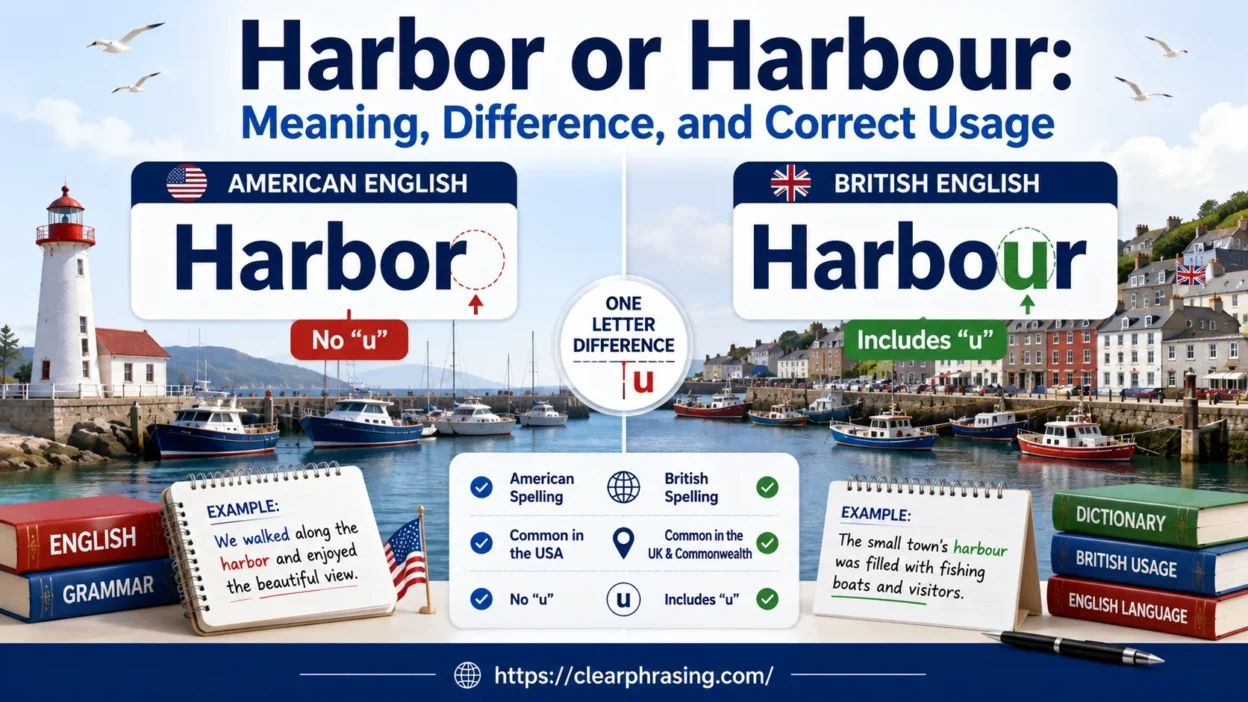
Harbor or Harbour: Meaning, Difference, and Usage is simple once you know the English standard your audience expects.
Harbor is the preferred spelling in American English, while harbour is standard in British English. Both words have the same meaning, pronunciation, and usage. They describe a place where ships find shelter from rough water or where a motorboat can stay near a dock.
This difference reflects history, geography, and English spelling rules. In my teaching experience, writers often worry about choosing the “correct” form. Both are correct. Simply match your writing to your audience and remain consistent throughout your article, email, or other formal writing.
Quick Answer
Harbor is the standard American English spelling.
Harbour is the standard British English spelling.
Both words mean the same thing and can function as either a noun or a verb.
| Spelling | English variety | Example |
| harbor | American English | The ship entered the harbor. |
| harbour | British English | The ship entered the harbour. |
So, if you’re writing for a US audience, choose harbor. If you’re following British English conventions, choose harbour.
The same distinction continues in related verb forms:
| American English | British English |
| harbor | harbour |
| harbors | harbours |
| harbored | harboured |
| harboring | harbouring |
Cambridge and Oxford both recognize these regional spelling differences.
What Does Harbor or Harbour Mean?
At its most literal level, harbor or harbour refers to a protected area of water where ships and boats can shelter or stay safely.
A harbor may sit along a coast, beside a city, or within another body of water. Natural landforms can provide protection, while walls and other structures can create or strengthen the shelter.
Oxford defines a harbour as an area of coastal water protected from the open sea where ships can shelter.
For example:
- The fishing boats returned to the harbor before the storm.
- Several yachts were anchored in the harbour.
- The town developed around a small natural harbor.
- We walked along the old harbour wall.
The meaning stays the same. Only the spelling changes.
Harbor or Harbour as a Noun
As a noun, the word describes the place itself.
You might use it when talking about:
- ships
- boats
- fishing fleets
- ports
- docks
- coastal towns
- marine traffic
- sheltered waters
- harbor walls
- harbor entrances
For example:
Several boats lay at anchor in the harbor.
In British English, the same sentence becomes:
Several boats lay at anchor in the harbour.
The word can also have a figurative sense. A safe harbor can describe a place or situation that provides protection or security.
Merriam-Webster lists both the literal maritime sense and the broader meaning of a place offering safety or refuge.
Harbor or Harbour as a Verb
Here’s where the word becomes more interesting.
As a verb, harbor or harbour can mean to provide shelter, contain something, or continue to hold a thought or feeling.
Consider these examples:
- The family was accused of harboring a fugitive.
- She still harbors doubts about the plan.
- He harbored resentment for years.
- The damp basement may harbor mold.
- The abandoned building could harbour insects.
Merriam-Webster lists meanings that include giving shelter, providing a habitat, and persistently holding a thought or feeling.
Cambridge also identifies uses involving thoughts and feelings as well as the containment of bacteria and other harmful organisms.
What Is the Difference?
The main difference between harbor and harbour is regional spelling.
There isn’t a separate definition hiding behind the extra letter. The u doesn’t create a new word. Instead, it reflects the spelling convention generally associated with British English.
| Feature | Harbor | Harbour |
| Standard in | American English | British English |
| Meaning | Same | Same |
| Noun | Yes | Yes |
| Verb | Yes | Yes |
| Extra “u” | No | Yes |
| Example | Boston Harbor | Sydney Harbour |
Cambridge explicitly labels harbor as the US spelling and harbour as the UK spelling. Merriam-Webster likewise describes harbour as a chiefly British spelling of harbor.
That means neither spelling deserves the label wrong without considering context.
If an American student writes harbor, the spelling is appropriate. If a British writer chooses harbour, that spelling is equally appropriate.
Why Does Harbor Have Two Spellings?
The spelling difference reflects the long history of English rather than a random modern spelling choice.
Merriam-Webster traces harbor back through Middle English forms such as herberwe, herbour, and harborow to Old English herebeorg, meaning shelter or lodging. The word ultimately has Germanic roots associated with protection and shelter.
Oxford also traces harbour to late Old English herebeorg, meaning shelter or refuge.
Over centuries, English spelling developed differently across regions. American English eventually favored harbor, while British English retained harbour.
You can see a similar pattern in several familiar words:
| American English | British English |
| color | colour |
| honor | honour |
| labor | labour |
| harbor | harbour |
The pattern isn’t absolute across English. However, it provides a useful clue when you encounter words ending in -or and -our.
When Should You Use Harbor?
Use harbor when you’re writing in American English.
That includes most writing intended for readers in the United States, such as:
- American school assignments
- US newspapers
- American websites
- US business writing
- American academic materials
- US-focused marketing content
- American government or institutional writing
For example:
- The ferry entered the harbor just before sunset.
- The city has one of the region’s busiest harbors.
- She harbors serious doubts about the proposal.
- The old warehouse may harbor dangerous bacteria.
Merriam-Webster uses harbor as its main headword and gives the forms harbors, harbored, and harboring.
When Should You Use Harbour?
Choose harbour when you’re following British English spelling conventions.
That includes writing for audiences in places where British spelling is standard or commonly expected.
Examples include:
- The fishing boats returned to the harbour.
- The town has a beautiful natural harbour.
- She harbours doubts about his explanation.
- He harboured resentment after the argument.
- The building may harbour germs.
Oxford lists harbour as the standard form and identifies harbor as the US English equivalent.
The important point is consistency. If the rest of your article uses British spellings such as colour, favour, and centre, then harbour will usually fit naturally.
If your article follows American conventions such as color, favor, and center, use harbor.
Harbor or Harbour Verb Forms
The spelling difference doesn’t disappear when you change the word’s tense.
American and British English carry the regional distinction through the related forms.
| Function | American English | British English |
| Base form | harbor | harbour |
| Third-person singular | harbors | harbours |
| Past tense | harbored | harboured |
| Present participle | harboring | harbouring |
This matters because writers sometimes switch forms accidentally.
For example, an American English sentence should normally read:
She harbored doubts about the agreement.
A British English version would read:
She harboured doubts about the agreement.
Similarly:
The building may be harboring harmful bacteria.
becomes:
The building may be harbouring harmful bacteria.
Cambridge’s entries for harboured and harbouring confirm the British forms and identify harbor as the US equivalent.
Pronunciation
The spelling difference doesn’t create two completely different pronunciations.
Cambridge gives the UK pronunciation as /ˈhɑː.bə(r)/ and the US pronunciation as /ˈhɑːr.bɚ/.
The biggest noticeable difference comes from broader pronunciation patterns between American and British English.
In many standard American accents, the r after the vowel is pronounced clearly. In many standard British accents, particularly non-rhotic varieties, that r isn’t pronounced in the same way when it occurs after the vowel.
So the spelling itself isn’t the main source of the pronunciation difference.
A simple pronunciation guide
- US: HAR-ber
- UK: HAR-buh
Regional accents can change the exact sound. English pronunciation isn’t a one-size-fits-all system.
Harbor or Harbour Examples in Sentences
Seeing the two forms side by side makes the rule much easier to remember.
Examples With Harbor
- The ship reached the harbor before nightfall.
- The city expanded its harbor facilities.
- Several fishing boats were waiting in the harbor.
- She harbors doubts about the new policy.
- He harbored resentment after losing the position.
- The abandoned building may harbor insects.
- The government plans to improve the harbor entrance.
Examples With Harbour
- The ship reached the harbour before nightfall.
- The city expanded its harbour facilities.
- Several fishing boats were waiting in the harbour.
- She harbours doubts about the new policy.
- He harboured resentment after losing the position.
- The abandoned building may harbour insects.
- The government plans to improve the harbour entrance.
Notice what remains unchanged: the meaning and sentence structure.
Only the spelling follows a different regional convention.
Common Expressions
The verb appears in several useful expressions, especially when people talk about long-held feelings or thoughts.
Common combinations include:
- harbor a grudge
- harbor doubts
- harbor suspicions
- harbor resentment
- harbor hopes
- harbor ambitions
- harbor fears
- harbor concerns
In British English, the corresponding forms use harbour.
For example:
She still harbors a grudge against her former colleague.
British English:
She still harbours a grudge against her former colleague.
To harbor a grudge means to continue holding anger or resentment toward someone instead of letting the feeling go.
Cambridge gives harbour a grudge as an example of the verb meaning to hold a thought or feeling over a period of time.
The word also appears in environmental and biological contexts:
Wet areas can harbor disease-carrying insects.
Damp surfaces can harbour bacteria.
That usage means the place contains or provides a habitat for something.
Proper Names
Here’s a detail worth remembering: don’t automatically change a proper name to match your preferred spelling system.
Established geographic names often have their own official spelling.
For example, Sydney Harbour uses the spelling harbour. Changing it casually to Sydney Harbor can make the name inaccurate even if you’re writing in another variety of English.
The same principle applies to names of:
- geographic features
- businesses
- organizations
- landmarks
- transportation facilities
- historical sites
A useful rule is:
Use the established spelling of a proper name rather than mechanically converting every word to US or UK spelling.
This explains why an American article can legitimately mention Sydney Harbour while otherwise using American spelling.
Canadian and Australian English
English doesn’t divide neatly into only two camps.
Canadian English often uses harbour, while American English uses harbor. Oxford’s American English entry specifically notes that Canadian English usually uses harbour.
Australian English also commonly follows British spelling patterns, so harbour appears in established Australian usage.
This matters when you’re writing for an international audience.
Don’t assume that every English-speaking country follows American spelling simply because its readers understand American English. Regional conventions still matter.
A practical regional guide
| Variety of English | Common spelling |
| American English | harbor |
| British English | harbour |
| Canadian English | harbour is usual |
| Australian English | harbour is usual |
When a publication has its own style guide, follow that guide first.
Common Mistakes
The most common mistake isn’t choosing the “wrong” spelling. It’s mixing spelling systems without a reason.
Mistake: Calling Harbour a Misspelling
Harbour isn’t an error simply because American English uses harbor.
Likewise, harbor isn’t incorrect simply because British English uses harbour.
The surrounding English variety determines the preferred spelling.
Mistake: Mixing Regional Forms
Consider this sentence:
The ship entered the harbour, and the color of the water looked unusual.
The sentence may be understandable, but it mixes British harbour with American color.
A consistently American version would use:
The ship entered the harbor, and the color of the water looked unusual.
A consistently British version would use:
The ship entered the harbour, and the colour of the water looked unusual.
Consistency gives your writing a cleaner, more professional feel.
Mistake: Changing a Proper Name
Don’t change an established name merely to make it match your preferred spelling system.
If the official name contains Harbour, retain it.
Mistake: Forgetting the Verb Forms
If you choose harbor, remember:
- harbors
- harbored
- harboring
If you choose harbour, remember:
- harbours
- harboured
- harbouring
The spelling rule travels with the word.
How to Choose the Right Spelling
Choosing the correct form doesn’t require a complicated grammar rule.
Start with your audience.
If you’re writing primarily for Americans, use harbor. If you’re writing for a British audience, use harbour.
Next, check the style requirements. A school, publisher, employer, or website may specify American or British English.
Then check consistency. Don’t switch between spelling systems just because both forms appear in search results.
Finally, verify proper names separately. A place name may retain its established regional spelling even when the surrounding text follows another English variety.
A quick decision guide
Writing in American English?
→ Use harbor.
Writing in British English?
→ Use harbour.
Writing for an international audience?
→ Choose a consistent English variety based on your publication or target readers.
Writing an official name?
→ Keep the established spelling of the name.
That’s the whole rule.
Harbor vs. Harbour: Quick Comparison
| Question | Answer |
| Are harbor and harbour different words? | No |
| Do they have different meanings? | No |
| Is harbor correct? | Yes, in American English |
| Is harbour correct? | Yes, in British English |
| Which spelling contains u? | Harbour |
| Which spelling is standard in US English? | Harbor |
| Which spelling is standard in UK English? | Harbour |
| Can both be nouns? | Yes |
| Can both be verbs? | Yes |
| Can both describe a place for ships? | Yes |
| Can both mean “hold a feeling”? | Yes |
| Should official names be changed? | No |
A Simple Memory Trick
If you keep forgetting which form belongs to American English, use this quick comparison:
US English → harbor
UK English → harbour
The extra u belongs to the British spelling.
You can also connect it with familiar pairs:
- color → colour
- honor → honour
- labor → labour
- harbor → harbour
That pattern makes the spelling easier to recall.
Read More: Personal vs. Personnel: Meaning, Difference, and Usage
FAQs
Is “harbor” or “harbour” correct?
Both are correct. Harbor is the standard American English spelling, while harbour is the standard British English spelling.
Is “harbour” British or American?
Harbour is the British English spelling. American English generally uses harbor.
Is “harbor” American or British?
Harbor is the standard American English spelling. Oxford also identifies harbor as the US form of harbour.
Do harbor and harbour have the same meaning?
Yes. Both can refer to a sheltered area of water where boats and ships can stay. Both can also function as verbs meaning to shelter, contain, or hold a thought or feeling.
How do you spell harbor in British English?
In British English, spell it harbour.
How do you spell harbour in American English?
In American English, spell it harbor.
Is “harbor” a noun or a verb?
It can be both.
As a noun, it refers to a protected area of water. As a verb, it can mean to provide shelter, contain something, or continue to hold a thought or feeling.
What does “harbor a grudge” mean?
To harbor a grudge means to continue holding anger or resentment toward someone over time.
For example:
She still harbors a grudge against her former business partner.
The British spelling is:
She still harbours a grudge against her former business partner.
Does the spelling change the pronunciation?
Not in a way that creates a different word. Cambridge lists UK and US pronunciation differences, particularly in the treatment of the r sound.
Is Sydney Harbor or Sydney Harbour correct?
The established name is Sydney Harbour. Proper names should retain their official or established spelling rather than being changed automatically to match the surrounding English variety.
Conclusion:
Harbor and harbour may look different, but they aren’t different words in meaning. They describe the same sheltered place for boats and ships. The spelling simply tells you which English standard the writer follows. American English favors harbor, while British English uses harbour.
Once you know that simple rule, the choice becomes much easier. Instead of wondering which spelling is universally correct, think about who will read your writing. Match the spelling to your audience, keep it consistent, and you’ll avoid an unnecessary spelling snag.

Mehwish Imtiaz is an English specialist and professional blog writer at ClearPhrasing.com. She specializes in grammar, spelling, vocabulary, punctuation, and writing improvement. With a strong passion for clear communication and language education, she creates reader-friendly articles that help students, professionals, and English learners understand complex language topics with ease.
Her writing focuses on accuracy, simplicity, and practical usage, ensuring that every article provides clear explanations and real-world examples. At ClearPhrasing.com, Mehwish is committed to publishing well-researched, original content that helps readers write more confidently and communicate more effectively in everyday and professional English.