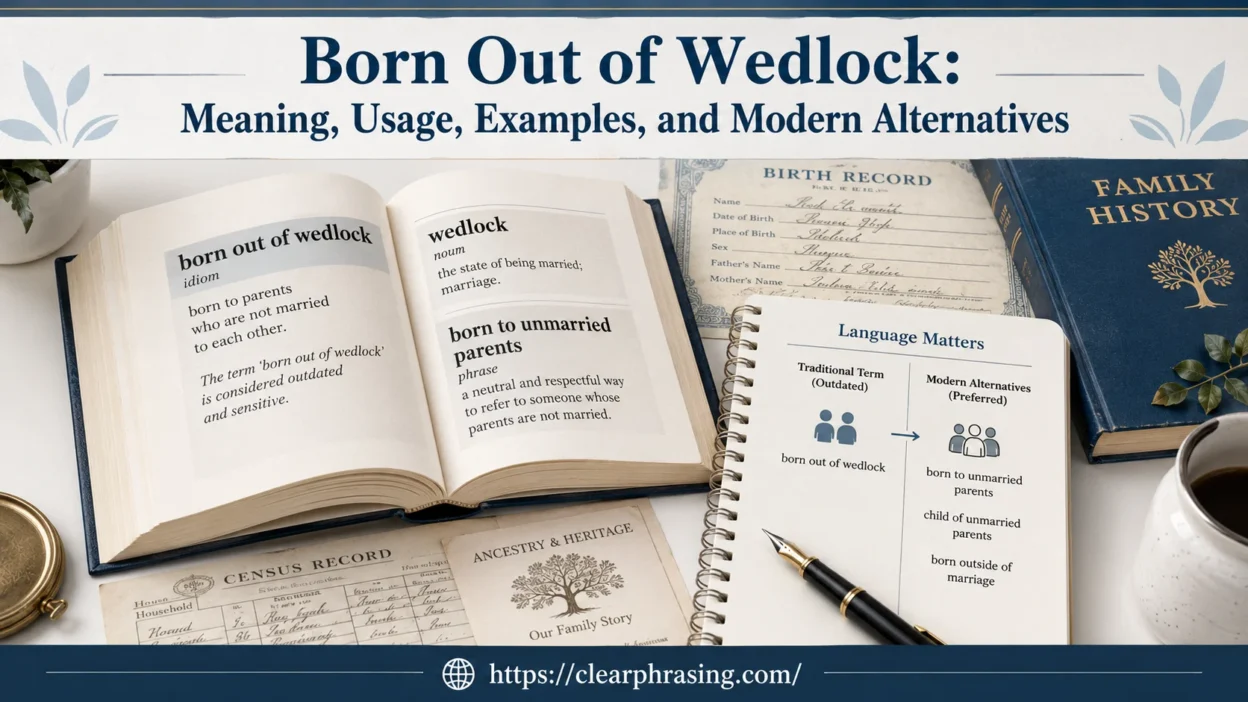
Born Out of Wedlock: Meaning, Usage, and Modern Alternatives explains a phrase used when a child is born to parents who are unmarried at the time of the birth.
This term has historical, cultural, social, and legal significance. Its meaning can also involve the conception of the child, although this point is sometimes debated. The opposite expressions are born in wedlock and born during wedlock.
In modern times, this terminology may carry stigma and sound outdated or offensive. Modern social perspectives and legal perspectives focus more on children’s well-being and rights than marital status.
In everyday contexts, modern alternatives such as “born to unmarried parents” often provide clearer, more respectful communication.
Quick Answer:
Born out of wedlock means born when the person’s parents were not married to each other.
For example:
“She was born out of wedlock in 1990.”
This sentence means that her parents weren’t married to each other when she was born.
The opposite expression is “born in wedlock,” which means that the parents were married when the child was born. Collins lists both expressions and classifies the construction as formal.
Quick comparison
| Phrase | Meaning |
| Born out of wedlock | Born while the parents weren’t married to each other |
| Born in wedlock | Born while the parents were married |
| Born to unmarried parents | A modern, neutral way to express the same basic fact |
| Born outside marriage | Another relatively neutral alternative |
One important detail matters here: the phrase describes the parents’ marital status at the time of birth. If the parents married later, that doesn’t change the literal meaning of the original statement.
What Does “Wedlock” Mean?
Wedlock simply means marriage or the state of being married.
Merriam-Webster traces the word to Middle English wedlok and Old English wedlāc, with its earliest recorded use dating to the 13th century.
Today, however, you rarely hear someone say “wedlock” in ordinary conversation. Dictionary.com notes that the word is rarely used by itself in modern English and appears most often in expressions such as “out of wedlock.”
That’s why the phrase can feel slightly dusty, like an old book pulled from a library shelf.
Consider these examples:
- “They entered into wedlock.” — very formal or old-fashioned
- “They got married.” — normal modern English
- “Their child was born out of wedlock.” — established but formal
- “Their child was born to unmarried parents.” — modern and neutral
Why Does “Wedlock” Sound Old-Fashioned?
The word has a long history tied to formal descriptions of marriage. Modern English usually favors simpler expressions such as marriage, married, and unmarried.
That doesn’t make wedlock incorrect. It simply affects its tone.
This distinction matters when you’re choosing words. Correct English isn’t always the same thing as the most natural English.
Is “Born Out of Wedlock” Correct English?
Yes. “Born out of wedlock” is a grammatically correct and established English expression.
Merriam-Webster identifies it as an idiom. Collins also recognizes “born out of wedlock” as a formal expression meaning that the parents weren’t married when the child was born.
You can use it in sentences such as:
- “He was born out of wedlock in 1975.”
- “The biography says she was born out of wedlock.”
- “The historical record identifies the child as born out of wedlock.”
- “His parents married several years after he was born out of wedlock.”
The grammar itself isn’t the problem. Tone and context are the bigger questions.
Is “Out of Wedlock” a Phrase or an Idiom?
“Born out of wedlock” is an established phrase and idiomatic expression.
Its meaning is still fairly literal, though. There isn’t a hidden metaphor behind it.
The structure works like this:
born + out of + wedlock
Here, “out of wedlock” functions as a phrase describing the circumstances surrounding the birth.
You can also encounter “out of wedlock” without “born”:
- “They had a child out of wedlock.”
- “She became pregnant out of wedlock.”
- “He fathered a child out of wedlock.”
The meaning centers on the fact that the parents weren’t married.
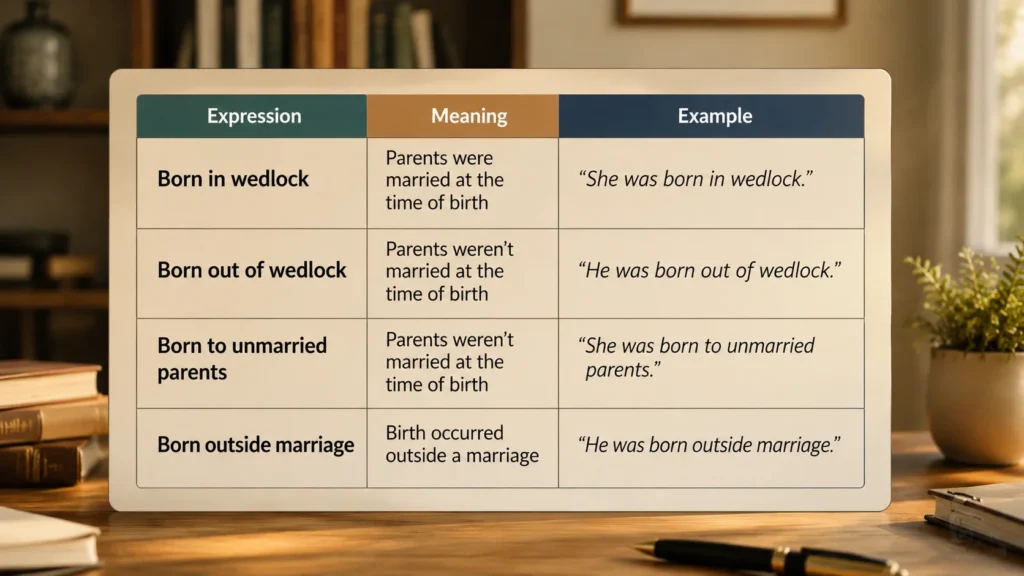
Born in Wedlock vs. Born Out of Wedlock
These expressions form a straightforward contrast.
Born in wedlock means the parents were married when the child was born.
Born out of wedlock means the parents weren’t married when the child was born.
| Expression | Meaning | Example |
| Born in wedlock | Parents were married at the time of birth | “She was born in wedlock.” |
| Born out of wedlock | Parents weren’t married at the time of birth | “He was born out of wedlock.” |
| Born to unmarried parents | Parents weren’t married at the time of birth | “She was born to unmarried parents.” |
| Born outside marriage | Birth occurred outside a marriage | “He was born outside marriage.” |
Example of “Born in Wedlock”
“The family records show that all three children were born in wedlock.”
This simply tells the reader that the parents were married when each child was born.
Example of “Born Out of Wedlock”
“The census records suggest that William was born out of wedlock.”
The sentence doesn’t necessarily tell you anything about the parents’ relationship beyond their marital status at the time.
That distinction is important. Being unmarried doesn’t automatically tell you whether the parents lived together, loved each other, separated later, or maintained a long-term relationship.
Is “Born Out of Wedlock” Offensive?
It can be sensitive or stigmatizing depending on the context.
The phrase isn’t inherently a slur. It remains a recognized English expression and appears in contemporary dictionaries and publications. However, it carries historical baggage because societies once attached significant social and legal consequences to births outside marriage.
Dictionary.com specifically notes criticism of “out of wedlock” because the phrase can stigmatize children and their unmarried parents.
That’s why modern writing often separates the fact from the judgment.
For example:
“She was born to unmarried parents.”
This describes the same basic circumstance without making marriage the implied standard against which the child’s birth is measured.
Is “Born Out of Wedlock” a Bad Term?
Not automatically.
A historian discussing an old document may need the phrase. A genealogist may encounter it in records. A dictionary article obviously needs to discuss it because the expression itself is the subject.
However, when writing about a living person in a modern context, “born to unmarried parents” will often sound more neutral.
The best choice depends on your purpose.
Born Out of Wedlock vs. Illegitimate
The expressions have historically overlapped, but they aren’t equally useful in modern writing.
Illegitimate has traditionally been used to describe someone born to parents who weren’t married to each other. Dictionary.com still records that definition.
Merriam-Webster’s definition of legitimate also preserves the historical legal sense of “lawfully begotten” and specifically connects it with being born in wedlock.
The problem with “illegitimate child” is easy to see. The word can sound as if the person themselves is somehow invalid or unlawful.
A more precise approach separates the person from the circumstance:
- Less neutral: “He was an illegitimate child.”
- More neutral: “He was born to unmarried parents.”
- Formal: “He was born out of wedlock.”
- Historical: “The record described him as illegitimate.”
The last example can be appropriate when you’re accurately reporting historical language.
Why “Illegitimate Child” Can Sound Harsh
Compare these two ideas:
“Born outside marriage” describes a circumstance.
“Illegitimate” can sound like a label attached to the person.
That difference is small grammatically but significant socially.
Language often becomes more respectful when it describes what happened rather than defining who someone is.
What Are Better Alternatives to “Born Out of Wedlock”?
If you want modern, neutral wording, several alternatives work well.
| Original phrase | Modern alternative | Tone |
| Born out of wedlock | Born to unmarried parents | Neutral |
| Child born out of wedlock | Child of unmarried parents | Neutral |
| Born out of wedlock | Born outside marriage | Formal/neutral |
| Illegitimate child | Child born to unmarried parents | Neutral |
| Illegitimate | Born outside marriage | Descriptive |
“Born to Unmarried Parents”
This is usually the clearest modern alternative.
“She was born to unmarried parents in Chicago.”
The sentence communicates the relevant fact without the historical baggage associated with “out of wedlock.”
“Born Outside Marriage”
This version also works:
“He was born outside marriage in 1988.”
It sounds formal but remains relatively neutral.
For academic, demographic, or policy writing, “nonmarital birth” may also appear.
How to Use “Born Out of Wedlock” in a Sentence
The phrase fits naturally after was born, were born, or similar constructions.
Simple Examples
- “He was born out of wedlock.”
- “She was born out of wedlock in 1972.”
- “The actor was born out of wedlock.”
- “Their daughter was born out of wedlock before they married.”
Formal Examples
- “Historical records indicate that the child was born out of wedlock.”
- “The biography notes that she was born out of wedlock.”
- “The parish register identifies the child as having been born out of wedlock.”
Genealogy Examples
- “The birth record suggests that Thomas was born out of wedlock.”
- “The researcher discovered that her great-grandmother had been born out of wedlock.”
- “The baptismal register identifies the mother but doesn’t name a father.”
Notice something important: the phrase doesn’t automatically establish paternity.
A record stating that a child was born outside marriage doesn’t prove who the biological father was. Historical documents can identify, omit, speculate about, or legally recognize a father in different ways.
Common Mistakes
Because the expression contains several prepositions, writers sometimes modify it incorrectly.
“Born Out the Wedlock”
Incorrect.
The established expression requires “of”:
“Born out of wedlock.”
“Born Out of a Wedlock”
This isn’t the normal established construction.
Use:
“Born out of wedlock.”
You don’t generally need “a” before “wedlock” because wedlock is an uncountable noun meaning the state of marriage.
“Born in Out of Wedlock”
Incorrect.
Don’t combine “in wedlock” and “out of wedlock.”
Choose one:
- born in wedlock
- born out of wedlock
“Born From Out of Wedlock”
This combination is unnecessarily awkward.
Use:
“Born out of wedlock.”
Simple wins here.
Can You Say “A Child Was Born Out of Wedlock”?
Yes.
The construction is grammatically correct:
“A child was born out of wedlock.”
You can also write:
“He was a child born out of wedlock.”
However, if the audience doesn’t need the formal expression, “a child born to unmarried parents” may read more naturally.
Compare:
“The biography describes him as a child born out of wedlock.”
with:
“The biography describes him as a child born to unmarried parents.”
Both communicate the basic fact. The second sounds more contemporary.
Can Parents Marry After a Child Is Born Out of Wedlock?
Yes.
A child can be born when the parents aren’t married and have parents who marry later.
For example:
- The child is born in January.
- The parents marry in June.
- The birth occurred before the marriage.
- Therefore, describing the birth as “out of wedlock” refers to the circumstances at the time of birth.
The later marriage doesn’t change the basic chronology.
However, legal consequences can differ by jurisdiction and historical period. Some legal systems have used marriage, acknowledgment of paternity, adoption, court orders, or other mechanisms to establish particular legal relationships.
That’s why linguistic meaning and legal status shouldn’t be treated as identical.
Does Being Born Out of Wedlock Affect Legal Rights?
This question requires more care than a simple yes or no.
Historically, children born outside marriage could face significant legal disadvantages. These included restrictions involving inheritance, property, parental recognition, and financial support.
Modern law has changed substantially in many jurisdictions. In the United States, courts and legislatures have removed many older distinctions between children born inside and outside marriage. For example, legal sources document the shift away from the traditional “legitimate” versus “illegitimate” classification.
Still, legal rules aren’t identical everywhere.
The relevant issue may involve:
- Paternity establishment
- Inheritance
- Child support
- Custody
- Guardianship
- Citizenship
- Estate planning
- Parental rights
So avoid writing a sweeping statement such as “children born out of wedlock have fewer legal rights.” That can be inaccurate without identifying a specific country, state, time period, and legal issue.
Historical Legal Case Study
Historical American law provides a useful example of how terminology and legal status changed.
In John M. v. Paula T. the Pennsylvania Supreme Court discussed older legal distinctions involving children born outside marriage. The court noted that Pennsylvania had already eliminated the legal distinction between “legitimate” and “illegitimate” children.
The case illustrates a larger point: legal language can change even when historical records continue to use older terminology.
That matters when reading genealogy records or researching family history. A historical label shouldn’t automatically be interpreted through today’s legal system.
Why Was Being Born Out of Wedlock Historically Significant?
For centuries, marriage wasn’t merely a private relationship. It could affect inheritance, property, family identity, social standing, and legal recognition.
As a result, the marital status of a child’s parents could matter greatly.
Historical records may therefore distinguish between children born within and outside marriage. Genealogists can encounter terms such as:
- Illegitimate
- Bastard
- Base-born
- Natural child
- Reputed father
These terms don’t all carry the same meaning in every historical setting.
The word “bastard,” in particular, once functioned as a legal and social term in historical contexts. Today, however, it is generally understood as offensive when used to label a person.
The safest approach to historical language is accuracy plus context.
If a historical document uses a particular term, report it when necessary. Don’t casually transfer its historical meaning into modern social or legal contexts.
Born Out of Wedlock in Genealogy and Family History
Genealogy is one area where this phrase can have practical value.
Suppose you’re researching a great-grandparent and find a birth record that lists the mother but doesn’t identify a father. That doesn’t necessarily mean the father was unknown forever. It simply means the particular record doesn’t establish him.
You might then examine:
- Birth certificates
- Baptismal registers
- Marriage records
- Census records
- Wills
- Probate documents
- Court records
- Newspaper notices
- Adoption records
- Later family documents
Historical terminology can also provide clues.
For example, a record may refer to a “reputed father.” That wording can indicate that a man was alleged or recognized as the father without necessarily providing the same legal certainty as modern documentation.
A Practical Genealogy Example
Imagine a 19th-century baptismal record reads differently from a later census record.
The baptismal record identifies a mother and uses historical language suggesting the child was born outside marriage. Twenty years later, a census lists a man with the same surname living in the household.
That later census entry may provide a research clue. It doesn’t automatically prove biological paternity.
Good genealogy works like detective work. One clue is useful. Several independent records are much stronger.
Is “Born Out of Wedlock” Still Used Today?
Yes.
The phrase remains recognizable and appears in contemporary dictionaries and published writing. Merriam-Webster continues to list it as an idiom, while Dictionary.com provides modern examples of “out of wedlock.”
The important distinction is between being understood and being preferred.
Readers will generally understand the phrase immediately. Yet a modern writer may choose different wording because it feels more neutral.
That’s especially true in writing about living people.
What Is the Most Respectful Way to Say “Born Out of Wedlock”?
For most modern contexts, “born to unmarried parents” is a strong choice.
It is direct. It avoids unnecessary judgment. Most importantly, it describes the parents’ marital status without making that status sound like a verdict on the child.
Use “born out of wedlock” when:
- You’re explaining the phrase itself.
- You’re discussing historical language.
- You’re quoting a historical document.
- You’re writing about legal terminology.
- The established expression fits the context.
Use “born to unmarried parents” when:
- You’re writing about a living person.
- You want a neutral contemporary tone.
- The marital status is relevant but shouldn’t become the focus.
- You’re writing for a broad general audience.
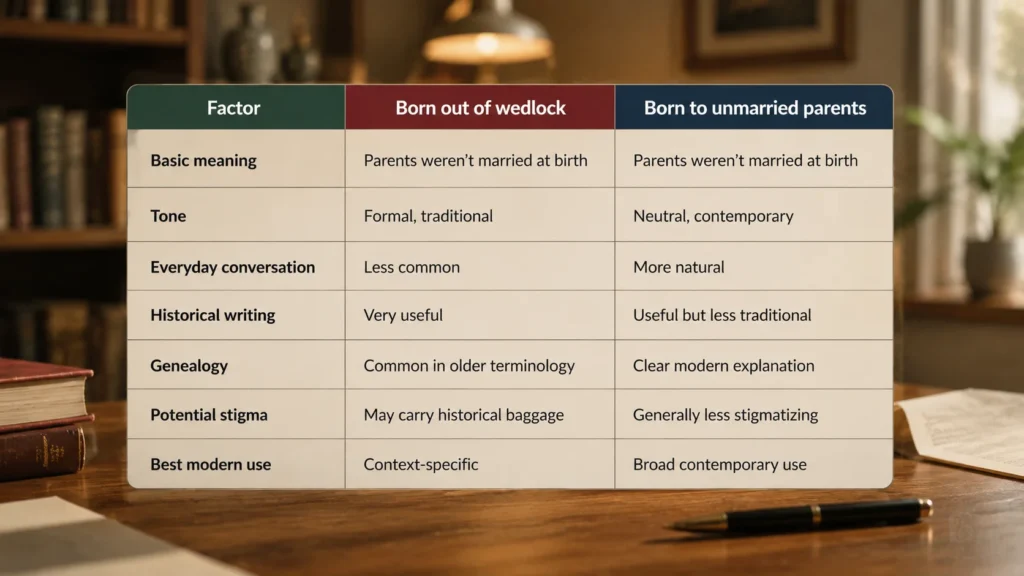
Born Out of Wedlock vs. Born to Unmarried Parents
The difference is mostly one of tone and context, not basic meaning.
| Factor | Born out of wedlock | Born to unmarried parents |
| Basic meaning | Parents weren’t married at birth | Parents weren’t married at birth |
| Tone | Formal, traditional | Neutral, contemporary |
| Everyday conversation | Less common | More natural |
| Historical writing | Very useful | Useful but less traditional |
| Genealogy | Common in older terminology | Clear modern explanation |
| Potential stigma | May carry historical baggage | Generally less stigmatizing |
| Best modern use | Context-specific | Broad contemporary use |
Neither expression changes the underlying historical fact.
The choice simply changes how that fact reaches the reader.
Case Study: Choosing the Right Phrase
Consider a biography about a person born in 1940.
A sentence might say:
“She was born out of wedlock in 1940.”
That’s perfectly understandable. It may even fit the historical tone of the biography.
But imagine a modern profile discussing the same person without any historical focus:
“She was born to unmarried parents in 1940.”
The second sentence feels less loaded. It gives readers the relevant information without drawing extra attention to marriage as a social standard.
Now imagine a historian quoting an old court document that explicitly calls the child “illegitimate.”
In that situation, changing the historical terminology could actually reduce accuracy.
The lesson is simple: don’t erase historical language when it matters, but don’t use dated labels unnecessarily when it doesn’t.
Key Insights
- “Born out of wedlock” means a child was born when the parents were not married to each other.
- The phrase is grammatically correct and well established, but its main issue is tone and context, not grammar.
- “Wedlock” means marriage, but the word sounds formal or old-fashioned in modern everyday English.
- “Born in wedlock” is the traditional opposite of “born out of wedlock.”
- The phrase can carry historical stigma, so it may sound sensitive or judgmental when describing a living person.
- “Born to unmarried parents” is generally the best modern, neutral alternative.
- “Illegitimate child” is more problematic because it can make the person sound “invalid” rather than simply describing the circumstances of their birth.
- Parents can marry after the child’s birth; that later marriage doesn’t change the fact that the child was born before they married.
- The phrase doesn’t establish paternity. A record saying a child was born outside marriage doesn’t automatically prove who the biological father was.
- Historical and legal contexts may still require older terminology, especially when quoting or interpreting historical records.
- The core lesson is: the meaning stays essentially the same, but the wording changes the tone. For modern general communication, “born to unmarried parents” is usually more respectful and natural.
Quick Practice
Fill in the blanks:
- He was born ___ wedlock.
- She was born ___ unmarried parents.
- The opposite is born ___ wedlock.
- Which is more neutral: born out of wedlock or born to unmarried parents?
Answers:
- out of
- to
- in
- born to unmarried parents
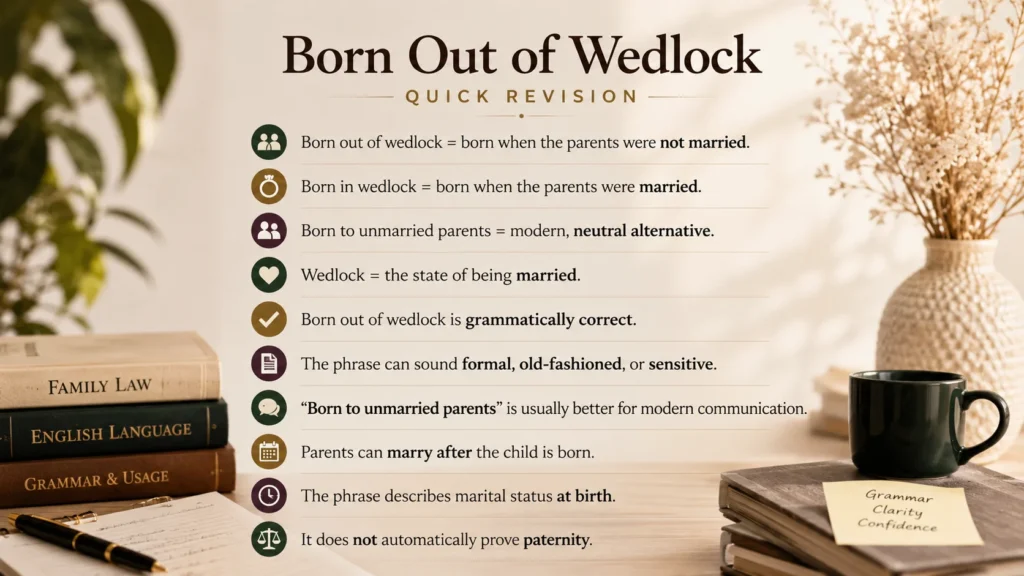
Quick Revision:
- Born out of wedlock = born when the parents were not married.
- Born in wedlock = born when the parents were married.
- Born to unmarried parents = modern, neutral alternative.
- Wedlock = the state of being married.
- Born out of wedlock is grammatically correct.
- The phrase can sound formal, old-fashioned, or sensitive.
- “Born to unmarried parents” is usually better for modern communication.
- Parents can marry after the child is born.
- The phrase describes marital status at birth.
- It does not automatically prove paternity.
Read More: Best Thing Since Sliced Bread: Meaning, Examples, and Usage
FAQs
What does “born out of wedlock” mean?
“Born out of wedlock” traditionally describes a child born to parents who weren’t married when the child was born. The phrase focuses on the parents’ marital status at the time of birth.
Is “born out of wedlock” still commonly used?
You may still encounter it in older books, legal records, historical discussions, and formal contexts. However, everyday speakers often choose more neutral wording today.
Is “born out of wedlock” offensive?
It can sound judgmental or outdated because of its historical association with social stigma. In sensitive situations, neutral alternatives such as “born to unmarried parents” are usually more appropriate.
What is the opposite of “born out of wedlock”?
The traditional opposites are “born in wedlock” and “born during wedlock.” Both indicate that the child’s parents were married when the child was born.
Does “born out of wedlock” refer to conception?
Usually, the expression refers to the parents’ marital status when the child was born. Whether it also covers the period of conception can depend on the context.
Can parents marry after their child is born?
Yes. Parents may marry after their child’s birth, but that later marriage doesn’t change the historical fact that the child was born before they were married.
What are modern alternatives to “born out of wedlock”?
“Born to unmarried parents” is a straightforward and neutral alternative. Depending on the situation, you can also simply say that the parents weren’t married when the child was born.
Why does the phrase have historical significance?
Marriage once carried stronger social and legal expectations surrounding childbirth. As attitudes and family structures changed, the language used to describe children born to unmarried parents also evolved.
Should I use “born out of wedlock” in formal writing?
That depends on your purpose. If you’re discussing history, law, literature, or the phrase itself, it may be appropriate. For general communication, a neutral alternative often works better.
Is “born out of wedlock” grammatically correct?
Yes, the phrase is grammatically correct. The issue isn’t grammar but tone, context, and modern usage. Choosing the right expression depends on what you want to communicate.
Conclusion
“Born out of wedlock” has a clear traditional meaning, but language doesn’t stand still. The phrase once appeared frequently in social, legal, and historical contexts because marriage strongly influenced how society viewed childbirth and family relationships. Today, however, many readers may see the expression as old-fashioned or judgmental.
When you’re explaining the phrase, teaching English, or discussing historical material, using it accurately is important. However, everyday communication often calls for more neutral wording. “Born to unmarried parents” communicates the same basic fact without carrying the same historical weight or stigma.
The best choice ultimately depends on context. Understanding both the traditional phrase and its modern alternatives helps you communicate with greater accuracy and sensitivity. Whether you encounter it in literature, legal writing, or ordinary conversation, knowing its meaning makes the expression much easier to understand.

Ayesha Siddiqa is an English specialist and professional content writer at ClearPhrasing.com. She is passionate about making the English language easy to understand through clear, accurate, and engaging content. Her expertise includes English grammar, spelling, vocabulary, punctuation, word usage, and writing techniques.
At ClearPhrasing.com, Ayesha creates well-researched, reader-friendly articles designed to help students, professionals, writers, and English learners strengthen their language skills. She focuses on providing practical explanations, real-world examples, and up-to-date guidance that readers can confidently apply in everyday communication.
Committed to accuracy and clarity, Ayesha ensures that every article meets high editorial standards and delivers reliable, easy-to-follow information that empowers readers to write and communicate with confidence.