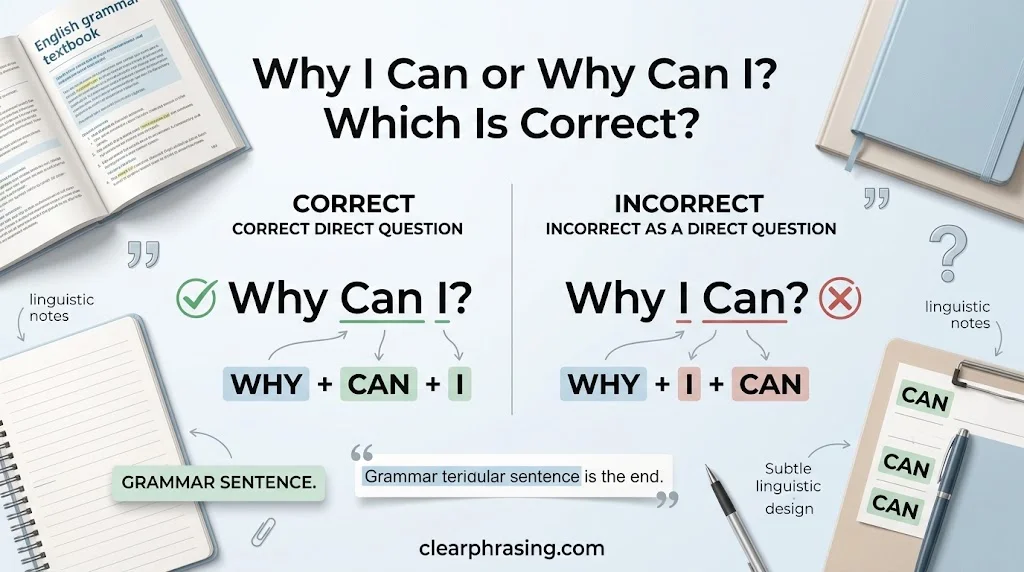
Why I Can or Why Can I? Which Is Correct? becomes easier when you understand word order, grammar, and sentence structure.
Why Can I forms a direct question, while Why I Can usually appears in an indirect question or statement. The correct usage depends on the context and intended meaning. In my teaching experience, English learners often feel confused because these phrases look similar. However, recognizing the subject, auxiliary verb, and main verb helps students understand the correct question form.
For example, Why Can I asks for a reason, while why I can introduces an explanation. Word order creates this structural difference, so careful practice improves clarity, confidence, and communication skills. A clear guide to direct questions, indirect questions, interrogative form, and declarative form helps learners avoid common mistakes.
With regular practice, students develop stronger grammatical accuracy, structural awareness, and practical English usage.
Quick Answer:
“Why can I…?” is correct when you’re asking a direct question.
Why can I use this feature?
Here, why begins the question, and the modal verb can comes before the subject I.
“Why I can…” is correct when the question becomes part of a larger sentence.
Can you explain why I can use this feature?
In this sentence, why I can use this feature is an embedded or indirect question. English keeps normal statement word order inside that structure.
The simplest rule is:
| Type | Correct structure | Example |
| Direct question | Why + can + I + verb? | Why can I leave early? |
| Indirect question | why + I + can + verb | Do you know why I can leave early? |
So, don’t treat “why I can” and “why can I” as interchangeable phrases. They perform different grammatical jobs.
Why Can I Is Correct in a Direct Question
The structure “Why can I…?” follows the normal pattern for direct questions with a modal verb.
The basic formula is:
Why + modal verb + subject + base verb?
With can, that becomes:
Why + can + I + base verb?
For example:
- Why can I enter this room?
- Why can I use this account?
- Why can I leave early?
- Why can I change the appointment?
- Why can I access this feature?
Notice what happens every time. Can comes before I.
That’s the key point.
Why Does Can Come Before I?
In a statement, the usual order is:
I can use this feature.
The subject I comes before the modal can.
When you turn the statement into a direct question, English generally reverses the positions of the subject and auxiliary or modal verb:
Can I use this feature?
When you add why, the question becomes:
Why can I use this feature?
The word why doesn’t remove the inversion. It simply introduces the question.
A Simple Word-Order Transformation
You can remember the pattern by looking at the transformation:
Statement:
I can leave early.
↓
Question:
Can I leave early?
↓
Why-question:
Why can I leave early?
This same pattern works with many modal verbs.
- Why should I wait?
- Why would I agree?
- Why could I refuse?
- Why must I explain?
- Why may I enter?
Once you recognize the pattern, “Why can I?” stops looking unusual.
Why I Can Is Correct in an Indirect Question
Here’s where things get interesting.
Although “Why I can?” isn’t normally correct as a standalone direct question, “why I can” can be completely grammatical inside a larger sentence.
Consider this example:
Can you explain why I can access the account?
The phrase why I can access the account is an embedded question. It doesn’t stand alone.
Compare the two structures:
Why can I access the account?
Can you explain why I can access the account?
The meaning remains closely related. The grammatical structure changes.
In the first sentence, you’re directly asking the question.
In the second, you’re asking someone to explain the reason for something.
More Examples of Why I Can
- Do you know why I can use this feature?
- I wonder why I can access the page.
- She explained why I can apply again.
- Can you tell me why I can change the settings?
- Nobody understands why I can open the file.
In each example, why I can belongs to a larger sentence.
That’s why saying “why I can” is always wrong would be inaccurate.
The Main Grammar Rule
The central rule is simple:
Direct questions use question word order. Indirect questions normally use statement word order.
That distinction explains almost everything about why I can vs why can I.
Direct Question Structure
A direct question with can usually follows this pattern:
Question word + can + subject + verb
For example:
Why can I enter?
When can I start?
Where can I park?
How can I fix this?
Indirect Question Structure
An indirect question usually follows this pattern:
Question word + subject + can + verb
For example:
Do you know why I can enter?
Can you tell me when I can start?
Do you know where I can park?
Could you explain how I can fix this?
The word order changes because the question no longer stands alone.
Why “Can You Tell Me Why Can I?” Is Incorrect
This mistake appears often because speakers combine two question patterns.
Someone may write:
Can you tell me why can I leave early?
That construction doesn’t follow standard English question order.
The correct version is:
Can you tell me why I can leave early?
Why?
Because “Can you tell me” already forms the main question. The phrase after it functions as an embedded question.
Think of the sentence as having two layers:
Main question:
Can you tell me…?
Embedded question:
why I can leave early
Put them together:
Can you tell me why I can leave early?
You don’t need to invert can again.
Another Clear Comparison
❌ Can you explain why can I access this page?
✅ Can you explain why I can access this page?
❌ Do you know why can I change the password?
✅ Do you know why I can change the password?
❌ Could you tell me why can I use this option?
✅ Could you tell me why I can use this option?
The embedded clause keeps the subject before the modal.
Direct and Indirect Questions
A side-by-side comparison makes the distinction easier to remember.
| Direct question | Indirect question |
| Why can I leave? | Do you know why I can leave? |
| Why can I enter? | Can you explain why I can enter? |
| Why can I use it? | I wonder why I can use it. |
| Why can I access the page? | She explained why I can access the page. |
| Why can I change the setting? | Do you know why I can change the setting? |
The first column contains standalone questions.
The second column contains questions embedded inside larger structures.
That’s the dividing line.
Why Can’t I Is Also Correct
Another phrase closely related to this topic is “Why can’t I…?”
This form is extremely common in everyday English.
Examples include:
- Why can’t I log in?
- Why can’t I change my password?
- Why can’t I open this file?
- Why can’t I park here?
- Why can’t I access the account?
Here, can’t is the contracted form of cannot.
The direct-question structure remains:
Why + can’t + subject + verb?
So:
Why can’t I log in?
is correct.
Why I Can’t Is Correct in an Indirect Question
Once again, the word order changes when the question becomes embedded.
Direct:
Why can’t I log in?
Indirect:
Do you know why I can’t log in?
Notice the shift:
Direct:
why + can’t + I
Indirect:
why + I + can’t
The negative doesn’t change the underlying rule.
Why Can I Not Is Also Grammatically Possible
You may also encounter:
Why can I not enter?
This sentence is grammatically acceptable. However, its tone can feel more formal or emphatic than the everyday:
Why can’t I enter?
Both can express the same basic idea.
| Form | Example | Typical feel |
| Why can’t I…? | Why can’t I enter? | Natural and conversational |
| Why can I not…? | Why can I not enter? | More formal or emphatic |
| Why cannot I…? | Why cannot I enter? | Generally unnatural in modern standard English |
The important point is that cannot doesn’t normally move ahead of the subject in a direct question.
Instead, standard question order gives you:
Why can I not enter?
In Real-World English
Grammar becomes easier when you see it in situations you might actually encounter.
At Work
Imagine an employee has access to a company document and wants to understand why.
Direct question:
Why can I access this document?
Indirect question:
Could you explain why I can access this document?
The first asks the question directly.
The second asks another person to explain it.
With Online Accounts
Suppose a website allows you to log in on one device but behaves differently on another.
You might ask:
Why can I log in on my phone?
If you’re asking support for an explanation, you might write:
Can you explain why I can log in on my phone but not my computer?
The grammar shifts naturally because the sentence structure shifts.
In a Classroom
A student might ask:
Why can I understand this example but not the next one?
A teacher might then say:
Let’s look at why you can understand one structure more easily than another.
The same words appear in different grammatical environments.
Why “Why I Can?” Doesn’t Work as a Standalone Question
A common temptation is to treat why like a normal statement opener.
You might think:
I can do this.
Therefore:
Why I can do this?
But English doesn’t form direct questions that way.
The question needs the appropriate inversion:
Why can I do this?
Compare it with another modal:
I should leave.
Direct question:
Why should I leave?
Not:
Why I should leave?
However, why I should leave becomes correct when embedded:
I don’t understand why I should leave.
The same principle applies to can.
Other Modal Verbs Follow the Same Pattern
The distinction isn’t unique to can. Other modal verbs follow similar patterns.
Should
Direct:
Why should I wait?
Indirect:
Do you know why I should wait?
Could
Direct:
Why could I not enter?
Indirect:
She explained why I could not enter.
Would
Direct:
Why would I agree?
Indirect:
I don’t know why I would agree.
Must
Direct:
Why must I leave?
Indirect:
Can you explain why I must leave?
This gives you a useful shortcut. When you learn the direct-versus-indirect question rule, you can apply it far beyond why can I.
Can “Why I Can” Start a Sentence?
Yes, but context matters.
The phrase why I can can appear at the beginning of a sentence when it isn’t functioning as a standalone direct question.
For example:
Why I can finish the project so quickly is easy to explain.
Here, why I can finish the project so quickly functions as a clause.
Another example:
Why I can help you today is simple.
You can also see it after phrases such as this is why:
This is why I can finish the task today.
And:
That’s why I can help.
These aren’t direct questions.
Therefore, the issue isn’t whether the sequence why I can can appear in English. It absolutely can.
The real question is what grammatical role does it play?
Common Mistakes
A few mistakes appear repeatedly.
Mistake 1: Using Statement Order in a Direct Question
❌ Why I can use this?
✅ Why can I use this?
The first sentence uses statement order.
The second uses direct-question order.
Mistake 2: Inverting an Embedded Question
❌ Can you tell me why can I use this?
✅ Can you tell me why I can use this?
The first sentence incorrectly applies direct-question inversion inside an indirect question.
Mistake 3: Assuming “Why I Can” Is Always Wrong
❌ Treating every occurrence of why I can as a grammatical error.
That approach ignores embedded questions and other clauses.
Correct:
I wonder why I can access the account.
Correct:
She explained why I can apply again.
Mistake 4: Treating Both Forms as Interchangeable
You can’t simply swap the two forms whenever you want.
Why can I leave?
is a direct question.
Why I can leave?
isn’t the standard way to form that direct question.
However:
Do you know why I can leave?
is correct.
Context controls the word order.
A Quick Test for Choosing the Right Form
When you’re unsure, ask yourself one question:
Am I asking the question directly?
If yes, use:
Why can I…?
If another phrase introduces the question, such as “Do you know,” “Can you explain,” “Could you tell me,” or “I wonder,” you usually need:
why I can…
Try These Examples
Direct question:
___ I change the appointment?
Answer:
Why can I change the appointment?
Indirect question:
Can you explain why ___ change the appointment?
Answer:
Can you explain why I can change the appointment?
Direct question:
___ I access this page?
Answer:
Why can I access this page?
Indirect question:
Do you know why ___ access this page?
Answer:
Do you know why I can access this page?
The pattern becomes much easier once you identify the sentence type first.
A Practical Comparison
| Phrase | Correct? | Where to use it | Example |
| Why can I…? | Yes | Direct question | Why can I enter? |
| Why I can…? | Yes, in the right structure | Embedded clause | I know why I can enter. |
| Why I can? | No, normally | Not a standard direct question | ❌ Why I can enter? |
| Why can’t I…? | Yes | Direct negative question | Why can’t I enter? |
| Why I can’t…? | Yes | Embedded negative question | Do you know why I can’t enter? |
| Why can I not…? | Yes | Direct negative question | Why can I not enter? |
This table captures the central rule without turning it into a memorization exercise.
Why Direct and Indirect Questions Matter
The difference isn’t just an academic grammar rule.
You’ll encounter these structures in emails, business communication, customer support, classrooms, formal writing, and everyday conversations.
A misplaced auxiliary can make an otherwise clear sentence sound awkward.
For example, compare:
Can you tell me why can I access the account?
with:
Can you tell me why I can access the account?
The second version follows standard English word order and sounds natural to fluent speakers.
In professional communication, small grammatical choices matter because they affect clarity and confidence.
Case Study: Asking a Customer Support Team
Imagine you’re contacting a website because your account behaves differently from another user’s.
A direct question might be:
Why can I access this feature when my colleague can’t?
Now suppose you want customer support to investigate the issue.
You might write:
Could you explain why I can access this feature while my colleague can’t?
The underlying idea stays the same. The sentence structure changes.
This is exactly why understanding direct and indirect questions is more useful than simply memorizing which phrase “sounds right.”
Case Study: Asking for an Explanation Politely
Direct questions can sound perfectly natural:
Why can I leave early?
But in some situations, you may prefer a softer or more indirect structure:
Could you explain why I can leave early?
The indirect structure doesn’t simply change the word order. It can also make the request feel less abrupt.
That distinction becomes especially useful in workplace conversations, formal emails, and customer-service communication.
Quick Grammar Checklist
Before choosing the phrase, check these points:
- Are you asking a direct question? Use why can I.
- Is the question embedded in another sentence? Use why I can.
- Does “do you know” introduce the question? Use normal statement order afterward.
- Does “can you explain” introduce the question? Keep the subject before the modal.
- Are you asking about inability or restriction? Consider why can’t I.
- Are you writing a formal or emphatic negative question? Why can I not…? may work.
- Don’t use “why I can?” as a standalone direct question.
Read More: Born Out of Wedlock: Meaning, Usage, and Modern Alternatives
FAQs
1. Is “Why Can I?” grammatically correct?
Yes, “Why can I?” is grammatically correct when you’re asking a direct question about a reason or possibility. For example, “Why can I see the mountains from here?” follows normal English question structure.
The auxiliary verb can comes before the subject I. This word order signals that you’re asking a question rather than making a statement.
2. Is “Why I Can” grammatically correct?
Yes, but “why I can” usually doesn’t work as a complete question by itself. It normally appears inside a longer sentence, where it introduces a reason or explanation.
For example, “I’ll explain why I can do it” is correct. Here, why I can forms part of the larger sentence rather than standing alone.
3. What is the main difference between “Why Can I?” and “Why I Can”?
The main difference is word order and sentence function. Why can I usually introduces a direct question, while why I can generally appears within a statement or indirect structure.
Think of it this way: direct questions often use auxiliary verb + subject, while statements and embedded clauses usually keep subject + verb order.
4. Can “Why I Can” start a sentence?
It can, although it usually needs more words to make the sentence complete and natural. For example, “Why I can succeed is easy to understand” is grammatically possible, although a different structure may sound more natural in everyday English.
More commonly, you’ll see why I can inside a sentence such as “She knows why I can help.” The surrounding words give the phrase its complete meaning.
5. Should I say “Why can I do this?” or “Why I can do this?”
If you’re directly asking for a reason, say “Why can I do this?” If you’re explaining or reporting the reason, “why I can do this” fits inside a larger sentence.
For example, “Why can I do this?” asks a question. “I understand why I can do this” gives information about the reason.
6. Why does English change the word order in questions?
English often changes word order to show that a sentence is a question. With can, the auxiliary verb moves before the subject in a direct question.
That’s why we say “Why can I leave?” rather than “Why I can leave?” The second pattern can still be correct when it appears inside a larger statement.
7. Is “Why Can I?” always a complete question?
Not always. “Why can I?” can be complete when the missing action is already obvious from the conversation. For instance, if someone asks, “Can you leave early?” you might respond, “Why can I?” depending on the intended meaning.
However, adding the main verb usually makes the question clearer: “Why can I leave early?” Clear wording prevents unnecessary confusion.
8. Can “Why I Can” be used in indirect questions?
Yes. This is one of the most useful places to understand the difference. An indirect question usually keeps normal statement word order after the question word.
For example, “I don’t understand why I can’t join” uses why I can’t correctly. You wouldn’t normally change it to “why can’t I” because the phrase is embedded inside a larger sentence.
9. Which form sounds more natural in everyday English?
It depends on what you’re trying to say. If you’re asking someone directly, “Why can I…?” will usually sound natural and correct.
If you’re explaining a reason or referring to a question indirectly, “why I can…” is often the better choice. The surrounding sentence determines which structure works.
10. How can I remember the difference easily?
Use a simple rule: direct question = “Why can I?” and embedded statement or indirect question = “why I can.” Then look at what comes before and after the phrase.
For example, “Why can I use this?” is a direct question. “She explained why I can use this” is an embedded structure. Once you notice this pattern in real sentences, the difference becomes much easier to remember.
Conclusion
The difference between “Why Can I?” and “Why I Can” may look tiny, but that small change in word order affects the entire sentence. Why can I normally introduces a direct question, where the auxiliary verb can comes before the subject I. Why I can, on the other hand, usually appears within a longer sentence as part of an explanation or indirect structure. Understanding this distinction helps you build clearer sentences instead of relying on how a phrase sounds.
With regular practice, this pattern becomes much easier to recognize. Pay attention to whether you’re asking a direct question or explaining something inside a larger sentence. Once that purpose becomes clear, choosing between “Why can I?” and “why I can” feels far more natural. A little attention to word order can make your English more accurate, confident, and polished.

Mehwish Imtiaz is an English specialist and professional blog writer at ClearPhrasing.com. She specializes in grammar, spelling, vocabulary, punctuation, and writing improvement. With a strong passion for clear communication and language education, she creates reader-friendly articles that help students, professionals, and English learners understand complex language topics with ease.
Her writing focuses on accuracy, simplicity, and practical usage, ensuring that every article provides clear explanations and real-world examples. At ClearPhrasing.com, Mehwish is committed to publishing well-researched, original content that helps readers write more confidently and communicate more effectively in everyday and professional English.