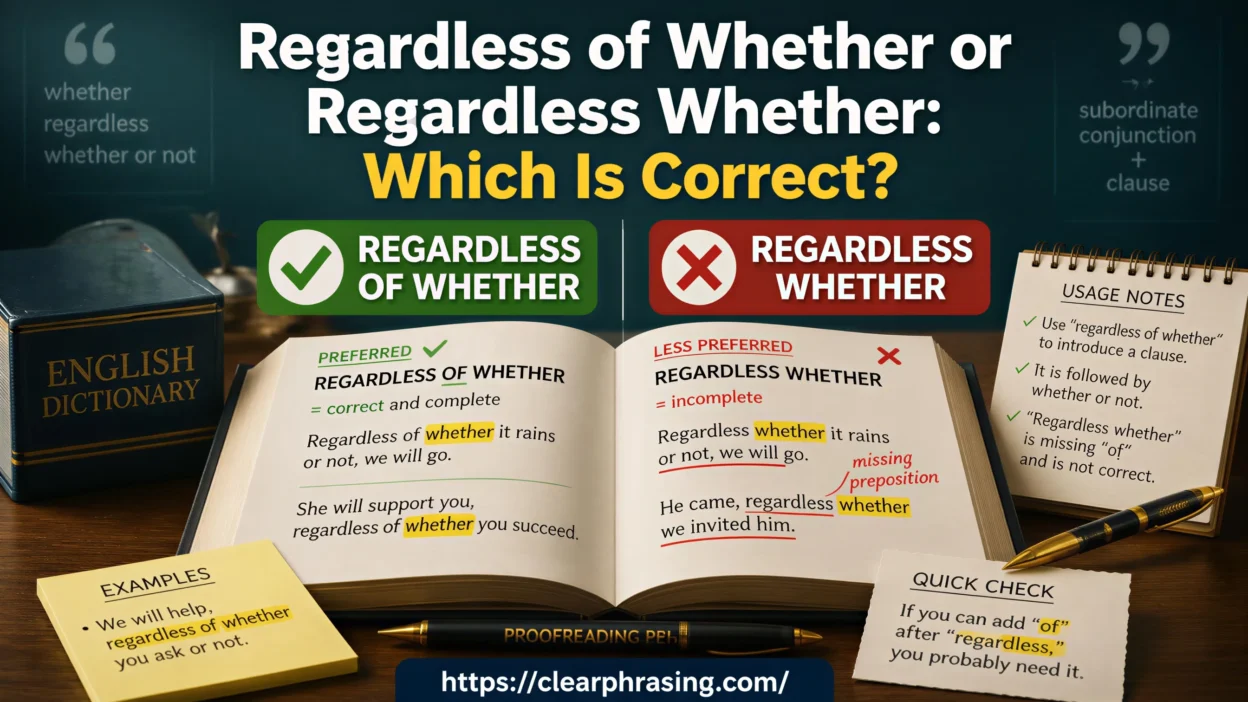
When comparing Regardless of Whether or Regardless Whether: Which Is Correct?, regardless is the widely accepted adverb in standard English.
It means without regard or consideration and has established roots in the English language. Irregardless is a non-standard blend of irrespective and regardless. Although it has gained informal traction, careful English usage favors regardless.
For language learners, the phrase Regardless of Whether is the correct phrase. It means something will happen or remain true, no matter what something else does. For example, “I will go to the park regardless of whether it rains or not.” Regardless Whether is often used in informal speaking or writing,
but Regardless of Whether remains the safer choice in formal settings.
Quick Answer:
Use “regardless of whether” in most situations, especially in formal and professional American English.
The phrase means that something remains true no matter which possibility applies.
Regardless of whether it rains, we’ll go hiking.
This means that rain won’t change the decision.
“Regardless whether” can be found in real English and is understandable. However, it is considerably less common in contemporary standard usage and may sound awkward or nonstandard to some readers. Garner’s usage guidance recommends replacing it with regardless of whether.
| Expression | Meaning | Practical recommendation |
| Regardless of whether | No matter which possibility is true | Preferred |
| Regardless whether | Essentially the same meaning | Less preferred |
| Regardless | No matter what / despite the circumstances | Correct when context is clear |
| Whether or not | In either case | Useful alternative |
| Regardless of whether or not | No matter whether something happens | Grammatically possible but often wordy |
If you’re unsure, remember one simple rule:
Keep the “of”: regardless of whether.
What Does “Regardless of Whether” Mean?
The phrase regardless of whether means no matter whether or without being affected by which possibility is true.
Consider this sentence:
Regardless of whether she agrees, we’ll continue with the plan.
There are two possible situations:
- She agrees.
- She doesn’t agree.
Neither possibility changes the outcome. The plan continues.
That’s the central idea behind regardless of whether. The expression introduces a condition or possibility that doesn’t affect the main action or conclusion.
For example:
We’ll hold the meeting regardless of whether everyone attends.
The sentence doesn’t say everyone will attend. Instead, it says attendance won’t change the decision to hold the meeting.
You can think of regardless as a shield around the main decision. Whatever happens inside the condition, the outcome stays the same.
The Basic Structure of “Regardless of Whether”
The most useful pattern is:
regardless + of + whether + clause
For example:
She’ll apply regardless of whether the position is still available.
We’ll finish the project regardless of whether the client approves the changes.
He plans to travel regardless of whether his friends join him.
The part after whether normally contains a clause with a subject and verb.
That structure makes the relationship between the condition and the main statement easy to understand.
Why Is “Regardless of Whether” Preferred?
The preference comes partly from the established construction regardless of.
The word regardless can work on its own as an adverb:
She continued regardless.
However, when you identify what the person or action remains unaffected by, regardless of provides the normal construction:
She continued regardless of the criticism.
She continued regardless of the circumstances.
She continued regardless of whether anyone supported her.
In the final example, whether anyone supported her supplies the condition. The preposition of connects that condition to regardless.
Bryan Garner’s usage guidance calls regardless of whether the idiomatic form and recommends it instead of regardless whether.
That recommendation matters most when your writing needs to sound polished and conventional.
“Regardless” and “Regardless of” Don’t Always Work the Same Way
The word regardless can stand alone when the surrounding context already makes the meaning obvious.
The weather looks terrible, but we’re going regardless.
Here, the listener already understands what the speaker means.
Now compare it with:
We’re going regardless of whether it rains.
The second version spells out the condition.
This distinction gives you a useful editing tool. If the condition matters to the reader, state it. If the context already supplies it, regardless may be enough.
Is “Regardless Whether” Grammatically Correct?
This question needs a more careful answer than simply saying “yes” or “no.”
Regardless whether exists in published English. It isn’t an unintelligible phrase, and historical evidence shows that the construction has been used for a long time. Language Log’s discussion of the issue even points out that older English sometimes used regardless whether more frequently than regardless of whether.
However, frequency and acceptability aren’t the same thing.
Modern standard American usage strongly favors regardless of whether. Language Log documented a striking difference in The New York Times: its search found 64 instances of regardless whether compared with 52,800 instances of regardless of whether during the period examined.
That difference doesn’t prove that every occurrence without of is grammatically impossible. It does show how strongly modern usage favors the longer construction.
So the practical answer is straightforward:
“Regardless whether” is found in English, but “regardless of whether” is the better choice for careful modern American writing.
Why You Still See “Regardless Whether” in Published Writing
Language isn’t a perfectly organized rulebook. Writers inherit expressions from earlier generations, regional varieties develop independently, and common phrases change over time.
The history of this particular construction makes the situation even more interesting. Language Log notes that regardless of whether appears to have become much more common during the last century.
That means today’s preferred form isn’t necessarily the form English speakers have always used.
This is an important lesson about grammar: current standard usage and historical usage aren’t always identical.
A form can have genuine historical roots while still being a poor choice for contemporary formal writing.
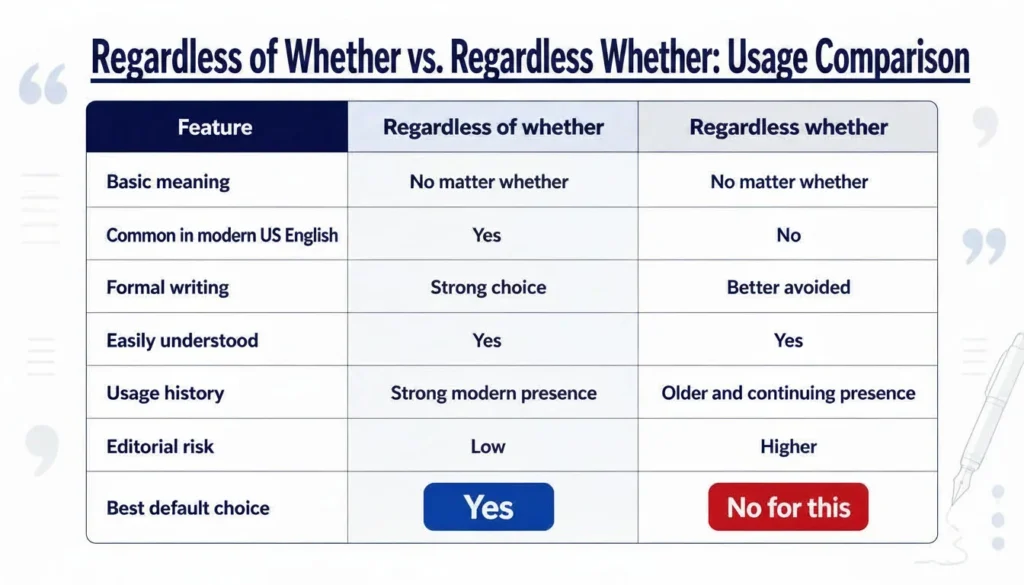
“Regardless of Whether” vs. “Regardless Whether”
The two expressions generally communicate the same basic idea. The major difference involves usage preference, not meaning.
| Feature | Regardless of whether | Regardless whether |
| Basic meaning | No matter whether | No matter whether |
| Common in modern US English | Yes | No |
| Formal writing | Strong choice | Better avoided |
| Easily understood | Yes | Yes |
| Usage history | Strong modern presence | Older and continuing presence |
| Editorial risk | Low | Higher |
| Best default choice | Yes | No |
If you’re writing for a broad audience, there’s little reason to create uncertainty. Choose the form readers are most likely to recognize as standard:
Regardless of whether
That small of costs nothing. It can save you from an unnecessary grammar debate.
Examples of “Regardless of Whether” in Sentences
Seeing the phrase in different settings makes the pattern much easier to remember.
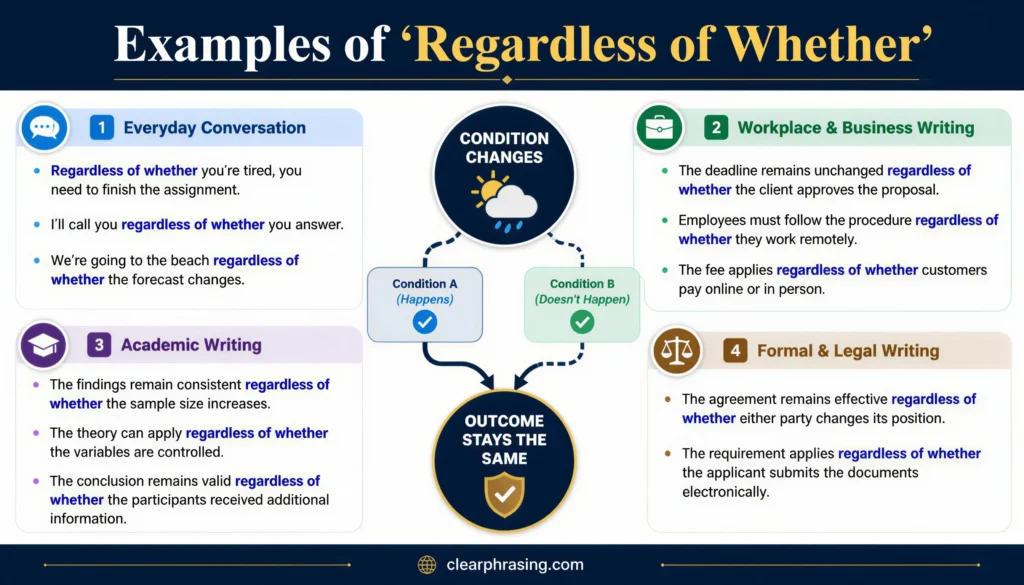
Everyday Conversation
Regardless of whether you’re tired, you need to finish the assignment.
I’ll call you regardless of whether you answer.
We’re going to the beach regardless of whether the forecast changes.
In casual conversation, speakers may shorten these sentences. Still, the full construction remains natural and clear.
Workplace and Business Writing
Professional communication often benefits from precise wording.
The deadline remains unchanged regardless of whether the client approves the proposal.
Employees must follow the procedure regardless of whether they work remotely.
The fee applies regardless of whether customers pay online or in person.
These sentences make the relationship between the condition and the outcome explicit.
Academic Writing
Academic prose often needs to describe situations that don’t alter a conclusion.
The findings remain consistent regardless of whether the sample size increases.
The theory can apply regardless of whether the variables are controlled.
The conclusion remains valid regardless of whether the participants received additional information.
Here, the phrase helps establish a logical relationship. The condition changes, but the conclusion doesn’t.
Formal and Legal Writing
Formal documents also frequently need to establish that an obligation or rule applies under multiple circumstances.
The agreement remains effective regardless of whether either party changes its position.
The requirement applies regardless of whether the applicant submits the documents electronically.
The value here is clarity. Formal writing has little room for ambiguity.
Examples of “Regardless Whether” and Their Better Alternatives
You may encounter sentences such as:
Regardless whether the company agrees, the policy will remain in effect.
The meaning is clear. However, many editors would revise it:
Regardless of whether the company agrees, the policy will remain in effect.
Here’s another:
Regardless whether he attends, we’ll begin at noon.
Better:
Regardless of whether he attends, we’ll begin at noon.
And another:
Regardless whether the price increases, customers will continue buying the product.
Preferred:
Regardless of whether the price increases, customers will continue buying the product.
The important point isn’t that readers suddenly become unable to understand the first versions. They don’t. The issue is conventional usage.
When two constructions convey the same meaning and one enjoys overwhelming preference in contemporary standard writing, choosing the conventional form usually makes sense.
“Regardless of Whether” vs. “Regardless of Whether or Not”
Another common question involves or not.
Consider:
We’ll go regardless of whether it rains.
This sentence already means that the decision won’t change if it rains.
You can also write:
We’ll go regardless of whether it rains or not.
The second sentence is understandable and grammatically possible. However, or not often adds words without adding much information.
Garner’s usage guidance specifically notes that when regardless is already present, adding or not can become redundant.
So this is usually cleaner:
Regardless of whether it rains, we’ll go.
Rather than:
Regardless of whether or not it rains, we’ll go.
When “Or Not” Adds Useful Emphasis
Sometimes or not deliberately emphasizes the two possibilities.
For example:
The rule applies whether you agree or not.
Here, or not makes the contrast explicit and gives the sentence a firmer tone.
However, when regardless already carries the idea of “no matter what,” you should consider whether those extra words actually help.
Good writing isn’t about removing every longer phrase. It’s about keeping words that earn their place.
Can You Say “Regardless of If”?
This construction causes another layer of confusion:
Regardless of if he agrees, we’ll proceed.
Many speakers understand it. However, regardless of whether is the cleaner and more established choice when you’re introducing alternatives or uncertainty.
Compare:
Regardless of whether he agrees, we’ll proceed.
Regardless of if he agrees, we’ll proceed.
The first sentence sounds more natural in careful English.
The word whether works particularly well because it directly signals alternatives or uncertainty. It doesn’t force the reader to interpret if as either a conditional marker or a way of presenting two possibilities.
For polished writing, use:
regardless of whether
rather than:
regardless of if
“Regardless of Whether” vs. “Whether or Not”
These expressions can overlap in meaning, but their sentence structures differ.
We’ll leave regardless of whether she arrives.
We’ll leave whether she arrives or not.
Both sentences communicate essentially the same outcome.
Sometimes whether or not sounds more direct:
We’ll go whether it rains or not.
Other times regardless of whether fits more naturally into a longer sentence:
The policy applies regardless of whether the customer submits the request online.
The best choice depends on the sentence around it.
| Expression | Example | Main effect |
| Regardless of whether | We’ll proceed regardless of whether they agree. | Highlights an unaffected outcome |
| Whether or not | We’ll proceed whether they agree or not. | Highlights the two possibilities |
| Regardless | We’ll proceed regardless. | Shortest option when context is clear |
Common Mistakes
Dropping “Of” in Formal Writing
The most common issue is replacing:
Regardless of whether
with:
Regardless whether
Although the shorter form appears in real English, regardless of whether is the safer standard choice.
Using “Regardless If”
This can create structural and meaning problems.
Regardless if she calls, we’ll leave.
Prefer:
Regardless of whether she calls, we’ll leave.
Adding Unnecessary “Or Not”
This isn’t necessarily wrong, but it can make an already long construction heavier.
Regardless of whether or not they approve the plan…
Often becomes:
Regardless of whether they approve the plan…
Shorter doesn’t automatically mean better. In this case, however, the shorter version usually says everything you need.
Confusing “Whether” With “Weather”
This mistake changes the meaning completely.
Whether introduces alternatives or uncertainty:
I don’t know whether she’ll come.
Weather refers to atmospheric conditions:
The weather looks terrible.
A useful memory trick is simple: weather has the word weather you experience outside.
Treating Every Grammar Question as a Strict Right-or-Wrong Rule
This particular debate demonstrates why usage deserves nuance.
Some grammar questions have a clear answer. Others involve standard preference, historical usage, regional variation, and changing conventions.
“Regardless whether” falls into the second category.
That doesn’t mean you should use it freely in formal writing. It means you should understand why the recommendation exists.
How to Use “Regardless of Whether” in Formal Writing
When the audience includes editors, teachers, clients, employers, or academic readers, conventional wording gives you an advantage.
Use regardless of whether when you want to express an outcome that won’t change despite two possible conditions.
It works well in:
- Academic papers
- Business reports
- Professional emails
- Formal essays
- Technical documentation
- Policies and procedures
- Research writing
- Legal and administrative documents
For example:
The procedure must be followed regardless of whether the equipment appears operational.
That’s direct. There’s no need for the reader to stop and wonder whether the missing of was intentional.
A Simple Way to Choose the Right Version
When you’re editing a sentence, ask one question:
Am I saying that the outcome won’t change no matter whether something happens?
If yes, regardless of whether will usually work.
For example:
The event will continue regardless of whether the speaker arrives on time.
If the condition is already obvious, you can simplify:
The event will continue regardless.
If you want a more direct alternative, try:
The event will continue whether the speaker arrives on time or not.
This gives you three useful choices without creating unnecessary complexity.
A Practical Style Guide
Keep these rules handy:
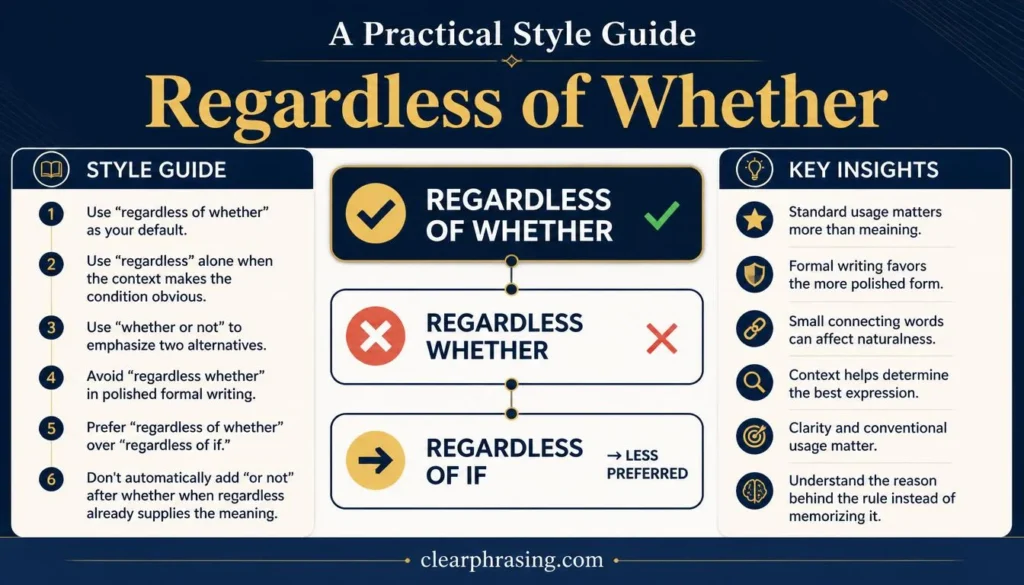
- Use “regardless of whether” as your default.
- Use “regardless” alone when the context makes the condition obvious.
- Use “whether or not” when you want to emphasize two alternatives.
- Avoid “regardless whether” in polished formal writing.
- Prefer “regardless of whether” over “regardless of if.”
- Don’t automatically add “or not” after whether when regardless already supplies the meaning.
Key Insights
- The main distinction is about standard usage, not meaning.
- One form is more suitable for formal writing, while the shorter version can still appear in real-world English.
- A small connecting word can affect how natural and polished a sentence sounds.
- Context matters when deciding whether the longer expression is necessary.
- Good English usage involves understanding both current conventions and how language changes over time.
- When two forms communicate the same idea, choosing the more widely accepted version can make your writing clearer and more professional.
- The best way to remember a usage point is to understand the reason behind it, rather than memorizing it as an isolated rule.
- Focus on clarity and conventional usage, not just word count.
My Personal Experience
As an English teacher and language specialist, I’ve noticed that students often choose words and phrases based on how they sound rather than how they function in a sentence.
In my classroom, learners sometimes leave out small words such as “of” because the shorter form feels natural in everyday speech. When teaching expressions like “regardless of whether,” I explain how the structure works instead of asking students to memorize it. This approach helps them understand why one form is preferred and recognize similar patterns in other sentences.
Over the years, I’ve found that students become more confident when grammar rules are connected to real communication. I often give them practical examples from formal writing, professional communication, and everyday conversations so they can see how word choice affects clarity. My experience has taught me that even a small word can make a sentence sound more polished and accurate.
Once learners understand the reason behind a usage rule, they’re much more likely to apply it correctly instead of simply trying to remember which version sounds right.
chage
Test Yourself
Complete each sentence with regardless of whether, regardless whether, or whether or not.
- ______ you agree with the decision, we must follow the rules.
- I’ll finish the assignment ______ I feel tired.
- She plans to attend the event ______ her friends join her.
- ______ the weather improves, the match will continue as planned.
- You can contact me ______ you need help.
Answer Key
- Regardless of whether
- regardless of whether
- regardless of whether
- Regardless of whether
- whether or not
Remember: Use regardless of whether you want to show that the final result won’t change despite different possibilities.
Read More: From Pillar to Post: Meaning, Origin, Examples, and Usage
FAQs
1. Is “Regardless of Whether” grammatically correct?
Yes. Regardless of whether is grammatically correct and widely accepted in standard English. It introduces a situation that doesn’t change the outcome, even when the circumstances may differ.
2. Is “Regardless Whether” correct?
Regardless whether appears in everyday speech and informal writing, but many style guides and language experts prefer regardless of whether. For formal writing, the longer form is the safer choice.
3. What does “regardless of whether” mean?
It means no matter whether something happens or is true. For example, “I’ll attend the meeting regardless of whether my colleague comes” means the speaker will attend in either situation.
4. Why do we use “of” in “regardless of whether”?
The word of forms the standard construction regardless of. When this phrase is followed by a clause beginning with whether, “regardless of whether” creates a clear grammatical structure.
5. Can I use “regardless of whether” in formal writing?
Absolutely. It works well in academic writing, business communication, professional emails, reports, and other formal contexts. It’s a clear and established expression.
6. Is “regardless of whether or not” correct?
Yes, regardless of whether or not is grammatically acceptable. However, or not is often unnecessary because whether can already express the two possible conditions.
7. What is the difference between “regardless” and “irregardless”?
Regardless is the standard word. Irregardless is generally considered nonstandard and is best avoided in formal English, even though some speakers use it informally.
8. Does “regardless of whether” mean “no matter if”?
In many sentences, yes. Both expressions can show that the result remains unchanged. For example, “I’ll go regardless of whether it rains” has essentially the same meaning as “I’ll go no matter if it rains.”
9. Can “regardless of whether” begin a sentence?
Yes. You can place it at the beginning when you want to emphasize the condition. For example: “Regardless of whether you agree, the decision has been made.”
10. Which form should English learners choose?
English learners should choose regardless of whether, especially in formal writing and professional communication. It follows the standard construction and avoids the uncertainty that regardless whether can sometimes create.
Conclusion
Choosing between regardless of whether and regardless whether is easier when you focus on standard usage and sentence structure. Regardless of whether is the preferred choice because it sounds natural, clear, and polished in both everyday and formal English. It works especially well in academic papers, professional messages, reports, and other situations where careful wording matters.
Regardless whether can still appear in conversations and published writing, and most readers will understand its meaning. However, it’s less common in contemporary standard English, so using it may make your sentence sound less conventional. If you want a reliable option, keeping of in the expression is the simplest approach. You can also use whether or not when that structure fits your sentence better.
As an English teacher and language specialist, I’ve found that learners remember grammar more effectively when they understand the reason behind a usage preference. Instead of memorizing isolated rules, look at how the expression connects ideas. When in doubt, choose regardless of whether for clear, confident, and professional writing.

Ayesha Siddiqa is an English specialist and professional content writer at ClearPhrasing.com. She is passionate about making the English language easy to understand through clear, accurate, and engaging content. Her expertise includes English grammar, spelling, vocabulary, punctuation, word usage, and writing techniques.
At ClearPhrasing.com, Ayesha creates well-researched, reader-friendly articles designed to help students, professionals, writers, and English learners strengthen their language skills. She focuses on providing practical explanations, real-world examples, and up-to-date guidance that readers can confidently apply in everyday communication.
Committed to accuracy and clarity, Ayesha ensures that every article meets high editorial standards and delivers reliable, easy-to-follow information that empowers readers to write and communicate with confidence.