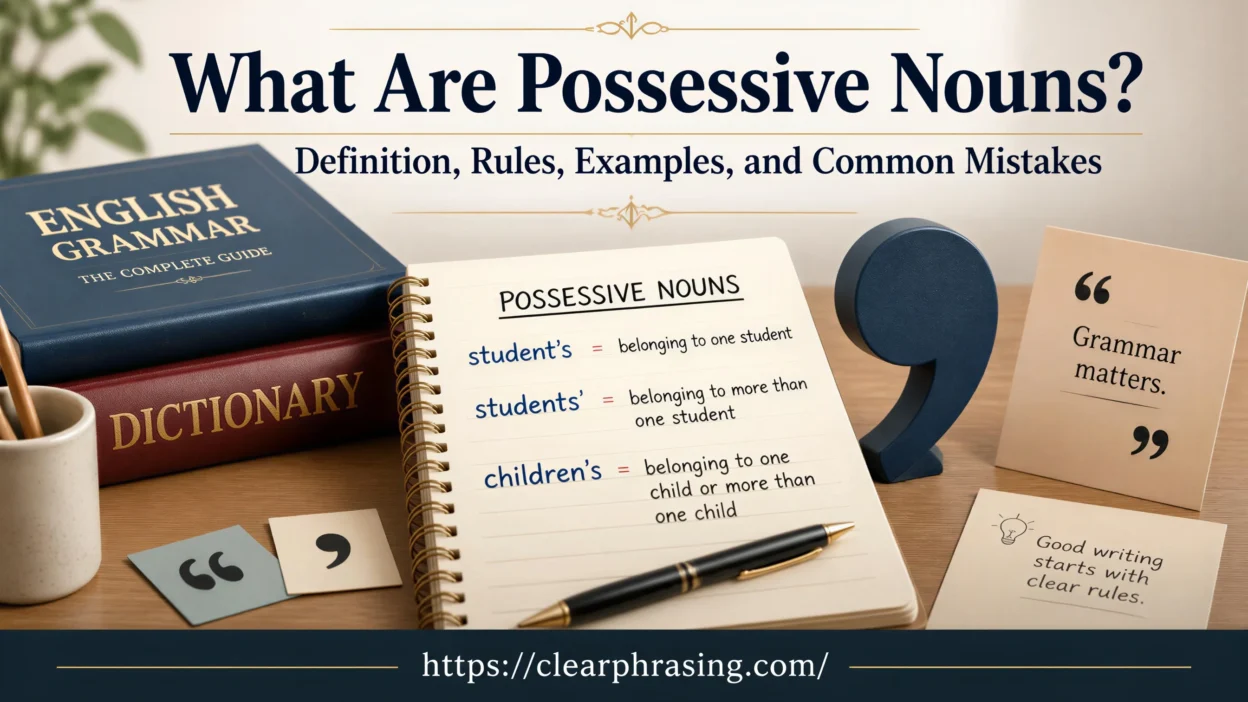
English Possessive Noun Rules: Definition, and Common Mistakes become easier when you understand possession, ownership, and the possessive form.
A possessive noun shows who or what something belongs to. In English grammar, an apostrophe + s often marks possession. For example, John’s brother means the brother of John.The possessive case, also called the Saxon Genitive, comes from Old English grammar.
When teaching English learners, I often see students struggle with this possessive construction. They may use an of construction when an apostrophe would sound more natural. Understanding this grammatical form improves clear communication.A singular noun usually takes ‘s, as in dog’s leash. A plural noun ending in s normally takes an apostrophe, as in dogs’ park.
A plural noun without s takes ‘s, as in children’s toys. These patterns help show noun ownership clearly.Correct apostrophe placement also prevents writing mistakes, grammar errors, and common mistakes. In my teaching experience, students remember the rule better when they ask who owns what.
This simple question helps make sentence meaning, sentence structure, and English writing much clearer.
Quick Answer:
A possessive noun is a noun that shows ownership, belonging, relationship, association, or another connection between one noun and another word.
Examples include:
- the boy’s bicycle — the bicycle belongs to one boy
- the teachers’ room — the room is associated with several teachers
- children’s books — books intended for or associated with children
- Maria’s sister — a family relationship
- today’s meeting — a connection with time
The basic rules are:
| Type of noun | Possessive form | Example |
| Singular noun | Add ’s | the girl’s bag |
| Regular plural ending in s | Add ’ | the girls’ bags |
| Irregular plural | Add ’s | the children’s bags |
| Singular name ending in s | Generally add ’s | James’s car |
The key point is simple: an apostrophe doesn’t automatically make a noun plural. In possessive nouns, it marks a relationship between words.
What Is a Possessive Noun?
A possessive noun modifies another noun to show ownership, belonging, association, or another meaningful connection.
Consider these examples:
- David’s phone
- the cat’s tail
- the company’s policy
- the student’s answer
In David’s phone, the possessive noun David’s tells you whose phone you’re talking about.
However, possession doesn’t always mean legal ownership.
For example, Emma’s brother shows a family relationship. Emma doesn’t own her brother. Likewise, the building’s entrance identifies an entrance associated with the building.
Possessive nouns can express:
- Ownership
- Family relationships
- Personal connections
- Association
- Characteristics
- Time
- Measurement
- Membership or affiliation
This broader meaning explains why possessive nouns appear so often in everyday English.
How Do You Form Singular Possessive Nouns?
For most singular nouns, form the possessive by adding ’s.
Examples:
- dog → dog’s
- teacher → teacher’s
- student → student’s
- company → company’s
- house → house’s
In sentences:
- The dog’s collar was hanging by the door.
- The teacher’s desk was covered with papers.
- The company’s website received thousands of visitors.
- The student’s answer showed careful reasoning.
The noun remains singular. The ’s creates its possessive form.
| Singular noun | Possessive form | Example |
| boy | boy’s | the boy’s jacket |
| woman | woman’s | the woman’s purse |
| teacher | teacher’s | the teacher’s notes |
| company | company’s | the company’s office |
| bird | bird’s | the bird’s wing |
A useful question is “Whose?”
Whose jacket?
→ The boy’s jacket.
Whose office?
→ The manager’s office.
How Do You Form Plural Possessive Nouns?
Regular plural nouns that already end in s usually take only an apostrophe.
Examples:
- students → students’
- teachers → teachers’
- players → players’
- dogs → dogs’
- customers → customers’
Compare these sentences:
The student’s book is on the desk.
This refers to one student.
The students’ books are on the desk.
This refers to multiple students.
That tiny apostrophe shift changes the meaning.
| Plural noun | Possessive form | Example |
| students | students’ | students’ assignments |
| teachers | teachers’ | teachers’ meeting |
| players | players’ | players’ uniforms |
| customers | customers’ | customers’ complaints |
| workers | workers’ | workers’ rights |
You don’t write students’s or teachers’s. Because these regular plurals already end in s, add only the apostrophe.
How Do You Form Irregular Plural Possessive Nouns?
Some plural nouns don’t end in s. These include children, men, women, people, and mice.
When these nouns become possessive, add ’s.
Examples:
- children → children’s
- men → men’s
- women → women’s
- people → people’s
- mice → mice’s
For example:
- The children’s playground was renovated.
- The women’s team won the championship.
- The men’s locker room is downstairs.
- The decision reflected the people’s concerns.
- The mice’s nest was hidden behind the wall.
| Plural noun | Possessive form | Example |
| children | children’s | children’s clothing |
| women | women’s | women’s clothing |
| men | men’s | men’s shoes |
| people | people’s | people’s opinions |
| mice | mice’s | the mice’s nest |
The easiest pattern to remember is:
Plural ending in s → add an apostrophe
Plural not ending in s → add ’s
What Do Possessive Nouns Show Besides Ownership?
The term possessive can be misleading because these nouns don’t always indicate literal ownership.
They can describe several different relationships.
Possessive Nouns for Family and Personal Relationships
Examples include:
- John’s sister
- Maria’s friend
- the child’s mother
- Robert’s teacher
These forms identify relationships rather than ownership.
Maria’s friend means a friend connected with Maria.
The child’s mother identifies the mother in relation to the child.
Possessive Nouns for Association
Possessive nouns can show that something relates to an organization, place, or group.
Examples include:
- the school’s rules
- the company’s employees
- the university’s library
- the country’s economy
- New York’s museums
A company doesn’t physically own every employee. The possessive form establishes a clear association.
Possessive Nouns for Characteristics
Possessive constructions can also identify characteristics or attributes.
Examples:
- the dog’s behavior
- the machine’s design
- the company’s reputation
- the child’s personality
The relationship doesn’t need to involve physical ownership.
Possessive Nouns for Time and Measurement
Possessive forms can express time, duration, distance, or measurement.
Examples include:
- a day’s work
- an hour’s drive
- two weeks’ notice
- three years’ experience
- a month’s salary
Consider this sentence:
We need two weeks’ notice.
The two weeks don’t own the notice. The possessive construction expresses the relationship between the period and the amount of notice.
Compare:
- one week’s vacation
- two weeks’ vacation
The rule remains consistent.
One week is singular → week’s
Two weeks is plural and ends in s → weeks’
Possessive Nouns With Names Ending in S
Names ending in s can create uncertainty.
In standard American English, a singular proper name ending in s generally takes ’s.
Examples:
- James’s car
- Charles’s house
- Chris’s phone
- Lucas’s jacket
For example:
James’s presentation begins at nine.
Some editorial styles use only an apostrophe with certain names ending in s. However, ’s is a consistent choice in standard American English.
Whatever style you follow, consistency matters.
Joint Possession vs. Separate Possession
When two people appear in a possessive construction, apostrophe placement can show whether they share something or possess separate things.
Joint Possession
If two people share the same thing, generally make only the final name possessive.
Sarah and David’s house is large.
This means they share one house.
Another example:
Tom and Lisa’s business has expanded rapidly.
The business belongs to both Tom and Lisa.
Separate Possession
If each person possesses something separately, make both names possessive.
Sarah’s and David’s cars are parked outside.
This suggests Sarah has one car and David has another.
| Meaning | Correct form | Explanation |
| One house shared by Sarah and David | Sarah and David’s house | They share the house. |
| Separate houses | Sarah’s and David’s houses | Each person has a house. |
| One business shared by Tom and Lisa | Tom and Lisa’s business | They share one business. |
| Separate businesses | Tom’s and Lisa’s businesses | They own separate businesses. |
Possessive Nouns vs. Plural Nouns
One of the most common errors involves confusing plural nouns with possessive nouns.
A plural noun tells you that there is more than one.
A possessive noun shows a relationship.
Compare:
- dog → one dog
- dogs → more than one dog
- dog’s → something associated with one dog
- dogs’ → something associated with multiple dogs
Consider these examples:
The dogs are outside.
This tells you there are multiple dogs.
The dog’s owner arrived.
This tells you the owner is associated with one dog.
The dogs’ owners arrived.
This indicates that the owners are associated with multiple dogs.
| Form | Meaning | Example |
| dogs | plural | The dogs barked. |
| dog’s | singular possessive | The dog’s leash broke. |
| dogs’ | plural possessive | The dogs’ leashes broke. |
A simple test helps:
Does the word simply mean “more than one”?
If yes, you probably need a plural noun without an apostrophe.
Does it show whose, what belongs to, or what is associated with something?
If yes, you probably need a possessive form.
Possessive Nouns vs. Possessive Pronouns
Possessive nouns aren’t the same as possessive pronouns.
Compare:
- Sarah’s book → possessive noun
- her book → possessive determiner
- The book is hers → possessive pronoun
Possessive pronouns include:
- mine
- yours
- his
- hers
- ours
- theirs
These forms don’t use apostrophes.
Correct:
This book is mine.
Incorrect:
This book is mine’s.
Likewise:
The decision is theirs.
Not:
The decision is their’s.
Possessive Nouns vs. “Of” Phrases
English can express similar relationships with possessive nouns and of phrases.
Compare:
- the teacher’s desk
- the desk of the teacher
Both can communicate the relationship. However, the first sounds much more natural in everyday English.
Possessive nouns often work particularly well with:
- people
- animals
- relationships
- organizations
- places
- time expressions
Examples:
- Maria’s idea
- the dog’s collar
- the company’s strategy
- today’s schedule
An of phrase can sometimes improve clarity when the possessor is long or complicated.
The choice depends on meaning, readability, and natural English usage.
Possessive Nouns in Compound Expressions
Compound nouns can also become possessive.
Examples include:
- my sister-in-law’s car
- the editor-in-chief’s decision
- the attorney general’s statement
Consider:
My sister-in-law’s car needs repairs.
The complete compound noun sister-in-law identifies the possessor. Therefore, the possessive marker appears at the end.
Possessive Nouns With Organizations, Countries, and Places
Possessive forms frequently appear with organizations, countries, and locations.
Examples include:
- the company’s employees
- the school’s principal
- America’s economy
- New York’s museums
- the university’s library
These forms usually communicate association rather than literal ownership.
For example:
The university’s library closes at midnight.
The university doesn’t “own” the library in the same everyday sense that a person owns a phone. The possessive structure identifies the library’s connection with the university.
Common Mistakes
Using an Apostrophe to Make a Plural
Incorrect:
The student’s are waiting.
Correct:
The students are waiting.
The apostrophe is unnecessary because students is simply a plural noun.
Confusing Singular and Plural Possessives
Incorrect:
The students book is missing.
Correct:
The student’s book is missing.
This refers to one student’s book.
For multiple students:
The students’ books are missing.
Writing “Childrens’”
Incorrect:
childrens’ toys
Correct:
children’s toys
Children is already an irregular plural and doesn’t end in s.
Writing “Teachers’s”
Incorrect:
the teachers’s room
Correct:
the teachers’ room
Teachers is a regular plural ending in s, so it needs only an apostrophe.
Confusing “Its” and “It’s”
Its is possessive.
The company changed its policy.
It’s means it is or it has.
It’s a useful policy.
Use the substitution test. If you can replace it’s with it is or it has, the contraction works.
It’s raining.
→ It is raining.
But:
The dog wagged its tail.
You can’t replace its with it is.
Adding an Apostrophe to Possessive Pronouns
Incorrect:
This book is your’s.
Correct:
This book is yours.
Possessive pronouns such as yours, hers, ours, and theirs don’t use apostrophes.
In Everyday English
Possessive nouns appear everywhere, from school assignments to business documents.
School
- the student’s assignment
- the teacher’s instructions
- the students’ desks
- the children’s books
At Work
- the manager’s office
- the company’s policy
- employees’ responsibilities
- the customer’s request
At Home
- my brother’s room
- the dog’s food
- my parents’ house
- the baby’s blanket
In Schedules and Planning
- today’s meeting
- tomorrow’s appointment
- next week’s schedule
- two days’ notice
Because possessive nouns appear so frequently, incorrect apostrophe placement can make otherwise polished writing look careless.
How to Identify a Possessive Noun
When you’re unsure whether a noun is possessive, follow these steps.
Find the noun. Look for the noun containing the apostrophe.
Ask what relationship it expresses. Does it show ownership, association, relationship, time, or measurement?
Determine whether the noun is singular or plural. This tells you which possessive pattern to consider.
Check whether the plural ends in “s.” That determines whether you use ’s or s’.
For example:
The players’ uniforms were clean.
Players is plural.
It ends in s.
Therefore, the possessive form is players’.
Examples in Complete Sentences
Here are examples covering the major patterns:
- The girl’s backpack was under the chair.
- The teacher’s explanation was easy to follow.
- The students’ projects filled the hallway.
- The children’s playground needs repairs.
- The women’s team practiced every morning.
- James’s laptop is on the desk.
- We received two weeks’ notice.
- It was a day’s journey from the village.
- Sarah and Mark’s house overlooks the lake.
- Sarah’s and Mark’s cars are parked outside.
- The company’s reputation improved.
- The dog’s behavior changed suddenly.
- Today’s meeting starts at ten.
- The employees’ concerns deserve attention.
- The school’s principal announced the decision.
Key Insights
- Possessive nouns identify a connection between two parts of a sentence, not just physical ownership.
- The position of the apostrophe changes the intended meaning, especially with singular and plural forms.
- Singular forms and irregular plurals follow different patterns, so identifying the base form first makes the choice easier.
- The same structure can express relationships, affiliation, duration, association, and other connections.
- Apostrophes should not be added simply because a word refers to more than one person or thing.
- Names that end with s can follow different editorial preferences, so maintaining one style throughout a piece is important.
- Shared and individual relationships require different apostrophe positions.
- Short expressions involving periods of time often use possessive patterns even when no literal ownership exists.
- Possessive nouns should be distinguished from related grammatical forms that do not take apostrophes.
- A practical way to check the correct form is to identify the relationship first, then determine whether the base noun is singular, regular plural, or irregular plural.
- Many errors happen because writers focus on the apostrophe itself rather than the relationship it represents.
- Understanding the meaning behind the form is more useful than memorizing isolated examples.
Quick Comparison
| Noun type | Rule | Example |
| Singular | Add ’s | student’s |
| Regular plural ending in s | Add ’ | students’ |
| Irregular plural | Add ’s | children’s |
| Singular name ending in s | Generally add ’s | James’s |
| Joint possession | Add possessive ending to final name | John and Mary’s |
| Separate possession | Make each noun possessive | John’s and Mary’s |
Test Your Understanding
Choose the correct form.
The ___ toys were scattered across the floor.
- child’s
- children’s
- childrens’
Answer: children’s
The ___ lounge is on the second floor.
- teachers
- teacher’s
- teachers’
Answer: teachers’
___ car is parked outside.
- James
- James’
- James’s
Answer: James’s in standard American English.
We received three ___ notice.
- weeks
- week’s
- weeks’
Answer: weeks’
The ___ collar was too tight.
- dog
- dogs
- dog’s
Answer: dog’s
The collar belongs to or is associated with one dog.
Quick Revision
- Possessive nouns indicate a link between two terms.
- First identify the related parties.
- Check whether the first term represents one or several.
- Regular plural forms ending in s follow a separate pattern.
- Irregular plural forms require another pattern.
- A mark placed incorrectly can alter the intended sense.
- More than one does not automatically require an apostrophe.
- Shared connections and individual connections may need different placement.
- Expressions involving duration can follow the same grammatical pattern.
- Related grammatical categories should not be treated alike.
- Consistency matters when following editorial conventions.
- Focus on meaning first, then choose the appropriate form.
Read More: Sank or Sunk: Correct Spelling, Meaning, and Difference
FAQs
What is a possessive noun?
A possessive noun shows ownership, belonging, or association. It tells the reader who owns something or who something is connected to. For example, Sarah’s book means the book belongs to Sarah.
You usually form a singular possessive noun by adding ’s. For instance, the teacher’s desk means the desk belongs to the teacher. The apostrophe helps readers understand the relationship between the two nouns.
How do you make a singular noun possessive?
For most singular nouns, add ’s to the end. Examples include the boy’s bicycle, the company’s policy, and the dog’s collar. This rule applies even when the singular noun already ends in s.
For example, you can write James’s car when following the common modern style. Some style guides may use James’ car, so consistency matters.
How do you make a plural noun possessive?
If a plural noun already ends in s, add only an apostrophe. For example, students’ books means the books belong to multiple students. Similarly, teachers’ lounge refers to a lounge used by several teachers.
If the plural noun does not end in s, add ’s. Therefore, we write children’s clothes, men’s shoes, and women’s rights.
Is “John’s brother” correct?
Yes, John’s brother is correct when you mean the brother who belongs to or is related to John. The possessive form makes the relationship direct and natural.
You can also say the brother of John, but that structure often sounds less natural in everyday English. In most ordinary contexts, John’s brother is the smoother choice.
What is the difference between possessive nouns and possessive pronouns?
A possessive noun uses an apostrophe to show ownership, as in Maria’s phone. The noun Maria changes into a possessive form because it identifies the owner.
A possessive pronoun replaces the noun phrase entirely. Words such as mine, yours, his, hers, ours, and theirs can stand alone: “That phone is hers.”
Do all possessive nouns use an apostrophe?
No. Possessive nouns generally use an apostrophe, but possessive pronouns do not. For example, the boy’s hat contains an apostrophe, while his hat does not.
This distinction causes many mistakes. Remember that its is possessive, while it’s means “it is” or “it has.” The apostrophe changes the grammatical function.
What is the difference between “dogs,” “dog’s,” and “dogs’”?
Dogs is simply the plural of dog. It means more than one dog. Dog’s is singular possessive and means something belongs to one dog.
Dogs’ is plural possessive. It means something belongs to multiple dogs. For example, the dog’s bowl refers to one dog, while the dogs’ bowls refers to several dogs.
When should I use “of” instead of a possessive noun?
Both structures can express relationships, but English speakers often prefer possessive nouns with people, animals, organizations, and time expressions. For example, my sister’s car sounds more natural than the car of my sister.
The of structure works especially well with many objects and longer descriptions. For example, the roof of the house sounds natural, while the house’s roof may sound less natural depending on the context.
What are the most common possessive noun mistakes?
Common mistakes include putting the apostrophe in the wrong place, confusing singular and plural possessives, and using it’s instead of its. Writers also sometimes add unnecessary apostrophes to ordinary plurals.
A useful check is to identify the owner first. Then decide whether that owner is singular or plural. This simple habit can prevent many possessive noun errors in academic, professional, and everyday writing.
Why are possessive noun rules important?
Possessive noun rules make relationships between words clear. Without the correct form, a sentence can become confusing or even change meaning. Compare the student’s assignment with the students’ assignment.
Once you understand the basic patterns, possessives become much easier to use. The key is to focus on who owns what and place the apostrophe according to whether the noun is singular or plural.
Conclusion
Possessive nouns may look like a small part of English grammar, but they play an important role in clear writing. A simple apostrophe can show whether something belongs to one person, several people, or another noun. Learning these patterns helps you avoid awkward phrases and makes your sentences sound more natural.
The basic rules are easier than they first appear. Use ’s with most singular nouns, use an apostrophe after s for regular plural possessives, and use ’s with irregular plurals such as children and men. Always pay attention to the difference between a plural noun and a possessive noun.
From my experience teaching English, students usually improve once they stop trying to memorize every example and start asking one simple question: Who owns what? That question gives you a practical way to choose the correct possessive form and use apostrophes with confidence.

Ayesha Siddiqa is an English specialist and professional content writer at ClearPhrasing.com. She is passionate about making the English language easy to understand through clear, accurate, and engaging content. Her expertise includes English grammar, spelling, vocabulary, punctuation, word usage, and writing techniques.
At ClearPhrasing.com, Ayesha creates well-researched, reader-friendly articles designed to help students, professionals, writers, and English learners strengthen their language skills. She focuses on providing practical explanations, real-world examples, and up-to-date guidance that readers can confidently apply in everyday communication.
Committed to accuracy and clarity, Ayesha ensures that every article meets high editorial standards and delivers reliable, easy-to-follow information that empowers readers to write and communicate with confidence.