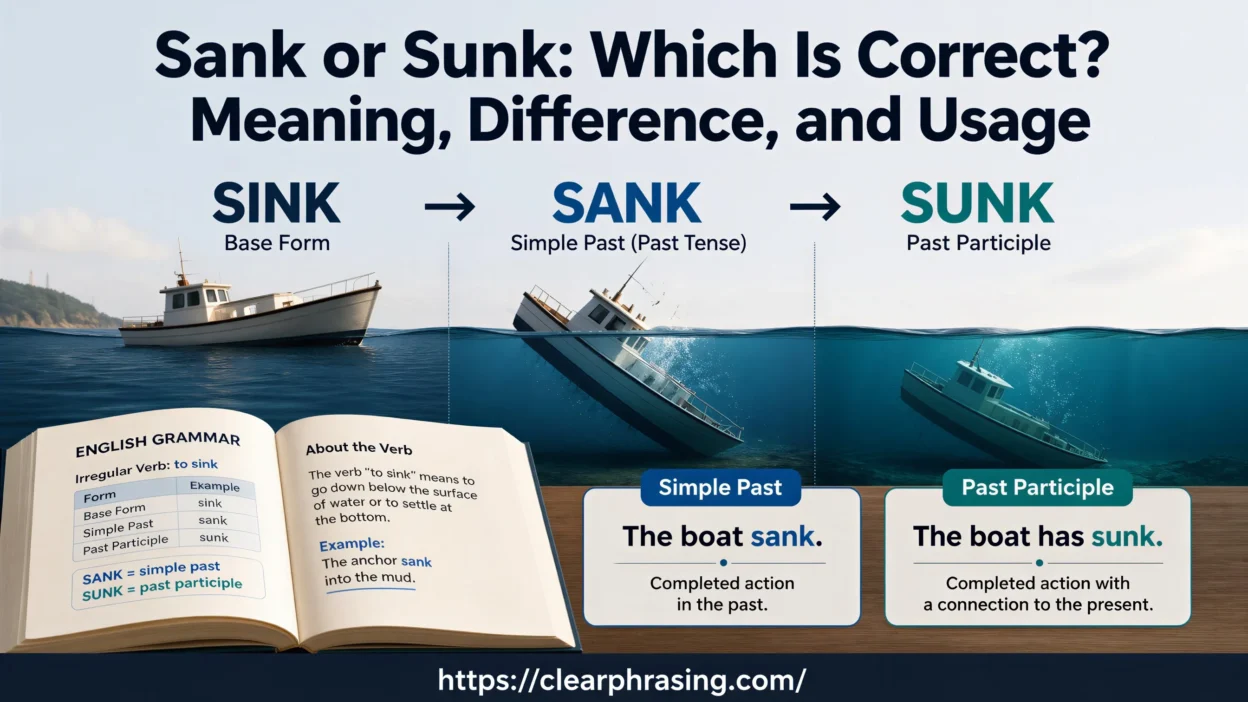
Sank or Sunk: Correct Spelling, Meaning, and Difference is easier to understand when you know their different grammar roles.
Sank is the past tense and simple past tense of sink, while sunk is the past participle form. For example, “The ship sank last year.” However, “The ship has sunk” uses a helping verb and belongs to the perfect tenses. This common grammar confusion occurs because these English verbs sound similar and people sometimes use them interchangeably.
The easiest simple tricks are to know the sentence pattern and use the surrounding words as a guide. Sank describes a completed action that happened in the past without help from another verb. Sunk needs a helper, such as has, have, or had, to describe an action related to the present or finished before another past action. “The boat sank” is correct, but “The boat has sank” is incorrect.
Once you explain the choice and practice it correctly, your writing and speaking become more natural and professional.
Quick Answer:
Sank is the standard simple past form of sink.
Sunk is the standard past participle and commonly appears with has, have, or had.
| Form | Grammatical role | Example |
| sink | Base form | The boat may sink. |
| sank | Simple past | The boat sank yesterday. |
| sunk | Past participle | The boat has sunk. |
| sinking | Present participle | The boat is sinking. |
So, in standard formal writing:
- The ship sank during the storm. ✅
- The ship has sunk. ✅
- The ship has sank. ❌
- The ship sunk yesterday. Usually avoid this when sank is available.
There is one important detail: major dictionaries recognize sunk as a past-tense variant in US English. That means calling every use of sunk in the simple past “wrong” would be too absolute.
For most writing, however, this pattern remains the easiest one to follow:
Sink → sank → sunk
What Does “Sank” Mean?
Sank is the simple past form of sink. It describes something that moved downward, went beneath a surface, dropped to a lower level, or declined in some way.
For example:
- The boat sank during the storm.
- The stone sank to the bottom.
- The sun sank below the horizon.
- Her heart sank when she heard the news.
- Temperatures sank overnight.
The verb sink has much wider uses than simply describing something going underwater. English uses it for physical movement, emotional reactions, falling prices or temperatures, business decline, and several figurative situations.
Sank as a Completed Past Action
Use sank when you’re describing an event that happened in the past.
Consider these examples:
The ferry sank three hours after leaving the harbor.
The temperature sank below freezing last night.
His confidence sank after the interview.
Each sentence describes a past event. Nothing else needs to be added to make sank work as the simple past.
Past-time expressions often make the choice especially clear:
- yesterday
- last night
- last year
- two hours ago
- during the storm
- in 2020
- before sunrise
For example:
The fishing boat sank last night.
The phrase last night establishes a completed past event, making sank the natural choice.
What Does “Sunk” Mean?
Sunk is the standard past participle of sink. It commonly appears after auxiliary verbs in perfect constructions.
Examples include:
- The ship has sunk.
- Several boats have sunk.
- The vessel had sunk before rescuers arrived.
- The water level has sunk considerably.
- His confidence had sunk to a new low.
The important point is that sunk isn’t simply another spelling of sank. In standard grammar, the two forms normally perform different jobs.
Compare:
The boat sank.
The boat has sunk.
The first sentence uses the simple past. The second uses the present perfect.
Sunk as a Past Participle
A past participle often works with an auxiliary verb to create perfect tenses.
For sink, the pattern is:
has/have/had + sunk
Examples:
- The ship has sunk.
- Several vessels have sunk.
- The boat had sunk before the rescue team arrived.
This explains why “has sank” doesn’t follow the standard pattern.
The auxiliary has requires the past participle in the present perfect, and the past participle of sink is sunk.
Sunk as an Adjective
Sunk can also function as an adjective.
In this use, it can describe someone or something that’s in serious trouble or has little chance of avoiding a bad result.
For example:
If we miss this deadline, we’re sunk.
Here, sunk doesn’t describe something going underwater. It means that the situation has become very difficult or hopeless.
This figurative use appears frequently in conversational English.
The Main Difference
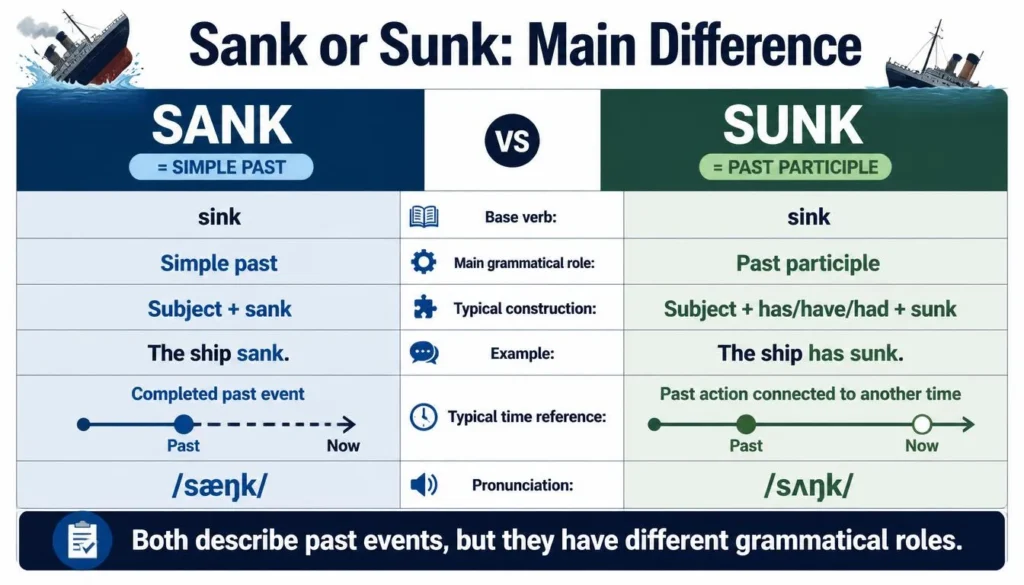
The easiest way to understand sank vs. sunk is to look at the grammatical role each word plays.
| Feature | Sank | Sunk |
| Base verb | sink | sink |
| Main grammatical role | Simple past | Past participle |
| Typical construction | Subject + sank | Subject + has/have/had + sunk |
| Example | The ship sank. | The ship has sunk. |
| Typical time reference | Completed past event | Past action connected to another time |
| Pronunciation | /sæŋk/ | /sʌŋk/ |
Notice that both forms can describe something that happened in the past.
That’s why thinking only about “past versus present” doesn’t solve the problem.
Instead, look at the verb construction.
Compare These Two Sentences
The ship sank yesterday.
The ship has sunk.
Both refer to a past event. Yet the grammar differs.
The first sentence uses the simple past.
The second uses the present perfect.
That’s the key distinction.
Complete Verb Forms
Here’s the complete basic pattern:
| Verb form | Example |
| sink | Ships can sink quickly. |
| sank | The ship sank yesterday. |
| sunk | The ship has sunk. |
| sinking | The ship is sinking. |
You can also see these forms in different verb tenses:
| Tense | Example |
| Simple present | The boat sinks quickly. |
| Simple past | The boat sank yesterday. |
| Present perfect | The boat has sunk. |
| Past perfect | The boat had sunk before dawn. |
| Future | The boat will sink if the leak continues. |
| Present progressive | The boat is sinking. |
| Past progressive | The boat was sinking when help arrived. |
One useful detail stands out here: after will, use the base form sink.
For example:
The boat will sink if nobody repairs it.
Not:
❌ The boat will sank.
And not:
❌ The boat will sunk.
When to Use “Sank”
Use Sank for the Simple Past
Use sank when you describe a completed event in the past.
Examples:
- The ship sank near the coast.
- The stone sank into the mud.
- The sun sank behind the mountains.
- The company’s profits sank sharply.
- Her heart sank after the announcement.
The sentence doesn’t need has, have, or had before the verb.
Sank Can Describe More Than Physical Movement
A common mistake is assuming that sink only relates to water.
It doesn’t.
Something can sink:
- into water
- into the ground
- beneath the surface
- to the floor
- below the horizon
- into despair
- to a lower level
For example:
The exhausted runner sank to the ground.
The sun sank behind the hills.
Her mood sank after the announcement.
These sentences use sank because each describes a past event.
When to Use “Sunk”
Use Sunk With Has, Have, or Had
This is one of the most useful rules to remember.
Use:
has + sunk
have + sunk
had + sunk
Examples:
- The ship has sunk.
- Three boats have sunk.
- The vessel had sunk before divers reached it.
- The price has sunk dramatically.
- His confidence had sunk after several failures.
Use Sunk in Perfect Tenses
Compare:
The ship sank yesterday.
The ship has sunk.
The first sentence uses the simple past.
The second uses the present perfect.
Now look at another pair:
The ship sank before midnight.
The ship had sunk before midnight.
The second sentence uses the past perfect because the sinking occurred before another past reference point.
A useful shortcut is:
Simple past → sank
Perfect construction → sunk
This isn’t an absolute rule for every dialect because English usage varies. Still, it’s the most useful pattern for standard formal writing.
Why “Has Sank” Is Usually Incorrect
“Has sank” is one of the most common mistakes involving these two forms.
Consider:
❌ The boat has sank.
The problem lies in the verb combination has + sank.
The standard form is:
✅ The boat has sunk.
The same rule applies to have and had:
❌ The boats have sank.
✅ The boats have sunk.
❌ The ship had sank before we arrived.
✅ The ship had sunk before we arrived.
The reason is grammatical rather than stylistic. Has, have, and had form perfect constructions here, so they need the past participle.
For sink, that form is sunk.
Is “Sunk” Ever Used as the Past Tense?
Yes. This is an important point that many simplified grammar explanations leave out.
Major dictionaries recognize sunk as a past-tense variant, particularly in American English.
Cambridge lists the past form as “sank or US also sunk” and gives sunk as the past participle. Merriam-Webster also lists sank or sunk as past forms while giving sunk as the past participle.
That means you may encounter sentences such as:
The boat sunk during the storm.
This usage exists in American English.
However, if you’re learning English and want the clearest standard form for formal writing, sank remains the safest simple-past choice:
The boat sank during the storm.
So the practical advice is simple: don’t treat every occurrence of sunk as a grammatical disaster. But don’t abandon sank either. It’s still the straightforward form to use when you need the simple past.
Sank or Sunk in American English
American English has some variation in how speakers use the past form of sink.
The familiar pattern remains:
sink → sank → sunk
But American dictionaries recognize sunk as another possible past-tense form.
That creates three forms with overlapping usage:
- sink — base form
- sank — standard simple past
- sunk — standard past participle and recognized US past-tense variant
For formal writing, consistency matters more than trying to reproduce every variation found in casual speech.
If you’re writing an essay, professional report, academic paper, or educational article, this pattern is easy and clear:
The ship sank yesterday.
The ship has sunk.
That distinction keeps your writing conventional and immediately understandable.
Common Expressions With Sank and Sunk
The verb sink appears in several familiar expressions.
“My Heart Sank”
My heart sank means you suddenly felt disappointed, worried, or upset.
For example:
My heart sank when I saw the damage.
Her heart sank after she received the rejection.
The phrase doesn’t describe literal movement. It uses sink metaphorically to describe a sudden emotional drop.
“Sink In”
Sink in means that something gradually becomes understood or fully realized.
For example:
It took several minutes for the news to sink in.
The seriousness of the situation finally sank in.
You can also use the perfect form:
The reality has finally sunk in.
Notice the difference:
The truth sank in.
The truth has sunk in.
Again, the surrounding grammar determines the form.
“Sunk Cost”
A sunk cost is money, time, effort, or another resource that someone has already spent and can’t recover.
For example:
The company shouldn’t continue the project simply because of its sunk costs.
The expression is common in business, economics, management, and everyday decision-making.
Common Mistakes
| Common mistake | Standard correction | Explanation |
| The ship has sank. | The ship has sunk. | Perfect construction needs the past participle. |
| The boat sunk yesterday. | The boat sank yesterday. | Sank is the straightforward simple past form. |
| The ship had sank. | The ship had sunk. | Had requires the past participle here. |
| Did the boat sank? | Did the boat sink? | Did takes the base form. |
| The boat was sank. | The boat was sinking. | Progressive constructions use the -ing form. |
The did example deserves special attention.
After did, use the base form:
❌ Did the ship sank?
❌ Did the ship sunk?
✅ Did the ship sink?
The reason is that did already carries the past tense.
The same principle appears in other irregular verbs:
- Did he go?
- Did she take it?
- Did they see him?
- Did the boat sink?
Side-by-Side Examples
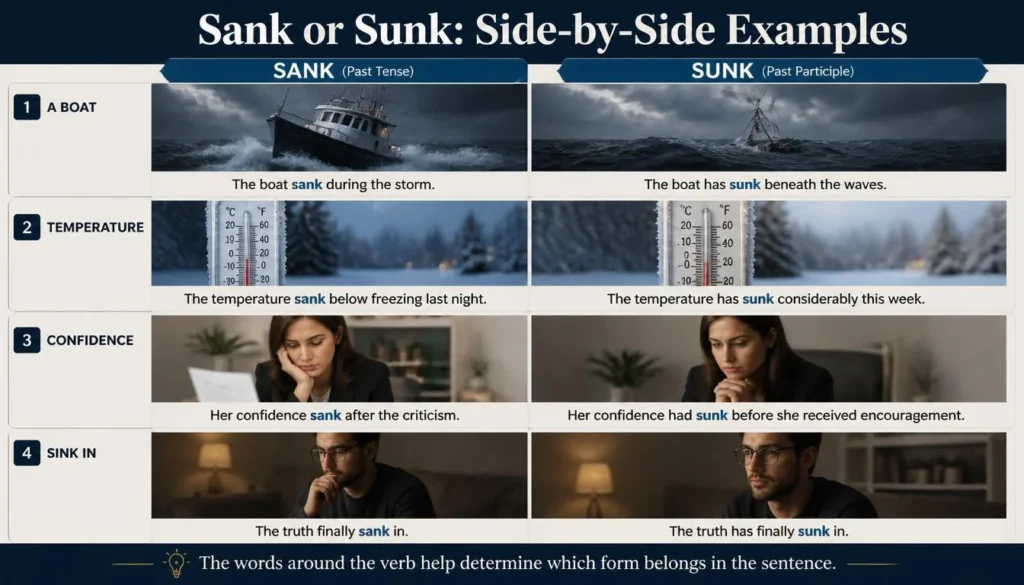
A Boat
- The boat sank during the storm.
- The boat has sunk beneath the waves.
Temperature
- The temperature sank below freezing last night.
- The temperature has sunk considerably this week.
Confidence
- Her confidence sank after the criticism.
- Her confidence had sunk before she received encouragement.
Sink In
- The truth finally sank in.
- The truth has finally sunk in.
The examples show why memorizing isolated words isn’t enough. The words around sank and sunk tell you which form belongs in the sentence.
Sank or Sunk in Questions and Negative Sentences
Questions make the distinction even clearer.
Questions With Did
Use sink after did:
- Did the boat sink?
- Did the ship sink yesterday?
- Why did the temperature sink so quickly?
Avoid:
- ❌ Did the boat sank?
- ❌ Did the boat sunk?
Questions With Has or Have
Use sunk:
- Has the boat sunk?
- Have the ships sunk?
- Has the temperature sunk below freezing?
Negative Sentences
The same pattern applies to negative constructions:
- The boat didn’t sink.
- The boat hasn’t sunk.
- The boat hadn’t sunk.
Once again, the auxiliary verb determines the form.
Key Insights
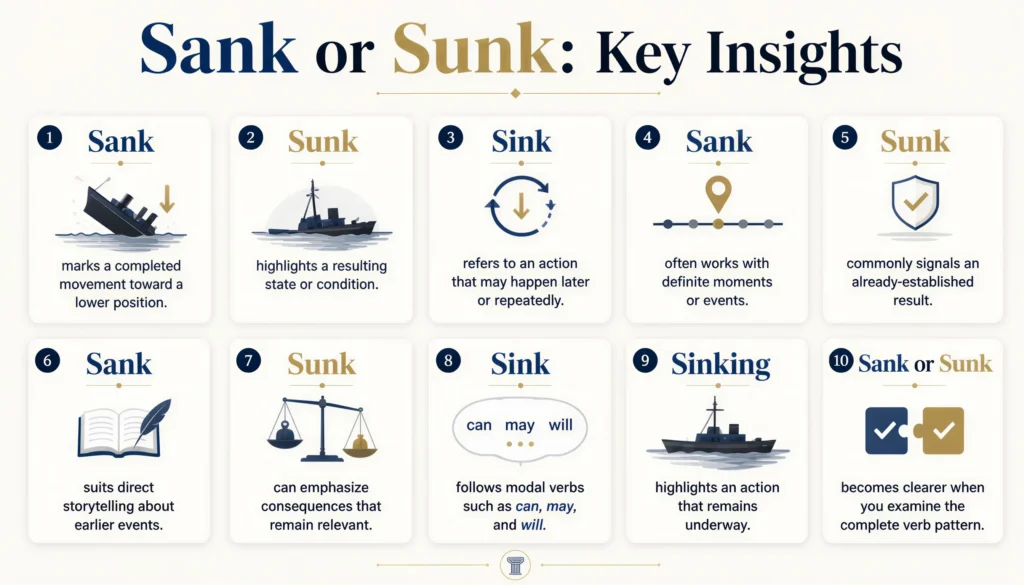
- Sank marks a completed movement toward a lower position.
- Sunk highlights a resulting state or condition.
- Sink refers to an action that may happen later or repeatedly.
- Sank often works with definite moments or events.
- Sunk commonly signals an already-established result.
- Sank suits direct storytelling about earlier events.
- Sunk can emphasize consequences that remain relevant.
- Sink follows modal verbs such as can, may, and will.
- Sinking highlights an action that remains underway.
- Sank or Sunk becomes clearer when you examine the complete verb pattern.
My Personal Experience
In my 15+ years of teaching English, I’ve noticed that learners often hesitate when choosing between Sank or Sunk because both forms feel familiar. I used to see students pause during speaking exercises, especially when they had to describe an event that had already happened. Instead of asking them to memorize isolated forms, I started giving them short situations and letting them choose the form that sounded natural within the sentence. This approach helped them recognize patterns more quickly and reduced their hesitation.
One classroom activity worked particularly well: I would give students incomplete sentences and ask them to complete each one without looking at a grammar chart. Afterward, we discussed why one form fitted better than another. Over time, students began noticing the surrounding structure themselves. In my experience, that small shift—from memorizing rules to recognizing patterns—made Sank or Sunk much easier to understand and use confidently.
A Simple Trick to Remember
Here’s a quick memory pattern:
Sink = base form
Sank = simple past
Sunk = past participle
Now connect each one with a sentence:
- Ships can sink.
- The ship sank yesterday.
- The ship has sunk.
Another shortcut works well:
Yesterday → sank
Has/have/had → sunk
For example:
1.The boat sank yesterday.
2.The boat has sunk.
3.The boat had sunk.
This simple pattern won’t cover every variation in English, but it works extremely well for standard usage.
Quick Practice:
Fill in each blank with the correct form.
- The ship ___ during the storm.
- The ship has ___ beneath the surface.
- The temperature ___ overnight.
- The vessel had ___ before the rescue team arrived.
- Did the boat ___?
- Her heart ___ when she heard the news.
- The reality finally ___ in.
- Several ships have ___ this year.
Answer Key
- sank — simple past
- sunk — present perfect
- sank — simple past
- sunk — past perfect
- sink — base form after did
- sank — simple past
- sank — simple past
- sunk — present perfect
The pattern becomes much easier once you focus on the complete verb phrase instead of treating sank and sunk as interchangeable spellings.
Quick Reference Chart
| If you see… | Usually use… | Example |
| Simple past | sank | The boat sank yesterday. |
| Has + ___ | sunk | The boat has sunk. |
| Have + ___ | sunk | Several boats have sunk. |
| Had + ___ | sunk | The ship had sunk before dawn. |
| Did + ___ | sink | Did the boat sink? |
| Is/was + ongoing action | sinking | The boat was sinking. |
| May/can/will + ___ | sink | The boat may sink. |
Final Verdict:
The best way to choose between sank and sunk is to examine the grammar around the verb.
Use sank for the standard simple past:
The ship sank yesterday.
Use sunk as the standard past participle:
The ship has sunk.
Use sink after did:
Did the ship sink?
Use sinking for an ongoing action:
The ship is sinking.
There is also a genuine American English variation in which sunk can function as a past-tense form. Major dictionaries recognize that usage. Still, sink → sank → sunk remains the clearest pattern for learners and formal writing.
Once you look at the entire verb construction instead of the individual word, the choice becomes much less confusing.
Read More: Saviour or Savior: Correct Spelling, Meaning, and Usage
FAQs
Is sank the past tense of sink?
Yes. Sank is the simple past tense of sink. You use it when the action happened in the past, such as, “The boat sank during the storm.”
Is sunk the past tense of sink?
No. Sunk is the past participle of sink. It usually appears with helping verbs such as has, have, or had, as in “The boat has sunk.”
Can I say “the ship has sank”?
No. “The ship has sank” is incorrect in standard English. Because has requires a past participle, the correct sentence is “The ship has sunk.”
When should I use sank in a sentence?
Use sank when you’re describing a completed action in the past without a helping verb. For example, “The swimmer sank below the surface” correctly uses the simple past form.
When should I use sunk in a sentence?
Use sunk with a helping verb when forming perfect tenses. For example, “The boat has sunk” uses sunk correctly, while “The boat had sunk before help arrived” uses the past perfect.
Is “sunk” ever used as an adjective?
Yes. Sunk can describe something that has gone beneath a surface or has been lowered. For example, “the sunk ship” describes a ship that is at the bottom of the sea.
What is an easy way to remember sank and sunk?
Think of sank as the form that can stand alone for a past action: “The boat sank.” Think of sunk as the form that usually needs a helper: “The boat has sunk.” This simple pattern can prevent many mistakes.
Why do people confuse sank and sunk?
The confusion comes from the fact that both forms come from sink and refer to past actions. Their meanings are closely connected, but their grammatical roles differ, so knowing the verb form helps you choose correctly.
Which is correct: “the boat sank” or “the boat sunk”?
“The boat sank” is correct when you’re using the simple past tense. “The boat sunk” is not standard English in that structure. If you want the past participle, say “The boat has sunk.”
Does using sank and sunk correctly improve my English?
Yes. Choosing the correct form makes your writing and speaking clearer and more natural. Once you understand when to use the simple past and past participle, this common grammar problem becomes much easier to avoid.
Conclusion
Understanding sank and sunk doesn’t require memorizing a complicated grammar rule. The key is to recognize their different roles. Sank is the simple past form of sink, so it works when you describe something that happened in the past: “The ship sank.” Sunk is the past participle, so it normally works with helping verbs such as has, have, and had: “The ship has sunk.” Keeping this basic distinction in mind can help you avoid one of the most common mistakes associated with this irregular verb.
From my experience teaching English, I’ve noticed that learners often remember these forms more effectively when they connect each one with a sentence pattern rather than trying to memorize definitions alone. When you see sank, think of a completed past event. When you see has sunk, have sunk, or had sunk, recognize the perfect-tense structure. With a little practice, the difference becomes almost automatic, and you’ll be able to choose the right form confidently in both everyday conversations and formal writing.
The most useful habit is to pause briefly whenever you’re unsure and look at the words around sank or sunk. If there’s no helping verb and you’re talking about a past event, sank will usually be the right choice. If has, have, or had comes before the verb, sunk is generally required. Once this pattern becomes familiar, you won’t need to second-guess sentences such as “The boat sank yesterday” or “The boat has sunk.” Correct grammar then becomes a natural part of clear, confident English.

Shamsa Kanwal is an English specialist and content writer at ClearPhrasing.com, where she helps readers navigate the English language with confidence. She enjoys breaking down grammar rules, spelling differences, vocabulary, and everyday writing challenges into simple, practical lessons that anyone can understand.
Her writing is focused on making learning approachable rather than overwhelming. Whether she’s explaining commonly confused words, punctuation rules, or grammar concepts, Shamsa believes that clear explanations and real-life examples are the key to effective learning.
Every article she writes is carefully researched, fact-checked, and edited to ensure it is accurate, easy to read, and genuinely helpful. Her goal is to create trustworthy resources that enable students, professionals, writers, and English learners to improve their communication skills and write with greater clarity.
Through her work at ClearPhrasing.com, Shamsa is committed to making English learning simpler, more practical, and accessible for readers around the world.