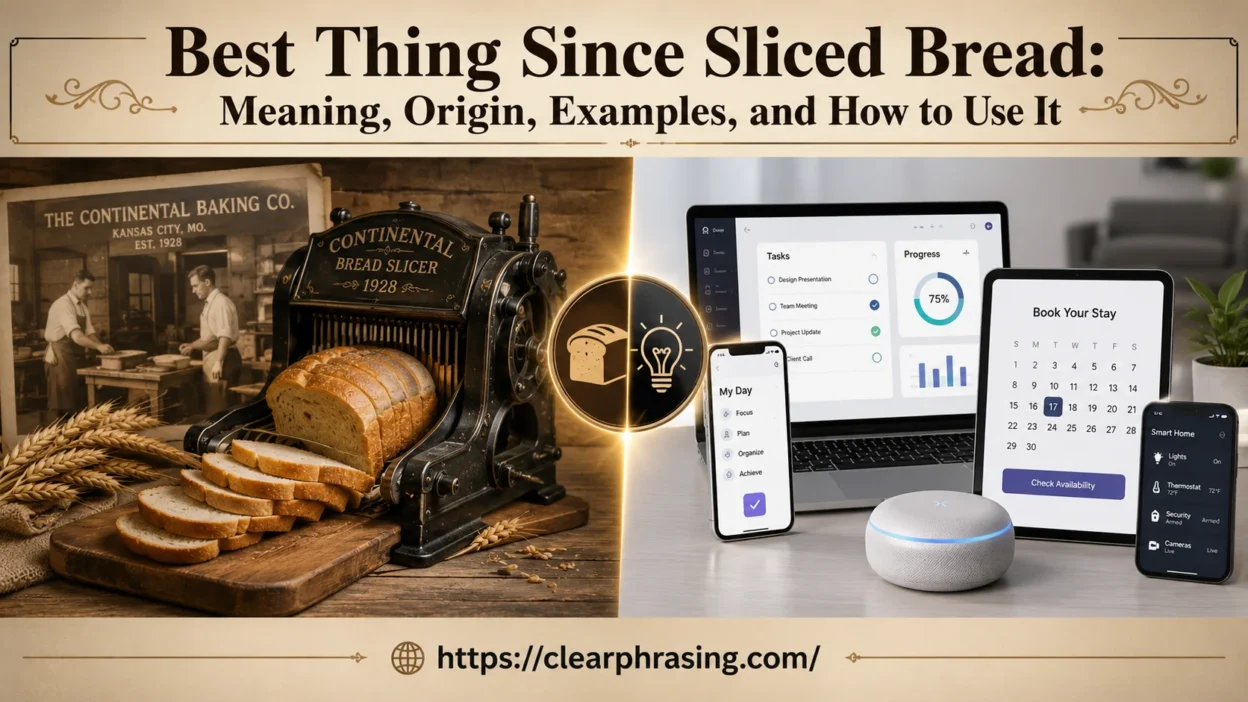
The phrase Best Thing Since Sliced Bread: Meaning, Examples, and Usage describes something really good, useful, or innovative.
The popular saying comes from sliced bread, which became a major convenience when it first appeared in stores.Today, the idiom often describes gadgets, great ideas, or new technologies that make life easier.
For example, someone might call a smartphone app the best thing since sliced bread if it seems clever and incredibly useful. The expression is also hyperbole, not a literal claim.
Quick Answer:
“The best thing since sliced bread” means something is extremely good, useful, convenient, or impressive.
It’s an informal English idiom that usually expresses strong enthusiasm for a person, product, invention, idea, service, or improvement.
For example:
This new note-taking app is the best thing since sliced bread.
The speaker means the app is exceptionally useful or convenient. They aren’t literally ranking the app against bread.
The phrase can also be sarcastic:
Another productivity app? The best thing since sliced bread, apparently.
Here, the speaker probably doesn’t think the app is extraordinary. The exaggerated praise creates the joke.
The expression appears in both “best thing since sliced bread” and “greatest thing since sliced bread” forms. Both communicate essentially the same idea.
What Does “Best Thing Since Sliced Bread” Really Mean?
At its core, the phrase describes something that seems like a major improvement or outstanding innovation.
When you call something the best thing since sliced bread, you’re suggesting that it belongs among the most useful or impressive developments to come along in a long time.
Depending on the context, the phrase can communicate several shades of meaning:
- Extremely good
- Highly useful
- Very convenient
- Innovative
- Impressive
- Exciting
- A significant improvement
- Something that makes life easier
For instance:
This online booking system is the best thing since sliced bread.
The speaker may love it because customers can schedule appointments without calling the business.
Likewise:
Her new filing system is the best thing since sliced bread.
That sentence doesn’t necessarily suggest that the filing system changed the world. It simply shows strong personal enthusiasm.
Why Is the Phrase So Exaggerated?
The expression uses hyperbole, which means deliberate exaggeration for emphasis.
People use hyperbole constantly in everyday English. You might say:
- “I’m starving.”
- “That movie lasted forever.”
- “I’ve told you a million times.”
- “This is the best coffee I’ve ever had.”
Nobody expects these statements to be mathematically or literally precise.
“The best thing since sliced bread” works the same way. Its exaggeration makes the praise more memorable.
Why Is Sliced Bread Used in the Expression?
The answer starts with convenience.
Before commercially sliced bread became available, people generally bought whole loaves and sliced them at home. Producing uniform slices mechanically sounds simple today. In the early 20th century, however, commercial bread slicing presented practical engineering challenges.
The Smithsonian’s National Museum of American History explains that earlier bread-cutting devices existed, but effective commercialization depended on producing loaves with sufficiently uniform shape, size, and consistency.
Otto Frederick Rohwedder and the 1928 Bread-Slicing Machine
Otto Frederick Rohwedder developed the first effective commercial bread-slicing machine. The Chillicothe Baking Company in Chillicothe, Missouri, put the machine into service in 1928.
That development turned an ordinary kitchen task into something manufacturers could automate.
The result was practical:
- Bread could arrive already sliced.
- Slices could have a more consistent thickness.
- Consumers didn’t need to cut every slice themselves.
- Bread manufacturers could package sliced loaves conveniently.
- Other kitchen equipment, including toasters, benefited from standardized slices.
By the 1930s, commercially pre-sliced bread had become firmly established. The Smithsonian notes that standardization was reinforced by other inventions that relied on uniform slices.
So when modern speakers call something “the best thing since sliced bread,” they’re borrowing the reputation of an invention that once represented remarkable everyday convenience.
The Origin of “Best Thing Since Sliced Bread”
The exact origin of the modern idiom isn’t as neat as a single person inventing a phrase on a particular afternoon.
That’s an important distinction.
Historical evidence shows that expressions involving “since sliced bread” appeared in advertising and newspaper writing before the exact modern idiom became established.
A 1939 advertisement, for example, described a bread product as the “newest thing” since sliced bread. By 1940, advertisements and newspaper material were using variations such as “greatest innovation since sliced bread” and “greatest convenience since sliced bread.”
That pattern suggests a gradual evolution:
Sliced bread becomes a famous innovation → advertisers use it as a benchmark → writers adapt the comparison → the expression becomes a general idiom.
When Did the Exact Idiom Appear?
Researchers have identified examples of the phrase in the early 1950s.
One particularly useful documented example appeared in 1951, when journalist Dorothy Kilgallen quoted someone describing actor Stewart Granger as “the greatest thing since sliced bread.” Linguistic research has also identified earlier possible examples in literary sources.
Because historical phrase research continues to uncover earlier examples, it’s better to avoid saying that one person definitely invented the idiom.
The evidence supports a gradual development from advertising language into everyday figurative English.
Did Wonder Bread Invent the Phrase?
You may encounter claims that Wonder Bread created the expression.
There is a historical connection worth mentioning. The Smithsonian notes that the phrase may have developed partly from advertising associated with Wonder Bread, which became an important commercial producer of pre-wrapped, pre-sliced bread.
However, the evidence doesn’t justify presenting Wonder Bread as the unquestionable inventor of the exact phrase.
A more accurate explanation is that commercial sliced bread created the cultural reference point, while advertising and popular language helped turn that reference into a broader expression.
How to Use “Best Thing Since Sliced Bread” in a Sentence
The most common structure is straightforward:
[Something] + is/was + the best thing since sliced bread.
Here are several natural examples:
This new calendar app is the best thing since sliced bread.
The speaker thinks the app is extremely useful.
That shortcut was the best thing since sliced bread during my commute.
The shortcut made traveling much easier.
Everyone thinks their new software is the best thing since sliced bread.
The sentence can imply enthusiasm or skepticism depending on context.
These noise-canceling headphones are the best thing since sliced bread.
The speaker strongly approves of the headphones.
Her new manager is the best thing since sliced bread.
The phrase can describe a person as well as an object.
“Best Thing Since Sliced Bread” Examples by Context
| Context | Example | Intended meaning |
| Technology | This app is the best thing since sliced bread. | The app is exceptionally useful. |
| Work | Our new project-management system is the best thing since sliced bread. | The system makes work much easier. |
| Shopping | This vacuum is the best thing since sliced bread. | The vacuum performs extremely well. |
| Food | This kitchen gadget is the best thing since sliced bread. | The gadget is very convenient. |
| Education | This study tool is the best thing since sliced bread. | The tool makes studying easier. |
| Personal life | That shortcut is the best thing since sliced bread. | The shortcut saves considerable time. |
Is “Best Thing Since Sliced Bread” Always Positive?
Usually, yes.
However, tone can completely change the meaning.
That’s one reason this idiom can be tricky for English learners. Written words don’t always reveal whether someone is genuinely enthusiastic or quietly mocking something.
Genuine Praise
This new payment system is the best thing since sliced bread.
The speaker probably loves the system.
Perhaps it makes payments faster and eliminates a tedious process.
Sarcastic Praise
Sure, another software update. The best thing since sliced bread.
The speaker probably doesn’t believe the update is revolutionary.
The exaggerated compliment becomes criticism.
How Can You Recognize Sarcasm?
Pay attention to the surrounding context.
Clues may include:
- An obviously exaggerated statement
- Negative comments before or after the phrase
- A mocking tone
- Words such as “apparently”
- Eye-rolling or dismissive behavior in conversation
- Punctuation or quotation marks in informal writing
For example:
Their “amazing” new feature is the best thing since sliced bread.
The quotation marks around “amazing” signal skepticism.
“Best Thing Since Sliced Bread” vs. “Greatest Thing Since Sliced Bread”
These expressions are almost interchangeable.
| Expression | Meaning | Typical tone |
| Best thing since sliced bread | Something exceptionally good | Informal |
| Greatest thing since sliced bread | Something exceptionally good | Informal and emphatic |
| Best thing ever | The speaker considers something their absolute favorite | Very informal |
| A game changer | Something significantly changes a situation | Informal |
| A major breakthrough | A significant advance or discovery | Neutral to formal |
“Greatest” can sound slightly more dramatic because it uses a stronger superlative.
For everyday conversation, however, both versions work naturally.
Is “Best Thing Since Sliced Bread” Formal or Informal?
It is informal.
You’ll hear it in conversations, interviews, social media posts, reviews, advertisements, and casual workplace discussions.
It can work well when the writing has a relaxed tone:
This scheduling tool is the best thing since sliced bread.
In a formal report, however, a more precise expression would usually work better.
Instead of:
This system is the best thing since sliced bread.
You could write:
The system significantly improves scheduling efficiency.
Or:
The new platform provides a substantial improvement in appointment management.
The second versions communicate a specific claim instead of relying on colorful exaggeration.
Where the Idiom Works Best
Use it naturally in:
- Casual conversation
- Text messages
- Social media
- Informal blog posts
- Personal reviews
- Friendly workplace conversations
- Advertising and promotional writing
Where You Should Avoid It
It usually doesn’t belong in:
- Academic research
- Legal documents
- Formal technical reports
- Scientific papers
- Highly formal business documentation
The issue isn’t grammar. The issue is register.
Can You Use “Best Thing Since Sliced Bread” for a Person?
Absolutely.
The idiom can describe someone you consider exceptionally talented, helpful, attractive, or impressive.
For example:
The new coach is the best thing since sliced bread.
Depending on the context, that could mean the coach has transformed the team.
You could also say:
Everyone in the department thinks she’s the best thing since sliced bread.
Here, the expression emphasizes strong admiration.
Because the phrase is exaggerated, it can also carry a playful tone. Calling a friend “the best thing since sliced bread” may sound affectionate rather than literal.
Can You Use “Best Thing Since Sliced Bread” for an Idea?
Yes. In fact, ideas and innovations are among its most natural subjects.
For example:
Their new online booking system is the best thing since sliced bread.
The system might eliminate phone calls and let customers schedule appointments at any time.
You can apply the phrase to:
- Products
- Services
- Apps
- Websites
- Business ideas
- Inventions
- Methods
- Strategies
- People
- Personal discoveries
The common thread is simple: the speaker sees the subject as unusually valuable or impressive.
Common Mistakes
The phrase looks simple, but learners sometimes alter it incorrectly.
Mistake: “Best Thing From Sliced Bread”
The established idiom is:
the best thing since sliced bread
Not:
the best thing from sliced bread
The word “since” matters because the phrase compares the subject with something that came earlier.
Mistake: “Best Thing Since Slice Bread”
The noun should be sliced bread.
“Sliced” functions as the adjective describing the bread.
Correct:
the best thing since sliced bread
Mistake: Assuming It Must Be Sincere
Not necessarily.
The phrase can express genuine admiration or sarcasm.
Context does the heavy lifting.
Mistake: Using It in Every Situation
Because it’s a familiar idiom, excessive use can make writing sound repetitive or cliché.
If you’re writing a detailed article or professional document, alternate it with more precise phrases such as:
- A major improvement
- A significant innovation
- An important development
- Highly effective
- Exceptionally useful
- A major breakthrough
“Best Thing Since Sliced Bread” vs. “Best Thing Ever”
These phrases sound similar, but they don’t make exactly the same comparison.
“Best thing ever” presents something as the speaker’s greatest experience or favorite thing.
This is the best pizza ever.
“Best thing since sliced bread” uses sliced bread as a historical benchmark for innovation or convenience.
This new kitchen gadget is the best thing since sliced bread.
The second expression has more personality because it carries a cultural reference.
It’s not simply praise. It’s praise with a wink.
Why Does the “Best Thing Since Sliced Bread” Idiom Still Work?
The phrase has survived because the underlying idea remains easy to understand.
People still celebrate inventions that remove small frustrations from daily life.
Consider what sliced bread did. It took a familiar product and made one repetitive task easier. That basic pattern hasn’t disappeared.
Modern examples include:
- Digital payments
- Online appointment scheduling
- Cloud storage
- Navigation apps
- Streaming services
- Automatic transcription
- Smart home devices
- Productivity software
A person might call a new app “the best thing since sliced bread” because it saves ten minutes every day.
That may sound trivial. It isn’t.
Small conveniences can become meaningful when millions of people use them repeatedly.
The original sliced-bread comparison works precisely because the invention wasn’t merely flashy. It addressed an everyday inconvenience.
The Historical Importance of Sliced Bread
The story behind the idiom reveals something interesting about technological change.
The bread slicer wasn’t a glamorous invention. It didn’t launch people into space or transform medicine. Instead, it simplified a routine household task.
That kind of innovation often has enormous practical value.
The Smithsonian describes bread production during this period as part of the broader mechanization of daily life. Bread production involved increasingly sophisticated machinery for mixing, baking, slicing, and wrapping.
Once sliced bread became widely available, other technologies benefited from the standardization of bread slices.
Convenience created a ripple effect.
That’s part of what makes the idiom so fitting. It doesn’t compare modern innovations with some mythical invention. It compares them with a real improvement that changed an ordinary routine.
Case Study: Why Sliced Bread Became a Benchmark
Consider the difference between these two experiences.
Before pre-sliced bread:
- Buy a whole loaf.
- Take out a knife.
- Slice the bread.
- Try to keep the slices reasonably even.
- Repeat the process whenever you need bread.
After commercially sliced bread:
- Open the package.
- Take out a slice.
- Make your sandwich or toast.
That sounds almost laughably simple today.
But that simplicity is exactly the point.
A useful invention doesn’t always need to look spectacular. Sometimes the best innovation is the one that quietly removes an annoying task from your day.
That’s the cultural idea behind “the best thing since sliced bread.”
Synonyms and Alternatives to “Best Thing Since Sliced Bread”
The best alternative depends on what you actually want to emphasize.
| Alternative | Best used when you mean… |
| A game changer | Something dramatically changes a situation |
| A major breakthrough | Something represents important progress |
| A major innovation | A new idea or technology offers meaningful improvement |
| A huge improvement | Something clearly works better than what came before |
| Cutting-edge | Something uses very advanced technology or methods |
| The next big thing | Something is expected to become highly popular or influential |
| A stroke of genius | An idea seems exceptionally clever |
| A breath of fresh air | Something feels new, refreshing, and welcome |
These alternatives aren’t exact substitutes.
For example, “game changer” emphasizes impact. “Cutting-edge” emphasizes modernity or technical advancement. “The best thing since sliced bread” emphasizes enthusiastic approval with a playful exaggeration.
Related Idioms About Excellence and Innovation
English has plenty of colorful ways to praise something.
A Game Changer
The new payment system is a game changer.
This means it significantly alters the way something works.
A Stroke of Genius
That was a stroke of genius.
This praises an unusually clever idea or decision.
The Next Big Thing
AI-powered search could become the next big thing.
This suggests something may become highly influential or popular.
Ahead of Its Time
The invention was ahead of its time.
This describes an idea that was unusually advanced for its period.
The Real Deal
This software is the real deal.
This informal expression suggests something is genuinely as good as people claim.
Each phrase has its own flavor. That’s why choosing the right idiom matters.
Read More: Harbor or Harbour: Meaning, Difference, and Usage
FAQs
What does “best thing since sliced bread” mean?
The phrase means that something is extremely good, useful, impressive, or innovative. It’s usually a strong compliment for a new idea, product, invention, or development.
Is “best thing since sliced bread” an idiom?
Yes. “Best thing since sliced bread” is a common English idiom. People use it to praise something they believe has made life easier or better.
Why is sliced bread mentioned in this expression?
Sliced bread represents convenience and innovation. Before pre-sliced bread became available, people had to cut loaves themselves. The invention made an everyday task much easier.
When did sliced bread become popular?
Commercially sliced bread became popular in the 1920s. Its convenience helped make it a memorable comparison for later inventions and improvements.
Can I use this phrase for a person?
You can, but the context matters. Calling someone the best thing since sliced bread usually means you think that person is exceptionally helpful, talented, or valuable.
Is “best thing since sliced bread” always literal?
No. The expression uses hyperbole, so it isn’t meant literally. It simply emphasizes how impressive or useful something seems.
Can I use this idiom in everyday conversation?
Absolutely. It works well in casual conversations when you want to show enthusiasm about something new. For example, you might praise a helpful app, kitchen tool, or clever invention.
Is this phrase appropriate in formal writing?
It depends on the context. The expression has a conversational and informal tone, so a formal report may need a more precise alternative such as highly useful innovation or major improvement.
What is an example of “best thing since sliced bread”?
You could say, “This new smartphone app is the best thing since sliced bread.” This means the speaker thinks the app is exceptionally useful, convenient, or clever.
Is “best thing since sliced bread” still commonly used?
Yes. The idiom remains familiar in modern English because people continue to use it when talking about new technology, useful products, clever ideas, and convenient solutions.
Conclusion
“Best thing since sliced bread” has survived because it captures a familiar human reaction: when something makes life noticeably easier, we want a memorable way to praise it. The expression turns an ordinary household convenience into a benchmark for innovation.
Today, you can use this idiom for everything from a clever app to a surprisingly useful invention. Just remember that it’s hyperbole, so the speaker isn’t claiming that something literally ranks above every invention ever made. It’s simply a lively way to say, “This is remarkably good.”

Shamsa Kanwal is an English specialist and content writer at ClearPhrasing.com, where she helps readers navigate the English language with confidence. She enjoys breaking down grammar rules, spelling differences, vocabulary, and everyday writing challenges into simple, practical lessons that anyone can understand.
Her writing is focused on making learning approachable rather than overwhelming. Whether she’s explaining commonly confused words, punctuation rules, or grammar concepts, Shamsa believes that clear explanations and real-life examples are the key to effective learning.
Every article she writes is carefully researched, fact-checked, and edited to ensure it is accurate, easy to read, and genuinely helpful. Her goal is to create trustworthy resources that enable students, professionals, writers, and English learners to improve their communication skills and write with greater clarity.
Through her work at ClearPhrasing.com, Shamsa is committed to making English learning simpler, more practical, and accessible for readers around the world.