Drunk or Drank: What’s the Difference? and Correct Usage is a common topic that creates confusion among students, writers, and native speakers.
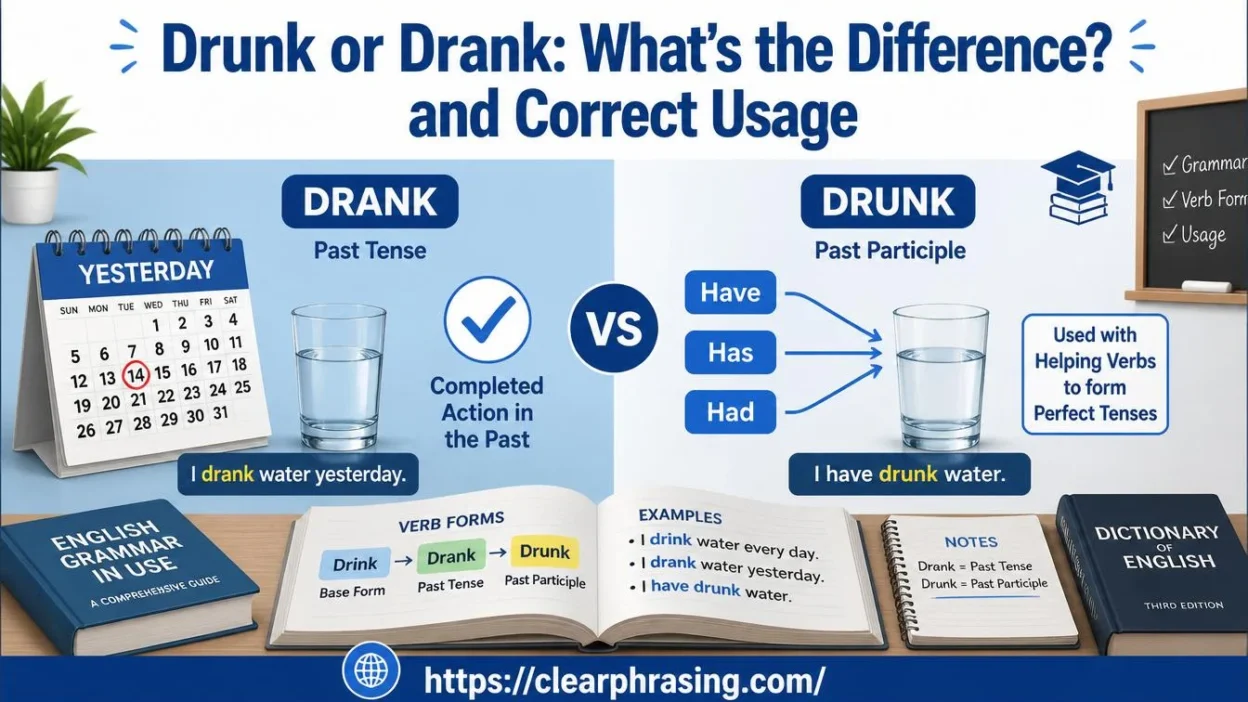
These words come from the same verb drink, but they have different roles in English grammar. Drank is the simple past tense used for a completed action in the past, such as “I drank coffee yesterday.” On the other hand, drunk is the past participle form that needs an auxiliary verb like have or had.
Understanding the context, grammar rules, and tenses makes it easier to use these words correctly. In my experience as an English teacher, I have seen many learners make mistakes like “I have drank water.” Learning the difference between past action and perfect tenses helps improve speaking and writing confidence. These simple rules make English usage easier to understand.
Quick Answer
Drank is the simple past tense of the verb drink.
- ✅ I drank two glasses of water after my workout.
- ✅ She drank coffee this morning.
Drunk is the past participle of drink and must usually follow a helping verb such as have, has, or had.
- ✅ I have drunk enough water today.
- ✅ They had drunk all the juice before dinner.
Simple rule to remember:
| Word | Use | Example |
| Drank | Simple past | We drank tea yesterday. |
| Drunk | Past participle | We have drunk enough tea today. |
If there isn’t a helping verb, drank is almost always the correct choice.
What Is the Difference Between Drank and Drunk?
Although drank and drunk come from the same verb, they belong to different verb forms. Understanding this distinction makes choosing the right word much easier.
What Does “Drank” Mean?
Drank is the simple past tense of drink. It describes an action that happened and ended in the past.
Examples:
- I drank orange juice before work.
- She drank plenty of water during the hike.
- They drank hot chocolate after skiing.
Every sentence refers to a completed action.
What Does “Drunk” Mean?
Drunk is the past participle of drink. It works with helping verbs to create perfect tenses.
Examples:
- I have drunk three bottles of water.
- She has drunk all her coffee.
- They had drunk enough before the movie started.
Without a helping verb, drunk usually isn’t correct as a verb.
The Core Grammar Rule
The easiest way to remember the difference is to learn the verb forms.
| Verb Form | Word |
| Base Form | Drink |
| Simple Past | Drank |
| Past Participle | Drunk |
| Present Participle | Drinking |
English contains many irregular verbs. Unlike regular verbs that simply add -ed, irregular verbs change form.
Compare these examples:
| Base | Past | Past Participle |
| Sing | Sang | Sung |
| Ring | Rang | Rung |
| Begin | Began | Begun |
| Drink | Drank | Drunk |
Notice the same vowel pattern. Learning these groups together makes them easier to remember.
Drank: Meaning and Correct Usage
When to Use “Drank”
Use drank whenever you’re talking about something someone consumed in the past.
Think of words like:
- Yesterday
- Last week
- Earlier today
- Last night
- A few minutes ago
Examples:
- We drank lemonade at the picnic.
- My brother drank all the milk.
- They drank coffee before leaving.
- She drank enough water during practice.
Each sentence describes one finished action.
Sentence Structure
The structure is simple.
Subject + drank + object
Examples:
- I drank tea.
- She drank milk.
- We drank juice.
This pattern works in almost every simple past sentence.
Common Mistakes with “Drank”
Incorrect:
- She has drank coffee already.
- I have drank enough water.
Correct:
- I have drunk enough water.
- She has drunk coffee already.
The helping verb changes everything.
Drunk: Meaning and Correct Usage
When to Use “Drunk”
Use drunk whenever the sentence contains a helping verb.
Common helping verbs include:
- Have
- Has
- Had
- Have been
- Has been
- Had been
- Will have
- Would have
- Could have
- Should have
Examples:
- I have drunk two cups of coffee.
- She has drunk enough juice.
- They had drunk all the soda before guests arrived.
- We will have drunk plenty of water by noon.
Sentence Structure
Subject + helping verb + drunk + object
Examples:
- He has drunk tea.
- We had drunk coffee.
- They have drunk enough water.
Once you spot a helping verb, drunk usually follows.
Common Mistakes
Incorrect:
- Yesterday I drunk milk.
Correct:
- Yesterday I drank milk.
Incorrect:
- She drunk coffee this morning.
Correct:
- She drank coffee this morning.
Drank vs. Drunk: Side-by-Side Comparison
| Feature | Drank | Drunk |
| Verb form | Simple past | Past participle |
| Needs helping verb | No | Yes |
| Action completed in the past | Yes | Works with perfect tenses |
| Example | I drank tea. | I have drunk tea. |
| Common mistake | Used after “have” | Used alone in past tense |
Looking at the table makes the difference much easier to remember.
Why People Confuse Drank and Drunk
Several reasons explain why these words cause confusion.
They Share the Same Meaning
Both words relate to drinking something.
The difference isn’t meaning. It’s grammar.
Irregular Verbs Can Be Difficult
English contains hundreds of irregular verbs.
Examples include:
- Go → Went → Gone
- See → Saw → Seen
- Eat → Ate → Eaten
- Drink → Drank → Drunk
Each verb follows its own pattern.
Everyday Speech Isn’t Always Grammatically Correct
People sometimes say:
- I drunk it yesterday.
Although you might hear this in informal conversation or regional dialects, it isn’t considered standard English.
Formal writing should always use drank.
Similar Sound Patterns
Because drank and drunk differ by only one vowel, learners often remember one but forget which tense it belongs to.
The Verb “Drink” in Every Tense
Learning every form helps prevent mistakes.
| Tense | Example |
| Present | I drink coffee every morning. |
| Present Continuous | I am drinking coffee now. |
| Simple Past | I drank coffee yesterday. |
| Present Perfect | I have drunk coffee today. |
| Past Perfect | I had drunk coffee before work. |
| Future | I will drink coffee tomorrow. |
| Future Perfect | I will have drunk coffee by noon. |
Notice that drunk only appears in perfect tenses.
Grammar Rules Explained Step by Step
Use “Drank” Without a Helping Verb
If your sentence doesn’t contain have, has, or had, choose drank.
Examples:
- She drank lemonade.
- We drank water.
- They drank tea.
Use “Drunk” After a Helping Verb
Whenever you see a helping verb, use drunk.
Examples:
- He has drunk enough water.
- We had drunk coffee already.
- They have drunk milk today.
Never Switch Them
These sentences are incorrect.
❌ I have drank enough.
❌ Yesterday I drunk tea.
Correct versions:
✅ I have drunk enough.
✅ Yesterday I drank tea.
Real-Life Examples of Drank vs. Drunk
Seeing these words in context makes the grammar rule much easier to remember. The following examples show how drank and drunk naturally appear in everyday English.
Everyday Conversation
- I drank a bottle of water after my run.
- Have you drunk enough water today?
- She drank coffee before work.
- We’ve drunk all the lemonade.
Workplace Communication
- The team drank coffee during the morning meeting.
- Everyone had drunk water before the presentation started.
- The guests have drunk the refreshments provided.
Academic Writing
- Participants drank the solution before the experiment began.
- Researchers had drunk only water during the fasting period.
News and Journalism
- Athletes drank plenty of fluids despite the heat.
- Emergency workers reported that residents had drunk clean water after supplies arrived.
Drunk vs. Drank in American English
American English follows the same grammar rule taught in schools and style guides.
- Drank = Simple past
- Drunk = Past participle
Examples:
- ✅ I drank iced tea yesterday.
- ✅ I have drunk iced tea all week.
In casual speech, you may occasionally hear someone say, “I drunk it yesterday.” That usage appears in some regional dialects, but it isn’t considered standard American English. In formal writing, school assignments, business communication, and professional emails, always use drank for the simple past.
Drunk vs. Drank in British English
The grammar rule remains exactly the same in British English.
Examples:
- I drank a cup of tea before breakfast.
- I’ve drunk three cups today.
The only noticeable difference is that British English often uses the present perfect more frequently than American English when discussing recent events.
For example:
- British English: I’ve drunk enough water today.
- American English: I drank enough water today.
Both are grammatically correct within their respective contexts.
Common Expressions Using Drink, Drank, and Drunk
English contains many everyday expressions that use different forms of drink.
| Expression | Meaning |
| Drink responsibly | Consume alcohol safely and in moderation. |
| Drink up | Finish your drink. |
| Get drunk | Become intoxicated after drinking alcohol. |
| Have you ever drunk…? | Ask about someone’s life experience. |
| Drank too much | Consumed an excessive amount. |
| Drink like a fish | An idiom meaning someone drinks a lot, especially alcohol. |
Remember that drunk also functions as an adjective.
Examples:
- He is drunk.
- She looked drunk after the party.
Here, drunk does not act as a verb. Instead, it describes a person’s condition.
Common Mistakes and How to Fix Them
Many learners repeat the same grammar mistakes. Once you recognize them, they’re easy to avoid.
| Incorrect | Correct | Why |
| I have drank enough. | I have drunk enough. | Present perfect needs a past participle. |
| Yesterday I drunk coffee. | Yesterday I drank coffee. | Simple past uses drank. |
| She has drank tea. | She has drunk tea. | Helping verb requires drunk. |
| We drunk milk last night. | We drank milk last night. | Past action uses drank. |
| They had drank everything. | They had drunk everything. | Past perfect requires drunk. |
A quick proofreading tip can save you from almost every mistake:
- No helping verb? Choose drank.
- Helping verb present? Choose drunk.
Memory Tricks to Never Confuse Drank and Drunk Again
Grammar becomes much easier when you connect it to simple patterns.
Think About Helping Verbs
Ask yourself one question:
Can you see have, has, or had?
- Yes → Use drunk.
- No → Use drank.
This single question solves most grammar problems involving these words.
Learn the Pattern with Similar Verbs
Several irregular verbs follow nearly identical patterns.
| Base Verb | Simple Past | Past Participle |
| Sing | Sang | Sung |
| Ring | Rang | Rung |
| Begin | Began | Begun |
| Swim | Swam | Swum |
| Drink | Drank | Drunk |
Instead of memorizing one verb at a time, study them as a group. You’ll begin recognizing the pattern naturally.
Visual Memory Trick
Imagine climbing three steps.
- Step 1: Drink
- Step 2: Drank
- Step 3: Drunk
Whenever a helping verb appears, you’ve climbed to the third step.
Practice Sentences
Test yourself before looking at the answers.
Choose drank or drunk.
- I have ________ enough water today.
- We ________ coffee before class.
- She had ________ the juice already.
- They ________ milk yesterday morning.
- Have you ever ________ coconut water?
Answer Key
- Drunk
- Drank
- Drunk
- Drank
- Drunk
If you answered all five correctly, you’ve mastered the basic rule.
MMini Quiz
Choose the correct answer.
Which sentence is correct?
A. I have drank enough water.
B. I have drunk enough water.
Answer: B
Which sentence uses the simple past tense?
A. She drank coffee yesterday.
B. She has drunk coffee today.
Answer: A
Which sentence is incorrect?
A. They had drunk all the juice.
B. They drunk all the juice yesterday.
Answer: B
Replace drunk with drank because no helping verb appears.
Key Takeaways
Before you finish, remember these important points:
- Drank is the simple past tense of drink.
- Drunk is the past participle and usually follows have, has, or had.
- The meaning stays the same, but the grammar changes.
- Checking for a helping verb is the fastest way to choose the correct word.
- Learning similar irregular verbs strengthens your grammar skills.
Read More: Lifes or Lives: Which Is Correct? and Usage
FAQs
Is drunk or drank the correct word to use?
Both drunk and drank are correct words, but they are used in different situations. Drank is the simple past form of the verb drink, while drunk is the past participle form that usually appears with helping verbs like have or had.
Can I say “I have drank water”?
No, “I have drank water” is grammatically incorrect. The correct sentence is “I have drunk water” because have requires the past participle form of the verb.
When should I use drank in a sentence?
Use drank when you are talking about a completed action that happened at a specific time in the past. For example, “I drank tea this morning” shows that the action is finished.
When should I use drunk in a sentence?
Use drunk when you need the past participle form with helping verbs. For example, “She has drunk enough water today” connects the past action with the present situation.
Why do people confuse drunk and drank?
People often confuse these words because they come from the same verb, drink, and they look and sound similar. The difference becomes clear when you understand verb tenses and sentence structure.
Are drunk and drank used differently in British and American English?
The basic grammar rule for drunk and drank is the same in both British English and American English. Speakers in both varieties use drank as the simple past and drunk as the past participle.
Is drunk ever used without have or had?
Yes, drunk can be used without helping verbs when it works as an adjective to describe someone’s condition, such as “He was drunk.” However, for the action of drinking, it usually needs a helping verb.
What is an easy way to remember drunk and drank?
A simple way to remember them is that drank is used for a finished past action, while drunk usually needs a helper verb like have, has, or had.
What are common mistakes with drunk and drank?
Common mistakes include sentences like “I have drank coffee” or “She had drank water.” The correct forms are “I have drunk coffee” and “She had drunk water” because perfect tenses require the past participle.
How can learning drunk and drank improve English skills?
Understanding the difference between these words improves grammar accuracy, speaking confidence, and writing skills. It helps learners create clearer sentences and avoid common English mistakes.
Conclusion
The difference between drunk and drank becomes easier when you understand their roles in English grammar. Both words come from the verb drink, but they belong to different tense structures. Drank describes a completed action in the past, while drunk is mainly used with helping verbs in perfect tenses.
Improving your knowledge of these small grammar rules can make your English more natural and effective. By practicing examples and paying attention to sentence structure, you can confidently choose the right word in everyday conversations, academic writing, and professional communication.

Shamsa Kanwal is an English specialist and content writer at ClearPhrasing.com, where she helps readers navigate the English language with confidence. She enjoys breaking down grammar rules, spelling differences, vocabulary, and everyday writing challenges into simple, practical lessons that anyone can understand.
Her writing is focused on making learning approachable rather than overwhelming. Whether she’s explaining commonly confused words, punctuation rules, or grammar concepts, Shamsa believes that clear explanations and real-life examples are the key to effective learning.
Every article she writes is carefully researched, fact-checked, and edited to ensure it is accurate, easy to read, and genuinely helpful. Her goal is to create trustworthy resources that enable students, professionals, writers, and English learners to improve their communication skills and write with greater clarity.
Through her work at ClearPhrasing.com, Shamsa is committed to making English learning simpler, more practical, and accessible for readers around the world.