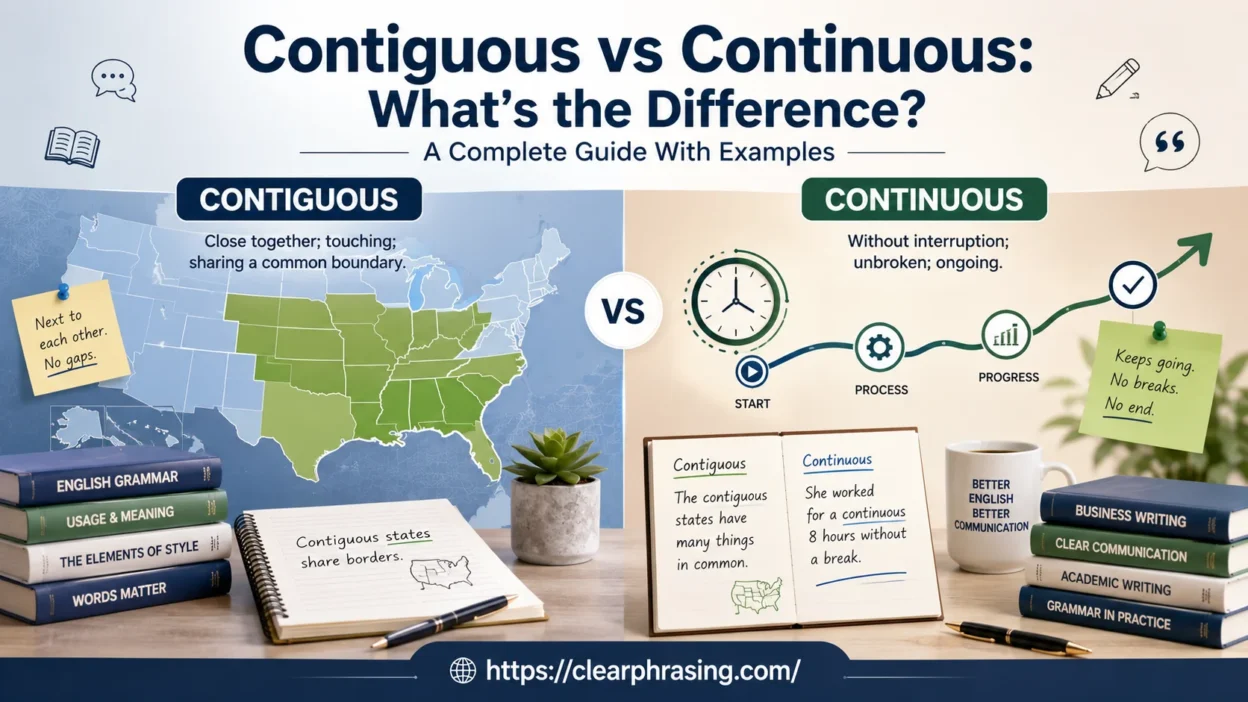
Contiguous vs Continuous: What’s the Difference? helps learners understand the difference between two words that sound similar and look similar.
In my teaching experience, many students think they are interchangeable, but the truth is different. This Complete Guide explains their meanings, definitions, comparison, examples, context clues, word choice, grammar, English usage, and correct usage. A simple explanation with reading, maps, reports, and everyday context gives a clearer understanding and improves English vocabulary.
Contiguous means connected, touching, or sharing a common border in physical space. The 48 contiguous states of the United States are a classic example, while Alaska is separate because Canada comes between them. Continuous, from Latin continuus, means without interruption, unbroken, and ongoing. A continuous line, continuous rain, or continuous sound keeps going without stopping.
Knowing this distinction helps you distinguish both terms, understand continuity and contiguity, and use each proper word correctly in English language learning.
Quick Answer:
Contiguous means sharing a common border, touching, or being physically connected without a gap.
Continuous means continuing without stopping, interruption, or a break over a period of time.
The easiest way to remember the difference:
| Word | Meaning | Example |
| Contiguous | Touching or connected physically | The United States has 48 contiguous states. |
| Continuous | Happening without stopping | The machine runs continuously for 24 hours. |
Use contiguous for space and location.
Use continuous for time and ongoing activity.
What Does Contiguous Mean?
The word contiguous refers to things that are next to each other and share a physical connection. These things touch directly without another object separating them.
When two areas meet at a boundary, they are contiguous.
For example:
- Two neighboring properties with a shared fence line are contiguous properties.
- Countries that share a border have contiguous territories.
- Rooms that connect through a shared wall can be described as contiguous spaces.
The important idea behind contiguous is physical closeness. It does not describe how long something lasts or how often something happens.
Think of contiguous as pieces of a puzzle. Each piece sits beside another piece and creates one connected shape.
Examples of Contiguous in Sentences
- The farmer owns several contiguous fields that create one large farming area.
- The two buildings have contiguous office spaces connected by a hallway.
- The United States includes 48 contiguous states located together on the mainland.
- The company purchased three contiguous properties for its new headquarters.
In each example, the things are connected because they physically touch.
What Does Continuous Mean?
The word continuous describes something that happens repeatedly or remains active without stopping.
Unlike contiguous, continuous focuses on time, movement, or an ongoing process.
A continuous activity does not have gaps or interruptions.
For example:
- A continuous rainfall continues for hours.
- Continuous learning means improving knowledge over time.
- Continuous monitoring means watching something regularly without stopping.
The key idea behind continuous is an uninterrupted flow.
Imagine a river. The water keeps moving forward. It does not stop and restart every few minutes. That ongoing movement represents something continuous.
Examples of Continuous in Sentences
- The company provides continuous support to its customers.
- The patient requires continuous monitoring by medical staff.
- The factory operates continuous production throughout the year.
- Teachers encourage continuous learning among students.
These examples focus on actions or conditions that continue over time.
Contiguous vs Continuous: The Main Difference
Although these words share similar sounds, their meanings are completely different.
The biggest difference is the type of connection they describe.
| Feature | Contiguous | Continuous |
| Main idea | Physical connection | Ongoing activity |
| Focus | Space | Time |
| Connection type | Things touching each other | Something continuing without breaks |
| Common areas | Geography, real estate, computing | Business, education, science |
| Example | Contiguous land | Continuous improvement |
A simple question can help you decide:
- Are you describing where something is located? Use contiguous.
- Are you describing how long something continues? Use continuous.
When Should You Use Contiguous?
You should use contiguous when describing things that share a boundary or are physically connected.
It commonly appears in technical, geographic, and professional contexts.
Contiguous in Geography
Geography is one of the most common areas where you will see this word.
The phrase contiguous United States refers to the 48 states that share borders on the North American mainland. Alaska and Hawaii are not included because they do not connect physically with those states.
Example:
The contiguous United States covers the mainland states connected by land.
Here, contiguous does not mean the states are close in time or constantly active. It means they physically touch.
Contiguous in Real Estate
Real estate professionals use contiguous to describe connected pieces of property.
For example:
- A company buys two contiguous buildings.
- A developer combines several contiguous lots.
- A farmer owns contiguous farmland.
The properties form one connected area because they share borders.
Contiguous in Computing
Technology also uses the term contiguous.
In computing, contiguous memory means a block of memory stored in one continuous physical location.
For example:
When a computer stores data in contiguous memory, it places the information in neighboring memory addresses rather than scattering it across different locations.
This arrangement can improve efficiency because the system can access related information more quickly.
When Should You Use Continuous?
Use continuous when you describe something that keeps happening over time.
It often appears with activities, processes, services, and improvements.
Continuous in Business
Businesses frequently use the word continuous when discussing improvement and operations.
Examples include:
- Continuous improvement
- Continuous quality management
- Continuous customer support
- Continuous workflow
A company that follows continuous improvement does not make changes only once. Instead, it regularly studies performance and finds ways to improve.
For example:
A factory may continuously improve its production process by reducing waste, improving safety, and increasing efficiency.
Continuous in Education
Learning is another area where continuous appears often.
Education does not stop after school or college. People continue developing skills throughout their careers.
Examples:
- Continuous learning
- Continuous assessment
- Continuous professional development
A teacher who encourages continuous learning helps students build knowledge step by step rather than studying only before exams.
Continuous in Technology
Modern technology uses continuous processes everywhere.
Examples:
- Continuous data streaming
- Continuous monitoring
- Continuous updates
- Continuous integration
A streaming platform delivers content continuously because data flows without major interruptions.
Contiguous vs Continuous: Common Mistakes
Many writers confuse these words because they both involve the idea of connection. However, replacing one with the other can create incorrect meanings.
Mistake: Using Continuous for Physical Connections
Incorrect:
The company purchased continuous properties.
Why is it wrong?
The sentence suggests the properties continue endlessly. It does not explain that they are next to each other.
Correct:
The company purchased contiguous properties.
The properties share a boundary.
Mistake: Using Contiguous for Ongoing Activities
Incorrect:
The team provides contiguous customer support.
Why is it wrong?
Customer support is an ongoing service, not a physical area.
Correct:
The team provides continuous customer support.
The support continues without interruption.
Mistake: Thinking They Are Synonyms
These words are related but not interchangeable.
Compare:
- Contiguous rooms → Rooms that touch each other.
- Continuous meetings → Meetings that continue without breaks.
Changing the word changes the meaning.
Contiguous vs Continuous: Side-by-Side Examples
Seeing these words in real sentences makes the difference much easier to understand. The examples below show how each word works in different situations.
| Sentence | Correct Word | Reason |
| The company owns several ___ buildings in the downtown area. | Contiguous | The buildings share physical boundaries. |
| The machine requires ___ operation during the manufacturing process. | Continuous | The machine keeps running without stopping. |
| The farmer combined three ___ plots of land. | Contiguous | The plots are connected physically. |
| The software receives ___ updates throughout the year. | Continuous | Updates happen regularly over time. |
| The lower 48 states are known as the ___ United States. | Contiguous | They share land borders. |
| The patient needs ___ medical monitoring. | Continuous | Monitoring happens without interruption. |
A quick review:
- Contiguous = connected places
- Continuous = connected moments
Common Collocations With Contiguous
Certain words frequently appear with contiguous. Learning these combinations helps you recognize when the word fits naturally.
Contiguous States
The phrase contiguous states is commonly used in geography. It usually refers to the 48 U.S. states connected on the mainland.
Example:
Weather conditions vary greatly across the contiguous states.
The word works because these states share borders.
Contiguous Land
Real estate and agriculture often use this phrase.
Example:
The company purchased contiguous land to expand its farming operations.
The land pieces connect and create one larger area.
Contiguous Territory
Governments and organizations use this phrase when discussing connected regions.
Example:
The country manages several contiguous territories along its border.
Contiguous Memory
Computer science uses this term to describe memory stored in nearby locations.
Example:
The program requires contiguous memory allocation for faster processing.
Common Collocations With Continuous
The word continuous appears frequently when discussing processes, improvement, and ongoing actions.
Continuous Improvement
This is one of the most common business phrases.
Continuous improvement means making small, regular changes to achieve better results over time.
For example:
A company may continuously improve its customer service by collecting feedback, training employees, and updating systems.
Continuous Learning
Continuous learning means developing knowledge and skills throughout life.
It applies to:
- Students
- Teachers
- Employees
- Business owners
- Professionals
The modern workplace changes quickly, so continuous learning helps people stay competitive.
Continuous Monitoring
Continuous monitoring means observing something constantly or regularly.
Examples:
- Security systems
- Medical equipment
- Network performance
- Industrial machines
A hospital may use continuous monitoring to track a patient’s condition.
Continuous Production
Manufacturing companies use this term for systems that operate with minimal interruption.
Examples:
- Oil processing
- Chemical production
- Power generation
These industries often depend on continuous production because stopping the process can be expensive.
Contiguous vs Continuous in Different Fields
The meaning of these words becomes clearer when you see how professionals use them.
Geography: Contiguous Areas
Geographers use contiguous when describing connected regions.
Examples:
- Contiguous countries
- Contiguous states
- Contiguous regions
A map provides a simple way to understand this concept. If two areas touch on the map, they are contiguous.
Technology: Different Types of Connection
Technology uses both words, but they describe different things.
Contiguous memory
A computer stores information in nearby memory locations.
Continuous data
Information moves or updates constantly.
For example:
A hard drive may store files in contiguous blocks.
A video platform may deliver continuous data streams.
One describes location. The other describes flow.
Business: Continuous Processes
Businesses usually use continuous because many business activities focus on improvement and long-term performance.
Common examples:
- Continuous improvement
- Continuous service
- Continuous innovation
- Continuous development
Companies rarely use contiguous unless they discuss physical locations, offices, factories, or property.
Real Estate: Contiguous Properties
Real estate professionals often describe connected properties as contiguous.
Example:
The developer purchased contiguous lots to build a larger commercial complex.
The lots touch each other, which allows the developer to combine them.Real-Life Case Studies
Case Study: Contiguous Land Expansion
A farming company wants to increase production. Instead of buying separate fields in different locations, it purchases neighboring fields that share borders.
The company now owns contiguous farmland.
Why?
Because the land connects physically.
This makes farming easier because workers can manage one large area instead of traveling between separate locations.
Case Study: Continuous Manufacturing
A factory produces bottled drinks. The production line runs day and night with regular maintenance checks.
The factory uses a continuous production system.
Why?
Because the process continues without major stops.
The focus is not where machines are located. The focus is how the operation continues over time.
A Simple Memory Trick: Contiguous vs Continuous
Remember these two words using their first ideas:
Contiguous = Contact
If two things touch, they are contiguous.
Examples:
- Neighboring states
- Connected buildings
- Adjacent properties
Continuous = Continues
If something keeps going, it is continuous.
Examples:
- Continuous learning
- Continuous rain
- Continuous improvement
A simple question can solve most confusion:
- Can I point to the connection on a map? If yes, use contiguous.
- Can I measure the connection with time? If yes, use continuous.
Mini Quiz: Choose Contiguous or Continuous
Fill in the blanks with the correct word.
- The company purchased three __________ offices in the same building.
- The workers received __________ training throughout the year.
- Alaska is not part of the __________ United States.
- The website requires __________ monitoring for security.
- The farmer owns __________ pieces of land.
Answers
- Contiguous — The offices are physically connected.
- Continuous — Training continues over time.
- Contiguous — The phrase refers to connected mainland states.
- Continuous — Monitoring happens without stopping.
- Contiguous — The land pieces share boundaries.
Contiguous vs Continuous: Final Comparison
| Question | Contiguous | Continuous |
| Does it describe location? | Yes | Usually no |
| Does it describe time? | No | Yes |
| Does it mean touching? | Yes | No |
| Does it mean ongoing? | No | Yes |
| Common example | Contiguous states | Continuous improvement |
Read More: Drunk or Drank: What’s the Difference? and Correct Usage
FAQs
What is the main difference between contiguous and continuous?
Contiguous describes things that are physically connected or share a common border. Continuous describes something that continues without any break or interruption.
Is contiguous the same as continuous?
No. Although the words look and sound similar, they have different meanings. One refers to physical connection, while the other refers to an uninterrupted flow or duration.
Can I use continuous when talking about states or countries?
Only if you mean something happens without stopping. If you mean states or countries that touch each other, contiguous is the correct word.
Why are the 48 U.S. states called the contiguous United States?
They are called contiguous because the 48 mainland states are connected by shared borders. Alaska and Hawaii are not part of the contiguous United States.
What are some examples of continuous?
A continuous rainstorm, a continuous line, nonstop music, or a machine running without interruption are all examples of something continuous.
How can I remember the difference between these words?
Think of contiguous as “touching together” and continuous as “keeping on without stopping.” This simple trick makes the meanings easier to remember.
Is continuous related to time?
Yes. Continuous often describes time, actions, sounds, or processes that continue without a pause or break.
Is contiguous only used in geography?
No. It is common in geography, but it can also describe rooms, buildings, properties, computer memory, or any objects that are physically adjacent.
Which word is more common in everyday English?
Continuous appears more often in everyday conversation because people frequently describe ongoing actions. Contiguous is more common in geography, mapping, and technical writing.
How can I avoid confusing contiguous and continuous?
Focus on the idea behind each word. If things touch, use contiguous. If something keeps going without interruption, use continuous.
Conclusion
The difference between contiguous and continuous becomes much easier once you connect each word with its core meaning. Contiguous always relates to physical connection, shared borders, or neighboring areas, while continuous describes something that continues without a break. Remembering this simple distinction will help you choose the correct word in both writing and conversation.
From my teaching experience, learners stop mixing these words once they practice with real-life examples instead of memorizing definitions. Whether you’re discussing geography, describing an ongoing process, or improving your English vocabulary, understanding this pair will make your writing clearer, more accurate, and more confident.

Mehwish Imtiaz is an English specialist and professional blog writer at ClearPhrasing.com. She specializes in grammar, spelling, vocabulary, punctuation, and writing improvement. With a strong passion for clear communication and language education, she creates reader-friendly articles that help students, professionals, and English learners understand complex language topics with ease.
Her writing focuses on accuracy, simplicity, and practical usage, ensuring that every article provides clear explanations and real-world examples. At ClearPhrasing.com, Mehwish is committed to publishing well-researched, original content that helps readers write more confidently and communicate more effectively in everyday and professional English.