Altogether vs All Together: Difference, Meaning, and Usage is easy to understand once you know the basic rule.
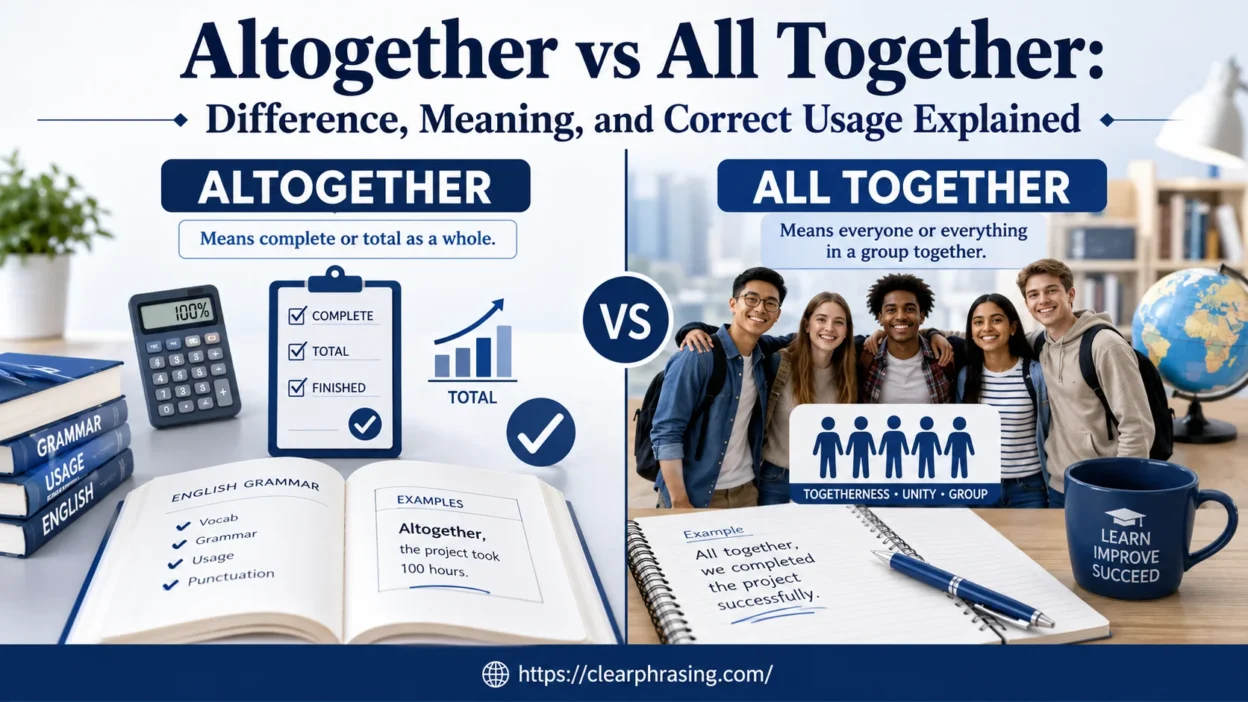
Altogether means completely, entirely, or in total, while All Together refers to a group doing something in one place or at the same time. These words have identical pronunciations, similar sounds, and similar spellings, but they have different meanings and are not interchangeable. As an English teacher, I often see students, English learners, writers, and even native English speakers confuse this word pair in academic writing, emails, essays, and reports.
Learning the difference, distinction, proper usage, grammar rules, usage rules, pronunciation, sentence structure, syntax, semantics, context, communication, clarity, vocabulary, and word choice helps you write with correct English, precision, fluency, readability, and confidence. This guide includes clear definitions, real examples, usage examples, sentence examples, proofreading, editing, and a side-by-side table to explain the subtle differences.
From my experience, mastering these grammar concepts makes everyday writing clearer and helps you avoid commonly confused words with confidence.
Quick Answer:
Altogether is one word that means completely, entirely, or in total.
Examples:
- The plan was altogether successful.
- The books cost $50 altogether.
All together is two words that means everyone or everything together in one place or at the same time.
Examples:
- The students stood all together for the picture.
- The family ate dinner all together.
A simple way to remember:
- Use altogether when you mean completely or the total amount.
- Use all together when you mean everyone or everything combined as a group.
Altogether vs All Together: Understanding the Main Difference
The biggest difference between altogether and all together is the idea each expression represents.
Altogether focuses on a complete situation, final result, or combined total.
All together focuses on a group of people or things existing or acting together.
Look at these examples:
| Sentence | Meaning |
| The repairs cost $300 altogether. | The total cost was $300. |
| The workers completed the project all together. | The workers worked as a group. |
| The movie was altogether confusing. | The movie was completely confusing. |
| The children played all together. | Every child played in the same group. |
The easiest way to separate them is to ask yourself one question:
Am I talking about a total or a group?
- Total or complete idea → altogether
- Group or shared action → all together
What Does Altogether Mean?
Altogether is an adverb. It modifies a word, phrase, or idea by showing completeness or a final total.
It has two main meanings:
- Completely or entirely
- In total or overall
The meaning depends on the sentence.
Altogether Meaning: Completely or Entirely
When altogether means completely, it shows that something is full, absolute, or complete.
Examples:
- The situation is altogether different now.
- Her explanation was altogether wrong.
- The experience was altogether unexpected.
In these sentences, altogether strengthens the description.
Compare these two sentences:
- The problem is different.
- The problem is altogether different.
The second sentence creates a stronger meaning. It tells the reader that the difference is complete.
Common phrases using this meaning include:
- altogether different
- altogether impossible
- altogether unnecessary
- altogether surprising
- altogether unusual
Example:
The results were altogether surprising.
Meaning:
The results were completely surprising.
Altogether Meaning: In Total or Overall
Altogether can also show the final amount after adding separate parts.
Examples:
- There were 75 people at the event altogether.
- The furniture cost $1,200 altogether.
- She answered 20 questions altogether.
Here, altogether works like “in total.”
For example:
You buy:
- A chair for $80
- A desk for $150
- A lamp for $40
The total price is:
$270 altogether.
The word combines all separate amounts into one final number.
Common Sentence Patterns With Altogether
You will often see altogether used in these structures:
Altogether + adjective
Examples:
- The idea was altogether impossible.
- The situation became altogether different.
Amount + altogether
Examples:
- We invited 40 guests altogether.
- The tickets cost $100 altogether.
Verb + altogether
Examples:
- The plan failed altogether.
- The machine stopped altogether.
These patterns can help you recognize when altogether is the correct choice.
What Does All Together Mean?
All together is a phrase made up of two separate words.
It describes people or things that are:
- In the same place
- Acting at the same time
- Combined into one group
The word all emphasizes that everyone or everything is included.
Examples:
- The students worked all together on the assignment.
- The family gathered all together during the holiday.
- The singers performed all together on stage.
The focus is not on a final result. The focus is on unity.
All Together Meaning: Everyone in One Place
One common use of all together is describing a group of people being in the same location.
Examples:
- The guests sat all together at one table.
- The team stood all together before the match.
- Everyone was all together in the meeting room.
In each sentence, the people are physically connected as a group.
All Together Meaning: Doing Something at the Same Time
“All together” can also describe actions happening simultaneously.
Examples:
- The audience clapped all together.
- The children shouted all together.
- The students repeated the answer all together.
The phrase shows that many people performed the same action at the same moment.
Altogether vs All Together Examples
Seeing both expressions side by side makes the difference clearer.
| Altogether | All Together |
| The answer was altogether incorrect. | The students answered all together. |
| We spent $500 altogether. | The team celebrated all together. |
| The situation is altogether different. | The family traveled all together. |
| There were 100 visitors altogether. | The singers performed all together. |
Notice the pattern:
Altogether describes a condition, result, or amount.
All together describes a group or shared activity.
How to Remember Altogether vs All Together Easily
Grammar rules become easier when you connect them with simple questions.
Use the Completely Test
Replace the word with completely.
If the sentence still makes sense, use altogether.
Example:
- The idea was altogether wrong.
- The idea was completely wrong.
Both sentences work.
Therefore, altogether is correct.
Use the Group Test
Ask:
“Am I talking about people or things being together?”
If yes, use all together.
Example:
- The children stood all together.
The sentence talks about a group standing in one place.
Common Mistakes With Altogether and All Together
Many people make mistakes because these expressions sound alike. Here are the most common problems.
Using All Together for Total Amounts
Incorrect:
- The products cost $200 all together.
Correct:
- The products cost $200 altogether.
Why?
The sentence talks about a total price, not a group.
Using Altogether for Group Actions
Incorrect:
- The employees attended the event altogether.
Correct:
- The employees attended the event all together.
Why?
The sentence describes people being present as one group.
Assuming They Are Just Different Spellings
Some writers think altogether and all together are interchangeable. They are not.
Compare:
The two reports are altogether different.
Meaning:
The reports are completely different.
The two reports are all together on the desk.
Meaning:
The reports are placed together in one location.
The spelling changes the meaning.
Altogether vs All Together in Everyday English
Both expressions appear often in daily conversations.
Examples with altogether:
- That movie was altogether amazing.
- The meal cost $40 altogether.
- There were 15 people altogether.
Examples with all together:
- Let’s take a picture all together.
- The children played all together.
- We arrived all together.
Learning this difference helps your spoken and written English sound more natural.
Altogether vs All Together in Professional Writing
Correct word choice matters in workplace communication. A small grammar mistake can create confusion.
Examples:
- The total expenses were $5,000 altogether.
- The department members attended the training all together.
The first sentence discusses a total amount.
The second sentence discusses a group of people.
Clear writing helps readers understand your message quickly.
Altogether vs All Together in Academic Writing
Students often use these expressions in reports and essays.
Examples:
- The results were altogether unexpected.
- The researchers collected 1,000 responses altogether.
- The participants worked all together during the experiment.
Academic writing requires precision. Choosing the correct word helps your ideas appear clearer and more professional.
Grammar Rules for Altogether vs All Together
Remember these important rules:
- Altogether is always written as one word.
- All together is always written as two words.
- Altogether often refers to completeness or totals.
- All together usually refers to groups.
- Pronunciation does not determine the correct spelling.
- Meaning and context decide which expression you should use.
Practice: Choose Altogether or All Together
Complete these sentences:
- The friends gathered ______ for dinner.
- The items cost $75 ______.
- The decision was ______ unexpected.
- The children laughed ______.
- There were 250 people ______ at the conference.
Answers:
- All together
- Altogether
- Altogether
- All together
- Altogether
Read More: Defence vs. Defense: Difference, Meaning, and Correct Usage
FAQs
What is the difference between altogether and all together?
Altogether means completely or in total. All together means a group of people or things are in the same place or doing something at the same time.
Is altogether one word or two words?
Altogether is always one word when it means completely, entirely, or in total. If you are talking about people or things being together, use the two-word form all together.
Can I use altogether and all together interchangeably?
No. Even though they sound the same, they have different meanings. Using the wrong one can change the meaning of your sentence.
How can I remember the difference between altogether and all together?
Think of all together as meaning all the people together. If you can replace it with “everyone together,” the two-word form is correct. Otherwise, altogether is usually the right choice.
Is altogether an adverb?
Yes. Altogether is an adverb that usually means completely, entirely, or in total. It modifies verbs, adjectives, or other adverbs.
Why do people confuse altogether and all together?
They are pronounced the same and have very similar spellings. Because of this, many writers choose the wrong form without noticing the difference in meaning.
Which form is more common in formal writing?
Both are correct in formal writing, but each must be used in the right context. Altogether is common when expressing totality, while all together is used for groups acting as one.
Are there grammar rules for using altogether and all together?
Yes. Use altogether when referring to completeness or total amounts. Use all together when describing people or things gathered or acting at the same time.
Can native English speakers make this mistake?
Yes. Many native English speakers occasionally confuse these terms because they sound identical in conversation, especially when writing quickly.
How can I avoid mistakes with altogether and all together?
Read your sentence carefully and ask yourself whether you mean completely or everyone together. A quick proofreading check is often enough to catch the error.
Conclusion
Understanding the difference between altogether and all together is easier than it first appears. Although they sound the same, each has a unique purpose in English. Altogether expresses a complete idea, while all together describes people or things acting as one group. Once you recognize this simple rule, choosing the correct form becomes much more natural.
The best way to master these words is through regular reading, writing, and practice. Pay attention to the meaning of your sentence before you choose either form, and always proofread your work. Over time, this small grammar point will become a habit, helping you write with greater clarity, accuracy, and confidence in every situation.

Shamsa Kanwal is an English specialist and content writer at ClearPhrasing.com, where she helps readers navigate the English language with confidence. She enjoys breaking down grammar rules, spelling differences, vocabulary, and everyday writing challenges into simple, practical lessons that anyone can understand.
Her writing is focused on making learning approachable rather than overwhelming. Whether she’s explaining commonly confused words, punctuation rules, or grammar concepts, Shamsa believes that clear explanations and real-life examples are the key to effective learning.
Every article she writes is carefully researched, fact-checked, and edited to ensure it is accurate, easy to read, and genuinely helpful. Her goal is to create trustworthy resources that enable students, professionals, writers, and English learners to improve their communication skills and write with greater clarity.
Through her work at ClearPhrasing.com, Shamsa is committed to making English learning simpler, more practical, and accessible for readers around the world.