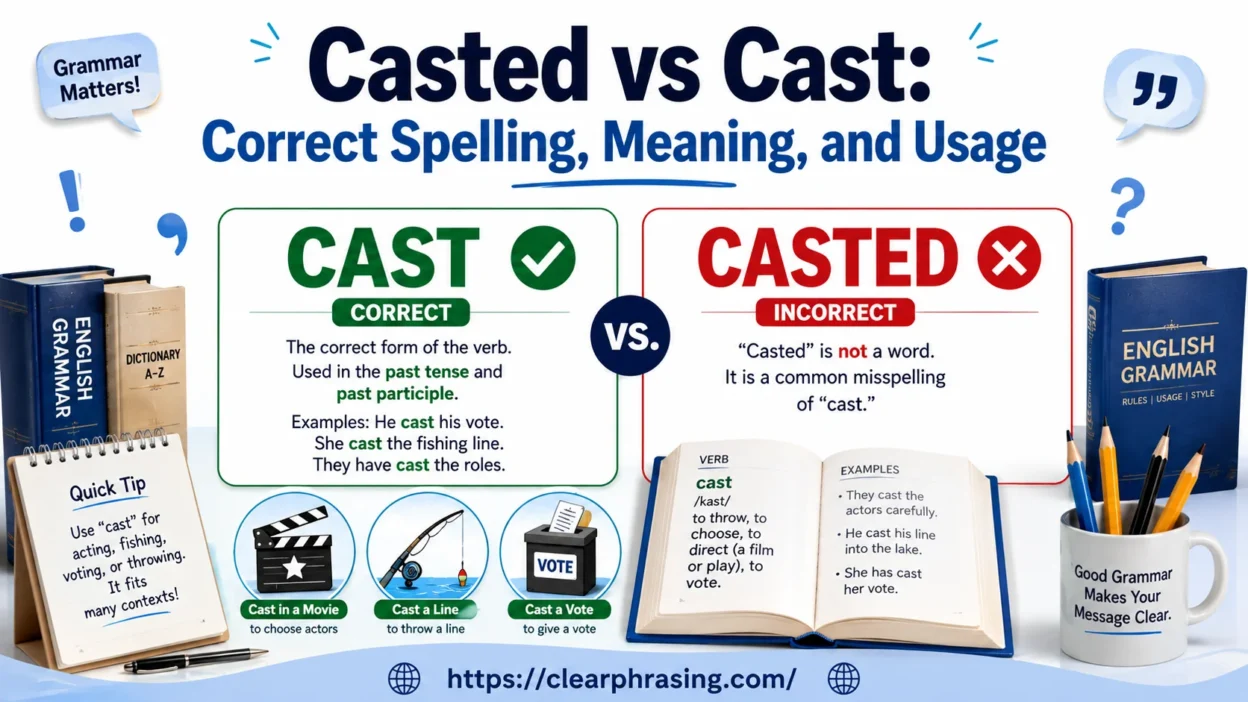
Casted vs Cast: Correct Spelling, Meaning, and Usage helps you understand why Cast is correct while Casted is usually incorrect in English.
Many English learners and English speakers find this difference confusing. Cast is an irregular verb, so it does not follow standard conjugation rules like regular verbs. You must memorize its past tense because the form never changes. If you compare cast vs. casted, the correct spelling, meaning, usage, and correct usage become clear. An example sentence is, “He cast a net yesterday,” which is correct, while “He casted a net yesterday” is incorrect.
As you continue reading, you will discover useful English grammar tips that improve writing, speaking, and communication. Understanding verb forms, present tense, tense, and context will help you use every word correctly. From my teaching experience, a simple example helps learners avoid confusion, remember the rule, and feel more confident when using Cast in different situations.
Quick Answer
If you’re wondering whether to use casted or cast, here’s the short answer:
- Cast is the correct present tense, past tense, and past participle in standard English.
- Casted is generally considered nonstandard in everyday English.
- Some technical fields, especially software programming, occasionally use casted as industry jargon.
- For school assignments, professional writing, exams, emails, and most conversations, always choose cast.
| Verb Form | Correct Word |
| Base Form | Cast |
| Present Tense | Cast |
| Past Tense | Cast |
| Past Participle | Cast |
| Present Participle | Casting |
Examples
1. ✅ She cast her vote early.
2. ✅ The producer cast two experienced actors.
3. ✅ They have cast the bronze sculpture.
❌ She casted her vote.
❌ The producer casted two experienced actors.
What Does “Cast” Mean?
The verb cast has several meanings, making it one of the most versatile verbs in English. Despite its many uses, its past tense never changes in standard grammar.
Cast Means to Throw Something
One of the oldest meanings of cast is to throw.
Examples
- The fisherman cast his line into the river.
- She cast the ball across the field.
- They cast stones into the lake.
Although “throw” is more common in casual conversation, cast often suggests a deliberate or skilled action rather than simply tossing something.
Cast Means to Assign Someone to a Role
In movies, television, theater, and commercials, cast means choosing actors or performers for specific roles.
Examples
- The director cast an award-winning actress as the lead.
- They cast several newcomers for the series.
- Netflix cast experienced performers for the historical drama.
This is one of the most common places where people mistakenly write casted instead of cast.
Cast Means to Shape Materials
Manufacturers use cast when pouring liquid metal, concrete, plaster, or other materials into molds.
Examples
- Workers cast the bridge supports from reinforced concrete.
- The artist cast the statue in bronze.
- Engineers cast steel components for heavy machinery.
Cast Means to Produce Light or Shadow
The verb also describes creating or projecting shadows, light, reflections, or doubt.
Examples
- The trees cast long shadows.
- Her statement cast doubt on the proposal.
- The setting sun cast a warm glow across the valley.
Cast Means to Vote
In elections and meetings, cast refers to submitting a vote.
Examples
- Citizens cast their ballots before noon.
- Every member cast one vote.
- The committee cast its final decision unanimously.
Is “Cast” an Irregular Verb?
Yes. Cast belongs to a group of irregular verbs whose forms remain unchanged in the past tense and past participle.
Unlike regular verbs that add -ed, irregular verbs follow their own historical patterns.
| Base Verb | Past Tense | Past Participle |
| Cast | Cast | Cast |
| Cut | Cut | Cut |
| Hit | Hit | Hit |
| Put | Put | Put |
| Set | Set | Set |
| Shut | Shut | Shut |
| Let | Let | Let |
Instead of memorizing each verb separately, it helps to recognize that several common English verbs never change.
Why Doesn’t the Past Tense Change?
English developed from several older languages, including Old English, Norse, and French. Over centuries, some verbs kept their original forms while others adopted the -ed ending.
Cast belongs to the group of verbs that retained the same spelling across multiple tenses. Although this may seem unusual at first, it’s a normal part of English grammar.
Why Do People Say “Casted”?
The mistake is understandable.
Most English verbs form the past tense by adding -ed.
For example:
- Walk → Walked
- Jump → Jumped
- Wash → Washed
- Cook → Cooked
After learning this pattern, many learners naturally assume that cast becomes casted. It follows the logic of regular verbs even though cast is irregular.
Children often make the same kind of mistake while learning English. They may say:
- Bringed instead of brought
- Buyed instead of bought
- Goed instead of went
- Casted instead of cast
These errors show that learners understand the general grammar rule but have not yet memorized the exceptions.
Why the Mistake Persists
Several factors keep casted alive.
- People hear it used informally.
- Some websites publish incorrect grammar.
- Specialized industries use the word differently.
- Non-native speakers apply regular verb rules.
Because of these influences, many people assume both forms are equally acceptable. Standard grammar, however, still favors cast.
Is “Casted” Ever Correct?
This question has a more nuanced answer.
While cast remains the correct choice in standard English, casted does appear in certain technical contexts.
Software Development
In computer programming, developers often discuss casting data from one type to another.
You may see sentences like:
- The value was casted to an integer.
- The object was automatically casted.
Many programming teams use this wording because it mirrors technical processes inside programming languages.
However, technical documentation varies. Many experienced developers still prefer writing:
- The value was cast to an integer.
- The object was converted to another type.
Both styles appear in programming communities, but this usage should not be carried into general English writing.
Broadcasting and Media
Some production crews casually say an actor was casted for a commercial or television show.
Even so, professional publications, entertainment magazines, and major news organizations overwhelmingly write:
- The actor was cast in the role.
That remains the preferred form in edited English.
Regional and Informal Speech
Certain regional dialects occasionally use casted in conversation.
Language naturally changes over time, and local expressions often differ from formal grammar. Nevertheless, dictionaries and style guides continue to recommend cast for standard written English.
Cast vs Casted in Everyday Writing
If you’re writing for school, work, publishing, or professional communication, the decision is easy.
| Situation | Recommended Form |
| Academic writing | Cast |
| Business emails | Cast |
| News articles | Cast |
| Books | Cast |
| Professional reports | Cast |
| Everyday conversation | Cast |
| Programming discussions | Usually Cast, sometimes Casted |
A helpful rule is simple:
If your audience expects standard English, always use “cast.”
Real-Life Examples Using Cast
Seeing the verb in context makes the grammar rule much easier to remember. Notice that cast stays the same whether the action happened yesterday or years ago.
Examples with “Cast”
- The director cast the perfect actor for the role.
- She cast her vote before the polls closed.
- The fisherman cast his line into the lake at sunrise.
- The company cast the machine parts from stainless steel.
- Clouds cast long shadows across the mountains.
- The magician cast a spell in the fantasy novel.
- The architect cast the concrete foundation last week.
- They have cast several experienced performers for the new series.
- The judge cast the deciding vote.
- Engineers cast the bridge supports using reinforced concrete.
Every sentence above follows standard English grammar.
Examples Where “Casted” Appears
Although casted isn’t the standard form, you may encounter it in specialized fields.
Examples include:
- The object was casted to a different data type.
- The variable was automatically casted during compilation.
- The software casted the value into an integer.
These examples come primarily from programming discussions and technical forums. Outside those settings, cast remains the better choice.
What Major Dictionaries Say About Cast vs Casted
The leading English dictionaries agree on one point: cast is the standard past tense and past participle.
| Dictionary | Preferred Past Tense | Notes |
| Merriam-Webster | Cast | Standard English usage |
| Cambridge Dictionary | Cast | Lists cast as an irregular verb |
| Oxford English Dictionary | Cast | Recognizes cast as the accepted form |
| Collins Dictionary | Cast | Recommends cast for all standard contexts |
| American Heritage Dictionary | Cast | Uses cast as past tense and past participle |
Across major dictionaries, the consensus is clear. While casted occasionally appears in niche contexts, cast remains the accepted grammatical choice for general English.
Grammar Rule to Remember
The easiest way to avoid mistakes is to remember one simple sentence:
If you can use the present tense “cast,” you can almost always use “cast” for the past tense as well.
Think of these examples:
- Today I cast my vote.
- Yesterday I cast my vote.
- We have cast our votes.
The verb never changes.
Common Expressions That Use “Cast”
The verb appears in many everyday expressions. Learning them will make your English sound more natural.
Cast a Vote
Meaning: To officially vote in an election or meeting.
Example: Thousands of citizens cast their votes before noon.
Cast a Spell
Meaning: To perform magic in stories or fantasy writing.
Example: The wizard cast a powerful spell.
Cast Doubt
Meaning: To make someone question or distrust something.
Example: New evidence cast doubt on the witness’s testimony.
Cast Light On
Meaning: To explain or clarify something.
Example: The latest research casts light on climate patterns.
Cast Shadows
Meaning: To create shadows.
Example: Tall trees cast long shadows across the field.
Cast Blame
Meaning: To accuse someone of responsibility.
Example: Nobody wanted to cast blame before the investigation ended.
Cast Aside
Meaning: To reject or ignore.
Example: She cast aside her fears and accepted the opportunity.
Cast Your Eyes
Meaning: To look at something.
Example: Cast your eyes toward the horizon.
These expressions have existed for centuries and always use cast, never casted.
Common Mistakes and How to Avoid Them
Many learners repeat the same errors because they assume cast follows the regular -ed pattern.
| Incorrect | Correct |
| She casted her vote. | She cast her vote. |
| The movie casted Tom Hanks. | The movie cast Tom Hanks. |
| They have casted the actor. | They have cast the actor. |
| He was casted in the role. | He was cast in the role. |
| The company casted the bridge. | The company cast the bridge. |
Memory Tips
- Think of cut, put, and hit. They never change.
- Group cast with those verbs.
- If you’re unsure, remove the time reference. The verb will usually stay cast.
- In formal writing, avoid casted unless you’re intentionally using technical programming language.
Cast vs Other Irregular Verbs
English contains several verbs that don’t change in the past tense.
| Base Verb | Past Tense | Past Participle |
| Cast | Cast | Cast |
| Cut | Cut | Cut |
| Hit | Hit | Hit |
| Put | Put | Put |
| Let | Let | Let |
| Set | Set | Set |
| Shut | Shut | Shut |
| Cost | Cost | Cost |
Learning these verbs together makes them much easier to remember.
Casted vs Cast in American and British English
Many people wonder whether one form belongs to American English and the other to British English.
The answer is simple.
Both American English and British English use cast as the correct past tense.
Examples from both varieties include:
- The BBC cast several experienced actors.
- Netflix cast a new lead actress.
- The committee cast its votes.
Neither variety officially recommends casted in ordinary writing.
The small differences that exist are mostly limited to technical industries rather than regional grammar.
Key Takeaways
Before finishing, remember these important points:
- Cast is the correct present tense, past tense, and past participle.
- Casted is generally considered nonstandard in everyday English.
- Some programmers and technical writers occasionally use casted, but this doesn’t change the standard grammar rule.
- Professional writing, academic work, journalism, and business communication should always use cast.
- Learning unchanged irregular verbs will help you avoid similar mistakes in the future.
Read More: Feet vs. Feat: Meaning, Correct Usage and Difference
FAQs
Is cast or casted the correct past tense?
Cast is the correct past tense of the verb cast in almost every situation. Casted is considered incorrect in standard English except in a few specialized technical or industry-specific uses.
Why is cast an irregular verb?
Cast is an irregular verb because it does not change its spelling in the past tense or past participle. It stays cast instead of becoming casted.
Is it ever correct to say casted?
In general English, no. However, some technical fields, such as software development or certain manufacturing processes, may use casted in specialized contexts.
Which is correct: “He cast the net” or “He casted the net”?
“He cast the net” is the correct sentence. “He casted the net” is incorrect in standard English grammar.
How can I remember the correct form?
Remember that cast works like other irregular verbs that keep the same form in different tenses. Practice using it in sentences until it becomes natural.
Does cast change in the present, past, and past participle?
No. The verb remains cast in the present tense, past tense, and past participle.
Is casted accepted in formal writing?
No. Formal writing, academic papers, and most style guides recommend using cast instead of casted.
Why do many learners use casted?
Many learners apply the regular -ed rule to every verb. Since cast is irregular, this common pattern leads to the mistake.
What are some common uses of the verb cast?
You can use cast when talking about throwing a fishing net, casting a vote, casting a movie actor, creating a metal object in a mold, or casting a spell.
How can I avoid confusing cast and casted?
Read quality English materials, practice writing sentences with cast, and remember that if the verb is cast, its past tense is also cast.
Conclusion
The difference between cast and casted is simple once you understand how irregular verbs work. Although casted may sound natural because many English verbs add -ed in the past tense, cast follows a different pattern. Using the correct form improves your grammar, makes your writing clearer, and helps you communicate with confidence in both formal and informal situations.
From my experience teaching English for many years, this is one of the most common mistakes students make. Once they learn that cast never changes in standard English, the confusion disappears quickly. Keep practicing with real examples, pay attention to context, and you’ll naturally choose the correct word every time.

Shamsa Kanwal is an English specialist and content writer at ClearPhrasing.com, where she helps readers navigate the English language with confidence. She enjoys breaking down grammar rules, spelling differences, vocabulary, and everyday writing challenges into simple, practical lessons that anyone can understand.
Her writing is focused on making learning approachable rather than overwhelming. Whether she’s explaining commonly confused words, punctuation rules, or grammar concepts, Shamsa believes that clear explanations and real-life examples are the key to effective learning.
Every article she writes is carefully researched, fact-checked, and edited to ensure it is accurate, easy to read, and genuinely helpful. Her goal is to create trustworthy resources that enable students, professionals, writers, and English learners to improve their communication skills and write with greater clarity.
Through her work at ClearPhrasing.com, Shamsa is committed to making English learning simpler, more practical, and accessible for readers around the world.