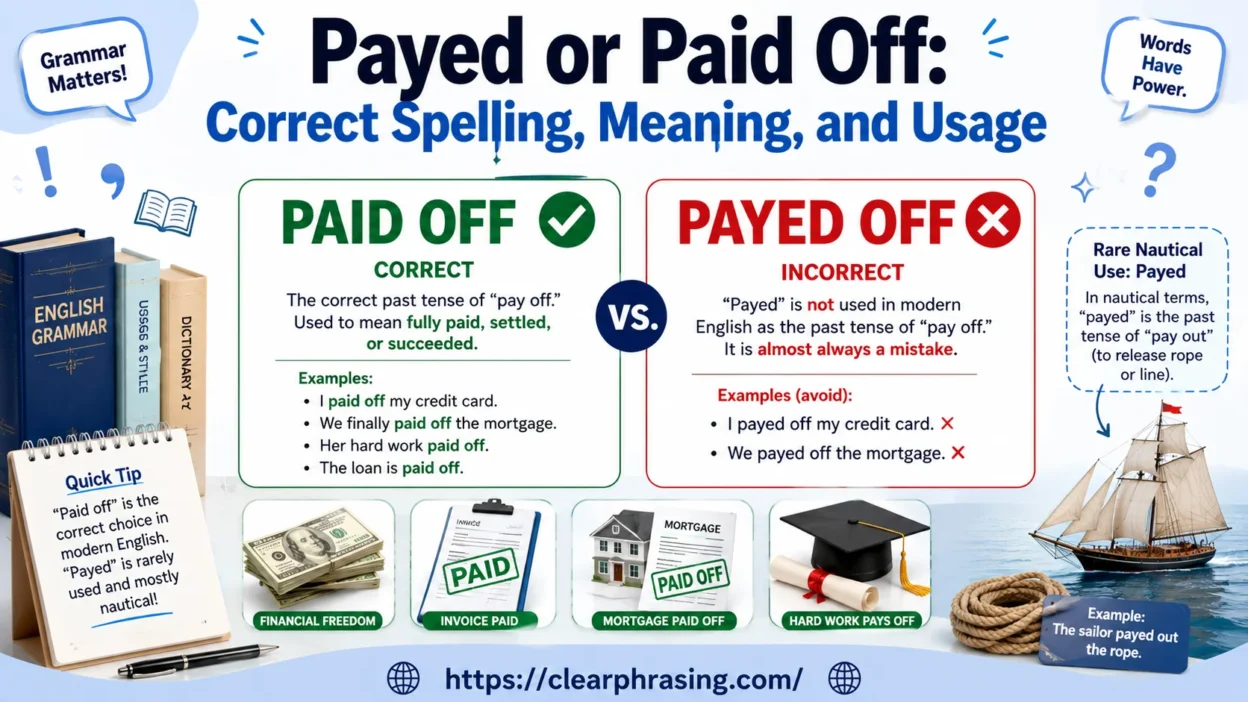
Payed or Paid Off: Correct Spelling, Meaning, and Usage explains the correct spelling and usage with simple English examples for everyday writing.
Many people pause and second-guess Payed, Paid, and Paid Off because they have the same pronunciation but different meanings. From my teaching experience, this common mistake creates spelling confusion and word confusion. Learning the difference through grammar, Correct Spelling, word usage, context, vocabulary, sentence examples, comparison, and explanation improves communication, proofreading, and writing skills.
Paid relates to money, payment, finance, bills, and financial terms, while Payed belongs to nautical and maritime language. It describes a ship, rope, or cable that sailors let out, slacken, or release during sailing. Discover this simple rule through trusted Language Resources, and the correct choice will become easy every time.
Quick Answer: Payed or Paid Off?
If you’re talking about money, debt, bills, success, effort, or results, the correct phrase is paid off.
✅ Correct: My student loan was paid off last month.
✅ Correct: All the extra practice paid off during the competition.
❌ Incorrect: My student loan was payed off last month.
❌ Incorrect: Her hard work payed off in the end.
The word payed is not the normal past tense of pay. Instead, it is a specialized nautical term used when talking about ships, ropes, or sealing wooden vessels with tar. Unless you’re writing about maritime history or sailing, you almost certainly need paid.
| Expression | Correct? | When to Use It |
| Paid off | ✅ Yes | Money, debts, loans, success, rewards, achievements |
| Payed off | ❌ Usually No | Incorrect in standard English |
| Payed | ✅ Rarely | Only in nautical contexts involving ships or ropes |
Why “Paid Off” Is Correct
English contains many irregular verbs, and pay is one of them. Instead of simply adding -ed to form the past tense, the spelling changes completely.
Here is how the verb changes:
| Verb Form | Word |
| Base Form | Pay |
| Present Participle | Paying |
| Past Tense | Paid |
| Past Participle | Paid |
This pattern has existed for centuries and appears consistently in modern dictionaries, newspapers, academic writing, and professional communication.
For example:
- She paid the invoice yesterday.
- We finally paid off the mortgage.
- Their investment paid off after several years.
- He paid for everyone’s lunch.
Notice that paid appears in every example. You won’t find payed used this way in edited publications because it is grammatically incorrect outside maritime language.
The Verb “Pay” Has an Irregular Past Tense
Unlike regular verbs such as walk → walked or jump → jumped, some English verbs change their spelling completely.
Here are several examples:
| Base Verb | Past Tense |
| Pay | Paid |
| Say | Said |
| Lay | Laid |
| Make | Made |
| Sell | Sold |
| Tell | Told |
| Think | Thought |
These verbs don’t follow the standard -ed pattern. Instead, they developed unique forms through the history of the English language.
That’s why writing payed instead of paid is similar to writing maked instead of made. It may seem logical, but it isn’t correct.
Why English Doesn’t Use “Payed” as the Normal Past Tense
Many spelling mistakes happen because writers assume every verb becomes past tense by adding -ed.
That works for regular verbs like:
- Play → Played
- Watch → Watched
- Work → Worked
- Clean → Cleaned
However, English contains hundreds of irregular verbs that don’t follow this rule.
Since pay belongs to this group, its correct past tense is paid.
Understanding this single rule will help you avoid one of the internet’s most common grammar mistakes.
Dictionaries Recognize “Paid” as the Standard Form
Major dictionaries agree that paid is the standard past tense and past participle of pay.
You’ll find paid used in contexts such as:
- Paying employees
- Paying taxes
- Paying rent
- Paying bills
- Paying for services
- Paying debts
- Paying attention
- Paying respect
Every one of these expressions uses paid, not payed.
What Does “Paid Off” Mean?
The phrase paid off has several meanings depending on the situation. Although the wording stays the same, the idea changes with context.
Paying a Debt Completely
This is the most literal meaning.
When you pay off something, you’ve paid every dollar you owe. Nothing remains outstanding.
Examples:
- She paid off her student loans five years early.
- They finally paid off their mortgage.
- We paid off the car before selling it.
- He paid off every credit card balance.
In finance, becoming debt-free is often described as paying off a loan or obligation.
Hard Work Leading to Success
This is probably the most common figurative meaning.
It means that effort eventually produced the desired result.
Examples:
- Months of studying paid off with excellent exam scores.
- Daily practice paid off during the championship.
- Her patience finally paid off after years of research.
- The company’s investment in training paid off.
This expression emphasizes that success didn’t happen by accident. It happened because someone invested time, effort, or resources.
Producing a Positive Result
Sometimes paid off refers to any decision that turns out well.
Examples include:
- Buying quality equipment paid off in the long run.
- Changing careers paid off financially.
- Hiring experienced staff paid off quickly.
- Their marketing strategy paid off with record sales.
Here, the phrase highlights a favorable outcome rather than a financial payment.
Everyday Uses of “Paid Off”
You’ll hear this expression in many situations.
Education
- Extra tutoring paid off.
- Reading every day paid off during exams.
Business
- The advertising campaign paid off.
- Customer service improvements paid off.
Sports
- The coach’s strategy paid off.
- Early morning training paid off.
Personal Life
- Saving consistently paid off.
- Healthy eating paid off with better energy.
Because it’s so versatile, paid off has become one of the most common expressions in spoken and written English.
What Does “Payed” Actually Mean?
Although payed is almost always incorrect in everyday writing, it is a real English word.
Its meaning belongs almost entirely to the world of ships and sailing.
Sealing the Seams of a Ship
Historically, sailors payed a ship by covering wooden seams with hot tar, pitch, or waterproof material.
This process prevented water from leaking into the vessel.
Example:
- The crew payed the hull before beginning the voyage.
Today, this meaning appears mainly in historical books, naval documents, and maritime museums.
Letting Out Rope or Cable
Another nautical meaning involves slowly releasing rope, anchor chain, or cable.
Example:
- The sailors payed out the anchor line carefully.
- They payed out more rope as the ship approached the harbor.
Outside maritime settings, most people will never encounter this usage.
Why Most Writers Never Need This Word
Unless you’re writing about:
- Sailing
- Naval history
- Shipbuilding
- Maritime engineering
- Historical seafaring
You almost certainly don’t need payed.
For everyday communication, business writing, school assignments, emails, blogs, and social media posts, paid is the correct choice every time.
“Paid Off” vs. “Payed Off”: Side-by-Side Comparison
| Feature | Paid Off | Payed Off |
| Standard English | ✅ Yes | ❌No |
| Financial writing | ✅ Yes | ❌No |
| Academic writing | ✅ Yes | ❌ No |
| Business communication | ✅ Yes | ❌ No |
| Everyday conversation | ✅ Yes | ❌ No |
| Refers to success or achievement | ✅ Yes | ❌ No |
| Maritime terminology | ❌ No | ✅ Rarely, with the nautical meaning of “payed” |
The comparison makes the choice simple. If you’re discussing money, effort, achievement, or results, paid off is always the correct expression.
Examples of “Paid Off” in Sentences
Money and Debt
- She paid off her home loan ten years ahead of schedule.
- We finally paid off the family car.
- He paid off every outstanding bill before moving.
- They paid off their credit cards to improve their credit score.
Work and Career
- Staying late every week paid off with a promotion.
- Learning new software paid off during the interview.
- Her dedication paid off after months of hard work.
- Building strong relationships with clients paid off over time.
Education
- Daily revision paid off on exam day.
- Practicing English every evening paid off with higher test scores.
- Reading one chapter a day paid off during finals.
- Consistent effort paid off throughout the semester.
Investments
- Investing early paid off after several years.
- Their patience paid off as the stock value increased.
- Buying property in that neighborhood paid off significantly.
- Long-term planning paid off financially.
Business
- Listening to customer feedback paid off with increased sales.
- Expanding into new markets paid off faster than expected.
- Improving product quality paid off through repeat business.
- Hiring experienced employees paid off in productivity.
Examples of “Paid” in Correct Sentences
The word paid appears in countless situations because it serves as both the past tense and past participle of pay. You’ll see it in everyday conversations, business communication, financial documents, and academic writing.
Everyday Examples
- I paid the electricity bill this morning.
- She paid for dinner last night.
- We paid our taxes before the deadline.
- They paid cash for the furniture.
- He paid the contractor after the work was completed.
Business Examples
- The company paid all invoices on time.
- Customers paid online using a secure payment system.
- The client paid the final installment yesterday.
- Employees were paid every two weeks.
- Investors paid close attention to the quarterly report.
Figurative Examples
Not every use of paid involves money.
- She paid attention during the lecture.
- They paid tribute to the firefighters.
- The team paid respect to their retiring coach.
- He paid little notice to the criticism.
These expressions have become standard English idioms and should never be written with payed.
Examples of “Payed” in Correct Sentences
Although uncommon, payed is still a legitimate English word in specialized maritime writing.
Historical Maritime Examples
- Sailors payed the wooden hull with hot tar before sailing.
- The crew carefully payed the seams to prevent leaks.
- Workers payed the deck before the vessel left port.
Rope and Cable Examples
- The captain ordered the crew to payed out more anchor chain.
- They slowly payed out the rope during the rescue operation.
- The sailors payed the cable carefully to avoid tangles.
Outside these technical meanings, using payed is considered incorrect.
Common Mistakes People Make
Many writers confuse paid and payed because English spelling isn’t always predictable. Fortunately, once you understand the grammar rule, the mistake becomes easy to avoid.
Assuming Every Verb Ends in “-ed”
One of the biggest mistakes is believing every past tense verb simply adds -ed.
For example:
- Walk → Walked ✅
- Jump → Jumped ✅
- Work → Worked ✅
Because of this pattern, some writers incorrectly assume:
- Pay → Payed ❌
However, pay is an irregular verb, so its correct past tense is paid.
Confusing Spelling With Pronunciation
Since paid and payed sound exactly alike, many people choose the wrong spelling.
This happens often in:
- Emails
- Social media posts
- Blog comments
- School assignments
Remember that identical pronunciation doesn’t always mean identical spelling.
Trusting Incorrect Online Examples
Not every website follows proper grammar standards.
Some blogs, forums, or social media posts contain spelling mistakes that spread quickly because readers assume they’re correct.
Whenever you’re unsure, rely on reputable dictionaries and respected style guides instead of random online examples.
Ignoring Context
Even though payed is a real word, it belongs only to maritime language.
Ask yourself one simple question:
Am I writing about ships, ropes, or sealing wooden vessels?
If the answer is no, then you almost certainly need paid.
Why “Pay” Becomes “Paid”
English developed over many centuries. During that time, some verbs changed naturally instead of following modern spelling patterns.
The verb pay adopted paid as its past tense long ago, and that form became the accepted standard.
Understanding Irregular Verbs
Irregular verbs don’t follow a single rule. Instead, each has its own historical development.
Here are some familiar examples:
| Base Verb | Past Tense | Past Participle |
| Pay | Paid | Paid |
| Say | Said | Said |
| Lay | Laid | Laid |
| Make | Made | Made |
| Sell | Sold | Sold |
| Tell | Told | Told |
| Buy | Bought | Bought |
| Teach | Taught | Taught |
| Think | Thought | Thought |
Learning these verbs takes practice, but they quickly become second nature because they’re used so frequently.
“Paid Off” in Common Expressions
The phrase paid off appears in many everyday expressions. In each case, it refers either to completing a payment or achieving a successful outcome.
Financial Expressions
- Paid off the mortgage
- Paid off the loan
- Paid off the debt
- Paid off the credit card
- Paid off the balance
- Paid off the medical bills
Each phrase means that nothing remains owed.
Success-Related Expressions
- Hard work paid off.
- The risk paid off.
- The investment paid off.
- The strategy paid off.
- Their patience paid off.
- The training paid off.
These expressions describe effort leading to positive results.
Business Expressions
- The advertising campaign paid off.
- The new software paid off.
- Staff training paid off.
- Better customer service paid off.
- The expansion paid off.
Businesses often use this phrase when discussing return on investment or successful decisions.
“Paid Off” in Business and Finance
In finance, paid off has a very specific meaning. It indicates that a financial obligation has been completed.
Loans
When someone pays off a loan, they have repaid the entire borrowed amount plus any required interest.
Example:
- She paid off her personal loan two years early.
Credit Cards
Paying off a credit card balance means eliminating outstanding debt.
Benefits include:
- Lower interest costs
- Better credit utilization
- Improved financial flexibility
- Reduced financial stress
Mortgages
Many homeowners celebrate the day they finally pay off their mortgage because they own their home free and clear.
Example:
- After thirty years, they finally paid off their mortgage.
Student Loans
Graduates often spend years paying off education debt.
Making additional payments can reduce total interest and shorten the repayment period.
Business Investments
Companies also say an investment paid off when it produces measurable benefits such as:
- Higher profits
- Increased productivity
- Greater customer satisfaction
- Improved efficiency
- Long-term growth
“Paid Off” in Everyday English
Beyond finance, paid off has become a common expression for success.
At Work
- Volunteering for extra projects paid off.
- Building leadership skills paid off.
- Networking paid off during the hiring process.
At School
- Studying every day paid off.
- Asking questions in class paid off.
- Completing practice exams paid off.
In Sports
- Daily training paid off.
- Better teamwork paid off.
- Improved fitness paid off.
In Personal Life
- Saving consistently paid off.
- Learning a new language paid off.
- Developing healthy habits paid off.
These examples show why paid off has become one of the most flexible expressions in modern English.
Grammar Rule You Should Remember
If you’re unsure whether to write paid off or payed off, remember this simple rule:
Use “paid” whenever you’re talking about money, bills, salaries, debts, purchases, success, rewards, effort, or positive results.
Use “payed” only when discussing:
- Sealing a ship with tar
- Letting out rope or cable
- Specialized maritime operations
For nearly every writer, paid is the correct choice.
Memory Trick to Never Confuse Them Again
Here’s an easy way to remember the correct spelling.
Think of this sentence:
Bills are paid—not payed.
You can also remember that paid shares the same vowel pattern as said and laid.
Another helpful shortcut:
- Money = Paid
- Ships = Payed
If your sentence has nothing to do with sailing, write paid with confidence.
Words Commonly Confused With “Paid”
Many English words create similar spelling problems.
| Correct | Incorrect |
| Paid | Payed |
| Said | Sayed |
| Laid | Layed |
| Made | Maked |
| Sold | Selled |
Correct only in specialized maritime contexts.
Recognizing these irregular verbs will improve both your grammar and your confidence as a writer.
Read More: Casted vs Cast: Correct Spelling, Meaning, and Usage
FAQs
Is paid off the correct spelling instead of payed off?
Yes. Paid off is the correct phrase when talking about paying a debt, loan, bill, or receiving a benefit. Payed off is almost never correct in everyday English.
When should I use payed?
Use payed only in nautical contexts. It refers to letting out or coating a rope, cable, or ship with tar. It is not used for financial payments.
Why do people confuse payed and paid?
They sound the same when spoken, so many writers assume both spellings work in every situation. In reality, each word has a different meaning and usage.
Is paid off used only for money?
No. Besides finances, paid off can also mean that hard work, patience, or a plan produced successful results.
Is payed an old English word?
Yes. It is an older term that survives mainly in maritime writing and is rarely seen in general English.
Can I write “I payed my bills”?
No. The correct sentence is “I paid my bills.” Using payed in this context is a spelling mistake.
How can I remember the difference?
Think about money. If the sentence involves paying money, always choose paid. Reserve payed for ships, ropes, and other nautical topics.
Is paid off common in business writing?
Yes. It is widely used in business, banking, accounting, and everyday communication when discussing debts, investments, or successful outcomes.
Are paid and payed pronounced differently?
No. They have the same pronunciation, which is one reason many learners confuse them in writing.
Will using payed instead of paid affect my writing?
Yes. In most situations, it appears as a spelling error and can reduce the clarity and professionalism of your writing.
Conclusion
Understanding the difference between payed, paid, and paid off helps you write with confidence. Although they sound alike, their meanings are very different. In almost every everyday situation involving money, salaries, bills, or debts, paid and paid off are the correct choices.
As an English teacher, I have noticed that students remember this rule much faster once they connect paid with finances and payed with sailing. Keeping that simple distinction in mind will improve your grammar, reduce common spelling mistakes, and make your writing clearer and more accurate.

Mehwish Imtiaz is an English specialist and professional blog writer at ClearPhrasing.com. She specializes in grammar, spelling, vocabulary, punctuation, and writing improvement. With a strong passion for clear communication and language education, she creates reader-friendly articles that help students, professionals, and English learners understand complex language topics with ease.
Her writing focuses on accuracy, simplicity, and practical usage, ensuring that every article provides clear explanations and real-world examples. At ClearPhrasing.com, Mehwish is committed to publishing well-researched, original content that helps readers write more confidently and communicate more effectively in everyday and professional English.