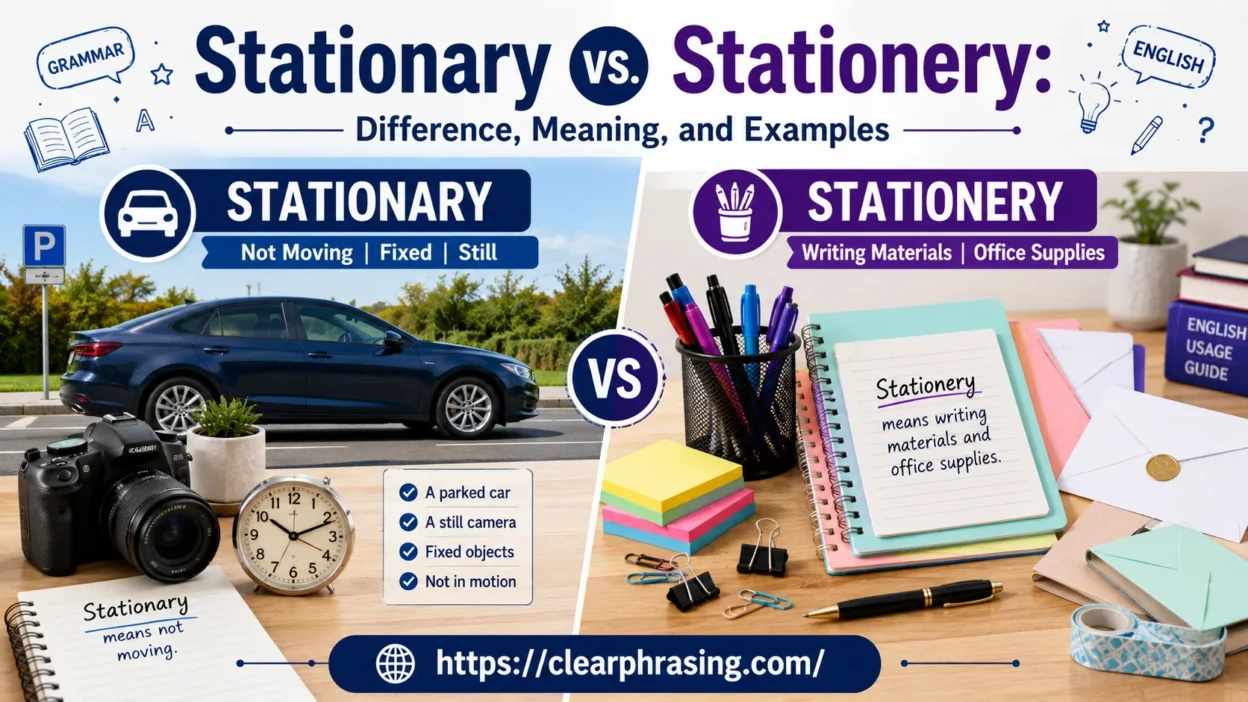
Stationary vs. Stationery: Difference, Meaning, and Examples helps you avoid common English writing mistakes with clear rules and practical examples.
Welcome to this guide. These homophones have a similar sound but different meanings, causing confusion in English writing and academic writing. This post explains their meaning, usage, difference, definitions, grammar, spelling, vocabulary, pronunciation, word choice, and correct usage through a simple comparison that improves understanding, communication, learning, accuracy, and every context.
As an English teacher, I use simple tricks to help students remember the difference. Stationary refers to something not moving, still, or in a fixed position, like a parked car. Stationery indicates writing materials such as paper, envelopes, notebook, pen, and pencil used to write a letter or correspondence.
Think of the letter e for envelope to recall the correct word. This simple idea builds a solid grasp and helps every learner avoid embarrassing mistakes.
Quick Answer:
The difference between stationary and stationery is based on their meanings and uses.
| Word | Meaning | Part of Speech | Example |
| Stationary | Something that stays still or does not move | Adjective | The car remained stationary during the traffic jam. |
| Stationery | Writing materials like paper, pens, and envelopes | Noun | She bought new stationery for her office. |
A simple way to remember:
- Stationary = Still
- Stationery = Supplies
If you are talking about movement, choose stationary. If you are talking about writing products, choose stationery.
What Does Stationary Mean?
Stationary means staying in one place without moving. It describes an object, person, vehicle, or situation that remains fixed or still.
The word is an adjective, which means it gives information about a noun. It tells you the condition or position of something.
For example:
- The bicycle remained stationary outside the house.
- The train was stationary at the platform.
- The camera needs to stay stationary while recording.
- The machine must remain stationary during maintenance.
Think about a parked car. The car exists in one location and does not move. The car is stationary.
The main idea behind stationary is lack of movement.
Common Uses of Stationary
The word stationary appears in many everyday and professional situations.
Transportation
Vehicles often become stationary when they stop temporarily.
Examples:
- The bus remained stationary because of heavy traffic.
- The airplane stayed stationary before takeoff.
- The truck was stationary near the loading area.
Science and Technology
Scientists and engineers often use stationary to describe stable objects or systems.
Examples:
- The researchers studied a stationary object.
- The equipment must stay stationary to produce accurate results.
- A stationary camera captures stable images.
Everyday Situations
People use stationary when describing anything that remains still.
Examples:
- Keep the phone stationary while taking a picture.
- The child stood stationary during the performance.
- The dog remained stationary after hearing the command.
What Does Stationery Mean?
Stationery refers to materials used for writing, printing, and office work.
Unlike stationary, which describes a condition, stationery is a noun because it names things.
Common examples of stationery include:
- Paper
- Pens
- Pencils
- Envelopes
- Notebooks
- Letterheads
- Folders
- Business cards
- Greeting cards
Examples:
- I need new stationery for my classes.
- The company ordered branded stationery.
- She organized her stationery in a desk drawer.
Whenever you think about writing tools or paper products, stationery is usually the correct choice.
Types of Stationery
Stationery appears in different areas of life. It is not limited to school supplies.
| Type of Stationery | Examples |
| Personal stationery | Letter paper, envelopes, notebooks |
| Business stationery | Letterheads, invoices, business cards |
| School stationery | Pens, pencils, folders, notebooks |
| Event stationery | Invitations, thank-you cards |
| Digital stationery | Templates, printable planners |
Businesses often use professional stationery to create a consistent brand image. A company letterhead or business card represents the organization and helps maintain a professional appearance.
Stationary vs. Stationery: Key Differences Explained
Although these words sound identical, their meanings are completely different.
| Feature | Stationary | Stationery |
| Meaning | Not moving or fixed | Writing materials |
| Word type | Adjective | Noun |
| Main idea | Stillness | Writing supplies |
| Example | A stationary vehicle | Office stationery |
A simple question can help you choose the correct word:
Is it about movement?
Use stationary.
Example:
- The bicycle is stationary.
Is it about writing materials?
Use stationery.
Example:
- I bought new stationery.
Why Do Stationary and Stationery Sound the Same?
English contains many words that share pronunciation but have different meanings. These words are called homophones.
Both stationary and stationery are pronounced:
/ˈsteɪʃəneri/
Because they sound identical, people often depend on memory or context to choose the correct spelling.
The spelling difference provides a helpful clue:
- Stationary → A can remind you of at rest
- Stationery → E can remind you of envelope
These small connections make the difference easier to remember.
Memory Tricks for Stationary vs. Stationery
Stationary Has “A” for At Rest
The letter A in stationary can remind you that something is at rest.
Example:
- The vehicle remained stationary.
The vehicle stopped moving.
Stationery Has “E” for Envelope
The letter E in stationery can remind you of an envelope.
Example:
- She purchased beautiful stationery for writing letters.
Focus on the Meaning
Ask yourself:
- Does something stay still? → Stationary
- Is it used for writing? → Stationery
This simple habit can prevent spelling mistakes.
Common Mistakes When Using Stationary and Stationery
Mistake 1: Using Stationery for Something That Does Not Move
Incorrect:
- The car was stationery outside the building.
Correct:
The car was stationary outside the building.
The car is not a writing product. It is simply not moving.
Mistake 2: Using Stationary for Writing Materials
Incorrect:
- I bought new stationary for my office.
Correct:
- I bought new stationery for my office.
Office supplies require the spelling stationery.
Mistake 3: Using Stationeries Incorrectly
Many people write “stationeries” when talking about multiple writing supplies. However, stationery is usually an uncountable noun.
Correct:
- I bought some stationery.
Better:
- I bought three notebooks and five pens.
Stationary vs. Stationery in Different Contexts
The correct word depends on what you are describing.
Business Communication
Professional communication often involves stationery.
Examples of business stationery:
- Company letterheads
- Official envelopes
- Printed forms
- Business cards
Example:
- The company redesigned its stationery with a new logo.
However, stationary can also appear in business contexts.
Example:
- The delivery vehicle remained stationary outside the office.
Education
Students use stationery regularly for learning.
Examples:
- Bring your stationery before the exam.
- The teacher asked students to keep the model stationary.
The first sentence refers to supplies. The second sentence refers to something staying still.
Technology and Science
Stationary is common in technical fields.
Examples:
- A stationary camera creates stable video.
- The device must remain stationary during testing.
Modern stationery can also include digital products such as online templates and printable planners.
Related Words That Cause Confusion
Some words look similar because they share the same root.
| Word | Meaning | Example |
| Station | A place where something stops | The train arrived at the station. |
| Stationary | Not moving | The train remained stationary. |
| Stationery | Writing materials | She purchased stationery. |
Understanding these related words helps you recognize their differences.
Grammar Rules for Stationary vs. Stationery
Stationary as an Adjective
Stationary describes a noun.
Examples:
- A stationary bike
- A stationary object
- A stationary position
It explains that something remains still.
Stationery as a Noun
Stationery names writing materials.
Examples:
- Office stationery
- School stationery
- Personal stationery
You usually say:
- Some stationery
- A set of stationery items
You normally do not say:
- A stationery
Real-Life Examples: Choosing the Correct Word
Example 1: Company Supplies
Sentence:
“The manager ordered new ______ with the company logo.”
Correct answer:
Stationery
Reason:
The company ordered printed materials.
Example 2: Traffic Situation
Sentence:
“The vehicle remained ______ during the inspection.”
Correct answer:
Stationary
Reason:
The vehicle was not moving.
Example 3: School Preparation
Sentence:
“Students need basic ______ before classes begin.”
Correct answer:
Stationery
Reason:
Students need writing supplies.
Example 4: Photography
Sentence:
“Keep the camera ______ to avoid blurry pictures.”
Correct answer:
Stationary
Reason:
The camera should not move.
Read More: Too Short or To Short: Correct Spelling, Meaning, and Usage
FAQs
How can I remember the difference between stationary and stationery?
A simple memory trick is to link the e in stationery with envelope. Since envelopes are writing materials, this makes it easier to remember that stationery refers to paper and office supplies. Stationary, with an a, means staying in one place.
Is a parked car stationary or stationery?
A parked car is stationary because it is not moving. The word describes the condition of being still or fixed in one location. Stationery would never be correct when talking about a vehicle.
What does stationery include?
Stationery includes items used for writing and correspondence. Common examples are paper, notebooks, envelopes, pens, pencils, greeting cards, and letter pads. These supplies are often found in homes, schools, and offices.
Why do people confuse stationary and stationery?
People confuse these words because they are homophones. They sound the same when spoken but have different spellings and meanings. Without paying attention to the context, it is easy to choose the wrong word.
Can stationary describe a person?
Yes. A person can be described as stationary when they are standing still or not moving. For example, a security guard may remain stationary while monitoring an entrance.
Is stationery only used in offices?
No. Although offices use a lot of stationery, students, teachers, artists, and anyone who writes by hand also use stationery. It is useful in schools, homes, and for personal correspondence.
Is stationary an adjective?
Yes. Stationary is an adjective because it describes the state of something that is not moving. It can describe people, vehicles, machines, or objects.
Is stationery a noun?
Yes. Stationery is a noun that refers to writing materials. It names a group of items rather than describing something.
Are stationary and stationery interchangeable?
No. These words cannot replace each other. One refers to being still, while the other refers to writing supplies. Using the wrong one changes the meaning of your sentence.
Which word should I use in formal writing?
Always choose the word that matches your intended meaning. If you mean writing materials, use stationery. If you mean not moving, use stationary. Checking the context before writing will help you avoid mistakes.
Conclusion
Learning the difference between stationary and stationery is easier than it first appears. Although they sound identical, each word has its own purpose and should be used in the right context. I have noticed that students remember the distinction much faster once they connect the e in stationery with envelope. That one small trick often prevents the spelling mistakes I regularly see in classrooms and everyday writing.
The best way to master these homophones is through regular practice and careful reading. Pay attention to how each word appears in books, emails, and professional documents, then try using both in your own sentences. Over time, the correct choice becomes natural, improving your grammar, confidence, and overall writing skills. Even experienced writers double-check confusing word pairs, so developing this habit will make your English clearer and more accurate.

Ayesha Siddiqa is an English specialist and professional content writer at ClearPhrasing.com. She is passionate about making the English language easy to understand through clear, accurate, and engaging content. Her expertise includes English grammar, spelling, vocabulary, punctuation, word usage, and writing techniques.
At ClearPhrasing.com, Ayesha creates well-researched, reader-friendly articles designed to help students, professionals, writers, and English learners strengthen their language skills. She focuses on providing practical explanations, real-world examples, and up-to-date guidance that readers can confidently apply in everyday communication.
Committed to accuracy and clarity, Ayesha ensures that every article meets high editorial standards and delivers reliable, easy-to-follow information that empowers readers to write and communicate with confidence.