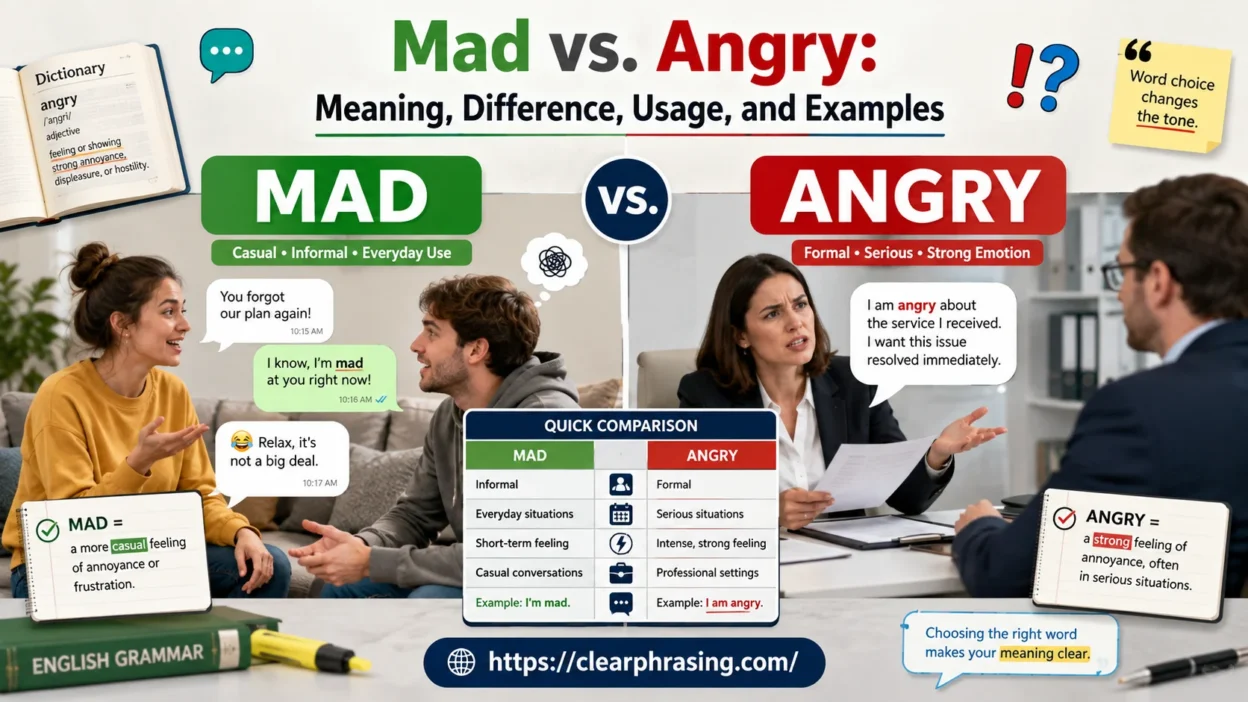
In “Mad vs. Angry: Meaning, Difference, Usage, and Examples,” mad and angry are adjectives that describe emotions and feelings. Both help you express yourself when you feel upset, annoyed, or irate.
In the English language, these words can seem interchangeable, but their usage changes with the context. Angry is a clear, straightforward way to describe anger, while mad often sounds more informal.
Think of mad and angry like a soft ball and a hard ball: both can show displeasure, but their impact may differ. Mad has a broader range of emotions because, in some contexts, it can mean crazy, mean foolish, or even insane.
Angry, however, directly describes an emotional reaction toward something or someone else. Understanding these similarities and the difference makes everyday conversations easier and helps you choose the word for situation.
Quick Answer:
Mad and angry can both describe the feeling of being upset, annoyed, or displeased.
However, mad is generally more informal in American English, while angry is neutral and more suitable for formal contexts. Cambridge’s English Thesaurus explicitly describes mad as more informal than angry.
| Word | Main meaning | Tone | Best use |
| Mad | Angry or annoyed | Informal | Conversation, texting, casual writing |
| Angry | Strong displeasure or irritation | Neutral | Conversation, professional writing, formal writing |
| Furious | Extremely angry | Strong | Situations involving intense anger |
| Annoyed | Slightly angry or bothered | Mild | Minor frustrations |
| Irritated | Annoyed or bothered | Mild to moderate | More precise descriptions |
A simple rule will help:
Use “mad” for casual American English. Use “angry” when you want a neutral or more formal choice.
Neither word automatically means stronger anger. “Really mad” can describe intense anger, while “slightly angry” can describe a mild reaction.
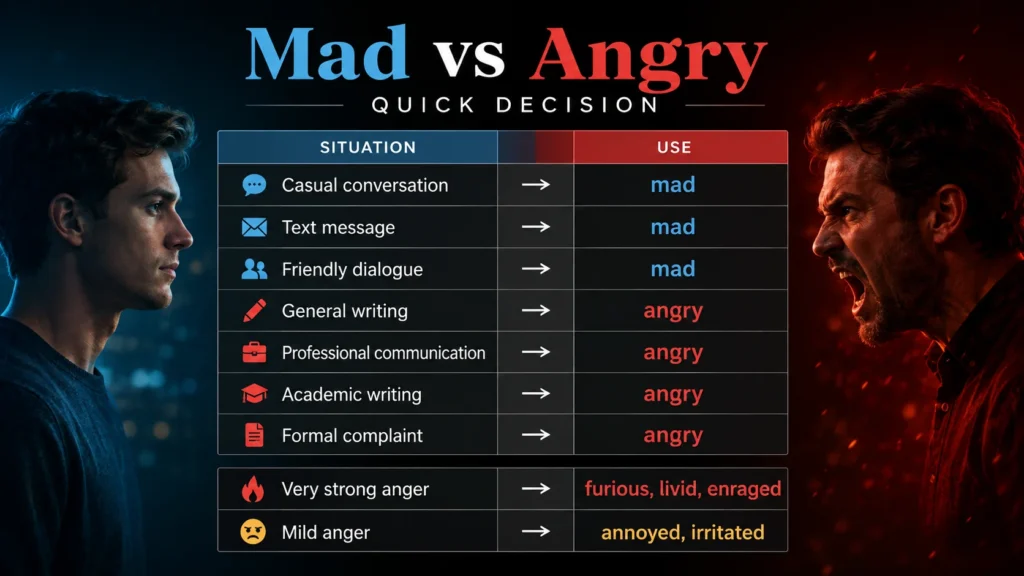
Quick Decision Chart
- Casual conversation → mad
- Text message → mad
- Friendly dialogue → mad
- General writing → angry
- Professional communication → angry
- Academic writing → angry
- Formal complaint → angry
- Very strong anger → furious, livid, enraged
- Mild anger → annoyed, irritated
What Does “Mad” Mean?
The adjective mad has several meanings, which is one reason this word can confuse English learners.
In American English, one of its most common meanings is angry or annoyed. Cambridge’s American Dictionary gives mad this meaning directly and provides examples such as being mad at another person.
For example:
- I’m mad at my brother.
- She got mad when she heard the news.
- Don’t get mad at me.
- That really made him mad.
- Why are you so mad?
In each sentence, mad describes an emotional reaction.
The word doesn’t necessarily suggest rage. Someone can be a little mad, really mad, or extremely mad, depending on the context and modifiers.
Mad as a Casual Word for Angry
American speakers use mad naturally in everyday conversation.
Imagine a friend forgets your birthday. You might say:
“I’m kind of mad that you forgot.”
That sounds completely natural.
In a formal complaint, however, you might choose:
“I am angry about the way the matter was handled.”
The basic emotion remains similar. The register changes.
That distinction matters because good word choice isn’t always about whether a word is technically correct. Sometimes it’s about whether the word fits the situation.
What Does “Angry” Mean?
Angry describes a strong negative emotional reaction, often caused by unfair treatment, offensive behavior, disappointment, frustration, or another upsetting event.
Cambridge defines angry as having a strong feeling against someone who has behaved badly or caused an upsetting situation.
Examples include:
- She was angry with her coworker.
- He became angry after hearing the accusation.
- The customers were angry about the delay.
- I’m angry that nobody told us.
- The decision made residents angry.
Unlike mad, angry has a broadly neutral register*. You can use it almost anywhere without making your sentence sound unusually casual.
That’s why angry is often the safer choice when you’re unsure.
Is “Mad” the Same as “Angry”?
In many American English contexts, yes.
If someone says:
“I’m mad at him.”
you can usually understand it as:
“I’m angry with him.”
The two sentences communicate essentially the same emotional state.
Cambridge lists mad as an informal synonym for angry.
Still, they aren’t perfect substitutes in every situation because mad has several additional meanings.
For example:
- She’s mad at me. → She’s angry with me.
- He’s mad about jazz. → Depending on the variety and context, he may be extremely enthusiastic about jazz.
- That’s a mad dash to the station. → The dash is wild, rushed, or uncontrolled.
- You’re mad to spend that much money. → You’re behaving foolishly or irrationally.
Context does the heavy lifting.
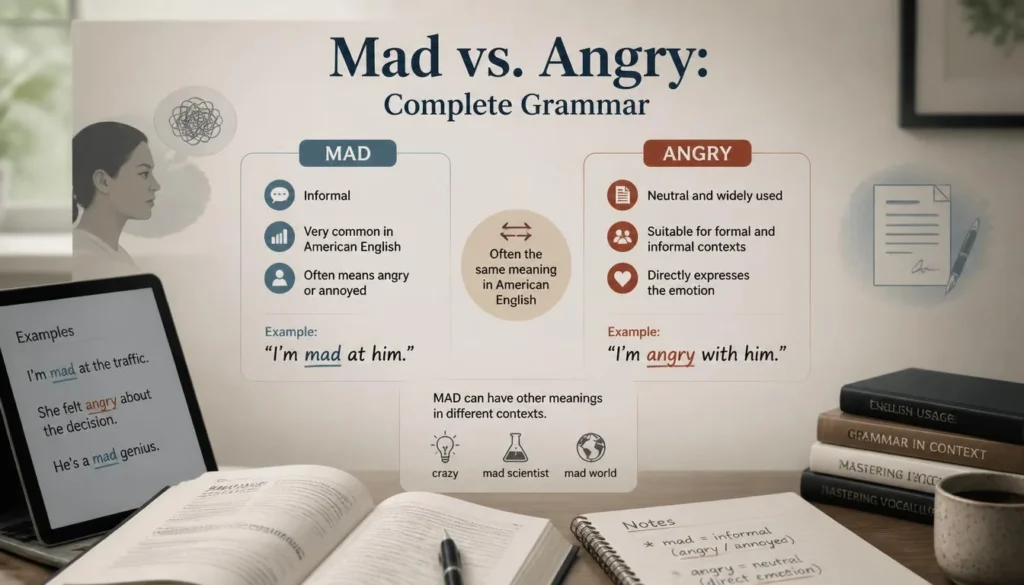
Mad vs. Angry in American English
The phrase mad vs. angry becomes especially interesting when you focus on American English.
In the United States, using mad to mean angry is extremely common. Cambridge labels mad at as mainly US usage in its general dictionary.
You’ll hear expressions such as:
- Are you mad at me?
- Don’t get mad.
- She made me mad.
- I’m still mad about what happened.
- He gets mad easily.
- Why did that make you so mad?
These aren’t slang expressions. They’re ordinary informal American English.
Consider a parent speaking to a teenager:
“I’m not mad at you. I’m just disappointed.”
That sentence sounds entirely natural in American conversation.
Replacing mad with angry is grammatically possible:
“I’m not angry with you. I’m just disappointed.”
However, the second version sounds slightly more deliberate and neutral.
Neither is wrong. The speaker simply chooses a different register.
Mad at vs. Angry With vs. Angry At
One of the most useful parts of understanding mad vs. angry involves prepositions.
You can say:
- mad at someone
- angry with someone
- angry at someone
- angry about something
These patterns are common, although their naturalness can depend on the context and variety of English.
Mad at Someone
Mad at is especially common in American English.
Examples:
- Are you mad at me?
- She’s mad at her sister.
- My parents were mad at me.
- He’s still mad at his boss.
This pattern usually identifies the person who caused the emotional reaction.
Angry With Someone
Angry with is very common when referring to a person.
Examples:
- I’m angry with him.
- She was angry with her brother.
- They became angry with the manager.
Angry at Someone
Angry at is also standard.
For example:
- She was angry at him for lying.
- I’m angry at myself.
- The coach was angry at the players.
Cambridge itself uses examples with both angry at and angry with, confirming that both patterns occur naturally.
Angry About Something
When the focus is an event, issue, decision, or situation, angry about often fits naturally.
Examples:
- I’m angry about the delay.
- She was angry about the decision.
- They were angry about the sudden price increase.
You can also hear mad about in American English when the meaning is angry:
“I’m still mad about what happened yesterday.”
Context makes the meaning clear.
Which Is More Formal?
If you’re writing a formal document, choose angry.
That doesn’t mean mad is incorrect. It simply means mad has a more conversational flavor.
Use “Mad” For:
- Casual conversations
- Text messages
- Friendly emails
- Informal social media posts
- Everyday dialogue
- Personal storytelling
Use “Angry” For:
- Academic writing
- Professional reports
- Formal complaints
- Business communication
- News-style writing
- Official statements
- Serious discussions
Compare these sentences:
Casual:
The customer was really mad about the delay.
Neutral:
The customer was angry about the delay.
More formal:
The customer expressed anger over the prolonged delay.
The meaning develops rather than completely changes. Each sentence simply creates a different level of formality.
Does “Mad” Mean Stronger Anger Than “Angry”?
No.
This is a common misunderstanding.
Mad doesn’t automatically mean more angry than angry.
Consider these examples:
- I’m slightly mad about it.
- I’m really mad about it.
- I’m extremely angry.
- I’m furious.
The modifiers control much of the emotional intensity.
For example, “slightly angry” describes a mild reaction. “Extremely mad” describes a much stronger one.
So don’t think of mad and angry as points on a simple intensity ladder. They’re mainly different choices for expressing the same general emotional territory.
Mad, Angry, Annoyed, Irritated, and Furious
English offers several words for negative emotions. They aren’t interchangeable in every situation.
A useful general progression looks like this:
annoyed → irritated → angry/mad → furious
This isn’t a mathematical scale. Emotional language depends heavily on context.
Annoyed
Annoyed usually describes a relatively mild negative reaction.
I’m annoyed because the website keeps crashing.
You aren’t necessarily furious. Something is simply bothering you.
Irritated
Irritated often suggests repeated or persistent annoyance.
She was irritated by the constant interruptions.
It can sound slightly more precise or restrained than mad.
Mad or Angry
These words describe a stronger emotional reaction.
He was angry when he discovered the mistake.
Or:
He was mad when he discovered the mistake.
Both work naturally in American English.
Furious
Furious describes very strong anger.
The customer was furious after waiting three hours.
Cambridge includes furious, irate, incensed, and livid among stronger words associated with anger.
The important point is simple: don’t use furious merely because someone is annoyed. It adds substantial emotional weight.
When Should You Use “Mad”?
Choose mad when you want your English to sound relaxed, personal, and conversational.
It works especially well when people are speaking directly to each other.
For example:
“Why are you mad at me?”
“I’m not mad. I just need some space.”
“Don’t get mad, but I accidentally broke your mug.”
That last sentence has a distinctly conversational rhythm. Angry could replace mad, but the sentence would sound a little more formal.
Mad also works well in dialogue because real conversations often favor shorter, familiar words.
When Should You Use “Angry”?
Choose angry when you want a neutral word that works across almost any setting.
It fits naturally in everyday speech:
I’m angry with him.
It also fits formal writing:
The residents expressed anger over the proposed changes.
That flexibility gives angry an advantage when you’re uncertain about your audience.
If you’re writing for a professor, employer, client, newspaper, or professional organization, angry is usually the cleaner choice.
Common Expressions With “Mad”
Several expressions make mad particularly common in American English.
Get Mad
Get mad means to become angry.
Don’t get mad at me.
He gets mad whenever someone questions his decision.
Make Someone Mad
This means to cause someone to become angry.
That comment made me mad.
The constant delays made everyone mad.
Be Mad at Someone
This means to feel angry toward someone.
She’s mad at her brother.
Mad About Something
This expression requires attention because mad about can have more than one interpretation.
In American English, context can make it mean angry:
I’m mad about what happened.
In other contexts, especially British English, mad about can mean very enthusiastic about something or someone. Cambridge specifically identifies this meaning as mainly informal British usage.
For example:
She’s mad about skiing.
Here, the sentence means she loves skiing or is extremely enthusiastic about it.
That’s a perfect example of why context matters.
Common Expressions With “Angry”
The word angry also appears in several useful structures.
Get Angry
He gets angry when people interrupt him.
Become Angry
She became angry after hearing the accusation.
Make Someone Angry
The decision made local residents angry.
Feel Angry
It’s normal to feel angry after being treated unfairly.
Angry With Someone
I’m angry with my brother.
Angry About Something
They’re angry about the new policy.
These structures are useful in both conversation and formal writing.
Real-Life Situations
Definitions become much easier when you see the words in realistic situations.
A Friend Cancels Dinner
You might tell another friend:
“I’m pretty mad that she canceled at the last minute.”
This sounds casual and natural.
A Customer Complains About Poor Service
A report might say:
“The customer was angry about the delayed response.”
Here, angry fits the professional setting better.
A Parent Talks to a Child
“I’m not mad at you. I want you to understand why that was dangerous.”
The informal word makes the sentence sound personal and conversational.
A Formal Complaint
“I am angry about the way my complaint was handled.”
Here, angry communicates dissatisfaction without sounding overly casual.
A Very Strong Reaction
“She was furious when she discovered that the contract had been changed.”
Using furious tells the reader that the emotion goes beyond ordinary anger.
Common Mistakes
Understanding the difference also means knowing what not to assume.
Mistake: Thinking “Mad” Is Incorrect
Some learners believe mad should never mean angry.
That’s incorrect in American English.
Cambridge explicitly defines mad as angry or annoyed and marks this usage as informal.
So:
Are you mad at me?
is perfectly acceptable American English.
Mistake: Thinking “Mad” Always Means Crazy
This mistake comes from another established meaning of mad.
Depending on context, mad can relate to mental illness, foolishness, uncontrolled behavior, enthusiasm, or anger.
For example:
You’re mad to spend that much money.
Here, the meaning isn’t simply angry.
Mistake: Assuming “Mad” Is Stronger
It isn’t.
Mad and angry don’t have a fixed intensity difference.
Use modifiers or stronger adjectives when you need to communicate intensity.
Mistake: Using “Mad” Everywhere
Although mad is correct, its informal register makes angry a better choice in many formal situations.
Good writing isn’t only about grammar. Register matters too.
Mad vs. Angry in American and British English
Regional usage adds another layer to this comparison.
In American English, mad meaning angry is extremely common. Cambridge labels mad at as mainly US usage.
In British English, mad has traditionally been more strongly associated with meanings such as crazy, foolish, or mentally ill, although British speakers also use mad in expressions connected with anger.
For example, British English commonly uses:
That will drive me mad.
He’ll go mad when he finds out.
Cambridge’s British English materials distinguish the meanings and identify mad = angry as mainly US usage.
This doesn’t mean British speakers never understand mad as angry. It simply means American learners are more likely to hear mad used directly as an everyday synonym for angry.
Side-by-Side Examples
| Situation | Casual American English | Neutral English |
| Asking about someone’s feelings | Are you mad at me? | Are you angry with me? |
| Describing frustration | That made me mad. | That made me angry. |
| Talking about a friend | She’s mad at him. | She’s angry with him. |
| Describing a complaint | The customer was mad. | The customer was angry. |
| Describing intense emotion | He was really mad. | He was extremely angry. |
| Formal context | Less suitable | Angry is usually better |
Notice something important: the difference isn’t always meaning. Sometimes it’s simply the voice of the sentence.
A Practical Decision Guide
When you’re choosing between the two, ask yourself three questions.
Who am I talking to?
If you’re chatting with a friend, mad sounds perfectly natural.
Where am I writing?
If you’re writing a formal report, angry is usually the stronger choice.
How strong is the emotion?
If ordinary anger isn’t enough, choose a stronger word such as furious, livid, or enraged.
Why Context Matters More Than a Simple Synonym List
A thesaurus might place mad and angry next to each other, but real communication isn’t a synonym-matching exercise.
Consider these two sentences:
“I’m mad at you.”
“I am angry with you.”
The emotional message is almost identical. Yet the first sounds more relaxed and conversational. The second sounds more measured.
Now compare:
“I’m furious with you.”
That changes the emotional intensity.
Then consider:
“I’m irritated with you.”
Now the emotion sounds milder.
This is why effective vocabulary depends on meaning + intensity + register + context.
A single synonym rarely captures all four.
A Simple Rule for Remembering
If you only remember one thing, remember this:
In American English, “mad” commonly means angry and sounds informal. “Angry” is neutral and works in both casual and formal contexts.
You don’t need to avoid mad. You simply need to understand its tone.
Think of the two words as wearing different clothes.
Mad is everyday clothing. It’s comfortable, familiar, and perfectly natural at home or with friends.
Angry is more versatile. It works at home, in the office, in an essay, and in a formal report.
Neither is inherently better.
The right choice depends on the situation.
My Personal Experience
As an English language specialist and teacher, I’ve noticed that learners often hesitate when choosing between Mad vs. Angry. During my teaching experience, I’ve seen students understand the general idea but struggle when they need a natural choice for a particular conversation or piece of writing.
I usually explain this distinction through everyday situations rather than complicated rules. Once learners notice how native speakers naturally use each expression, the difference becomes much easier to recognize. I’ve found that short, realistic examples help students build confidence faster than memorizing definitions.
Over the years, this approach has helped many learners become more comfortable with vocabulary choices and communicate their thoughts with greater confidence.
Key Insights
- Mad vs. Angry centers on register, context, and regional usage.
- Mad suits relaxed, everyday American speech.
- Angry offers a neutral, broadly appropriate alternative.
- Neither term automatically signals greater emotional intensity.
- Modifiers determine emotional strength.
- Mad carries additional interpretations beyond emotional displeasure.
- Surrounding language determines the intended sense.
- Angry provides greater clarity when precision matters.
- Formal settings generally favor angry.
- Informal interactions naturally accommodate mad.
- Preposition patterns vary according to expression and context.
- Regional differences influence how listeners interpret mad.
- American usage strongly associates mad with emotional displeasure.
- British usage gives mad several other prominent interpretations.
- Stronger vocabulary such as furious communicates heightened intensity.
- Milder alternatives such as annoyed indicate lower intensity.
- Effective vocabulary selection depends on audience, setting, tone, and intended force.
- Memorizing synonyms alone doesn’t guarantee natural word selection.
Practice Section:
Choose the correct word: mad or angry.
- Are you ___ at me?
- She was ___ about the decision.
- I’m really ___ that you forgot.
- The customer was ___ about the delay.
- Don’t get ___ at me!
Answers:
- mad
- angry
- mad
- angry
- Mad
Read More: Can You Start a Sentence With “Yet”? Grammar and Correct Usage
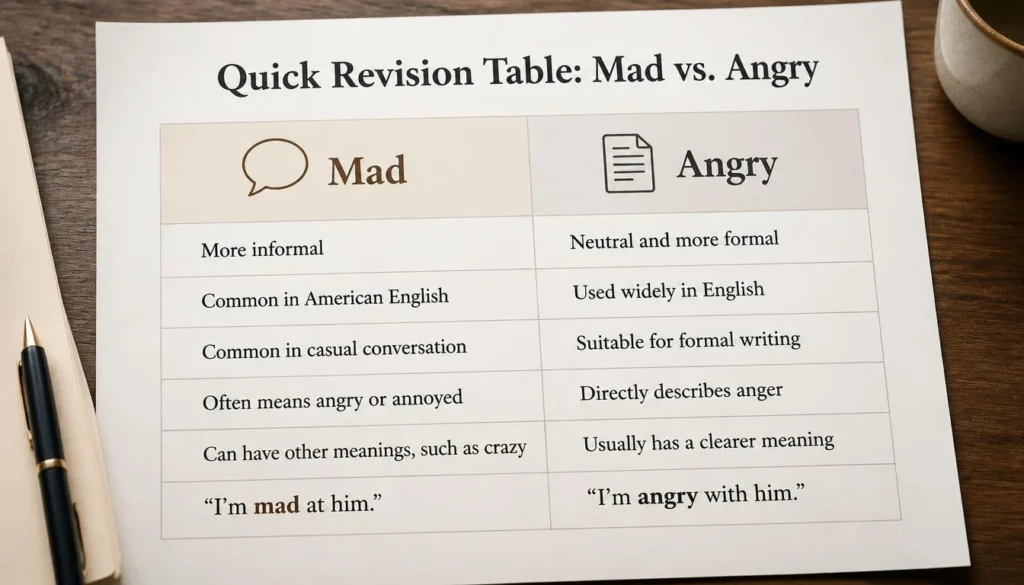
Quick Revision Table
| Mad | Angry |
| More informal | Neutral and more formal |
| Common in American English | Used widely in English |
| Common in casual conversation | Suitable for formal writing |
| Often means angry or annoyed | Directly describes anger |
| Can have other meanings, such as crazy | Usually has a clearer meaning |
| Example: I’m mad at him. | Example: I’m angry with him. |
FAQs
1. Is “mad” the same as “angry”?
Mad and angry can both describe a person who feels upset, annoyed, or displeased. In everyday American English, you can often use them interchangeably when talking about anger. For example, “I’m mad at him” and “I’m angry with him” communicate a very similar idea.
The main difference is often tone and formality. “Mad” sounds more casual and conversational, while “angry” is more direct and neutral. That’s why you’ll frequently hear “mad” in relaxed conversations with friends and family.
2. Is “mad” more informal than “angry”?
Yes. Mad generally sounds more informal than angry when both words refer to anger. You might say, “She’s mad because you forgot her birthday” in an everyday conversation. In more formal writing, “She’s angry because you forgot her birthday” may sound more appropriate.
This distinction is small, but it matters when you want your English to match the situation. In my experience teaching English, learners often know the basic meaning but overlook how naturally each word fits a particular setting.
3. Can “mad” mean crazy?
Yes. Mad has another meaning: crazy, insane, or mentally unstable, depending on the context. For example, “That would be a mad idea” can suggest that the idea is foolish or unreasonable rather than that someone feels angry.
Context makes the meaning clear. If someone says, “She’s mad at me,” the meaning is usually angry. If someone says, “You must be mad to do that,” the speaker may mean crazy or foolish.
4. Can “angry” mean crazy?
No, not normally. Angry specifically describes a feeling of anger or strong displeasure. It doesn’t generally carry the additional meaning of crazy or insane that mad can have.
For example, “He is angry about the decision” tells you about his emotional reaction. It doesn’t suggest that he has lost his mind. This makes “angry” a clearer choice when you want to talk specifically about anger.
5. Which word is stronger, “mad” or “angry”?
Neither word is automatically stronger. The intensity comes from the context, the speaker’s tone, and the words surrounding them. Someone can be mildly mad, extremely mad, mildly angry, or extremely angry.
For example, “I’m a little mad about what happened” suggests mild irritation. “I’m absolutely furious” expresses much stronger anger. So, when comparing mad vs. angry, don’t assume that one word always represents a higher level of emotion.
6. Should I use “mad” or “angry” in formal writing?
Angry is usually the safer choice for formal writing when you mean that someone feels anger. It has one clear emotional meaning and avoids the possible confusion caused by the other meanings of “mad.”
For example, in an academic article, report, or professional explanation, “The customer was angry about the delay” sounds precise. “The customer was mad about the delay” is understandable, but it has a more conversational feel.
7. Do Americans use “mad” to mean angry?
Yes. In American English, “mad” commonly means angry. Phrases such as “Are you mad at me?” and “She got mad when she heard the news” are completely natural.
This usage sometimes confuses English learners because “mad” can also mean crazy in other contexts. However, everyday American conversations usually make the intended meaning easy to understand.
8. What is the difference between “mad at” and “angry with”?
Both mad at and angry with can describe anger toward a person. For example, “I’m mad at John” and “I’m angry with John” are both natural sentences.
You can also hear “angry at,” depending on the situation and variety of English. The important point is that the preposition can vary, so learners should pay attention to common expressions rather than assume that only one combination is possible.
9. Can “mad” and “angry” describe the same situation?
Absolutely. Imagine that your friend cancels your plans at the last minute. You might say, “I’m mad because she canceled,” or “I’m angry because she canceled.” Both sentences tell the reader that you feel displeased about what happened.
The difference lies mainly in style and nuance. Mad often feels more casual, while angry sounds more neutral and direct. The situation itself doesn’t have to change for either word to work.
10. How can I remember the difference between “mad” and “angry”?
A simple trick is to remember that angry almost always points directly to the emotion. When you see or hear “angry,” think anger. “Mad” can also mean anger, but it has an extra meaning connected with being crazy, foolish, or insane.
When you’re unsure, consider the setting first. In casual American conversation, “mad” is perfectly natural. In formal writing or when you want maximum clarity, “angry” is often the better choice.
Conclusion
Understanding mad vs. angry becomes much easier when you stop treating them as completely separate words. Both can describe anger, annoyance, displeasure, and an emotional reaction to something that bothers you. In everyday American English, either word can often fit the same situation, especially when you’re speaking casually.
Still, the small difference in tone is worth noticing. Mad tends to sound more informal and conversational, while angry usually feels more neutral and direct. That distinction can make your English sound more natural because good word choice isn’t only about dictionary definitions; it’s also about knowing how a word behaves in real conversations.
You should also remember that mad has meanings that angry doesn’t normally have. Depending on the context, “mad” can suggest that someone is crazy, foolish, or insane. This is one reason context matters so much when you’re learning English. A short sentence can carry a completely different meaning when the surrounding words change.
After teaching English for many years, I’ve found that learners often improve quickly once they stop asking which word is “correct” and start asking which word sounds more natural for the situation. If you keep context, tone, formality, and meaning in mind, choosing between mad and angry becomes much more straightforward.

Mehwish Imtiaz is an English specialist and professional blog writer at ClearPhrasing.com. She specializes in grammar, spelling, vocabulary, punctuation, and writing improvement. With a strong passion for clear communication and language education, she creates reader-friendly articles that help students, professionals, and English learners understand complex language topics with ease.
Her writing focuses on accuracy, simplicity, and practical usage, ensuring that every article provides clear explanations and real-world examples. At ClearPhrasing.com, Mehwish is committed to publishing well-researched, original content that helps readers write more confidently and communicate more effectively in everyday and professional English.