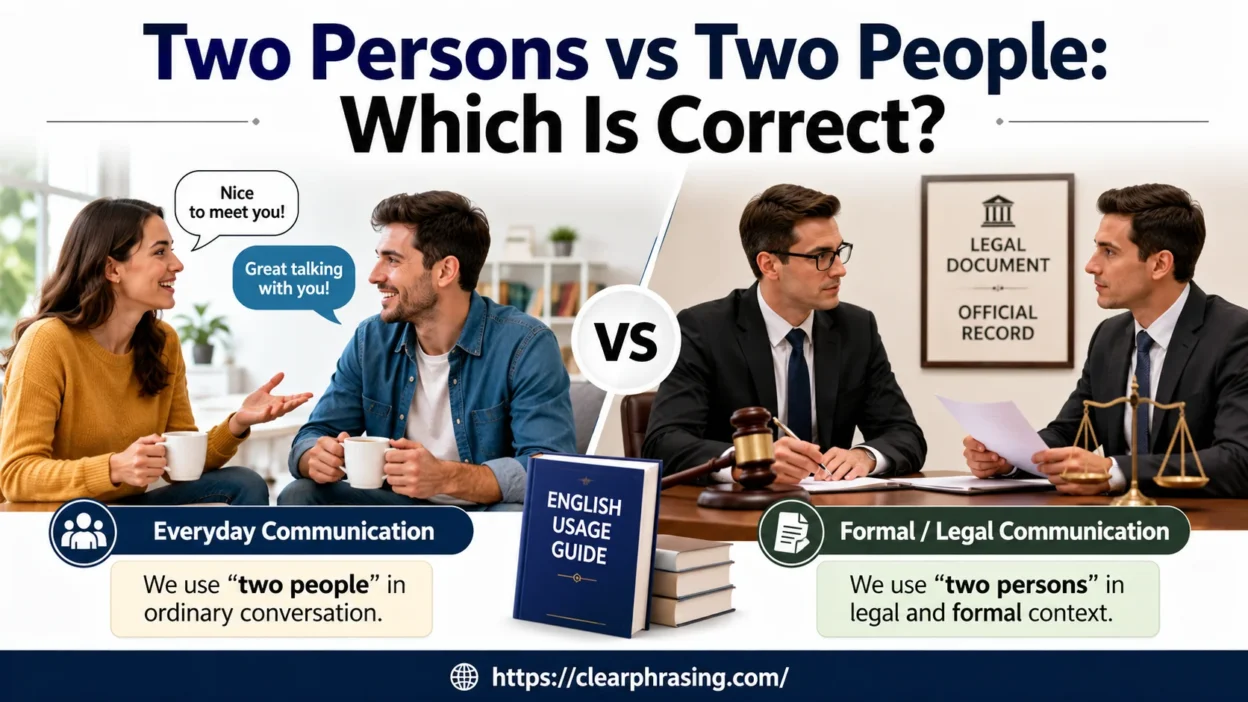
We often think about Two Persons vs Two People: Which Is Correct? Although two persons is technically correct, it is mainly used in formal language, legal language, official statements, legal documents, formal writing, and other specific contexts. From my teaching experience, understanding the context, grammar rules, usage rules, and choosing the right phrase, sentence, and word choice is far more important than simply memorizing the rule.
In real life, people is the natural use for friends, readers, listeners, and native speakers, while persons appear in examples such as missing persons, persons under eighteen years of age, or an elevator with a maximum of ten persons. As you read, recognise, refer to, and use these forms correctly, your English grammar, English usage, vocabulary, spelling, understanding, and making sense of the language become much stronger.
Quick Answer:
Both “two persons” and “two people” are correct English expressions.
However:
| Phrase | Correct? | Best Used For |
| Two people | ✅ Yes | Everyday conversation, articles, emails, general writing |
| Two persons | ✅ Yes | Legal documents, official forms, regulations, formal notices |
The simple rule is:
Use “two people” in normal writing and conversation. Use “two persons” when writing about individuals in a legal, official, or regulatory context.
For example:
✅ Two people were waiting outside the restaurant.
✅ Two persons were identified in the official investigation report.
The first sentence sounds natural in daily English. The second sounds more formal because it focuses on identified individuals.
What Is the Difference Between Two Persons and Two People?
The difference between two persons and two people is not about grammar. It is about context and tone.
Both words refer to human beings. The main difference comes from how English speakers use them.
What Does “People” Mean?
People is the most common plural form of person.
In modern English, people is used when talking about humans generally or when counting individuals in ordinary situations.
Examples:
- Two people are sitting at the table.
- Five people attended the meeting.
- Many people enjoy learning new languages.
- Those people live near my office.
The word feels natural, friendly, and conversational.
You will find people in:
- Daily conversations
- Newspapers
- Books
- Websites
- Emails
- Social media posts
- Business communication
For most situations, people is the default choice.
What Does “Persons” Mean?
Persons is also a correct plural form of person.
However, it sounds more formal and official. It is commonly used when referring to individuals as separate legal or administrative subjects.
Examples:
- Missing persons report
- Authorized persons only
- Persons under 18 years old
- Persons of interest
- Unauthorized persons prohibited
The word often appears when accuracy, rules, or legal responsibility matter.
For example:
“Two persons entered the restricted area.”
This sentence sounds like something from a security report. It focuses on identifying specific individuals rather than simply describing people.
Why Is “Two People” More Common Than “Two Persons”?
Language changes over time. Although persons was once more common, modern English gradually moved toward people for everyday communication.
Several factors influenced this change:
- People sounds more natural in conversation.
- Writers prefer simpler expressions.
- Newspapers and media use people more frequently.
- English generally favors shorter, familiar words.
Compare these examples:
Natural:
Two people moved into the apartment next door.
Less natural:
Two persons moved into the apartment next door.
The second sentence is not wrong. It simply sounds more formal than the situation requires.
A useful comparison is clothing:
- People is like everyday clothing you wear comfortably.
- Persons is like a suit you wear for official occasions.
Both work, but the setting matters.
When Should You Use “Two People”?
Use “Two People” in Everyday Conversations
When speaking casually, native English speakers almost always choose people.
Examples:
- I saw two people walking their dogs.
- Two people called me yesterday.
- There were two people ahead of us in line.
Using persons in these situations can make your sentence sound stiff.
Use “Two People” in Articles and Blog Posts
Most online content should use people because readers expect natural language.
Example:
Two people can have completely different opinions about the same topic.
This sounds approachable and easy to understand.
A sentence like:
Two persons can have completely different opinions…
sounds unnecessarily formal.
Use “Two People” in Business Writing
Professional writing does not always need formal vocabulary.
Clear writing usually works better.
Example:
✅ Two people from the marketing team joined the meeting.
Instead of:
❌ Two persons from the marketing team joined the meeting.
The first option sounds professional without feeling cold.
When Should You Use “Two Persons”?
Although uncommon, two persons has specific uses.
Legal Documents
Legal writing often uses persons because it refers to individuals with specific rights, duties, or responsibilities.
Examples:
- No unauthorized persons may enter this area.
- The agreement applies to all persons listed below.
- The law protects persons affected by discrimination.
Legal language often values precision over conversational style.
Government Forms and Regulations
Government agencies frequently use persons in official documents.
Examples:
- Persons applying for citizenship must provide identification.
- Persons under the age of 18 require parental consent.
- All persons entering the building must register.
The word creates a formal, administrative tone.
Safety Signs and Notices
You often see persons on signs because these messages focus on rules.
Examples:
- Authorized persons only.
- Maximum occupancy: 50 persons.
- No persons allowed beyond this point.
A safety notice needs to sound official and direct.
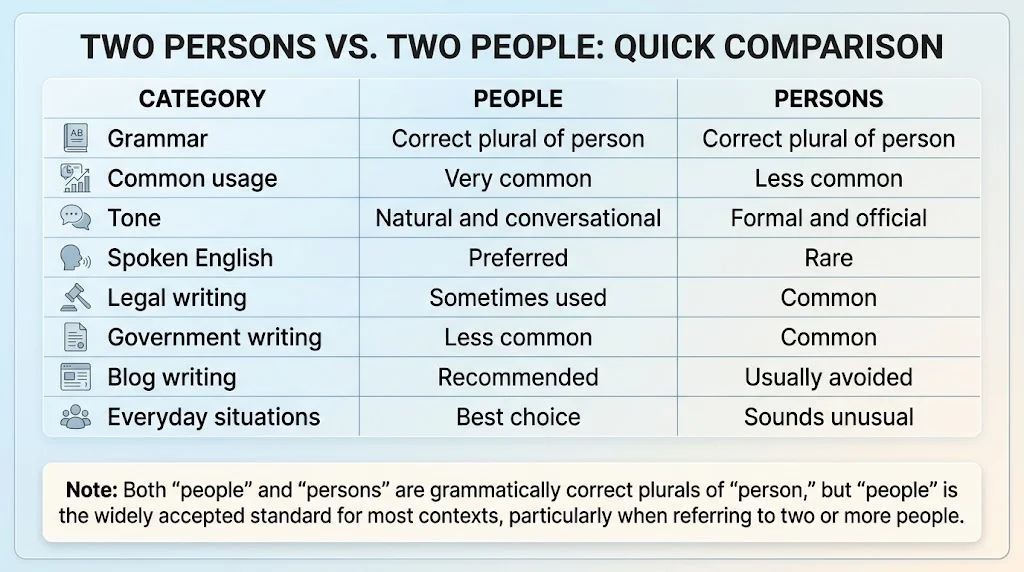
Comparison Table
| Category | People | Persons |
| Grammar | Correct plural of person | Correct plural of person |
| Common usage | Very common | Less common |
| Tone | Natural and conversational | Formal and official |
| Spoken English | Preferred | Rare |
| Legal writing | Sometimes used | Common |
| Government writing | Less common | Common |
| Blog writing | Recommended | Usually avoided |
| Everyday situations | Best choice | Sounds unusual |
Real Examples of Two People vs Two Persons
Examples Using “Two People”
- Two people joined the online meeting.
- I saw two people crossing the street.
- Two people helped the injured driver.
- The restaurant can seat two people at this table.
- Two people applied for the position.
These examples sound natural because they describe ordinary situations.
Examples Using “Two Persons”
- Two persons were detained during the investigation.
- The contract requires signatures from two persons.
- Two persons were found responsible for the violation.
- Only authorized persons may enter this facility.
- The document must be completed by two persons.
These examples fit formal or official settings.
Common Expressions That Use “Persons”
Some phrases almost always appear with persons.
Missing Persons
Example:
The police released a missing persons notice.
This phrase refers to official investigations.
Persons of Interest
Example:
Investigators questioned two persons of interest.
This expression is common in legal and police contexts.
Authorized Persons Only
Example:
Authorized persons only beyond this point.
This wording appears on restricted areas and official signs.
Persons with Disabilities
Example:
The organization provides services for persons with disabilities.
This is common in official and institutional writing.
Common Expressions That Use “People”
Many everyday expressions sound natural only with people.
Examples:
- Most people agree.
- Young people often use technology.
- People around the world celebrate holidays differently.
- Many people enjoy traveling.
- People say practice makes perfect.
Replacing people with persons would make these sentences sound unnatural.
Example:
❌ Most persons agree.
This sounds formal and unusual.
✅ Most people agree.
This sounds normal.
Is “People” Singular or Plural?
People is a plural noun.
It always takes a plural verb.
Correct:
✅ People are waiting outside.
Incorrect:
❌ People is waiting outside.
More examples:
- People have different opinions.
- People enjoy different types of music.
- People need clear information.
Is “Persons” Singular or Plural?
Persons is also plural.
It follows the same grammar rules.
Correct:
✅ Three persons were involved.
Incorrect:
❌ Three persons was involved.
However, remember that correct grammar does not always mean natural style.
A sentence can be grammatically correct but still sound unusual.
Why Does English Have Two Plural Forms?
English has collected words from many languages throughout history.
The word person comes from Latin through French influence. Over time, English developed different ways to refer to groups of humans.
Historically:
- Persons remained connected with formal and legal language.
- People became the everyday plural.
Modern English kept both forms because they serve different purposes.
Common Mistakes
Mistake: Using “Persons” Everywhere
Incorrect:
Two persons went to the park.
Better:
Two people went to the park.
The first sentence is understandable, but it sounds overly formal.
Read More: Cite vs. Site vs. Sight: What’s the Difference?
Mistake: Thinking “Persons” Is More Correct
Some writers believe persons is more educated or professional.
That is not true.
Good writing depends on using the right word for the situation.
A simple word can be the better word.
Mistake: Using “People” in Legal Contexts Without Checking
In everyday writing, people works well.
However, legal documents often require specific wording.
Example:
Unauthorized persons are not permitted.
This sounds appropriate because the message is about rules.
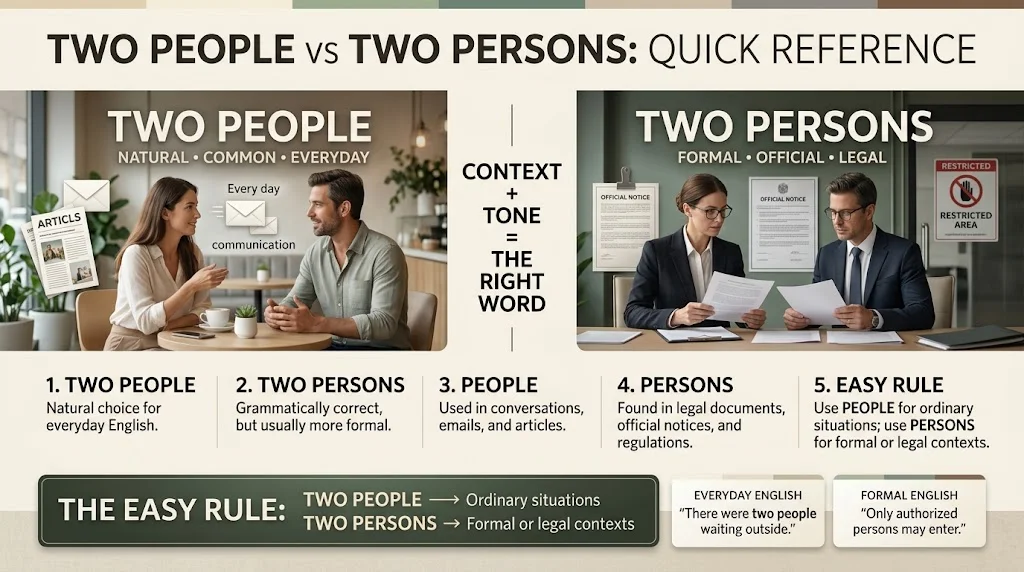
Key Insights
- Two people is the natural choice for everyday English.
- Two persons is grammatically correct but usually sounds formal.
- Context and tone determine which expression fits best.
- People works well in conversations, emails, articles, and general writing.
- Persons commonly appears in legal documents, official notices, regulations, and safety signs.
- Don’t assume persons sounds more educated or professional; appropriate word choice matters more.
- For ESL learners, the easiest rule is: people for ordinary situations, persons for formal or legal contexts.
- Both people and persons are plural nouns and require plural verbs.
Which One Should ESL Learners Use?
For English learners, the safest rule is simple:
Use “people” most of the time.
Choose persons only when you see it in official phrases or formal documents.
A practical guide:
| Situation | Use |
| Conversation | People |
| Emails | People |
| Essays | People |
| Blog posts | People |
| Legal forms | Persons |
| Official notices | Persons |
My Personal Experience
During my teaching career, I’ve often seen learners hesitate when choosing between two people and two persons.Many students initially assume that one must be grammatically right while the other must be wrong.
I explain that the real challenge lies in recognizing the situation in which each expression belongs.When we work through everyday conversations, professional messages, official notices, and legal examples, students quickly notice how much context influences English usage. I’ve found that this practical approach makes the distinction easier to remember than simply learning a rule from a textbook.
One classroom activity that consistently helps is asking students to rewrite the same idea for different audiences. A casual sentence may naturally call for people, while an official statement may require persons because of its formal tone. This exercise shows students that effective grammar involves more than identifying correct forms; it also requires thoughtful word choice.
After practicing these small differences, my learners become more confident because they stop treating English as a collection of rigid rules and start paying attention to purpose, audience, and tone.
Practice:
Test your understanding by choosing the option that best fits each sentence.
- I saw ___ talking near the entrance.
a) two people
b) two persons - The contract must be signed by ___ authorized individuals.
a) two people
b) two persons - ___ from our team attended the meeting yesterday.
a) Two people
b) Two persons - The notice states that only authorized ___ may enter the area.
a) people
b) persons - ___ were waiting for the bus outside.
a) Two people
b) Two persons
Answers
- Two people — This describes an ordinary situation.
- Two persons — A contract calls for formal language.
- Two people — This is natural for everyday business communication.
- Persons — Official notices commonly use this formal expression.
- Two people — The sentence describes a normal daily activity.
Quick Challenge
Rewrite this sentence so it sounds natural in everyday English:
“Two persons were sitting at the coffee shop.”
Answer: Two people were sitting at the coffee shop.
The goal isn’t simply to identify which form is grammatically correct. You should also consider context, tone, and word choice before making your final decision.
Quick Revision
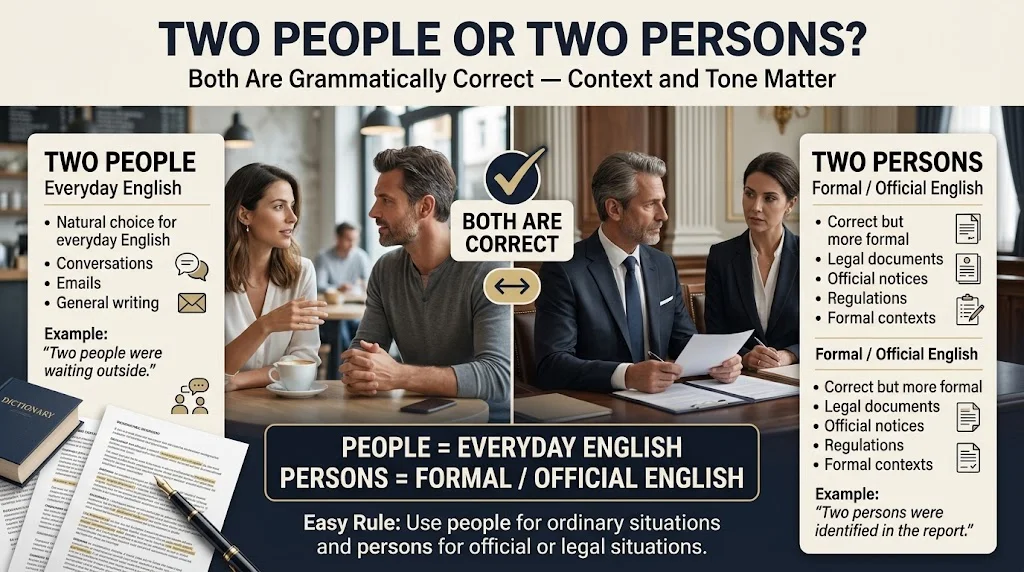
- Two people → the natural choice for everyday English, conversations, emails, and general writing.
- Two persons → correct but more formal; commonly found in legal documents, official notices, regulations, and formal contexts.
- Both are grammatically correct.
- The main difference is context and tone, not correctness.
- Easy rule: Use people for ordinary situations and persons for official or legal situations.
- Example: Two people were waiting outside.
- Formal example: Two persons were identified in the report.
- Remember: People = everyday English; Persons = formal/official English.
FAQs
Q1. Is two people more common than two persons?
Yes. Two people is the normal expression in everyday English. Native speakers use it in both speaking and informal writing.
Q2. When should I use two persons?
Use two persons in formal situations, especially in legal documents, official notices, contracts, and regulations where precise language is preferred.
Q3. Is two persons grammatically correct?
Yes. It is grammatically correct, but its use is limited to formal and legal contexts rather than everyday conversation.
Q4. Why do legal documents often use persons instead of people?
Legal writing aims to be precise and consistent. The word persons is traditionally used to define individuals in laws, contracts, and official policies.
Q5. Can I say two persons in daily conversation?
You can, but it will sound unusually formal. In normal conversations, two people is the more natural choice.
Q6. Do native English speakers usually say people or persons?
Most native English speakers almost always say people. Many rarely use persons unless they are reading or writing formal documents.
Q7. Does persons have the same meaning as people?
Generally, yes. Both refer to more than one person, but persons carries a more formal or legal tone.
Q8. Is it wrong to always use people?
No. For nearly all everyday situations, people is correct. You only need persons in specific formal or legal contexts.
Q9. How can I remember the difference between people and persons?
A simple trick is to remember: people for everyday English, persons for legal and official English.
Q10. Which form should English learners use most of the time?
English learners should normally use two people because it is the standard choice in conversation, emails, articles, and most types of writing.
Conclusion
Choosing between two people and two persons is easier once you understand the context. In almost every everyday situation, two people is the natural and preferred expression. Two persons is also correct, but it mainly appears in legal, official, and other formal documents where precise wording is important. Knowing this small difference will help you sound more natural and write with greater confidence.
As an English language teacher, I’ve found that many learners worry about this choice more than they need to. The best approach is to use two people in normal conversations and everyday writing, and reserve two persons for formal or legal contexts. With regular reading and practice, you’ll quickly recognize when each expression fits, making your English clearer, more accurate, and more professional.

Mehwish Imtiaz is an English specialist and professional blog writer at ClearPhrasing.com. She specializes in grammar, spelling, vocabulary, punctuation, and writing improvement. With a strong passion for clear communication and language education, she creates reader-friendly articles that help students, professionals, and English learners understand complex language topics with ease.
Her writing focuses on accuracy, simplicity, and practical usage, ensuring that every article provides clear explanations and real-world examples. At ClearPhrasing.com, Mehwish is committed to publishing well-researched, original content that helps readers write more confidently and communicate more effectively in everyday and professional English.