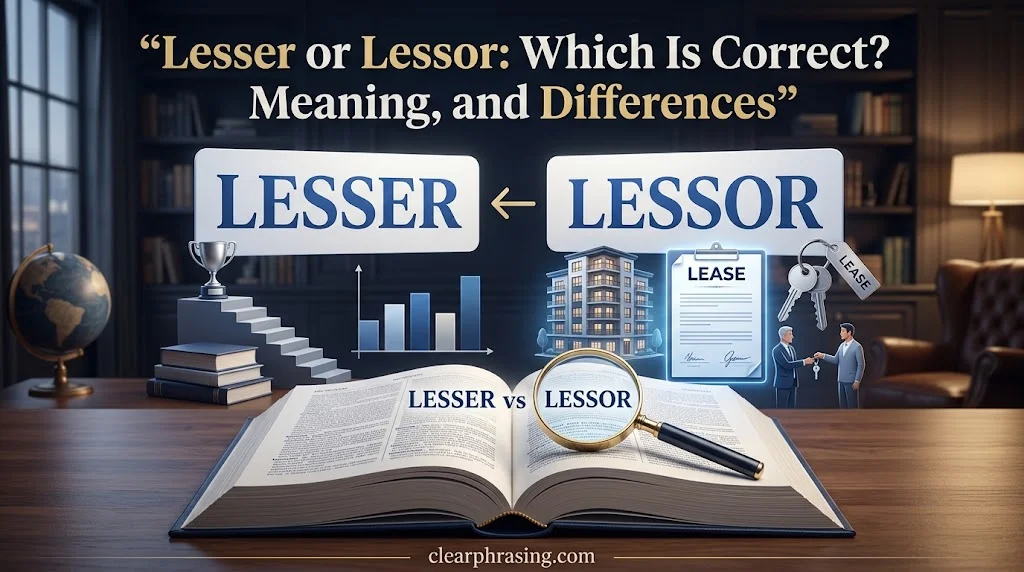
Lesser or Lessor: Which Is Correct? Meaning, and Differences helps you avoid common mistakes in English grammar and choose the correct word every time.
Many learners confuse Lesser and Lessor because they look similar but have different meanings. Lesser is an adjective that describes a smaller quantity, degree, or quality, while Lessor is a noun that refers to a property owner who leases a rental property to a lessee. Knowing this difference improves word choice, legal writing, and everyday English usage.
From my teaching experience, I have found that a simple comparison with examples makes this topic much easier to remember. Whether you are reading a legal document, signing a lease agreement, or improving your English vocabulary, understanding the correct meaning and usage of these words helps you write with greater confidence and accuracy.
Quick Answer
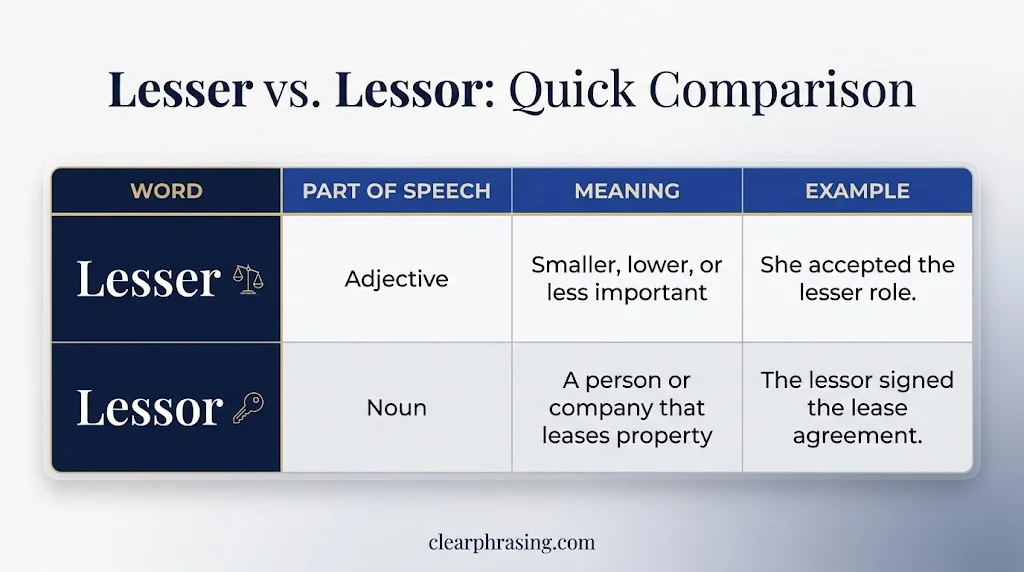
The difference between lesser and lessor comes down to meaning and grammar.
| Word | Part of Speech | Meaning | Example |
| Lesser | Adjective | Smaller, lower, or less important | She accepted the lesser role. |
| Lessor | Noun | A person or company that leases property | The lessor signed the lease agreement. |
Remember this simple rule:
- Use lesser when comparing importance, size, degree, or status.
- Use lessor only when talking about a lease, landlord, or property agreement.
Although the words sound identical, they are never interchangeable.
Why People Confuse Lesser and Lessor
Many spelling mistakes happen because English contains words that sound alike but carry different meanings. Lesser and lessor are a perfect example.
Several factors contribute to this confusion.
- They have the same pronunciation.
- Only one letter separates their spellings.
- Both often appear in formal writing.
- Spell-check software may not detect the mistake because both words are correctly spelled.
- Many people rarely encounter lessor unless they read legal or real estate documents.
Imagine reading this sentence:
The lesser signed the apartment lease.
It looks reasonable at first glance. However, it’s completely wrong because a person signing a lease is the lessor, not the lesser.
Likewise:
She accepted the lessor position in the company.
This sentence is also incorrect because it discusses status rather than leasing property.
The key is to focus on context, not pronunciation.
Lesser Meaning and Definition
What Does “Lesser” Mean?
Lesser is an adjective. It describes something that has less importance, size, value, degree, influence, or status than something else.
Most dictionaries define lesser as:
Smaller in amount, lower in rank, or less significant when compared with another person or thing.
Unlike less, which often refers to quantity, lesser usually emphasizes relative importance or quality.
For example:
- a lesser problem
- a lesser priority
- a lesser-known author
- a lesser offense
In each case, the word compares one thing with another.
When to Use Lesser
Use lesser whenever you compare two things and want to describe one as less significant or less important.
Common situations include:
Comparing Importance
Some tasks deserve immediate attention, while others can wait.
Examples:
- Safety should never become a lesser concern.
- Education is no lesser priority than healthcare.
Comparing Rank or Status
Organizations often have senior and junior positions.
Examples:
- She accepted a lesser leadership role.
- The committee assigned him to a lesser position.
Comparing Influence
People sometimes compare achievements or historical impact.
Examples:
- Historians consider him a lesser political figure.
- The film focused on a lesser-known inventor.
Comparing Quality
Products, services, and creative works often differ in quality.
Examples:
- Customers rejected the lesser version.
- The cheaper material proved to be of lesser quality.
Comparing Severity
Courts and legal systems frequently classify crimes by seriousness.
Examples:
- The judge convicted him of a lesser offense.
- Doctors ruled out the disease and diagnosed a lesser condition.
Common Expressions Using Lesser
Some expressions appear so frequently that they have become part of everyday English.
| Expression | Meaning |
| Lesser-known | Not widely recognized |
| Lesser evil | The better of two bad choices |
| Lesser degree | Smaller amount or intensity |
| Lesser extent | Lower level of impact |
| Lesser priority | Something less urgent |
| Lesser role | A smaller responsibility |
| Lesser offense | A less serious crime |
| Lesser impact | Reduced effect |
These expressions appear regularly in journalism, education, politics, and business writing.
Examples of Lesser in Sentences
Here are examples from different situations.
Everyday Conversation
- We decided to take the lesser risk.
- That’s the lesser of two problems.
Academic Writing
- Researchers observed a lesser effect among younger participants.
- The second experiment produced lesser improvements.
Business Communication
- The company eliminated lesser expenses first.
- Managers focused on the most profitable products instead of lesser brands.
News Reporting
- Officials reported lesser damage in neighboring towns.
- Experts warned about lesser-known cybersecurity threats.
Literature
- Critics praised the novel while calling the sequel a lesser work.
Lessor Meaning and Definition
What Does “Lessor” Mean?
Unlike lesser, lessor is a noun.
A lessor is the person, organization, or company that owns property and grants another person the legal right to use it through a lease agreement.
In simple terms:
The lessor is the owner who rents something to someone else.
The person renting the property is called the lessee.
Because lessor belongs to legal and financial vocabulary, you’ll mostly encounter it in:
- apartment leases
- commercial property agreements
- office rentals
- vehicle leases
- equipment rental contracts
- farmland leases
Who Can Be a Lessor?
Many different people and organizations can serve as lessors.
Examples include:
- A homeowner renting out a house.
- A landlord leasing an apartment.
- A corporation leasing office space.
- A bank leasing equipment.
- A dealership leasing vehicles.
- A government agency leasing land.
In every situation, the lessor owns the property.
Responsibilities of a Lessor
Although responsibilities differ by country and contract, a lessor commonly must:
- Provide the agreed property.
- Maintain ownership rights.
- Follow lease conditions.
- Respect tenant rights.
- Handle major repairs if required by law.
- Collect rent according to the lease.
These duties appear in many residential and commercial lease agreements.
Examples of Lessor in Sentences
Residential Leasing
- The lessor approved the tenant’s application.
- The lessor repaired the roof before winter.
Commercial Property
- The lessor negotiated a five-year lease.
- The shopping center’s lessor increased rent after renewal.
Vehicle Leasing
- The lessor requires regular maintenance.
- The vehicle must be returned to the lessor at the end of the contract.
Equipment Leasing
- The construction company paid the lessor each month.
- The lessor retained ownership of the machinery.
Legal Documents
Most lease agreements include wording similar to this:
“The lessor leases the property to the lessee under the following terms and conditions.”
This sentence clearly identifies the property owner.
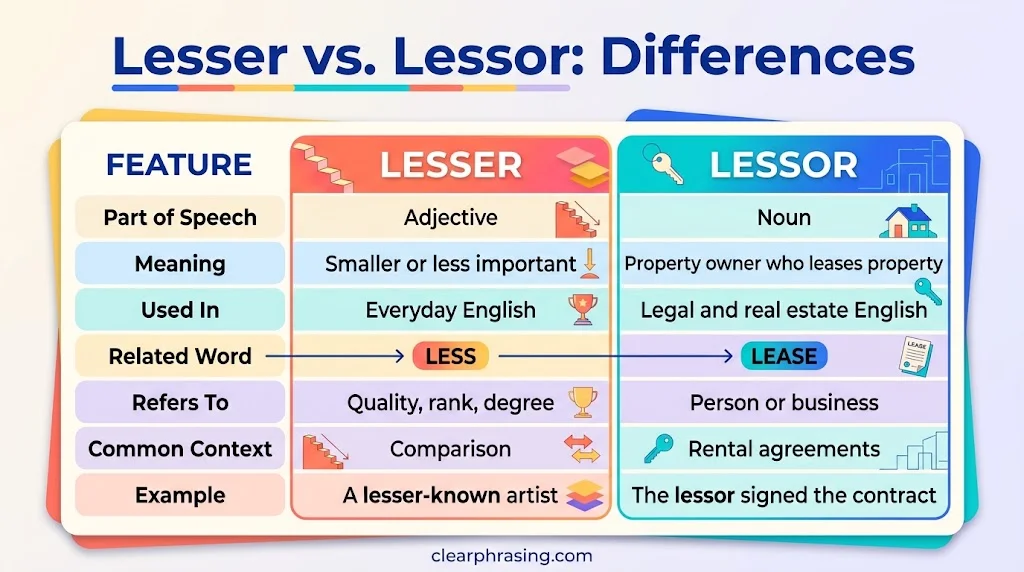
Lesser vs. Lessor: Key Differences
Although they sound identical, these words belong to different parts of speech and serve entirely different purposes.
| Feature | Lesser | Lessor |
| Part of Speech | Adjective | Noun |
| Meaning | Smaller or less important | Property owner who leases property |
| Used In | Everyday English | Legal and real estate English |
| Related Word | Less | Lease |
| Refers To | Quality, rank, degree | Person or business |
| Common Context | Comparison | Rental agreements |
| Example | A lesser-known artist | The lessor signed the contract |
The Biggest Difference
A quick way to separate them is to ask yourself a simple question:
Am I describing something or naming someone?
- If you’re describing importance, quality, or degree, use lesser.
- If you’re naming the owner in a lease agreement, use lessor.
This one question eliminates most confusion.
Lesser vs. Lessor in Real-Life Examples
Learning through examples makes the distinction much easier to remember.
Everyday Examples
✔ We chose the lesser risk.
✔ She accepted the lesser opportunity because it offered better work-life balance.
✘ We chose the lessor risk.
The last sentence is incorrect because risk is being described, not leased.
Business Examples
- The company discontinued its lesser-performing products.
- Managers invested more money in high-performing brands than in lesser ones.
- Investors ignored several lesser-known startups.
Notice that every sentence uses lesser to compare importance or performance.
Real Estate Examples
- The lessor inspected the apartment before handing over the keys.
- The lessor prepared the lease agreement.
- The tenant contacted the lessor about plumbing repairs.
These examples use lessor correctly because they refer to the property owner.
Legal Examples
Legal contracts almost always distinguish between the two parties.
For example:
- Lessor – the owner granting possession.
- Lessee – the person receiving possession under the lease.
Using lesser in these documents would create a grammatical error and could confuse readers.
Grammar Rules for Using Lesser and Lessor
Choosing between lesser and lessor becomes much easier once you understand how each word functions in a sentence.
Use Lesser as an Adjective
The word lesser always describes a noun. It compares importance, rank, quality, or degree.
Examples:
- She accepted a lesser role in the company.
- We focused on the lesser issues first.
- He wrote several lesser-known novels before publishing his bestseller.
If the word describes something, lesser is almost always the correct choice.
Use Lessor as a Noun
The word lessor identifies a person or organization.
Examples:
- The lessor signed the agreement.
- The lessor inspected the apartment before the tenant moved in.
- The lessor renewed the lease for another year.
Unlike lesser, lessor never describes another noun.
Use Context to Choose the Right Word
A simple question can help you decide.
Are you comparing two things?
If yes, use lesser.
Are you referring to a property owner involved in a lease?
If yes, use lessor.
Common Mistakes People Make
Because these words are pronounced the same way, writers often confuse them.
Here are some of the most common errors.
| Incorrect Sentence | Correct Sentence |
| The lesser signed the lease agreement. | The lessor signed the lease agreement. |
| She became a lessor-known actress. | She became a lesser-known actress. |
| The lessor option costs less. | The lesser option costs less. |
| Our apartment lesser increased the rent. | Our apartment lessor increased the rent. |
These mistakes usually happen because writers rely on pronunciation instead of meaning. Reading the sentence carefully before choosing the spelling helps prevent these errors.
Memory Tricks to Remember the Difference
Simple memory techniques can make these words much easier to remember.
Connect Lessor with Lease
Notice that lessor and lease begin with similar letters.
If your sentence includes words like:
- property
- landlord
- tenant
- rent
- apartment
- contract
the correct word is almost certainly lessor.
Connect Lesser with Less
The word lesser comes from less.
If you’re comparing importance, size, quality, or degree, choose lesser.
Examples include:
- lesser concern
- lesser priority
- lesser responsibility
- lesser importance
Use the One-Question Rule
Ask yourself:
“Am I describing something or naming the property owner?”
If you’re describing something, use lesser.
If you’re naming the owner in a lease, use lessor.
Common Phrases Using Lesser
Several expressions containing lesser appear frequently in everyday English.
Lesser-Known
Used for someone or something that is not widely recognized.
Example:
The article introduced readers to several lesser-known national parks.
Lesser Evil
Refers to the better of two unpleasant choices.
Example:
Taking the longer route was the lesser evil compared with sitting in heavy traffic.
Lesser Degree
Means a smaller amount or lower intensity.
Example:
The new regulations affected rural communities to a lesser degree.
Lesser Extent
Indicates a reduced level of influence or impact.
Example:
The policy affected small businesses to a lesser extent than expected.
Lesser Priority
Describes something that is less urgent.
Example:
Replacing office furniture became a lesser priority after the budget cuts.
Lesser Role
Refers to a supporting or less significant position.
Example:
Although she played a lesser role, her performance impressed the audience.
Common Legal Phrases Using Lessor
The word lessor appears frequently in legal, financial, and real estate documents.
Lessor and Lessee
This phrase identifies the two parties involved in a lease agreement.
The lessor owns the property, while the lessee rents it.
Lessor’s Rights
A lessor generally has the legal right to:
- Collect rent
- Enforce lease terms
- Inspect the property when permitted by law
- Recover possession after the lease expires
Lessor’s Obligations
A lessor also has legal responsibilities, including:
- Delivering the property in usable condition
- Completing repairs required by law or contract
- Following local housing regulations
- Respecting the tenant’s legal rights
Commercial Lessor
A commercial lessor leases office buildings, retail stores, warehouses, or industrial properties.
Residential Lessor
A residential lessor rents apartments, houses, condominiums, or other residential properties.
Origin and Etymology
Learning where these words came from makes them easier to remember.
Origin of Lesser
The word lesser comes from Old English and developed from the comparative form of less. For centuries, it has described something lower in importance, quality, rank, or degree.
Origin of Lessor
The word lessor entered English through Anglo-French legal language. It developed alongside the word lease, which explains why it remains closely associated with property law and rental agreements today.
British vs. American English
The good news is that there are no spelling differences between British and American English for these words.
Both varieties use:
- lesser
- lessor
- lessee
- lease
with the same meanings and grammar rules.
The main difference is usage.
Lesser appears frequently in everyday writing because people often compare importance, quality, or degree.
Lessor is mostly found in legal documents, rental agreements, and commercial contracts.
Can Lesser and Lessor Ever Be Interchangeable?
No. Although they are homophones, lesser and lessor have different meanings and grammatical functions.
Consider these examples:
❌ The lesser renewed the apartment lease.
✔ The lessor renewed the apartment lease.
Another example:
❌ She accepted the lessor position.
✔ She accepted the lesser position.
Whenever you write one of these words, focus on the context rather than the pronunciation. If you’re making a comparison, choose lesser. If you’re referring to the owner in a lease agreement, choose a lessor.
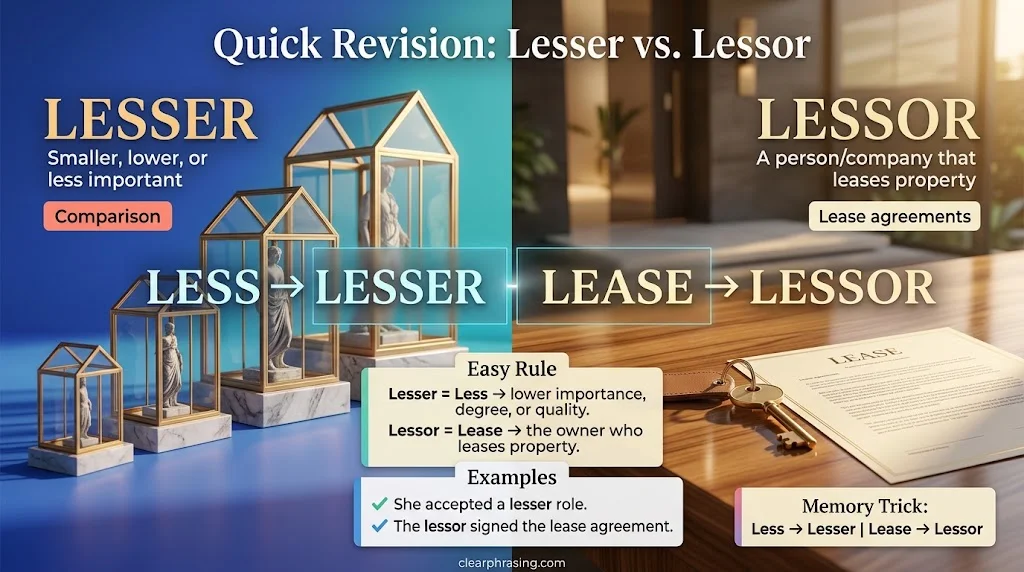
Quick Revision:
| Word | Meaning | Use |
|---|---|---|
| Lesser | Smaller, lower, or less important | Comparison |
| Lessor | A person/company that leases property | Lease agreements |
Easy Rule
- Lesser = Less → lower importance, degree, or quality.
- Lessor = Lease → the owner who leases property.
Examples
✔ She accepted a lesser role.
✔ The lessor signed the lease agreement.
Memory Trick: Less → Lesser | Lease → Lessor.
Practice
Choose the correct word:
- The ______ signed the apartment lease.
- This is the ______ of two problems.
- The property ______ collected the rent.
Answers: 1. Lessor | 2. Lesser | 3. Lessor
Read More: Is It Scot Free or Scotch Free? The Correct Phrase, and Meaning
FAQs
Q1. What is the difference between Lesser and Lessor?
Lesser is an adjective that means smaller in amount, importance, or degree. Lessor is a noun that refers to the person or company that leases property to someone else.
Q2. Which is correct: Lesser or Lessor?
Both are correct, but they are used in different situations. Use Lesser for comparisons and Lessor in legal or rental agreements.
Q3. Is Lessor only used in legal documents?
It is most common in legal, real estate, and lease contracts, but it can also appear in business and finance documents involving property rentals.
Q4. Can I use Lesser instead of Lessor in a lease agreement?
No. Replacing Lessor with Lesser changes the meaning of the sentence and may create confusion in legal writing.
Q5. What part of speech is Lesser?
Lesser is an adjective. It describes a noun by showing a lower degree, amount, or importance.
Q6. What part of speech is Lessor?
Lessor is a noun. It names the owner who rents or leases property to another person, known as the lessee.
Q7. How can I remember the difference between Lesser and Lessor?
Think of Lessor as the person who signs a lease. The similar spelling makes it easier to connect Lessor with leasing property.
Q8. Is Lesser-known a correct English expression?
Yes. Lesser-known is a common and correct expression used to describe someone or something that is not widely recognized.
Q9. Why do people confuse Lesser and Lessor?
They have similar spelling and pronunciation, but they belong to different parts of speech and have completely different meanings.
Q10. Are Lesser and Lessor pronounced the same?
They are pronounced very similarly in everyday English, which is one reason many learners mix them up. Paying attention to the context helps you choose the correct word.
Conclusion
Although Lesser and Lessor differ by just one letter, they serve completely different purposes in English. Lesser compares things by showing a lower degree or amount, while Lessor identifies the owner who leases property in a legal agreement. Understanding this distinction helps you avoid common grammar mistakes and write with greater confidence in both everyday and professional situations.
From my experience teaching English for many years, I have found that learners remember these words much more easily once they connect Lessor with lease and Lesser with comparison. A simple memory trick like this can prevent costly mistakes, especially in legal or business writing. The more you read real examples and practice using both words in context, the more natural the correct choice will become.

Shamsa Kanwal is an English specialist and content writer at ClearPhrasing.com, where she helps readers navigate the English language with confidence. She enjoys breaking down grammar rules, spelling differences, vocabulary, and everyday writing challenges into simple, practical lessons that anyone can understand.
Her writing is focused on making learning approachable rather than overwhelming. Whether she’s explaining commonly confused words, punctuation rules, or grammar concepts, Shamsa believes that clear explanations and real-life examples are the key to effective learning.
Every article she writes is carefully researched, fact-checked, and edited to ensure it is accurate, easy to read, and genuinely helpful. Her goal is to create trustworthy resources that enable students, professionals, writers, and English learners to improve their communication skills and write with greater clarity.
Through her work at ClearPhrasing.com, Shamsa is committed to making English learning simpler, more practical, and accessible for readers around the world.