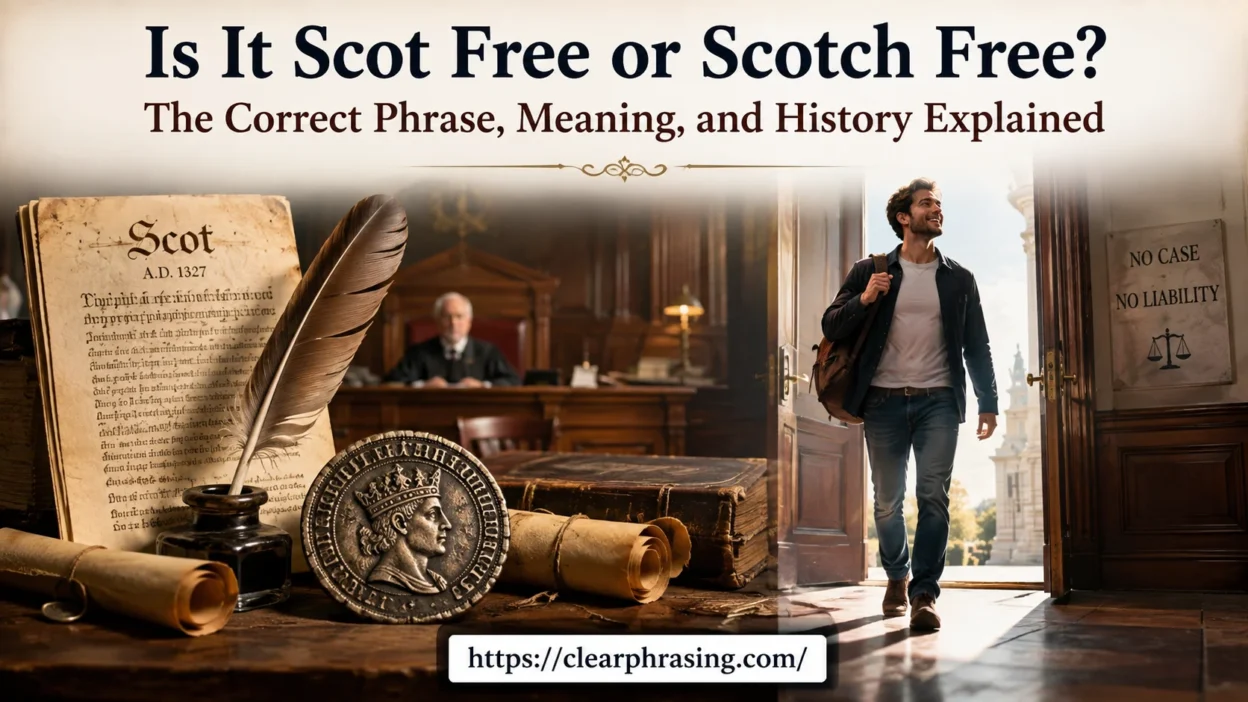
Is It Scot Free or Scotch Free? The Correct Phrase, and Meaning explains the correct phrase and its meaning, helping you avoid a common English idiom mistake with confidence.
The correct phrase is Scot Free or Scot-free, while Scotch Free is the incorrect phrase. The phrase meaning, historical meaning, and etymology come from Old English, where scot referred to a fine or tax, payment, or due payment. Someone who could get off scot-free would escape, avoid payment, avoid fine, avoid tax, and leave without paying, without penalty, or without cost.
From my experience teaching English, this tricky phrase often creates common confusion in conversation, discussion, office chat, and even at a dinner party. Many people connect Scotch with Scotland, Scottish identity, or Scotch whisky, but the correct saying is Scot Free. Good English grammar, vocabulary, language, and the right context help you avoid this common mistake and use the phrase correctly.
Quick Answer:
The correct phrase is scot-free, not scotch-free.
Scot-free means getting away without facing a punishment, cost, or responsibility.
Correct example:
“The driver caused the accident but escaped scot-free because there was not enough evidence.”
Incorrect example:
“The driver escaped scotch-free.”
“Scotch-free” is not the accepted expression in standard English. It is simply a common misunderstanding caused by the similar sound of the two words.
What Does Scot-Free Mean?
The phrase scot-free means someone avoids something negative without having to pay the expected price.
The “price” does not always mean money. It can refer to any consequence, including:
- Legal punishment
- Financial responsibility
- Social criticism
- Blame
- Extra work
- A difficult situation
The expression usually suggests that the person escaped something they probably should have experienced.
Examples of Scot-Free in Modern English
Legal situation:
“The suspect walked away scot-free after prosecutors dropped the case.”
Workplace situation:
“Everyone stayed late to fix the mistake, but the person responsible went scot-free.”
Everyday situation:
“My brother broke the lamp and somehow got off scot-free.”
In each example, someone avoids a negative outcome.
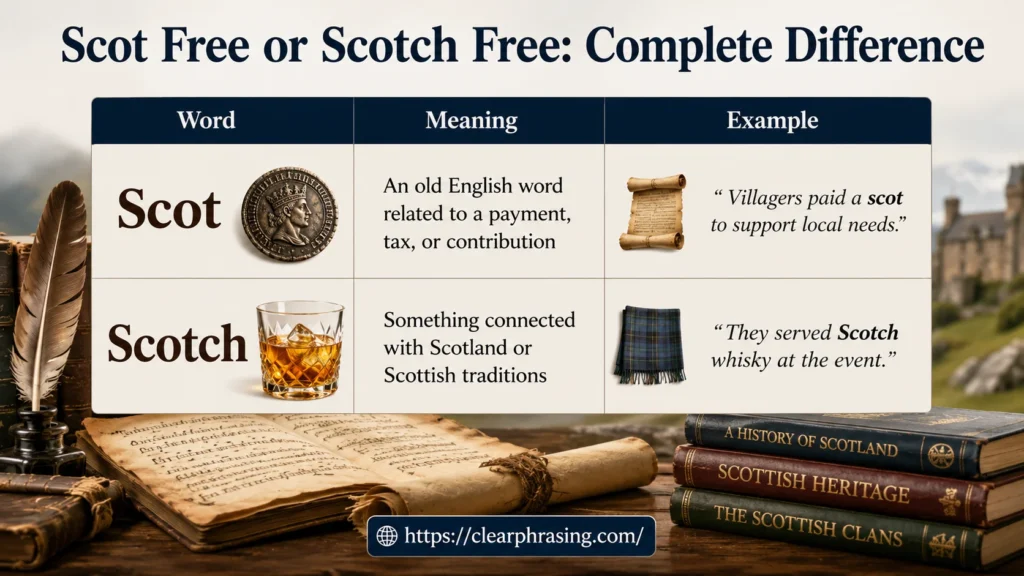
Is It “Scot Free” or “Scotch Free”? Understanding the Difference
The confusion between scot-free and scotch-free happens because the words sound almost identical. However, their meanings are completely different.
| Word | Meaning | Example |
| Scot | An old English word related to a payment, tax, or contribution | “Villagers paid a scot to support local needs.” |
| Scotch | Something connected with Scotland or Scottish traditions | “They served Scotch whisky at the event.” |
The phrase scot-free has nothing to do with Scotland, Scottish people, or Scotch whisky.
The word “scot” is simply an old word that most modern speakers rarely encounter.
Where Did the Phrase Scot-Free Come From?
The origin of scot-free dates back to medieval England.
Hundreds of years ago, communities collected different types of payments from residents. These payments helped support shared responsibilities. A person’s required contribution was known as a scot.
If someone was free from paying that contribution, they were considered scot-free.
The original meaning was closer to:
“Free from having to pay a required amount.”
Over time, people started using the phrase in a broader way.
The meaning developed like this:
| Period | Meaning |
| Early usage | Free from paying a required contribution |
| Later usage | Free from a financial obligation |
| Modern usage | Escaping punishment or consequences |
This type of change is common in language. Words often move away from their original meanings as generations use them in new situations.
What Did the Word Scot Originally Mean?
The old word scot referred to a share, payment, or contribution that someone owed.
It was connected to the idea that members of a community had financial responsibilities.
For example, people might have been expected to contribute toward:
- Local expenses
- Community obligations
- Public needs
- Required payments
Someone who avoided paying their share was free from that obligation.
That is where the phrase began.
Today, most people no longer use “scot” as a standalone word. However, the phrase scot-free survived because it became a common expression.
Why Do People Say Scotch-Free Instead?
The mistake happens because people naturally try to make unfamiliar language easier to understand.
There are a few main reasons behind the confusion.
The Word Scot Is Rare Today
Most English speakers do not hear the word “scot” in everyday conversations.
People usually say:
- Tax
- Fee
- Bill
- Payment
- Contribution
Because “scot” feels unfamiliar, speakers often replace it with a word they already know.
Scotch Is a More Familiar Word
The word Scotch appears much more often in modern English.
People recognize it from:
- Scotch whisky
- Scotch tape
- Scottish culture
When they hear “scot-free,” their brain may automatically connect it with “Scotch.”
This creates a false connection between two unrelated words.
Similar Sound Creates Language Mistakes
Many English expressions have been changed because people misunderstood them.
Here are some examples:
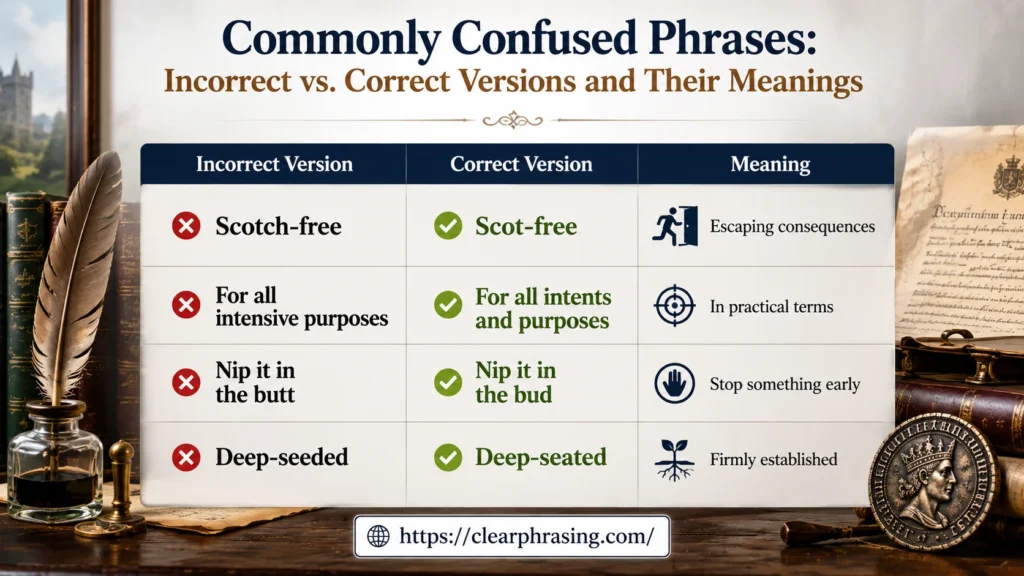
| Incorrect Version | Correct Version | Meaning |
| Scotch-free | Scot-free | Escaping consequences |
| For all intensive purposes | For all intents and purposes | In practical terms |
| Nip it in the butt | Nip it in the bud | Stop something early |
| Deep-seeded | Deep-seated | Firmly established |
These mistakes are normal because spoken language often changes faster than written language.
Read More: Two Persons vs Two People: Which Is Correct?
How to Use Scot-Free Correctly in a Sentence
The phrase is commonly used with verbs like:
- Get
- Escape
- Walk away
- Go
- Leave
Everyday Examples
“Everyone apologized for the mistake, but Sarah got off scot-free.”
“The company ignored safety rules and somehow escaped scot-free.”
“He forgot to complete his assignment but went scot-free because the teacher never checked.”
Formal Writing Example
“The investigation ended without charges, allowing the organization to walk away scot-free.”
The phrase works well in both casual conversations and professional writing.
Is Scot-Free Hyphenated?
Yes, the standard spelling is:
scot-free
The hyphen joins the two words because they work together as a single expression.
Correct:
- “He escaped scot-free.”
- “They walked away scot-free.”
Incorrect:
- “He escaped scot free.”
- “They walked away scotch-free.”
Although some informal writing may remove the hyphen, scot-free remains the preferred spelling.
My Personal Experience
As an English language specialist, I’ve seen how easily learners can choose the wrong version of an expression when one word sounds more familiar than the correct one.
With scot-free, many students naturally connect the phrase with Scotch because they recognize that word more quickly. This kind of confusion has appeared repeatedly in my teaching, especially when students learn idioms mainly through listening rather than through reading.
Over the years, I’ve learned that giving students a reason behind a phrase helps them far more than simple correction. When I explain the meaning and background of scot-free, learners begin to see why the expression uses scot rather than Scotch. That understanding usually stays with them, and they become more careful and confident when using similar English expressions.
Practice Section:
Choose the correct phrase:
- He got off scot-free / scotch-free.
- She escaped scot-free / scotch-free.
- They walked away scot-free / scotch-free.
Answers: All three use scot-free. ✅
Quick Revision
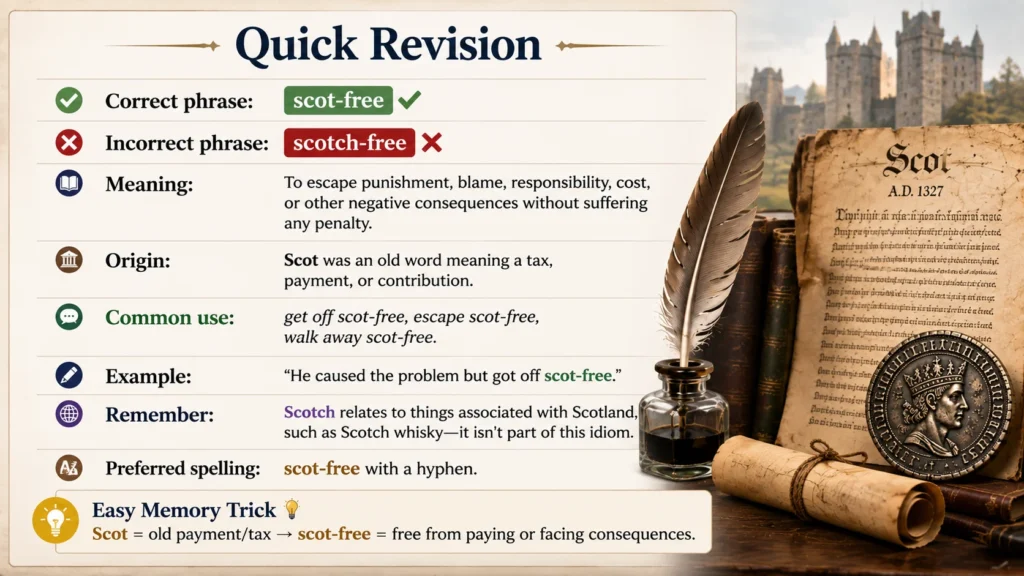
- Correct phrase: scot-free ✅
- Incorrect phrase: scotch-free ❌
- Meaning: To escape punishment, blame, responsibility, cost, or other negative consequences without suffering any penalty.
- Origin: Scot was an old word meaning a tax, payment, or contribution.
- Common use: get off scot-free, escape scot-free, walk away scot-free.
- Example: “He caused the problem but got off scot-free.”
- Remember: Scotch relates to things associated with Scotland, such as Scotch whisky—it isn’t part of this idiom.
- Preferred spelling: scot-free with a hyphen.
Easy Memory Trick 💡
Scot = old payment/tax → scot-free = free from paying or facing consequences.
FAQs
Q1. Is Scot Free the correct phrase?
Yes. Scot Free (or Scot-free) is the correct English phrase. Scotch Free is considered incorrect in modern English.
Q2. Why do people say Scotch Free?
Many people confuse the words because Scotch is strongly associated with Scotland. However, the idiom has nothing to do with Scottish nationality.
Q3. What does Scot Free mean today?
Today, Scot Free means escaping punishment, blame, or consequences without suffering any loss or penalty.
Q4. Where did the phrase Scot Free come from?
The phrase comes from Old English, where scot meant a tax or payment. Originally, it described someone who did not have to pay a required tax.
Q5. Can I use Scot-free with a hyphen?
Yes. Both Scot Free and Scot-free are accepted spellings, although many dictionaries prefer the hyphenated form.
Q6. Is Scot Free used in formal writing?
Yes. It is appropriate in formal, academic, journalistic, and everyday English when used in the correct context.
Q7. Does Scot Free only refer to legal situations?
No. It can describe any situation where someone avoids responsibility, criticism, costs, or negative consequences.
Q8. Is the phrase connected to Scotland or Scottish people?
No. Although the words look similar, the idiom is not related to Scotland, Scottish people, or Scotch whisky.
Q9. Why is this phrase often confusing for English learners?
The similarity between Scot, Scotch, and Scottish makes the expression easy to misunderstand, especially for learners who rely on pronunciation.
Q10. How can I remember the correct phrase?
Think of scot as an old word for a tax or payment. If you remember that history, you’ll naturally choose Scot Free instead of Scotch Free.
Conclusion
The phrase Scot Free has survived for centuries because its meaning is still useful today. Although many people mistakenly say Scotch Free, the historical evidence is clear: the correct expression comes from an old word meaning a tax or payment, not from Scotland. Knowing this small detail can make your English more accurate and confident.
In my experience teaching English, these are the kinds of expressions that students remember once they learn the story behind them. Instead of memorizing rules, understanding the origin makes the correct phrase feel natural. The next time you hear someone say Scotch Free, you’ll know why Scot Free is the right choice and be able to use it correctly in both speaking and writing.

Shamsa Kanwal is an English specialist and content writer at ClearPhrasing.com, where she helps readers navigate the English language with confidence. She enjoys breaking down grammar rules, spelling differences, vocabulary, and everyday writing challenges into simple, practical lessons that anyone can understand.
Her writing is focused on making learning approachable rather than overwhelming. Whether she’s explaining commonly confused words, punctuation rules, or grammar concepts, Shamsa believes that clear explanations and real-life examples are the key to effective learning.
Every article she writes is carefully researched, fact-checked, and edited to ensure it is accurate, easy to read, and genuinely helpful. Her goal is to create trustworthy resources that enable students, professionals, writers, and English learners to improve their communication skills and write with greater clarity.
Through her work at ClearPhrasing.com, Shamsa is committed to making English learning simpler, more practical, and accessible for readers around the world.