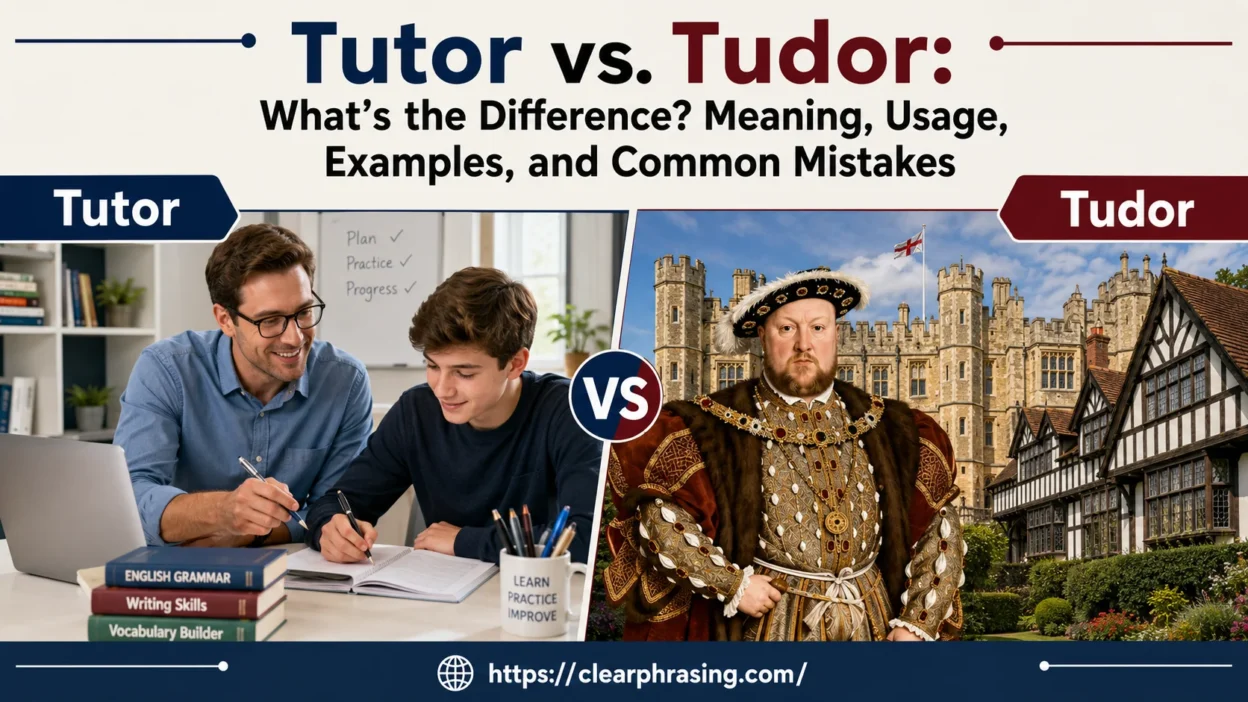
Tutor vs Tudor: Difference, Meaning, Usage, and Examples helps you understand two homophones with different meanings.
A tutor is a teacher who gives private instruction, while Tudor refers to the English royal dynasty and Tudor architecture. In my teaching experience, paying attention to spelling, pronunciation, and context clues is the easiest way to choose the correct term and avoid common mistakes.
A simple way to remember the difference is that tutor is connected with education, students, and learning, while Tudor belongs to English history, the British royal family, and the historical period from 1485 to 1603. Reading more examples and practicing English vocabulary will help you use both words correctly.
This guide will help you choose the right word with confidence every time.
Quick Answer:
A tutor is a person who teaches or gives private instruction to students. Tudor refers to the English royal dynasty that ruled from 1485 to 1603 or anything related to that period, such as Tudor history or Tudor architecture.
| Word | Meaning | Part of Speech | Example |
| Tutor | A private teacher or instructor | Noun (also a verb) | She hired a tutor to improve her math grades. |
| Tudor | The English royal dynasty or something related to it | Proper noun or adjective | We toured a beautiful Tudor manor. |
If you’re talking about teaching or learning, use tutor. If you’re talking about English history, monarchs, or architecture, use Tudor.
What Does “Tutor” Mean?
A tutor is someone who teaches another person individually or in a small group. Unlike a classroom teacher who works with many students at once, a tutor provides personalized instruction based on the learner’s strengths, weaknesses, and goals.
Tutors help students understand difficult subjects, prepare for exams, build new skills, and gain confidence. Today, tutoring happens both in person and online, making it easier than ever to receive one-on-one support.
Definition of Tutor
A tutor is a person who gives private instruction or academic guidance. The word can also function as a verb, meaning to teach or coach someone individually.
Common examples include:
- An English tutor helping students improve grammar.
- A math tutor preparing someone for final exams.
- A music tutor teaching piano lessons.
- A coding tutor helping beginners learn programming.
Origin of the Word “Tutor”
The word tutor comes from the Latin word tutor, meaning guardian, protector, or guide. Over time, its meaning shifted from someone who protects another person to someone who guides another person’s education.
Today, the word is widely used in schools, universities, training centers, and online learning platforms around the world.
When Should You Use “Tutor”?
Use tutor whenever you’re referring to someone who provides instruction outside the traditional classroom or offers personalized teaching.
You can use the word in situations such as:
- Private lessons
- Homework assistance
- Test preparation
- College entrance exam coaching
- Language learning
- Professional certification courses
- Online education
Examples:
- My chemistry tutor explained the topic much better than my textbook.
- She works as an online English tutor.
- They hired a tutor to help their daughter prepare for college entrance exams.
Examples of “Tutor” in Sentences
Education
- My tutor helped me understand algebra in just a few weeks.
- The school recommended a science tutor for struggling students.
- Every weekend, she studies with her English tutor.
College
- His economics tutor explained complex theories using everyday examples.
- University tutors often supervise research projects and academic writing.
Professional Training
- The company hired a software tutor to train new employees.
- Our driving tutor remained patient throughout every lesson.
Everyday Conversation
- Do you know a good guitar tutor?
- She earns extra income by working as a private tutor.
- His tutor encouraged him to practice every day.
What Does “Tudor” Mean?
Unlike tutor, Tudor has nothing to do with education.
Tudor refers to the House of Tudor, the royal family that ruled England between 1485 and 1603. The dynasty began when Henry VII defeated Richard III at the Battle of Bosworth Field in 1485. This victory ended the Wars of the Roses and started a new chapter in English history.
The Tudor period remains one of the most important eras because it transformed England politically, religiously, economically, and culturally.
Definition of Tudor
Tudor is a proper noun because it names a specific royal dynasty. It can also be used as an adjective when describing something connected with that historical period.
Examples include:
- Tudor monarchs
- Tudor England
- Tudor architecture
- Tudor manor
- Tudor history
Because it refers to a proper name, Tudor should always begin with a capital letter.
The Tudor Dynasty Explained
The House of Tudor ruled England for 118 years and produced six monarchs who shaped the nation’s future.
| Monarch | Years of Reign | Known For |
| Henry VII | 1485–1509 | Founded the Tudor dynasty |
| Henry VIII | 1509–1547 | Six marriages and the English Reformation |
| Edward VI | 1547–1553 | Expanded Protestant reforms |
| Mary I | 1553–1558 | Restored Roman Catholicism |
| Elizabeth I | 1558–1603 | Led the Elizabethan Golden Age |
Why the Tudor Era Is Important
The Tudor period changed England in lasting ways.
Major developments included:
- The English Reformation.
- The growth of overseas exploration.
- Greater royal authority.
- Economic expansion.
- Remarkable achievements in literature and the arts.
Many of William Shakespeare’s famous plays were written during the later years of the Tudor period, making it one of the richest cultural eras in English history.
Tudor Architecture
The word Tudor is also widely used in architecture. Tudor-style buildings are known for their distinctive appearance and traditional English design.
Classic Tudor buildings often include:
- Steeply pitched roofs
- Decorative half-timbering
- Tall brick chimneys
- Leaded glass windows
- Large stone fireplaces
- Exposed wooden beams
- Brick or stone walls
The Tudor Revival style later became popular in countries such as the United States and Canada. Many modern homes still borrow design features from traditional Tudor architecture.
Examples of “Tudor” in Sentences
History
- Elizabeth I became one of the greatest Tudor monarchs.
- The museum displays many treasures from the Tudor period.
- Students learned about the rise of the Tudor dynasty.
Architecture
- They purchased a charming Tudor-style home.
- The castle showcases classic Tudor craftsmanship.
- Visitors admired the Tudor manor’s impressive wooden beams.
Literature
- Many historical novels explore life during Tudor England.
- The documentary explains how the Tudor monarchy changed British history.
Tutor vs. Tudor: Side-by-Side Comparison
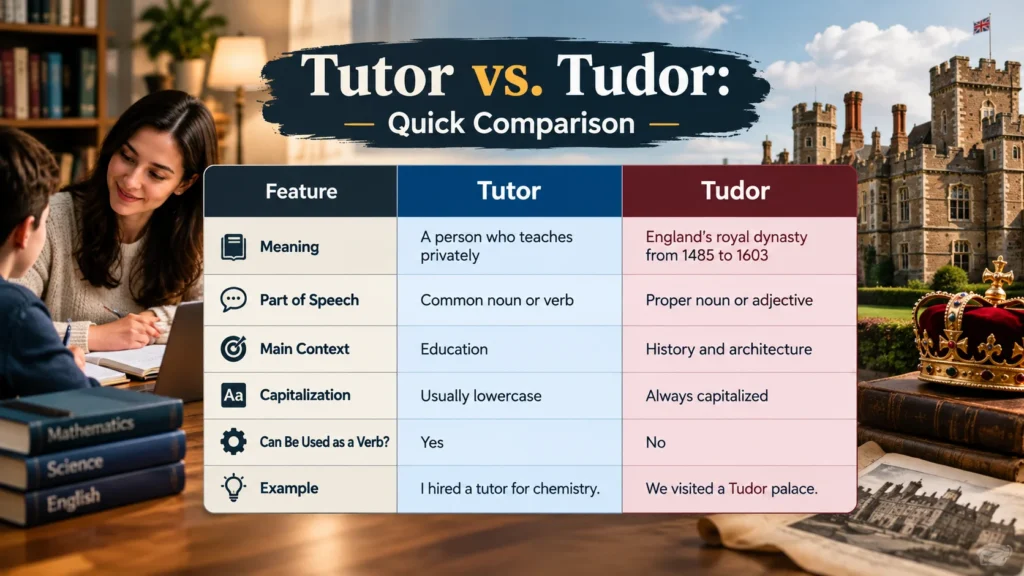
Although Tutor and Tudor sound alike, their meanings are completely different.
| Feature | Tutor | Tudor |
| Meaning | A person who teaches privately | England’s royal dynasty from 1485 to 1603 |
| Part of Speech | Common noun or verb | Proper noun or adjective |
| Main Context | Education | History and architecture |
| Capitalization | Usually lowercase | Always capitalized |
| Can Be Used as a Verb? | Yes | No |
| Example | I hired a tutor for chemistry. | We visited a Tudor palace. |
An Easy Way to Remember the Difference
Think about the topic you’re discussing.
If you’re talking about studying, teaching, homework, exams, or education, the correct word is tutor.
If you’re talking about kings, queens, castles, English history, or historic buildings, the correct word is Tudor.
Remember this simple phrase:
Tutor teaches. Tudor ruled.
That one sentence is often all you need to choose the correct word every time.
Tutor vs. Tudor Pronunciation
One reason people confuse Tutor and Tudor is that they sound very similar. In many English accents, especially American English, the pronunciation is almost identical. That’s why context matters much more than pronunciation.
How to Pronounce “Tutor”
In American English, tutor is commonly pronounced as “TOO-ter” or “TYOO-ter.” The exact pronunciation depends on regional accents, but the meaning always relates to teaching.
Examples:
- She hired a tutor for math.
- My English tutor explained the grammar rule.
How to Pronounce “Tudor”
Tudor is usually pronounced almost the same as tutor. In British English, you may hear a slightly clearer “dy” sound, while many American speakers pronounce both words nearly identically.
Examples:
- The Tudor dynasty ruled England.
- They visited a Tudor castle.
Why They Sound So Similar
English contains many words that share similar pronunciations but different meanings. These are called homophones or near-homophones. Because Tutor and Tudor belong to different topics, the surrounding words almost always reveal which one is correct.
Key Differences Between Tutor and Tudor
Although the spellings differ by only one letter, the meanings couldn’t be more different.
| Feature | Tutor | Tudor |
| Meaning | A private teacher | An English royal dynasty |
| Field | Education | History |
| Capitalization | Lowercase in most cases | Always capitalized |
| Can Be a Verb? | Yes | No |
| Modern Use | Very common | Mostly historical and architectural |
The easiest way to remember the difference is to think about the subject.
If someone is helping you learn, they’re a tutor.
If you’re reading about kings, queens, or castles, you’re reading about the Tudors.
Common Mistakes People Make
Many spelling mistakes happen because people write words based on how they sound instead of what they mean.
Writing “Tudor” Instead of “Tutor”
❌ I hired a Tudor to help me with chemistry.
✅ I hired a tutor to help me with chemistry.
Since the sentence is about education, tutor is correct.
Writing “Tutor” Instead of “Tudor”
❌ Henry VIII was a famous Tutor king.
✅ Henry VIII was a famous Tudor king.
Henry VIII belonged to the House of Tudor, so the proper noun Tudor is required.
Forgetting Capital Letters
❌ tudor dynasty
✅ Tudor dynasty
Because Tudor is a proper noun, it always begins with a capital letter.
Trusting Spell Check Too Much
Most spell checkers only verify spelling. They don’t always understand context.
For example:
- My Tutor explained algebra.
- My Tudor explained algebra.
Both words are spelled correctly, but only one fits the sentence.
Memory Tricks to Remember the Difference
Simple memory tricks make confusing words much easier to remember.
Tutor Teaches
Both Tutor and Teach begin with the letter T.
Think:
Tutor = Teaching
Tudor Ruled England
The word Tudor reminds many people of kings, queens, palaces, and history.
Think:
Tudor = Throne
Picture Association
Imagine two pictures.
The first picture shows a student studying with a private teacher.
That’s a tutor.
The second picture shows a king wearing a crown inside a castle.
That’s Tudor.
Visual memories often last much longer than simple definitions.
Can “Tutor” Be Used as a Verb?
Yes. Although most people use tutor as a noun, it also functions as a verb.
When used as a verb, it means to teach, coach, or give private instruction.
Examples:
- She tutors high school students every weekend.
- He tutored me before the final exam.
- They hired someone to tutor their son in mathematics.
The meaning stays connected to education in every case.
Can “Tudor” Be Used as a Common Noun?
Generally, no.
Tudor refers to a specific royal family, so it remains a proper noun.
However, it often works as an adjective.
Examples:
- Tudor architecture
- Tudor furniture
- Tudor clothing
- Tudor history
These phrases describe things connected with the Tudor period rather than naming individual people.
Real-Life Examples
Understanding how each word appears in everyday life makes the difference easier to remember.
Education
- The tutor created a personalized study plan.
- Online tutors now teach students around the world.
- Many universities provide free tutoring services.
History
- Visitors toured Hampton Court Palace to learn about the Tudor monarchs.
- Historians continue studying the political changes of Tudor England.
Architecture
- The neighborhood contains several Tudor-style homes.
- The building features decorative timber framing typical of Tudor design.
Books and Television
Historical novels, documentaries, and television dramas frequently explore the Tudor period, especially the lives of Henry VIII and Elizabeth I.

Tutor vs. Teacher vs. Mentor
People often confuse these three roles because all involve helping someone learn.
| Word | Primary Role | Typical Setting |
| Tutor | Individual instruction | Private lessons or online learning |
| Teacher | Classroom education | Schools and colleges |
| Mentor | Personal or career guidance | Workplace or professional development |
A teacher usually instructs an entire class.
A tutor focuses on one learner or a small group.
A mentor shares advice, experience, and long-term guidance rather than formal lessons.
Tutor vs. Tudor in American and British English
The meanings of Tutor and Tudor stay the same in both American and British English.
The main differences involve pronunciation.
- American English often pronounces both words almost identically.
- British English may produce a slightly clearer distinction depending on the regional accent.
Regardless of pronunciation, spelling and meaning never change.
Grammar Tips for Using Tutor and Tudor Correctly
Following a few grammar rules will help you avoid mistakes.
Capitalization
- Tutor ✔ (only at the beginning of a sentence or in a title)
- tutor ✔
- Tudor ✔
- tudor ✘
Plural Forms
- tutor → tutors
- Tudor → Tudors
Examples:
- The school employs several tutors.
- The Tudors ruled England for more than a century.
Possessive Forms
Examples:
- The tutor’s advice improved my grades.
- The Tudors’ influence shaped English history.
My Personal Experience
As an English language specialist and teacher with more than 15 years of teaching experience, I’ve noticed that students often confuse words that sound alike, even when their meanings are completely different. I’ve seen this happen with tutor and Tudor.
Learners sometimes choose the spelling that feels right because they focus on pronunciation instead of context. In my classes, I’ve found that a simple connection works better than asking students to memorize definitions. When the sentence involves teaching, students, or learning, I guide them toward tutor. When it involves English history, royalty, or architecture, I point them toward Tudor.
One technique I regularly use is to turn confusing words into quick mental pictures. I ask students to imagine a teacher helping a learner with homework for tutor, and a king inside a historic English castle for Tudor. This makes the distinction easier to recall when they write later. After years of teaching English, I’ve learned that students become more accurate when they understand the idea behind a word rather than simply trying to remember its spelling.
That’s why I always encourage learners to look at meaning and context first, especially when two words sound almost identical.
Related Words People Often Confuse
Several words are commonly mixed up with Tutor or Tudor.
| Word Pair | Difference |
| Tutor vs Teacher | Individual instruction vs classroom teaching |
| Tutor vs Mentor | Academic teaching vs personal guidance |
| Tutor vs Tuition | Teacher vs the cost or act of teaching |
| Tudor vs Stuart | Two different English and Scottish royal dynasties |
| Tutor vs Coach | Academic instruction vs skill or sports training |
Learning these differences improves both vocabulary and writing accuracy.
Read More: Lesser or Lessor: Which Is Correct? Meaning, and Differences
FAQs
1. What is the difference between Tutor and Tudor?
A tutor is a person who teaches or gives private lessons, while Tudor refers to the English royal dynasty that ruled from 1485 to 1603 or anything related to that period, such as Tudor architecture.
2. Is Tutor or Tudor used for a teacher?
Use tutor when talking about someone who provides academic help or private instruction. Tudor is never used to describe a teacher.
3. Why do Tutor and Tudor sound the same?
They are homophones, meaning they have similar pronunciation but different spellings and meanings.
4. Is Tudor always capitalized?
Yes. Tudor is a proper noun, so it should always begin with a capital T when referring to the royal family or historical period.
5. Can tutor be used as a verb?
Yes. Tutor can also be used as a verb. For example, She tutors students in English after school.
6. What is the Tudor period?
The Tudor period is the period in English history from 1485 to 1603, when rulers such as Henry VIII and Elizabeth I were on the throne.
7. How can I remember the difference between Tutor and Tudor?
Remember that tutor starts with “tu” like tuition, while Tudor is linked to the English royal family and history.
8. Are Tutor and Tudor commonly confused?
Yes. Because they are homophones, many English learners and even native speakers sometimes mix them up in writing.
9. What is Tudor architecture?
Tudor architecture is a historic English building style known for half-timbered walls, steep roofs, and decorative wooden details.
10. How can I avoid mixing up Tutor and Tudor?
Focus on the meaning of the sentence before choosing the word. If it is about teaching, use tutor. If it is about history or royalty, use Tudor.
Conclusion
Even though Tutor and Tudor sound almost identical, their meanings are completely different. Tutor belongs to education and learning, while Tudor is connected to English history, the royal dynasty, and architecture. Understanding this simple difference will help you avoid common writing mistakes.
From my experience teaching English, learners remember confusing word pairs much faster when they connect each word to its meaning instead of its pronunciation. The more you read, write, and practice these words in real sentences, the more natural the correct choice becomes. Keep this guide as a quick reference whenever you’re unsure, and you’ll use Tutor and Tudor with confidence.

Shamsa Kanwal is an English specialist and content writer at ClearPhrasing.com, where she helps readers navigate the English language with confidence. She enjoys breaking down grammar rules, spelling differences, vocabulary, and everyday writing challenges into simple, practical lessons that anyone can understand.
Her writing is focused on making learning approachable rather than overwhelming. Whether she’s explaining commonly confused words, punctuation rules, or grammar concepts, Shamsa believes that clear explanations and real-life examples are the key to effective learning.
Every article she writes is carefully researched, fact-checked, and edited to ensure it is accurate, easy to read, and genuinely helpful. Her goal is to create trustworthy resources that enable students, professionals, writers, and English learners to improve their communication skills and write with greater clarity.
Through her work at ClearPhrasing.com, Shamsa is committed to making English learning simpler, more practical, and accessible for readers around the world.