I Was Told vs. I Have Been Told vs. I Am Told: Complete Difference helps beginners, learners, English learners, and readers master these similar English phrases.
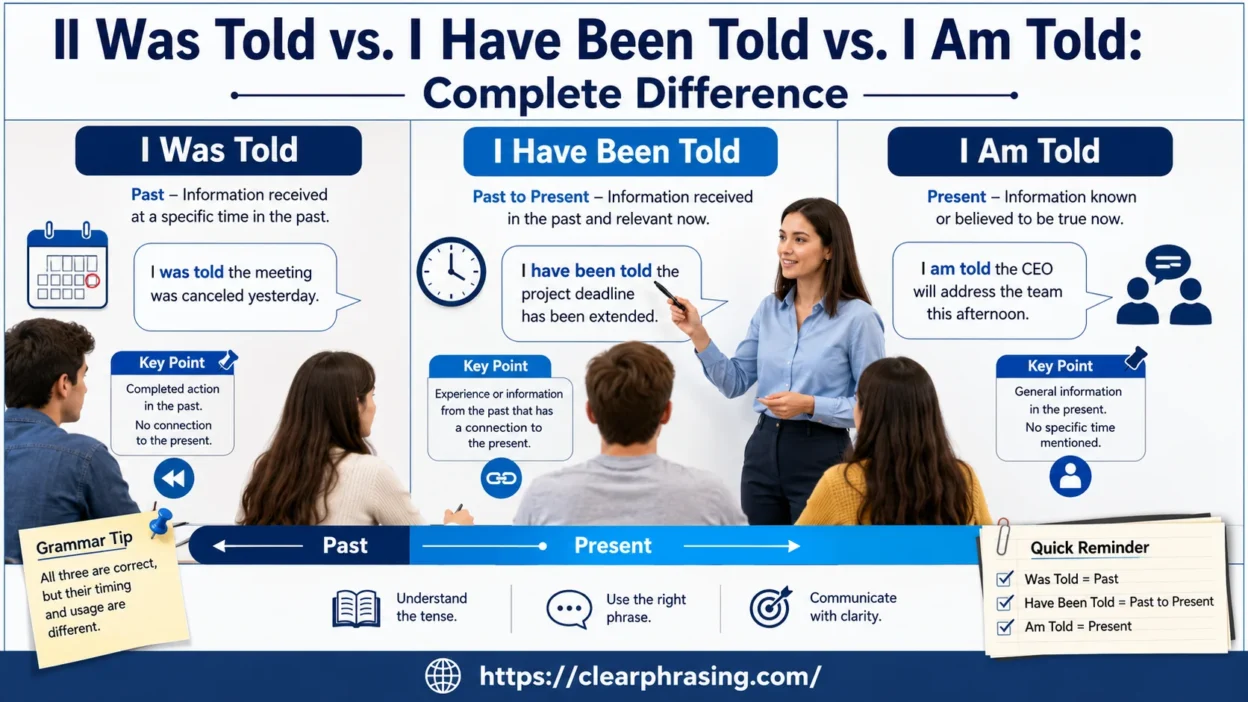
Generally, I was told uses the simple past to describe something someone said at a specific time in the past. Meanwhile, I have been told uses the present perfect for information received at an unspecified time or on multiple occasions that still matters now. I am told expresses information that is currently being reported or shared. Knowing the right contexts, tense, verb, and time reference improves English grammar, correct usage, writing, speaking, conversation, communication, and every message you communicate.
In my teaching experience, I have found that learning becomes easier when students study real examples instead of only memorizing grammar rules. One example is, “I have been told this restaurant is good,” where the fact matters more than when the information was received. Paying attention to context, expression, passive voice, sentence structure, and how these phrases convey meaning will polish your English skills.
Trusted Language Resources also help you understand every phrase, make the perfect use of the present forms, avoid confuse, strengthen your skills, and see what each explanation focuses on without confusion.
Quick Answer:
The short answer is:
| Phrase | Meaning | When to Use It | Example |
| I was told | Someone gave me information in the past | A completed past event | I was told the meeting was canceled yesterday. |
| I have been told | Someone has given me information that still matters now | Past information connected to the present | I have been told this book is very helpful. |
| I am told | Someone is currently informing me or reporting information | Formal statements or current reports | I am told the company will announce changes soon. |
A simple way to remember:
- I was told = Past information
- I have been told = Information from the past that matters now
- I am told = Current or formal information
Although these phrases share the same basic idea, they create different impressions.
Understanding “I Was Told”
What Does “I Was Told” Mean?
“I was told” uses the simple past passive voice. It means someone gave you information at a specific time in the past.
The focus is not on the person who delivered the information. Instead, the focus is on the information you received.
For example:
- My manager told me about the deadline.
- I was told about the deadline.
Both sentences have the same meaning. However, the second sentence focuses on the receiver of the information.
The phrase often appears when the exact person who gave the information is not important or when the speaker does not want to mention them.
Grammar Structure of “I Was Told”
The structure is:
Subject + was + past participle
Examples:
- I was told the office would close early.
- I was told to complete the assignment before Friday.
- I was told that the restaurant had excellent food.
Here, “was” shows past time and “told” is the past participle form of the verb tell.
When Should You Use “I Was Told”?
When Referring to a Specific Past Event
Use “I was told” when something happened at a known or completed time.
Examples:
- I was told about the schedule change this morning.
- I was told the train was delayed yesterday.
- I was told about the new policy during the meeting.
In these examples, the information belongs to a finished moment.
The speaker is looking back at something that happened.
When Reporting Someone Else’s Words
You can use “I was told” when sharing information from another person.
Examples:
- I was told that Sarah moved to New York.
- I was told that the project deadline changed.
- I was told you were looking for me.
You are not saying who gave you the information because the source is either obvious or unimportant.
When Explaining Instructions
This phrase is common when talking about advice, rules, or directions received in the past.
Examples:
- I was told to arrive early.
- I was told not to open the file.
- I was told to contact customer support.
These sentences describe something someone instructed you to do.
Understanding “I Have Been Told”
What Does “I Have Been Told” Mean?
“I have been told” uses the present perfect passive voice. It describes information that someone gave you before now, but the information still connects to the present.
The exact time is usually not mentioned because it is not important.
For example:
- I have been told that this restaurant is amazing.
This means people have given you this information before and the opinion or information still matters now.
The sentence does not tell us when someone said it. The focus is on the current relevance of the information.
Grammar Structure of “I Have Been Told”
The structure is:
Subject + have/has + been + past participle
Examples:
- I have been told that the exam is difficult.
- I have been told many times to practice more.
- I have been told about your achievements.
When Should You Use “I Have Been Told”?
When Past Information Affects the Present
Use this phrase when something you learned before is still important.
Examples:
- I have been told that this course improves writing skills.
- I have been told that the new software is easier to use.
- I have been told that the city has beautiful parks.
The information continues to influence your current understanding.
When Something Has Happened Repeatedly
Another common use is for repeated experiences.
Examples:
- I have been told many times that I need more practice.
- I have been told repeatedly to check my work.
- I have been told by several people that this method works.
The phrase suggests that the action happened more than once.
In Professional Communication
You will often see “I have been told” in workplace and formal situations.
Examples:
- I have been told that your application is under review.
- I have been told that the issue has been resolved.
- I have been told that the meeting will begin at noon.
It sounds professional because it reports information without focusing on personal opinions.
Understanding “I Am Told”
What Does “I Am Told” Mean?
“I am told” uses the simple present passive voice. It usually introduces information that someone is currently reporting or information presented as a fact.
This phrase sounds more formal than everyday conversation.
Examples:
- I am told that the new restaurant is excellent.
- I am told that the results will be announced tomorrow.
- I am told that the problem has been fixed.
In casual conversations, native speakers often prefer “I’ve heard” or “I understand” instead.
For example:
More natural:
- I’ve heard that this movie is good.
More formal:
- I am told that this movie is good.
Grammar Structure of “I Am Told”
The structure is:
Subject + am/is/are + past participle
Examples:
- I am told that the company is expanding.
- I am told that the service has improved.
- I am told that the teacher is very helpful.
When Should You Use “I Am Told”?
When Reporting Current Information
Use it when someone has recently informed you about something.
Examples:
- I am told the manager will join us soon.
- I am told the weather will improve tomorrow.
- I am told the new system is faster.
The speaker presents information received from another source.
In Formal Writing and Speech
You may see “I am told” in:
- Business communication
- News reports
- Public speeches
- Formal discussions
Examples:
- I am told that the investigation is continuing.
- I am told that the company plans to expand internationally.
It creates a professional and slightly formal tone.
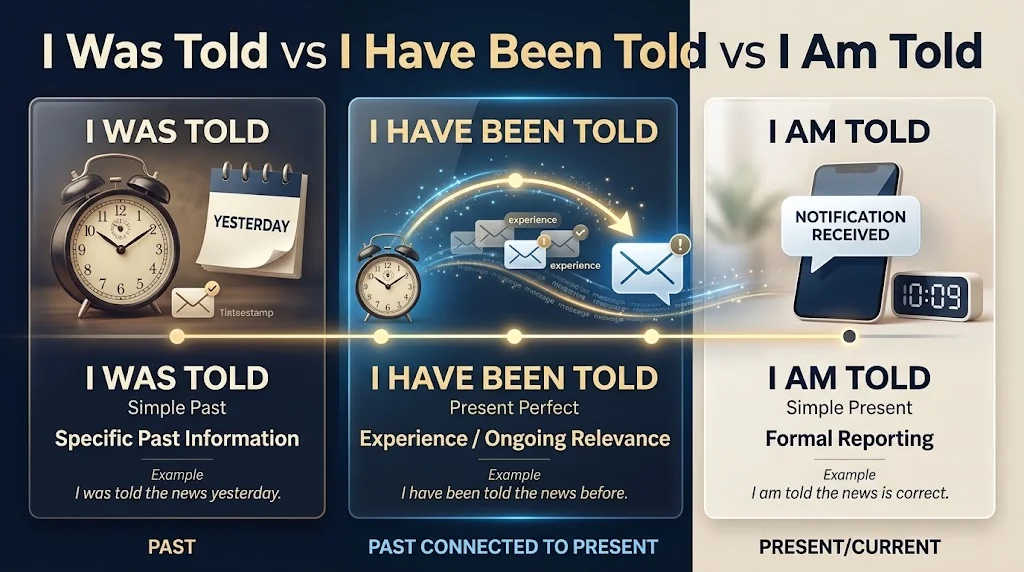
Key Differences Between “I Was Told,” “I Have Been Told,” and “I Am Told”
Understanding the timeline makes the difference easier.
| Feature | I Was Told | I Have Been Told | I Am Told |
| Tense | Simple past | Present perfect | Simple present |
| Time Focus | Past | Past connected to present | Present/current |
| Common Use | Specific past information | Experience or ongoing relevance | Formal reporting |
| Tone | Neutral | Informative and professional | Formal |
| Example | I was told the news yesterday. | I have been told the news before. | I am told the news is correct. |
The biggest difference is the relationship between the information and the present moment.
1. I was told” looks backward.
2.I have been told” connects the past with now.
3.I am told” presents information as current.
I Was Told vs. I Have Been Told: Main Difference
Many learners confuse these two phrases because both describe receiving information.
The main difference is the connection to the present.
“I Was Told” = A Completed Past Event
Example:
- I was told the shop was closed yesterday.
This tells us about a past situation. The moment of receiving the information is finished.
“I Have Been Told” = Information Still Matters Now
Example:
- I have been told the shop is closed.
This suggests the information is still relevant at the current time.
Compare:
- I was told that John left the company last year.
- I have been told that John is leaving the company.
The first sentence reports a past event. The second sentence connects the information to the present.
I Have Been Told vs. I Am Told: Main Difference
Both phrases can introduce information from another source, but the feeling is different.
I have been told emphasizes the experience of receiving information.
Example:
- I have been told that this book is useful.
Many people have given you this information.
I am told emphasizes the current report.
Example:
- I am told that this book is useful.
Someone is informing you now or you are presenting it formally.
In everyday English, “I have been told” is usually more common.
I Was Told vs. I Am Told
Although both phrases use the passive voice, they describe different points in time.
“I was told” refers to information you received during a completed event in the past.
“I am told” presents information as something you are being informed about now or as a formal report.
Consider these examples:
- I was told the office closed early yesterday.
- I am told the office is closed today.
The first sentence looks back at a past conversation. The second presents information that is currently being reported.
A Simple Way to Remember
If the information belongs to a finished conversation, use “I was told.”
If you’re introducing current information in a formal way, use “I am told.”
Why These Phrases Use the Passive Voice
Many English learners wonder why native speakers often say “I was told” instead of “Someone told me.”
The answer is simple. The speaker usually wants to emphasize the information instead of the person who shared it.
Compare these sentences.
Active Voice
- My teacher told me the answer.
- My manager told me about the deadline.
- My friend told me the restaurant was excellent.
Passive Voice
- I was told the answer.
- I was told about the deadline.
- I was told the restaurant was excellent.
Both versions are correct. However, the passive version shifts attention to what was learned instead of who delivered the message.
This style appears frequently in business communication, news reports, and formal writing because the source is sometimes unknown or unnecessary.
Common Mistakes and How to Avoid Them
Even advanced learners occasionally mix these phrases. Fortunately, the mistakes are easy to fix once you understand the time difference.
Using “I Am Told” for Past Events
Incorrect
- I am told yesterday that the meeting was canceled.
Correct
- I was told yesterday that the meeting was canceled.
The word yesterday clearly refers to the past, so the simple past is the correct choice.
Using “I Was Told” for Ongoing Advice
Less Natural
- I was told many times to practice every day.
Better
- I have been told many times to practice every day.
The second sentence shows repeated advice that still applies now.
Using the Wrong Verb Form
Incorrect
- I have been tell that…
- I was telling that...
Correct
I have been told that...- I was told that…
Remember that told is the past participle of tell.
Mixing Time Expressions
Avoid combining present-perfect phrases with finished time expressions.
Incorrect
- I have been told yesterday.
Correct
- I was told yesterday.
Or
- I have been told recently.
The present perfect usually does not pair with finished time markers like yesterday, last week, or in 2022.
Real-Life Examples
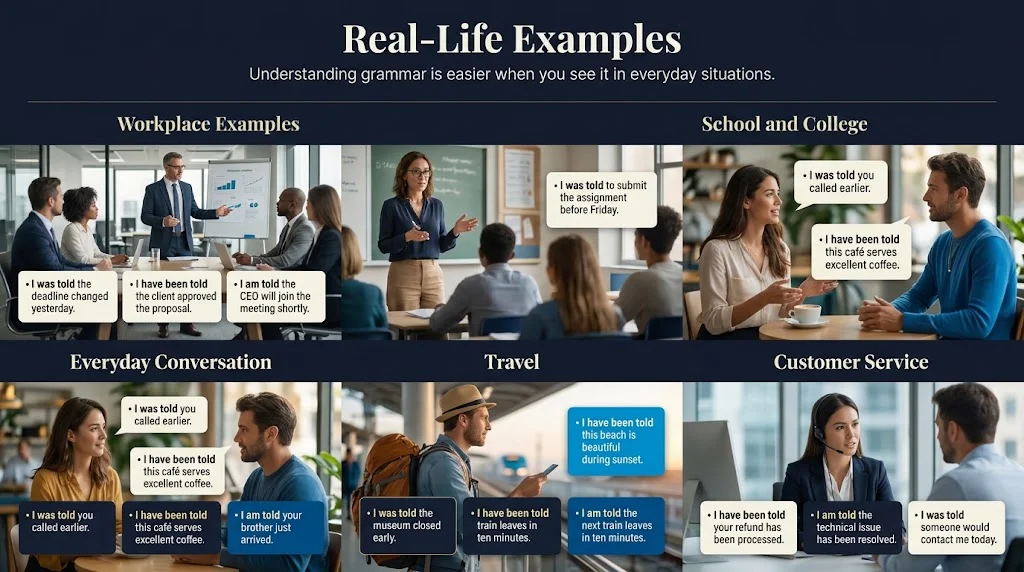
Understanding grammar is easier when you see it in everyday situations.
Workplace Examples
Imagine your manager updates the team.
- I was told the deadline changed yesterday.
- I have been told the client approved the proposal.
- I am told the CEO will join the meeting shortly.
Each sentence fits a different timeline.
School and College
Teachers often use these expressions.
- I was told to submit the assignment before Friday.
- I have been told that reading daily improves vocabulary.
- I am told the exam schedule has been finalized.
Everyday Conversation
These phrases appear naturally in daily life.
- I was told you called earlier.
- I have been told this café serves excellent coffee.
- I am told your brother just arrived.
Travel
Travelers often report information from locals.
- I was told the museum closed early.
- I have been told this beach is beautiful during sunset.
- I am told the next train leaves in ten minutes.
Customer Service
Support representatives frequently use formal passive expressions.
- I have been told your refund has been processed.
- I am told the technical issue has been resolved.
- I was told someone would contact me today.
Mini Case Study: One Situation, Three Different Meanings
Imagine Emma is planning a business trip.
On Monday, her assistant says:
“Your flight leaves at 9:00 AM.”
Later that evening Emma says:
I was told my flight leaves at 9:00 AM.
She is referring to that earlier conversation.
The next day several coworkers repeat the same information.
Emma now says:
I have been told my flight leaves at 9:00 AM.
This shows she has received the information multiple times and it still matters.
During a meeting, Emma announces:
I am told the flight is still on schedule despite the weather.
Now she is formally reporting current information.
Although each sentence discusses the same flight, the grammar changes the perspective.
Which Expression Sounds Most Natural?
Native English speakers use all three expressions, but not equally.
| Expression | Everyday Conversation | Business Writing | Academic Writing | News & Reports |
| I was told | ⭐⭐⭐⭐⭐ | ⭐⭐⭐⭐ | ⭐⭐⭐ | ⭐⭐⭐ |
| I have been told | ⭐⭐⭐⭐ | ⭐⭐⭐⭐⭐ | ⭐⭐⭐⭐⭐ | ⭐⭐⭐⭐ |
| I am told | ⭐⭐ | ⭐⭐⭐⭐ | ⭐⭐⭐⭐ | ⭐⭐⭐⭐⭐ |
Generally:
- I was told is the most common in everyday speech.
- I have been told is very common in professional and academic English.
- I am told appears more often in formal writing, speeches, journalism, and official statements.
Quick Decision Guide
If you’re unsure which phrase to use, ask yourself these questions.
Did someone tell me at a specific time in the past?
Use I was told.
Example:
- I was told about the changes yesterday.
Does the information still affect me now?
Use I have been told.
Example:
- I have been told this software is reliable.
Am I introducing information formally?
Use I am told.
Example:
- I am told the negotiations are progressing well.
Tips to Remember the Difference
Learning grammar becomes easier when you connect it with simple ideas.
- Was = Yesterday
- Have been = Until now
- Am = Right now
Another memory trick is to think of a timeline.
Past ————-Present
- I was told
2. I have been told
3. I am told
The farther right you move, the closer the information comes to the present moment.
Key Insights
- I was told → Use for a completed past event, especially with a specific past time.
Example: I was told about the change yesterday. - I have been told → Use for information received before now when the exact time isn’t important, or when the information still matters.
Example: I have been told this course is helpful. - I am told → Use to present current information, often in a formal or professional context.
Example: I am told the meeting will start soon. - All three phrases use the passive voice, but their tenses and time perspectives are different.
- Was = past → I was told
- Have been = before now + present connection → I have been told
- Am = current/formal report → I am told
- Don’t use present perfect with finished time expressions such as yesterday, last week, or in 2022.
- When the information has been repeated, I have been told is often the best choice.
Example: I have been told many times to check my work. - I was told is generally more natural in everyday conversations, while I am told can sound more formal.
- The easiest way to choose is to ask: When was the information received, and does it connect to the present?
Practice:
Choose the best phrase to complete each sentence.
Fill in the Blanks
- I ________ about the schedule change yesterday.
(was told / have been told / am told) - I ________ that this restaurant serves excellent food.
(was told / have been told / am told) - I ________ that the manager will arrive in a few minutes.
(was told / have been told / am told) - I ________ to submit the assignment last Monday.
(was told / have been told / am told) - I ________ many times to check my spelling carefully.
(was told / have been told / am told) - I ________ the meeting has been postponed until tomorrow.
(was told / have been told / am told) - I ________ about the problem during yesterday’s meeting.
(was told / have been told / am told) - I ________ that this course is very useful for English learners.
(was told / have been told / am told) - I ________ that the company is planning to open a new office.
(was told / have been told / am told) - I ________ not to touch the equipment when I visited the lab last week.
(was told / have been told / am told)
Challenge
Correct the mistakes:
- I have been told yesterday that the class was canceled.
- I am told about the changes last week.
- I have been tell that this book is useful.
- I was told many times to practice every day.
Try them yourself first. Send me your answers (1–14), and I’ll check them and explain any mistakes.
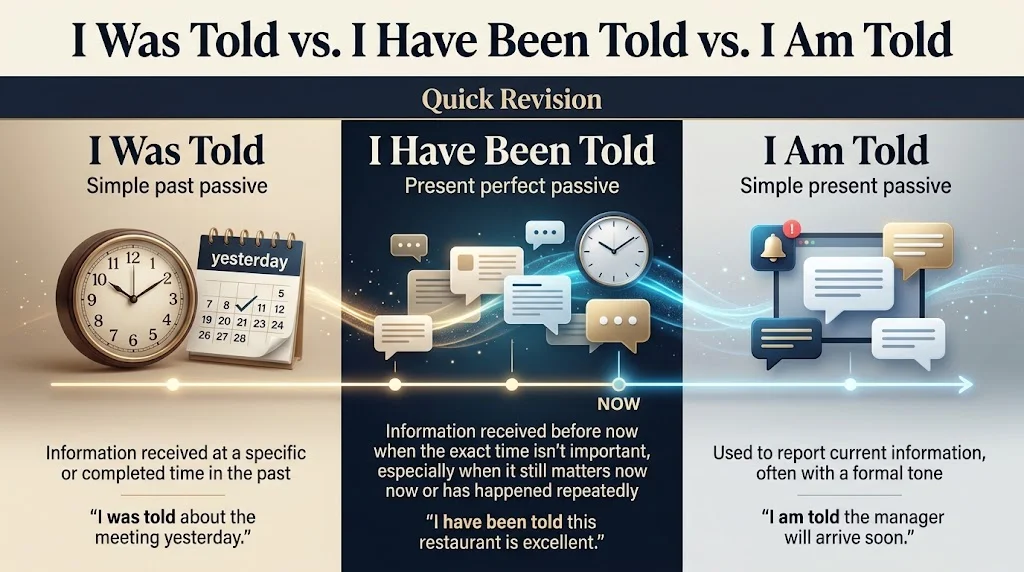
Quick Revision
- I was told → Simple past passive; use it for information received at a specific or completed time in the past.
Example: I was told about the meeting yesterday. - I have been told → Present perfect passive; use it for information received before now when the exact time isn’t important, especially when it still matters now or has happened repeatedly.
Example: I have been told this restaurant is excellent. - I am told → Simple present passive; use it to report current information, often with a formal tone.
Example: I am told the manager will arrive soon.
Easy Memory Trick
Was = Past → I was told
Have been = Before now + present connection → I have been told
Am = Current/formal report → I am told
Read More: Tutor vs Tudor: Differenc, Meaning, Usage, and Examples
FAQs
1. What is the difference between “I was told,” “I have been told,” and “I am told”?
The main difference is the time each phrase refers to. Generally “I was told” points to a specific moment in the past. “I have been told” refers to information received at an unspecified time before now. “I am told” describes information that is currently being reported or commonly said.
2. When should I use “I was told”?
Use “I was told” when someone gave you information at a particular time in the past. For example: I was told to arrive 15 minutes early.
3. When is “I have been told” the correct choice?
Choose “I have been told” when the exact time is not important or when you have heard the same information more than once. For example: I have been told this book is worth reading.
4. Is “I am told” commonly used in everyday English?
Yes, but it is more common in formal speech, news reports, and professional writing. It often introduces information that the speaker has recently received or believes to be true.
5. Are all three phrases in the passive voice?
Yes. All three expressions use the passive voice, but each belongs to a different tense and serves a different purpose.
6. Which phrase is best for academic or formal writing?
All three are correct in formal writing. The best choice depends on the time reference and the meaning you want to express.
7. Can I replace one phrase with another?
Not always. Although the phrases are similar, changing one for another can alter the meaning or timeline of your sentence.
8. Why do English learners often confuse these phrases?
They all use the verb “told” and follow a similar structure, so learners often overlook the differences in tense and time reference.
9. How can I remember which phrase to use?
Think about when the information was received. If it happened at one specific time, use “I was told.” When the time is unknown or still relevant, use “I have been told.” If the information is currently being reported, use “I am told.”
10. What is the easiest way to master these expressions?
Practice them in real conversations, read authentic English content, and create your own example sentences. Using them regularly will make the differences feel natural.
Conclusion
Choosing between “I was told,” “I have been told,” and “I am told” becomes much easier once you understand the time each phrase describes. While they all use the passive voice, they are not interchangeable. Paying attention to the tense and the context will help you express yourself more accurately in both spoken and written English.
After more than 15 years of teaching English, I have noticed that students stop making this mistake when they focus on real-life examples instead of memorizing grammar rules. A little daily practice goes a long way. Once you start noticing these phrases in books, conversations, and articles, you’ll naturally develop the confidence to use the right one every time.

Shamsa Kanwal is an English specialist and content writer at ClearPhrasing.com, where she helps readers navigate the English language with confidence. She enjoys breaking down grammar rules, spelling differences, vocabulary, and everyday writing challenges into simple, practical lessons that anyone can understand.
Her writing is focused on making learning approachable rather than overwhelming. Whether she’s explaining commonly confused words, punctuation rules, or grammar concepts, Shamsa believes that clear explanations and real-life examples are the key to effective learning.
Every article she writes is carefully researched, fact-checked, and edited to ensure it is accurate, easy to read, and genuinely helpful. Her goal is to create trustworthy resources that enable students, professionals, writers, and English learners to improve their communication skills and write with greater clarity.
Through her work at ClearPhrasing.com, Shamsa is committed to making English learning simpler, more practical, and accessible for readers around the world.