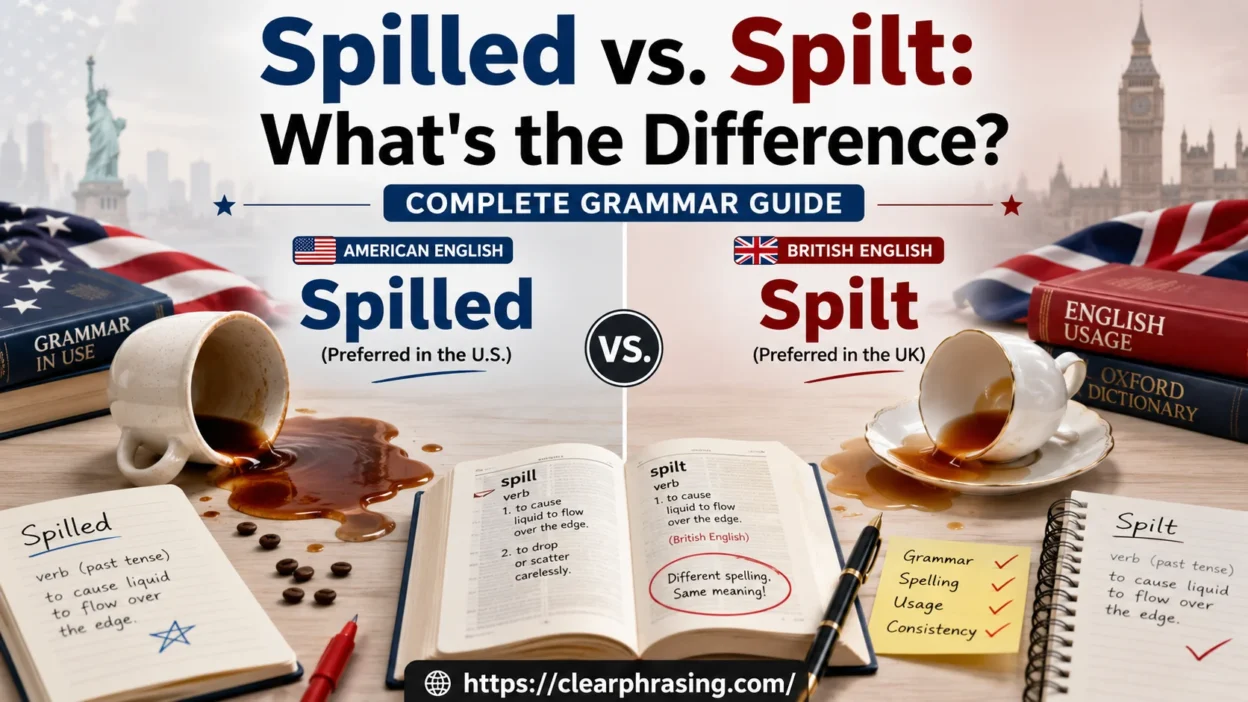
Spilled vs. Spilt: What’s the Difference? Complete Grammar Guide explains the Difference in simple English. Many learners feel confused about Spilled, Spilt, and Split.
The correct form is Spilled in American English. Spilt is an older, less common variant in British English. Both are acceptable in certain contexts. Split is a different verb. This Complete Grammar Guide covers usage, rule, exceptions, spelling, meaning, past tense, past participle, and understanding with example sentences about coffee, milk, a drink, a container, a table, the floor, something accidentally poured, pour, or dropped over the edge.
As an English teacher, I often see this debate while reading, checking a book, watching a TV show, or talking with students. This article explores the origins of these words and how language evolves with time. You can find them in U.S. and UK publications, real texts, informal writing, or even a video marked muted. A spill can cause liquid to flow, appear, and stir the pot. Remember to write with confidence and clarity.
The contenders remain differentiated, and each sentence, context, and meaning helps you moving forward.
Quick Answer
Both spilled and spilt are correct past tense and past participle forms of the verb spill.
- Spilled is the standard choice in American English.
- Spilt is more common in British English, although spilled is also accepted there.
- Neither word changes the meaning of the sentence.
- The most important rule is to stay consistent throughout your writing.
| English Variety | Preferred Form | Also Accepted |
| American English | Spilled | Spilt (rare) |
| British English | Spilt | Spilled |
| Canadian English | Spilled (more common) | Spilt |
| Australian English | Both | Spilt is slightly more traditional |
What Does “Spill” Mean?
The verb spill means to accidentally or intentionally let a liquid, powder, or other substance flow out of its container. It can also describe revealing information that was supposed to remain secret.
English speakers use this verb every day because accidents happen frequently. Coffee spills, water spills, milk spills, and sometimes even secrets spill out during conversations.
Literal Meaning
The most common meaning involves something physically falling or flowing from a container.
Examples:
- She spilled her coffee on the desk.
- Someone spilt water across the kitchen floor.
- The child spilled juice on the carpet.
Figurative Meaning
The verb also has a figurative meaning. It describes revealing information that was meant to stay private.
Examples:
- He spilled the secret before the surprise party.
- They accidentally spilt confidential information during the meeting.
Common Situations Where “Spill” Is Used
You will often see spill in situations involving:
- Drinks
- Food
- Chemicals
- Paint
- Oil
- Ink
- Secrets
- Emotions
- Personal information
Because of its wide range of meanings, spill appears in both casual conversations and formal writing.
Spilled vs. Spilt: The Main Difference
The biggest difference between spilled and spilt is not grammar. It is regional preference.
Both words represent the past tense and past participle of spill. Both are grammatically correct. They simply belong to different varieties of English.
| Feature | Spilled | Spilt |
| Grammar | Correct | Correct |
| Meaning | Same | Same |
| American English | Preferred | Rare |
| British English | Common | Common |
| Formal Writing | Excellent | Excellent in British English |
| Pronunciation | Slightly longer | Slightly shorter |
Many English verbs developed two acceptable past tense forms over time. One follows the regular -ed pattern, while the other keeps an older shortened ending.
This is why both versions exist today.
Pronunciation
Although the pronunciation differs slightly, native speakers understand both forms immediately.
- Spilled sounds like spild.
- Spilt sounds like spilt.
The pronunciation difference is small enough that meaning never changes.
Is “Spilled” Correct in American English?
Yes. In fact, spilled is the standard form in American English.
Most American newspapers, schools, universities, publishers, and style guides recommend spilled because it follows the regular pattern used by most English verbs.
Examples include:
- She spilled milk on the kitchen floor.
- I accidentally spilled coffee on my laptop.
- They spilled paint across the garage floor.
Using spilled also creates consistency with other regular verbs such as:
| Base Verb | Past Tense |
| Walk | Walked |
| Clean | Cleaned |
| Open | Opened |
| Spill | Spilled |
Because American English favors regular verb forms, spilled feels more natural to American readers.
Examples in American Writing
Here are some everyday examples.
- The waiter spilled water on the table.
- She spilled soup while carrying the bowl.
- Someone spilled coffee inside the meeting room.
- The reporter spilled new details about the investigation.
Notice that every sentence sounds perfectly natural in American English.
Is “Spilt” Correct in British English?
Yes.
British English has long accepted spilt as the traditional past tense of spill. Although spilled has become increasingly common, especially in modern publications, spilt remains a familiar choice throughout the United Kingdom.
Examples include:
- Someone spilt tea across the table.
- The child spilt milk before breakfast.
- She spilt ink onto the letter.
Many British novels, newspapers, and magazines still use spilt, particularly when maintaining traditional spelling patterns.
Modern British Usage
Language changes over time. Today, British writers often use either form.
Many newspapers now choose spilled, while literature and everyday speech may still prefer spilt.
This means British readers usually recognize both forms without hesitation.
Why Do Two Past Tense Forms Exist?
English has evolved over hundreds of years. During that time, many verbs developed more than one accepted past tense form.
Some verbs gradually became regular by adding -ed, while others kept shorter historical forms.
The verb spill followed both paths.
Older English commonly used spilt, but modern English increasingly adopted spilled, especially outside Britain.
The same pattern appears with several other verbs.
| Base Verb | Regular Form | Short Form |
| Spill | Spilled | Spilt |
| Burn | Burned | Burnt |
| Dream | Dreamed | Dreamt |
| Learn | Learned | Learnt |
| Smell | Smelled | Smelt |
These pairs show how English preserves older forms while allowing newer regular forms to become popular.
Why Language Changed
Several factors influenced this change.
- English became more standardized.
- Schools encouraged regular verb patterns.
- American English preferred -ed endings.
- Publishing style guides promoted consistency.
- Modern learners found regular verbs easier to remember.
As a result, spilled became dominant in many parts of the world while spilt remained common in British English.
Spilled vs. Spilt: Side-by-Side Comparison
| Feature | Spilled | Spilt |
| Meaning | Identical | Identical |
| Grammar | Correct | Correct |
| Verb Form | Past tense and past participle | Past tense and past participle |
| American English | Standard | Rare |
| British English | Accepted | Traditional preference |
| Formal Writing | Recommended in the US | Suitable in the UK |
| Informal Writing | Very common | Common in Britain |
| Reader Familiarity | Worldwide | Mostly UK and Commonwealth |
The comparison shows that the difference comes down to audience rather than correctness.
When to Use “Spilled”
Choose spilled whenever you write for an American audience or an international audience that generally follows American English.
It also works well in academic papers, professional reports, online articles, business communication, and marketing content aimed at readers in the United States.
Use “Spilled” in American Writing
American readers naturally expect spilled because it matches the standard spelling taught in schools.
Examples:
- I spilled orange juice on my shirt.
- The mechanic spilled oil during the repair.
- Someone spilled water near the electrical outlet.
Use “Spilled” in Business Writing
Professional documents often favor the regular verb form.
Examples include:
- An employee spilled chemicals in the storage room.
- The report noted that the machine spilled hydraulic fluid.
- A customer spilled coffee near the reception desk.
Use “Spilled” in Academic Writing
Universities in the United States almost always expect spilled.
Example:
During the experiment, the student accidentally spilled the solution onto the laboratory table.
Academic writing values consistency, so using the standard American form helps maintain a professional style.
When to Use “Spilt”
Use spilt when writing primarily for a British audience or when following British English style. It appears frequently in UK newspapers, novels, magazines, and everyday conversations. Although spilled is also acceptable in Britain, spilt still carries a traditional British flavor.
Use “Spilt” in British Writing
Many British writers naturally choose spilt in both formal and informal contexts.
Examples:
- She spilt tea across the kitchen table.
- He spilt coffee on his newspaper.
- The child spilt milk before school.
- Someone spilt paint on the pavement.
Use “Spilt” in Literature
British authors often use spilt because it matches the rhythm and style of traditional British English.
Example:
The candle tipped over and spilt wax across the old wooden desk.
Regional Preference Matters
If your readers live mainly in the UK, Ireland, Australia, or New Zealand, spilt may feel slightly more familiar. If your audience is global, spilled is generally the safer choice because it is recognized almost everywhere.
Can You Use Either Word?
Yes. Both words are grammatically correct, and dictionaries recognize them as standard English.
However, you should choose one version and stick with it throughout your writing. Switching between spilled and spilt in the same document can distract readers and make your writing appear inconsistent.
Choose Based on Your Audience
- Use spilled for American English.
- Use spilt or spilled for British English.
- Use spilled for international business and academic writing unless a British style guide says otherwise.
Consistency always matters more than personal preference.
Common Expressions with “Spill”
The verb spill appears in many everyday expressions. Some refer to actual accidents, while others have figurative meanings.
Spill the Beans
Meaning: Reveal a secret.
Example:
She finally spilled the beans about the surprise party.
Don’t Cry Over Spilled Milk
Meaning: Don’t waste time worrying about mistakes that cannot be changed.
Example:
We missed the deadline, but there’s no use crying over spilled milk.
Spill Your Drink
Example:
Be careful not to spill your drink on the keyboard.
Spill Coffee
Example:
He spilled coffee all over his notebook before class.
Spill Water
Example:
Someone spilled water near the entrance, so the floor became slippery.
Spill Ink
Example:
The pen leaked and spilled ink across the document.
Spill Blood
Meaning: Cause injury or death during violence or conflict.
Example:
Leaders hoped to solve the dispute without spilling blood.
Spill Information
Example:
The witness accidentally spilled important information during the interview.
Spilled vs. Spilt in Idioms
Most idioms work with both forms, but regional preference still affects which version people use.
| Idiom | American English | British English |
| Cry over spilled milk | Preferred | Accepted |
| Cry over spilt milk | Rare | Preferred |
| Spill the beans | Preferred | Preferred |
| Spill your heart out | Preferred | Preferred |
Many famous American books, films, and newspapers use spilled milk, while British publications often write spilt milk.
Common Mistakes to Avoid
Even though the difference is simple, writers still make several common mistakes.
Mixing American and British English
Incorrect:
- She spilt coffee yesterday. Later she spilled tea.
Correct:
Choose one style and use it consistently.
Confusing “Spill” with “Split”
These verbs have completely different meanings.
| Word | Meaning |
| Spill | Let something fall or flow out |
| Split | Divide into parts |
Examples:
- She spilled water.
- He split the wood.
Using the Wrong Audience Style
If you write for an American university, spilled is usually expected.
If you’re writing for a British newspaper, spilt may better match the publication’s style.
Examples in Everyday Sentences
Home
- Dad spilled juice while making breakfast.
- My sister spilt tea across the table.
- Someone spilled soup on the floor.
At School
- A student spilled paint during art class.
- The teacher quickly cleaned the spilled water.
- Someone spilt ink on the assignment.
At Work
- The employee spilled coffee on the conference table.
- A technician spilled oil while repairing the machine.
- Someone accidentally spilled confidential documents across the desk.
In News Reports
- A truck spilled fuel onto the highway.
- Heavy rain caused chemicals to spill into nearby rivers.
- Officials confirmed that workers quickly contained the spilled material.
In Creative Writing
- Moonlight reflected in the wine she had spilt.
- Golden sunlight spilled through the open window.
- Tears spilled down his face as the truth emerged.
Synonyms of “Spill”
Sometimes another verb fits the situation better.
| Word | Best Used When | Example |
| Pour | Intentionally letting liquid flow | She poured milk into the glass. |
| Leak | Liquid escapes slowly | The pipe leaked overnight. |
| Overflow | Container becomes too full | The sink overflowed. |
| Scatter | Objects spread in different directions | The box scattered papers everywhere. |
| Dump | Empty something completely | They dumped the waste safely. |
| Empty | Remove everything from a container | He emptied the bucket. |
Choosing the right synonym makes your writing more precise and natural.
Spilled vs Spilt vs Spill
Understanding every verb form helps prevent grammar mistakes.
| Verb Form | Word | Example |
| Base Form | Spill | Please don’t spill the water. |
| Present Simple | Spill / Spills | She spills coffee every week. |
| Past Tense | Spilled / Spilt | He spilled tea yesterday. |
| Past Participle | Spilled / Spilt | The milk has spilled. |
| Present Participle | Spilling | Water is spilling onto the floor. |
How to Remember the Difference
A simple memory trick can save you time.
- Think “America = ED.” American English usually prefers spilled.
- Think “Britain = T.” British English often prefers spilt.
Another easy rule is this:
If your audience is American, write “spilled.” If your audience is British, either form works, but “spilt” sounds more traditional.
Read More: Beside vs Besides: What’s the Difference?and Usage
FAQs
Q1. Is spilled or spilt correct?
Both are correct. Spilled is preferred in American English, while spilt is more common in British English.
Q2. What is the difference between spilled and spilt?
The main difference is regional usage. They have the same meaning but are preferred in different varieties of English.
Q3. Is spilt used in American English?
It is understood, but spilled is the standard and much more common form in American English.
Q4. Why is spilled more common than spilt?
Modern American English favors regular -ed verb forms, making spilled the preferred choice.
Q5. Is spilt old-fashioned?
No. It is still commonly used in British English, although it appears less often in American writing.
Q6. Is split the same as spilt?
No. Split means to divide something, while spilt is the past tense of spill.
Q7. Can I use spilt in formal writing?
Yes. It is acceptable in British English, but spilled is usually better for international audiences.
Q8. Which spelling should students learn first?
Most learners should learn spilled first because it is the more widely used form worldwide.
Q9. Are spilled and spilt interchangeable?
Yes, in many cases they have the same meaning, but you should stay consistent with either American or British English.
Q10. How can I remember the difference between spilled and spilt?
Remember that spilled is the standard choice in American English, while spilt is commonly used in British English. Consistency is more important than mixing both forms.
Conclusion
The choice between spilled and spilt is not about right or wrong. It is mainly about the variety of English you are using. Spilled is the standard form in American English and is also the most common choice in international writing. Spilt remains a correct and widely accepted form in British English, especially in everyday writing and speech.
If you write for a global audience, using spilled is usually the safest option. If you follow British English, spilt is perfectly natural. The key is to stay consistent throughout your writing. Once you understand this simple difference, you can avoid common grammar mistakes and write with greater confidence, clarity, and accuracy.

Mariam Asghar is an English specialist and professional content writer at ClearPhrasing.com. She is dedicated to helping readers improve their English through clear, practical, and easy-to-understand content. Her areas of expertise include grammar, spelling, vocabulary, punctuation, sentence structure, and effective writing.
At ClearPhrasing.com, Mariam writes comprehensive, well-researched articles that simplify complex language concepts for students, professionals, writers, and English learners. She believes that strong communication begins with a solid understanding of the English language and strives to make every lesson accessible and engaging.
With a strong commitment to quality, accuracy, and continuous learning, Mariam ensures that each article is carefully researched, thoroughly reviewed, and written to help readers communicate with greater confidence and clarity.