Scrap or Scrape: What’s the Difference? Meaning, and Usage explains a common pair of similar words in the English language.
These commonly confused words may sound the same, but they have different meanings and are not interchangeable. This article uses definitions, grammar, English grammar, English usage, context, word choice, spelling, examples, memory tricks, and real-world examples to improve your understanding, confidence, and writing skills for academic writing, business emails, and everyday conversation.
A scrap is a small piece, fragment, or leftover like metal scrap, paper scrap, or food scrap. Scrapped means to discard a project or old car, while scrape means to rub, remove rust, scrape paint from a wall, or scrape your knee on the pavement. Learning these meanings helps you choose the proper word correctly, avoid confusion, and improve communication.
This guide makes it easy to remember the difference between scrap and scrape and use both words with confidence.
Quick Answer
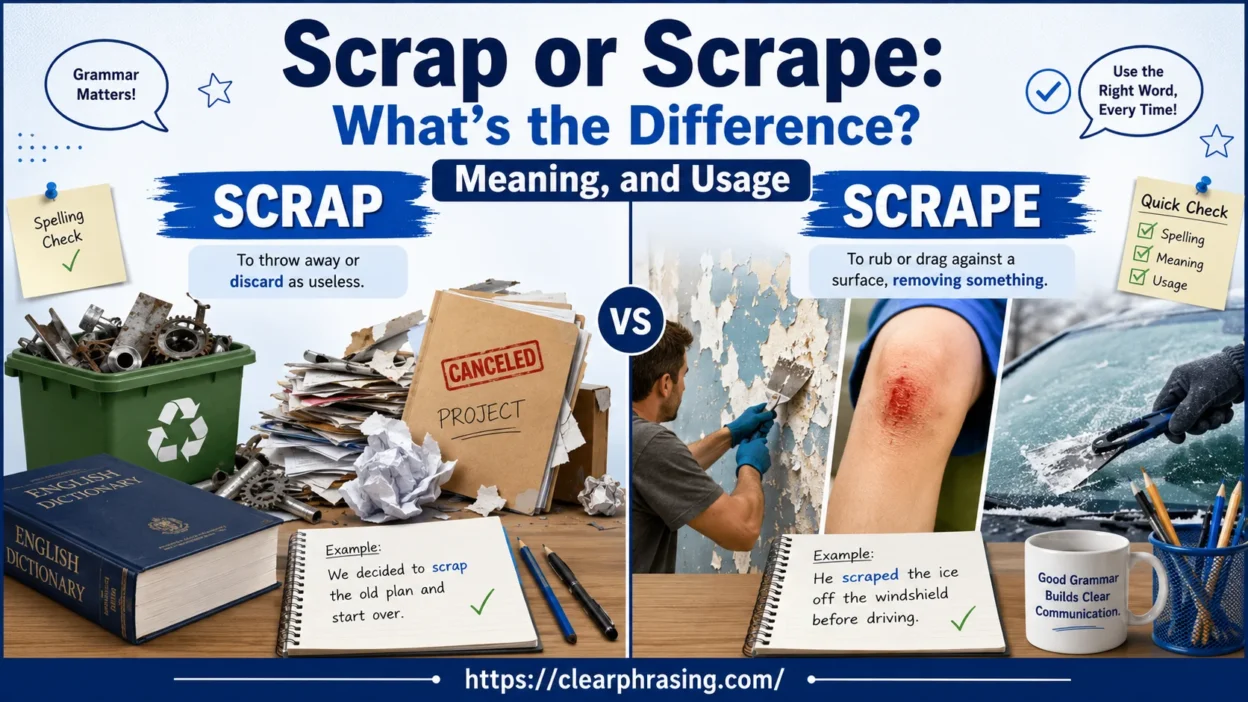
Scrap means to throw something away, cancel it, or a small leftover piece of something.
Scrape means to rub against a surface, remove something by rubbing, or cause a slight scratch or injury.
| Word | Part of Speech | Meaning | Example |
| Scrap | Noun, Verb | Leftover piece or discard something | We scrapped the old proposal. |
| Scrape | Noun, Verb | Rub or remove by rubbing | She scraped the paint off the wall. |
| If you’re getting rid of something, use scrap. | |||
| If you’re rubbing, scratching, or removing something from a surface, use scrape. |
What Does “Scrap” Mean?
The word scrap refers to a small leftover piece of something or the act of throwing away or canceling something that no longer has value. You’ll often hear it in recycling, manufacturing, construction, business, and everyday conversations.
As a noun, scrap means a remaining piece of paper, fabric, metal, food, or another material. As a verb, it means to abandon, discard, or permanently stop using something.
Definition of Scrap
Scrap (noun): A small leftover piece of material, food, paper, wood, or metal.
Scrap (verb): To discard, recycle, abandon, or cancel something because it is no longer useful.
Origin of the Word “Scrap”
The word scrap comes from Middle English and originally described small broken or cut pieces left over from a larger object. Over time, its meaning expanded to include the idea of rejecting or canceling something completely.
Today, businesses commonly use the word when discussing canceled projects, retired equipment, recycled materials, or discontinued products.
Scrap as a Noun
As a noun, scrap refers to leftover pieces that may still have value or be reused.
Common examples include:
- Scrap paper
- Scrap metal
- Scrap fabric
- Scrap wood
- Food scraps
- Plastic scraps
Examples
- Please use scrap paper for your rough calculations.
- The recycling company purchased several tons of scrap metal.
- She saved every fabric scrap for quilting projects.
- We collected food scraps for composting.
- The carpenter reused wood scraps to build a small shelf.
Scrap as a Verb
When used as a verb, scrap means to abandon or throw something away because it is outdated, damaged, or no longer practical.
Common uses include:
- scrap a project
- scrap a proposal
- scrap old machinery
- scrap a vehicle
- scrap a business plan
Examples
- The company decided to scrap the original marketing campaign.
- Engineers scrapped the first prototype after safety tests.
- The city plans to scrap several aging buses.
- We had to scrap the damaged materials.
- They scrapped the outdated software before launching the new system.
Common Situations Where “Scrap” Is Used
Business
Companies often scrap ideas or products that no longer support their goals.
Example:
The management team scrapped the proposal after reviewing customer feedback.
Manufacturing
Factories recycle scrap metal, aluminum, and steel to reduce waste and lower production costs.
Construction
Builders collect leftover wood, copper, and steel as scrap instead of sending everything to landfills.
Technology
Software developers sometimes scrap applications that have become obsolete.
Everyday Life
People regularly talk about:
- food scraps
- paper scraps
- fabric scraps
- cardboard scraps
What Does “Scrape” Mean?
Unlike scrap, the word scrape always involves contact with a surface. It describes rubbing, scratching, or removing something by applying friction. It can also describe a small injury or scratch.
You’ll hear this word in cooking, cleaning, painting, home improvement, sports, and everyday conversations.
Definition of Scrape
Scrape (verb): To remove something from a surface by rubbing.
Scrape (noun): A small scratch or minor injury.
Origin of the Word “Scrape”
The word scrape comes from an old Germanic root meaning to scratch or rub roughly. Its meaning has remained remarkably consistent for centuries.
Scrape as a Verb
This is the most common use of the word.
Examples include:
- scrape paint
- scrape mud
- scrape ice
- scrape cheese
- scrape wallpaper
- scrape dirt
Examples
- Please scrape the old paint off the door.
- He scraped mud from his boots.
- She carefully scraped the cake mixture from the bowl.
- I had to scrape ice off my windshield this morning.
- The chef scraped every bit of sauce from the pan.
Scrape as a Noun
As a noun, scrape refers to a minor scratch or abrasion on skin or another surface.
Examples include:
- a scrape on your knee
- a scrape on the wall
- a scrape on the table
- a scrape on the car
Examples
- The child came home with a small scrape on his elbow.
- There was a long scrape along the side of the car.
- Moving the furniture left a scrape on the wooden floor.
Common Everyday Uses of “Scrape”
Cleaning
People scrape dried food from pans before washing them.
Home Improvement
Painters scrape loose paint before applying a fresh coat.
Cooking
Chefs scrape mixing bowls so they don’t waste ingredients.
Winter Weather
Drivers scrape frost and ice from windshields before driving.
Sports
Athletes often get small scrapes during practice or competition.
Scrap vs. Scrape: Side-by-Side Comparison
The easiest way to remember these words is to compare them directly.
| Feature | Scrap | Scrape |
| Main Meaning | Throw away or leftover piece | Rub, scratch, or remove by rubbing |
| Part of Speech | Noun, Verb | Noun, Verb |
| Physical Contact | Usually no | Yes |
| Refers to Waste | Frequently | Rarely |
| Used in Recycling | Yes | No |
| Used in Cleaning | Rarely | Very often |
| Business Meaning | Cancel or abandon | Almost never |
| Example | Scrap the project | Scrape the paint |
| The biggest difference is simple. | ||
| Scrap relates to discarding something or leftover material. | ||
| Scrape relates to rubbing a surface or removing something through friction. | ||
| Compare these examples: |
We scrapped the old business plan. ✔️- We scraped the old business plan. ✘
The first sentence means the plan was canceled. The second incorrectly suggests someone physically rubbed the document.
Now compare another pair: - She scraped the mud off her boots. ✔️
- She scrapped the mud off her boots. ✘
Only scraped is correct because the mud is removed by rubbing.
Scrap as a Noun
When scrap functions as a noun, it refers to a small leftover piece of a larger material. These leftovers may still have value because they can often be reused, recycled, or repurposed.
Industries such as construction, manufacturing, recycling, and crafting use the word every day.
Common Types of Scrap
- Scrap metal
- Scrap paper
- Scrap wood
- Scrap fabric
- Food scraps
- Plastic scraps
- Leather scraps
Real-Life Examples
- The recycling center pays by weight for scrap metal.
- She made a colorful quilt from fabric scraps.
- Don’t throw away the wood scraps because they can be reused.
- Composting food scraps helps reduce household waste.
- Students often keep scrap paper for notes and calculations.
Why Scrap Matters
Many industries recover valuable materials from scrap instead of producing new materials from raw resources. Recycling scrap metal, paper, and plastic saves energy, lowers production costs, and reduces environmental waste.
Scrap as a Verb
As a verb, scrap means to abandon, cancel, reject, or permanently stop using something. This meaning appears frequently in business, engineering, manufacturing, transportation, and government.
Common Uses
- Scrap a proposal
- Scrap a project
- Scrap a contract
- Scrap old equipment
- Scrap a vehicle
- Scrap an aircraft
- Scrap a product launch
Business Examples
Organizations don’t move forward with every idea they develop. Instead, they evaluate each proposal and scrap those that no longer meet their objectives.
Examples:
- The startup scrapped its original pricing strategy.
- Engineers scrapped the first design after testing.
- The publisher scrapped the planned release date.
- Officials scrapped the construction proposal after the environmental review.
Using scrap clearly tells readers that something was canceled or discarded, not physically damaged.
Scrape as a Verb
The verb scrape describes rubbing a surface to remove material, clean an object, or create friction. It appears in everyday activities ranging from cooking to home maintenance.
Common Uses
- Scrape paint
- Scrape rust
- Scrape mud
- Scrape wallpaper
- Scrape ice
- Scrape food
- Scrape dirt
Everyday Examples
- She scraped the burnt cheese from the baking dish.
- We scraped old wallpaper before repainting the room.
- The mechanic scraped rust from the metal frame.
- He scraped gum off the sidewalk.
- The gardener scraped moss from the stone path.
Figurative Meaning
The word scrape also appears in expressions where nothing is physically rubbed.
Examples include:
- They scraped together enough money to buy a car.
- She scraped by on a tight budget.
- He scraped through the final exam.
In these expressions, scrape means achieving something with difficulty or by using limited resources.
Common Phrases with “Scrap”
Learning common expressions helps you understand how native speakers naturally use scrap in conversations and writing.
Everyday Expressions
- Scrap metal – recycled metal from old vehicles or machinery.
- Scrap paper – paper used for notes or rough work.
- Food scraps – leftover pieces of food.
- Scrap heap – a place where discarded materials are stored.
- Scrap value – the value of something sold for recycling.
- Scrap yard – a business that buys and sells recyclable materials.
- Scrap a plan – cancel a proposal or project.
- Scrap a vehicle – permanently remove a vehicle from service for recycling.
Examples
- The factory sold its scrap metal to a recycling company.
- We decided to scrap the proposal after reviewing the costs.
- Please keep the scrap paper for rough notes.
- The old truck was sent to the scrap yard.
Common Phrases with “Scrape”
Unlike scrap, these expressions usually involve rubbing, removing, or barely succeeding.
Everyday Expressions
- Scrape by
- Scrape together
- Scrape through
- Scrape off
- Scrape away
- Scrape clean
- Scrape against
Examples
- We barely scraped by on our monthly budget.
- They scraped together enough money for a new laptop.
- Please scrape off the old paint before repainting.
- The chair scraped against the floor.
- She scraped clean every bowl after baking.
Scrap vs. Scrape in American and British English
One reason learners ask about scrap or scrape is whether the meaning changes between American and British English.
The good news is that both varieties use these words in exactly the same way.
| Usage | American English | British English |
| Scrap metal | ✔ | ✔ |
| Scrap a project | ✔ | ✔ |
| Scrape ice | ✔ | ✔ |
| Scrape your knee | ✔ | ✔ |
| The pronunciation differs slightly because of regional accents, but the spelling and meaning remain the same. |
Why People Confuse Scrap and Scrape
The confusion happens for several reasons.
Similar Spelling
Only one letter separates the two words.
Similar Pronunciation
Both begin with scrap-, making them easy to mix up when speaking quickly.
Similar Contexts
Construction, manufacturing, automotive repair, and home improvement often use both words.
For example:
- Scrap metal
- Scrape rust
- Scrap a car
- Scrape paint
The Best Way to Tell Them Apart
Ask yourself one question.
Are you throwing something away?
Use scrap.
Are you rubbing or removing something from a surface?
Use scrape.
That simple question solves almost every case.
Memory Trick to Remember the Difference
A quick memory trick can help you remember these words forever.
- Scrap = Trash.
Both words relate to getting rid of something. - Scrape = Surface.
Both words contain the idea of touching a surface.
Another way to remember it is this:
If your hands are rubbing something, you’re probably scraping.
If you’re throwing something away, you’re scrapping it.
Real-Life Examples in Different Contexts
Business
The company decided to scrap its outdated expansion strategy.
Manufacturing
Factories recycle scrap metal to reduce production costs.
Construction
Workers scraped old paint from the walls before repainting.
Automotive
The insurance company declared the damaged vehicle a total loss, so it was sold as scrap.
Education
Students often keep scrap paper for solving math problems.
Cooking
The chef scraped every bit of batter from the mixing bowl.
Household Cleaning
She scraped dried glue from the table with a plastic scraper.
Sports
The cyclist scraped his knee after falling during the race.
Personal Finance
After paying the bills, they barely scraped together enough money for groceries.
Common Mistakes to Avoid
Many learners accidentally swap these words because they sound alike.
| Incorrect | Correct | Reason |
| Scrape the proposal. | Scrap the proposal. | A proposal is canceled, not rubbed. |
| Scrap the mud off your boots. | Scrape the mud off your boots. | Mud is removed by rubbing. |
| Food scrape | Food scraps | Leftover food pieces are scraps. |
| I scrapped my knee. | I scraped my knee. | A knee receives a scrape, not a cancellation. |
| Scrap the paint. | Scrape the paint. | Paint is removed by scraping. |
Grammar Notes
Both scrap and scrape function as nouns and verbs.
Verb Forms
| Base Form | Past Tense | Past Participle | Present Participle |
| Scrap | Scrapped | Scrapped | Scrapping |
| Scrape | Scraped | Scraped | Scraping |
Parts of Speech
| Word | Noun | Verb |
| Scrap | ✔ | ✔ |
| Scrape | ✔ | ✔ |
Collocations You Should Know
Scrap
- Scrap metal
- Scrap paper
- Scrap wood
- Scrap fabric
- Scrap vehicle
- Scrap plans
- Scrap contract
- Scrap materials
Scrape
- Scrape paint
- Scrape rust
- Scrape ice
- Scrape dirt
- Scrape skin
- Scrape cheese
- Scrape together money
- Scrape by
Using these natural word combinations makes your English sound more fluent.
Synonyms and Near Synonyms
Scrap
| Word | Best Used When |
| Discard | Throwing something away |
| Reject | Refusing an idea |
| Abandon | Leaving something behind |
| Cancel | Ending a plan |
| Dispose of | Removing unwanted items |
Scrape
| Word | Best Used When |
| Scratch | Making a mark |
| Rub | Moving across a surface |
| Shave | Removing a thin layer |
| Remove | Taking something away |
| Peel | Removing an outer layer |
Practice Quiz
Choose the correct word.
- We decided to ______ the outdated proposal.
- She ______ the frost off the windshield.
- The recycling center purchased several tons of ______ metal.
- He ______ his elbow while playing soccer.
- They managed to ______ together enough money for the trip.
Answers
- Scrap
- Scraped
- Scrap
- Scraped
- Scrape
Read More: Alter vs. Altar: Difference, Meaning, and Usage
FAQs
Q1. How do I remember the difference between scrap and scrape?
Think of scrap as something left over, such as a scrap of paper. Scrape means to rub or remove something from a surface. Remember: scrape has an extra “e”, which can remind you of the edge of a surface.
Q2. Is scrapped the same as scraped, or do they have different meanings?
No. Scrapped means something was discarded or canceled, while scraped means something was rubbed, scratched, or removed from a surface. They are never interchangeable.
Q3. When should I use scrap instead of scrape in a sentence?
Use scrap when talking about leftover materials, small pieces, or throwing something away. Use scrape when describing rubbing against a surface or removing material by rubbing.
Q4. Can scrap and scrape both be used as nouns and verbs?
Yes. Scrap can be a noun (a scrap of paper) or a verb (to scrap a plan). Scrape can also be a noun (a minor scrape on your arm) or a verb (to scrape paint off a wall).
Q5. Why do people often confuse scrap and scrape?
They look and sound very similar, and only one letter separates them. However, their meanings are completely different, so choosing the wrong one can change the message.
Q6. What are some common examples of scrap and scrape in everyday English?
You might scrap an old project or recycle metal scrap. You might scrape ice from a windshield, scrape paint off a wall, or scrape your knee after a fall.
Q7. Is scrapped the project grammatically correct?
No. The correct form is “The project was scrapped.” You can also say, “They scrapped the project.” Both are grammatically correct depending on the sentence structure.
Q8. Does scrape always involve rubbing against a surface?
Almost always. Scrape usually means rubbing or dragging something across a hard surface, often to remove material, leave a mark, or cause a minor injury.
Q9. Are scrap and scrape pronounced the same?
No. They are similar but not identical. Scrape has a longer vowel sound because of the silent “e,” while scrap has a shorter vowel sound.
Q10. How can I avoid mixing up scrap and scrape in writing?
Focus on the meaning before you write. If you mean throw away, use scrap. If you mean rub or remove from a surface, use scrape. Reading your sentence aloud is also a simple way to catch mistakes.
Conclusion
Scrap and scrape may look similar, but they have completely different meanings. Scrap refers to leftover material or throwing something away, while scrape means rubbing against a surface or removing something by rubbing. Learning this simple difference helps you avoid common writing mistakes and communicate more clearly.
The best way to remember them is to focus on the context before you write. With regular practice and the examples in this guide, choosing the correct word will soon become natural. Keep this guide handy whenever you need a quick reminder of the difference between scrap and scrape.

Shamsa Kanwal is an English specialist and content writer at ClearPhrasing.com, where she helps readers navigate the English language with confidence. She enjoys breaking down grammar rules, spelling differences, vocabulary, and everyday writing challenges into simple, practical lessons that anyone can understand.
Her writing is focused on making learning approachable rather than overwhelming. Whether she’s explaining commonly confused words, punctuation rules, or grammar concepts, Shamsa believes that clear explanations and real-life examples are the key to effective learning.
Every article she writes is carefully researched, fact-checked, and edited to ensure it is accurate, easy to read, and genuinely helpful. Her goal is to create trustworthy resources that enable students, professionals, writers, and English learners to improve their communication skills and write with greater clarity.
Through her work at ClearPhrasing.com, Shamsa is committed to making English learning simpler, more practical, and accessible for readers around the world.