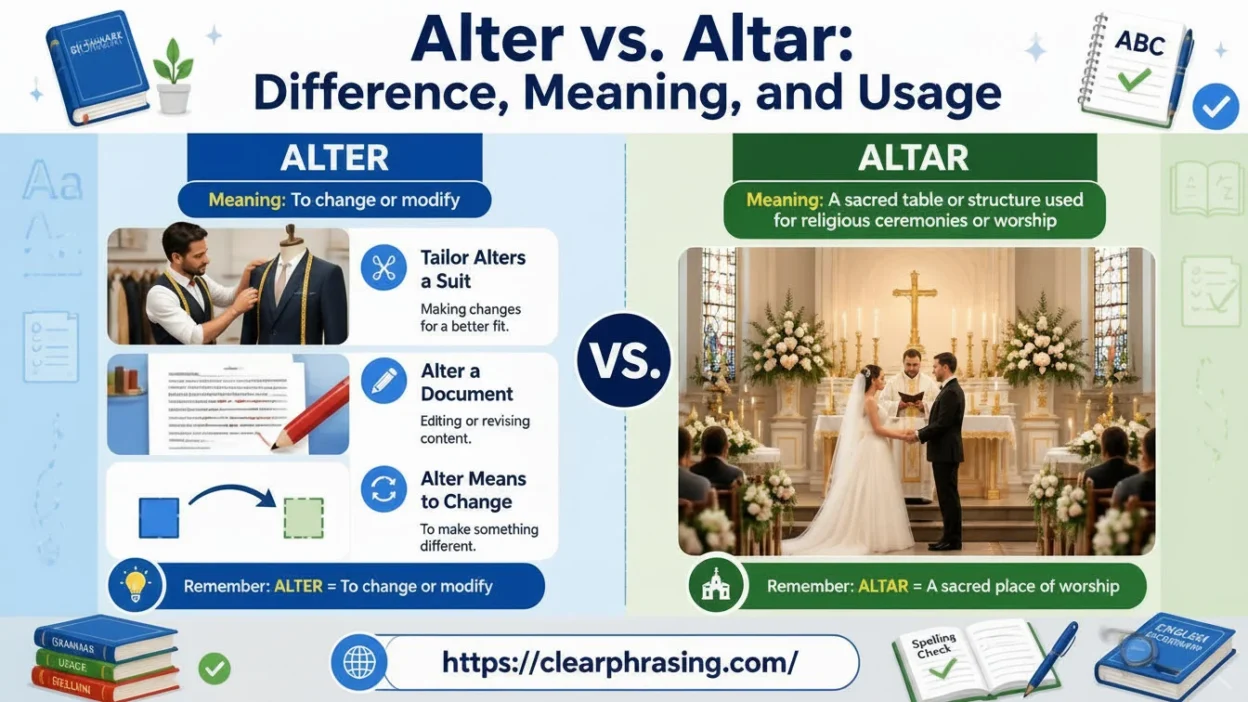
Alter vs. Altar: Difference, Meaning, and Usage helps learners and native speakers avoid common mistakes by explaining these confusing English homophones clearly.
Many people mix alter and altar because they sound the same but have different meaning and usage. As an English teacher, I often see this confusion in conversations, essays, official documents, and even a wedding invitation. This guide explains the difference, helps you understand each term, and shows the proper usage.
The means are simple. Alter means to change something, while an altar is a sacred table used for religious ceremonies. Remember this rule to use each word correctly in writing, speaking, and everyday language, and avoid common mistakes through practice, grammar, proofreading, and language learning.
Quick Answer:
The difference is simple.
- Alter means to change, modify, or make something different.
- Altar is a raised table or structure used for religious ceremonies, worship, or weddings.
| Word | Meaning | Part of Speech | Example |
| Alter | To change something | Usually a verb | We decided to alter the design. |
| Altar | A religious table or sacred structure | Noun | The couple stood at the altar. |
If you’re talking about making changes, choose alter.
If you’re talking about a church, temple, or wedding ceremony, choose altar.
Why People Confuse Alter and Altar
The confusion comes from pronunciation. Both words are homophones, which means they sound the same but have different spellings and meanings.
When spoken aloud, there’s no noticeable difference between alter and altar in most American accents. Because of that, many writers rely on memory instead of meaning, which often leads to mistakes.
Several factors make this pair especially confusing.
- Both words contain five letters.
- Only one letter differs.
- Spell check usually accepts both words because each spelling is correct on its own.
- They’re common enough that many people recognize both words without fully understanding them.
Imagine writing this sentence:
The church decided to alter the wedding ceremony.
That sentence makes sense because the church changed the ceremony.
Now compare it with this one:
The church decided to altar the wedding ceremony.
Here, altar is incorrect because it isn’t a verb.
Likewise:
The bride walked toward the alter.
This sentence should use altar because the bride walks toward a religious structure during the ceremony.
Small spelling mistakes can completely change the meaning.
What Does Alter Mean?
Definition of Alter
Alter means to change something while keeping its basic identity.
Instead of replacing something completely, you modify or adjust it. The change may be small or significant depending on the context.
Pronunciation
Alter is pronounced:
AWL-ter
Its pronunciation matches altar, making context essential.
Origin and Etymology
The word alter comes from the Latin verb alterare, meaning “to change.” It entered English through Old French and has carried essentially the same meaning for centuries.
Its history reflects consistency. Whether discussing clothing, laws, plans, or behavior, alter always refers to making changes.
Common Uses of Alter
You’ll often see alter in everyday writing because people constantly make changes.
Everyday Conversation
People use alter when discussing daily adjustments.
Examples include:
- alter your hairstyle
- alter your schedule
- alter your plans
- alter your appearance
- alter your opinion
Example sentences:
- We had to alter our travel plans because of the weather.
- She decided to alter her dress before the wedding.
- The chef didn’t alter the original recipe.
Business Writing
Businesses frequently use alter when discussing products, contracts, policies, or strategies.
Examples:
- alter the agreement
- alter the proposal
- alter company policy
- alter production methods
Sentence examples:
- Management agreed to alter the pricing strategy.
- The client requested several changes that would alter the final design.
Academic Writing
Researchers and students often describe changes using alter.
Examples:
- alter variables
- alter conditions
- alter conclusions
- alter procedures
Example:
- Changing one variable may alter the experiment’s outcome.
Legal Documents
Legal writing frequently includes alter because many laws involve modifications.
Examples:
- alter legal documents
- alter official records
- alter evidence
Example:
- It is illegal to alter official government records.
Examples of Alter in Sentences
Seeing real examples makes the meaning much clearer.
Everyday Examples
- You should alter your routine if it isn’t working.
- The tailor can alter your jacket today.
- Nothing will alter my decision.
- We need to alter our plans before Friday.
- The artist chose to alter the painting.
Professional Examples
- Engineers altered the blueprint after reviewing safety concerns.
- The company won’t alter its refund policy.
- Developers decided to alter the software interface.
Academic Examples
- Scientists altered the temperature during testing.
- Researchers didn’t alter the original data.
- Small changes can alter the final results dramatically.
What Does Altar Mean?
Definition of Altar
An altar is a raised table, platform, or sacred structure used for religious worship, ceremonies, sacrifices, or weddings.
Although many people immediately think of churches, altars appear in numerous religions and cultures around the world.
Unlike alter, altar is always a noun.
Pronunciation
Altar is pronounced:
AWL-ter
Again, the pronunciation is identical to alter.
Origin and Etymology
The word altar comes from the Latin word altare, meaning a place of sacrifice or worship.
Throughout history, altars have symbolized devotion, prayer, offerings, remembrance, and sacred ceremonies.
Today, they remain central to many religious traditions.
Religious and Cultural Meaning
Although styles differ across cultures, the purpose remains similar.
An altar serves as a sacred place where important religious acts occur.
Examples include:
- Christian churches
- Catholic cathedrals
- Orthodox churches
- Hindu temples
- Buddhist temples
- Shinto shrines
- Family prayer spaces
Some altars are simple wooden tables, while others feature stone carvings, candles, flowers, religious symbols, and artwork.
Altar in Christian Churches
In Christianity, the altar often stands at the front of the church.
Important events take place there, including:
- Communion
- Prayer
- Weddings
- Baptisms
- Special services
Many churches decorate the altar with:
- Candles
- Crosses
- Flowers
- Communion vessels
- Sacred cloths
For many believers, the altar represents reverence and worship.
Altar at Weddings
One of the most familiar uses of altar appears during wedding ceremonies.
People commonly say:
- standing at the altar
- meeting at the altar
- walking to the altar
- exchanging vows at the altar
Example sentences:
- The bride smiled as she approached the altar.
- Family members gathered near the altar before the ceremony began.
- The couple exchanged rings at the altar.
These expressions appear regularly in novels, magazines, movies, and wedding announcements.
Altars in Other Religions
Altars are not limited to Christianity.
Many faiths include sacred spaces used for prayer and offerings.
For example:
| Religion | Purpose of the Altar |
| Hinduism | Offerings, prayer, and worship of deities |
| Buddhism | Meditation, incense, candles, and offerings |
| Shinto | Honoring kami (spirits) |
| Ancient Judaism | Animal sacrifices in biblical times |
| Traditional religions | Rituals and sacred ceremonies |
Although designs vary, each altar serves as a place of spiritual importance.
Examples of Altar in Sentences
Everyday Examples
- Flowers surrounded the altar.
- The children stood quietly near the altar.
- The church restored its historic altar last year.
- Visitors admired the beautiful marble altar.
- Candles burned beside the altar throughout the service.
Religious Examples
- The priest approached the altar before beginning the service.
- Worshippers knelt before the altar in prayer.
- Fresh flowers decorated the altar every Sunday.
Wedding Examples
- The bride waited at the altar with her parents.
- Everyone watched as the couple met at the altar.
- Their wedding photos featured the beautifully decorated altar.
Alter vs. Altar: Side-by-Side Comparison
Understanding the difference becomes much easier when you compare both words directly. Even though they sound identical, they belong in completely different contexts.
| Feature | Alter | Altar |
| Meaning | To change or modify something | A sacred table or structure used for worship |
| Part of Speech | Verb (occasionally a noun in specialized fields) | Noun |
| Pronunciation | AWL-ter | AWL-ter |
| Main Use | Describing change | Referring to a religious place |
| Common Context | Writing, business, science, daily life | Churches, weddings, temples, ceremonies |
| Example | Please alter the schedule. | They stood at the altar. |
A simple way to remember the distinction is this:
- If you can replace the word with change, use alter.
- If you’re talking about worship or a wedding, use altar.
Alter vs. Altar in Grammar
Grammar helps explain why these words can never replace each other.
Alter Is a Verb
A verb describes an action.
Examples:
- We need to alter the document.
- She plans to alter the dress.
- The weather may alter our plans.
Because alter expresses an action, it changes tense like other verbs.
Examples:
- alter
- alters
- altered
- altering
Altar Is a Noun
A noun names a person, place, thing, or idea.
Examples:
- The altar was decorated with flowers.
- Visitors admired the ancient altar.
- The ceremony took place before the altar.
Unlike alter, altar never functions as an action.
Why Context Matters
Since both words sound the same, readers depend entirely on context.
Consider these examples:
- The tailor will alter your jacket.
- The bride walked toward the altar.
The surrounding words immediately reveal the correct choice.
Common Mistakes and How to Avoid Them
Many mistakes happen because writers rely on pronunciation instead of meaning.
Here are some of the most common errors.
Mistake: Using “Altar” When You Mean Change
❌ We need to altar the contract.
✅ We need to alter the contract.
Mistake: Using “Alter” During a Wedding
❌ The bride walked to the alter.
✅ The bride walked to the altar.
Mistake: Trusting Spell Check
Spell check often misses these mistakes because both spellings exist in the dictionary.
Instead of relying on software, ask yourself:
- Am I talking about changing something?
- Am I talking about a sacred place?
That quick question usually gives the answer.
Easy Tricks to Remember the Difference
Memory tricks make confusing words much easier to remember.
Remember That Alter Means Change
The word alter begins with A, just like adjust.
Both involve changing something.
Think:
Alter = Adjust
Remember That Altar Is Used for Weddings
Many people remember the phrase:
The bride walks to the altar.
If weddings or churches come to mind, choose altar.
Letter Association
Notice that altar contains the word tar.
Imagine a church walkway leading to the altar.
The image helps connect the spelling with a place rather than an action.
Visual Memory Technique
Picture two scenes.
Scene one:
A tailor changes a dress.
➡️ Alter
Scene two:
A couple exchanges vows inside a church.
➡️ Altar
The mental picture often sticks longer than memorizing a definition.
Real-Life Examples
These examples show how each word appears in everyday writing.
Workplace
- The manager decided to alter the meeting schedule.
- Engineers altered the building plans before construction.
School
- Teachers sometimes alter lesson plans for different learning styles.
- Students should never alter official transcripts.
Weddings
- Guests gathered near the altar before the ceremony.
- White flowers surrounded the altar.
Churches
- The church restored its wooden altar.
- Candles illuminated the altar during the evening service.
News Headlines
Correct examples include:
- Company to alter expansion strategy.
- Historic altar discovered during restoration.
- Scientists alter testing methods.
- Cathedral unveils newly restored altar.
These examples highlight how different the meanings really are.
Alter and Altar in Literature and History
Both words appear throughout English literature, although in very different settings.
Authors use alter when describing change, transformation, or personal growth.
Historical writers use altar when discussing religious ceremonies, temples, churches, or ancient civilizations.
For centuries, altars have appeared in historical accounts from cultures across Europe, Asia, Africa, and the Middle East.
Meanwhile, alter has remained one of the most common verbs for describing change in law, science, medicine, education, and everyday life.
Common Expressions with Alter
You’ll often see alter in familiar phrases.
- alter your plans
- alter your appearance
- alter the agreement
- alter the design
- alter the course of history
- alter expectations
- alter behavior
- alter the schedule
- alter the outcome
- alter public opinion
These expressions all involve changing something.
Common Expressions with Altar
Likewise, altar appears in several well-known expressions.
- at the altar
- before the altar
- walk to the altar
- kneel at the altar
- decorate the altar
- altar cloth
- altar candles
- family altar
Each phrase refers to a religious setting.
Words Commonly Confused with Alter and Altar
English contains many words that cause similar confusion.
| Word Pair | Difference |
| Alter vs. Amend | Both involve change, but amend often means correcting or improving something official. |
| Alter vs. Change | Change is broader, while alter usually suggests modifying rather than replacing completely. |
| Altar vs. Shrine | An altar is a place for worship or offerings. A shrine is a sacred place honoring a person, deity, or event. |
| Altar vs. Pulpit | An altar is used for ceremonies. A pulpit is where sermons are delivered. |
Learning these related words strengthens your vocabulary even more.
US vs. UK English
Unlike many English words, alter and altar do not change between American and British English.
The spelling remains identical.
Pronunciation also stays nearly the same across English-speaking countries.
Whether you’re writing in the United States, Canada, Australia, or the United Kingdom, the meanings never change.
Which Word Should You Use?
Whenever you’re unsure, ask yourself one simple question.
Are you talking about changing something?
If the answer is yes, use alter.
If not, ask another question.
Are you talking about a church, temple, religious ceremony, or wedding?
If the answer is yes, use altar.
That quick decision works almost every time.
Quick Checklist
1. ✔ Use alter for change.
2. ✔ Use altar for worship.
3.✔ Remember that alter is usually a verb.
4.✔ Remember that altar is always a noun.
5.✔ Read your sentence again before submitting it.
Practice Quiz
Test your understanding by filling in the blanks.
- We need to ______ the project timeline.
- The bride smiled as she approached the ______.
- Scientists decided to ______ the experiment.
- Candles surrounded the church’s ______.
- Please don’t ______ the original document.
- The flowers decorated the ______ beautifully.
- Tailors often ______ clothing for customers.
- Everyone stood quietly near the ______.
- The committee agreed to ______ the proposal.
- The wedding ceremony began at the ______.
Answers
- alter
- altar
- alter
- altar
- alter
- altar
- alter
- altar
- alter
- altar
Read More: Spilled vs. Spilt: What’s the Difference? Complete Grammar Guide
FAQs
Q1. What is the main difference between alter and altar?
Alter means to change or modify something. Altar is a sacred table used in religious ceremonies and places of worship.
Q2. Why do people confuse alter and altar?
People confuse them because they are homophones. They sound the same but have different spellings and meanings.
Q3. Is alter or altar used for changing something?
Alter is the correct word when you mean to change, adjust, or modify something.
Q4. What does altar mean in English?
An altar is a sacred table or structure used during religious worship and ceremonial events.
Q5. How can I remember the difference between alter and altar?
Remember that alter relates to changing something, while altar is connected with worship, churches, and ceremonies.
Q6. Is “meet at the alter” correct?
No. If you mean a wedding or religious ceremony, the correct phrase is “meet at the altar.”
Q7. Are alter and altar homophones?
Yes. They are homophones because they have the same pronunciation but different meanings and spellings.
Q8. Can alter and altar be used interchangeably?
No. They have completely different meanings, so using one in place of the other changes the meaning of the sentence.
Q9. Which word is more common in everyday writing?
Alter appears more often because it is used in daily conversations and writing about change. Altar is mainly used in religious contexts.
Q10. How can I avoid mistakes with alter and altar?
Practice reading and writing both words in context. Creating simple example sentences is one of the best ways to remember their correct usage.
Conclusion
In the end, knowing the difference between alter and altar is easier than it first appears. Once you connect alter with change and altar with worship, choosing the correct word becomes natural. A small spelling difference can completely change the meaning of a sentence, so paying attention to context always matters.
As an English language teacher, I’ve noticed that learners remember these words much faster when they use them in their own sentences instead of only memorizing definitions. With regular practice and careful proofreading, you’ll avoid common mistakes and use alter and altar confidently in both everyday and formal writing.

Shamsa Kanwal is an English specialist and content writer at ClearPhrasing.com, where she helps readers navigate the English language with confidence. She enjoys breaking down grammar rules, spelling differences, vocabulary, and everyday writing challenges into simple, practical lessons that anyone can understand.
Her writing is focused on making learning approachable rather than overwhelming. Whether she’s explaining commonly confused words, punctuation rules, or grammar concepts, Shamsa believes that clear explanations and real-life examples are the key to effective learning.
Every article she writes is carefully researched, fact-checked, and edited to ensure it is accurate, easy to read, and genuinely helpful. Her goal is to create trustworthy resources that enable students, professionals, writers, and English learners to improve their communication skills and write with greater clarity.
Through her work at ClearPhrasing.com, Shamsa is committed to making English learning simpler, more practical, and accessible for readers around the world.