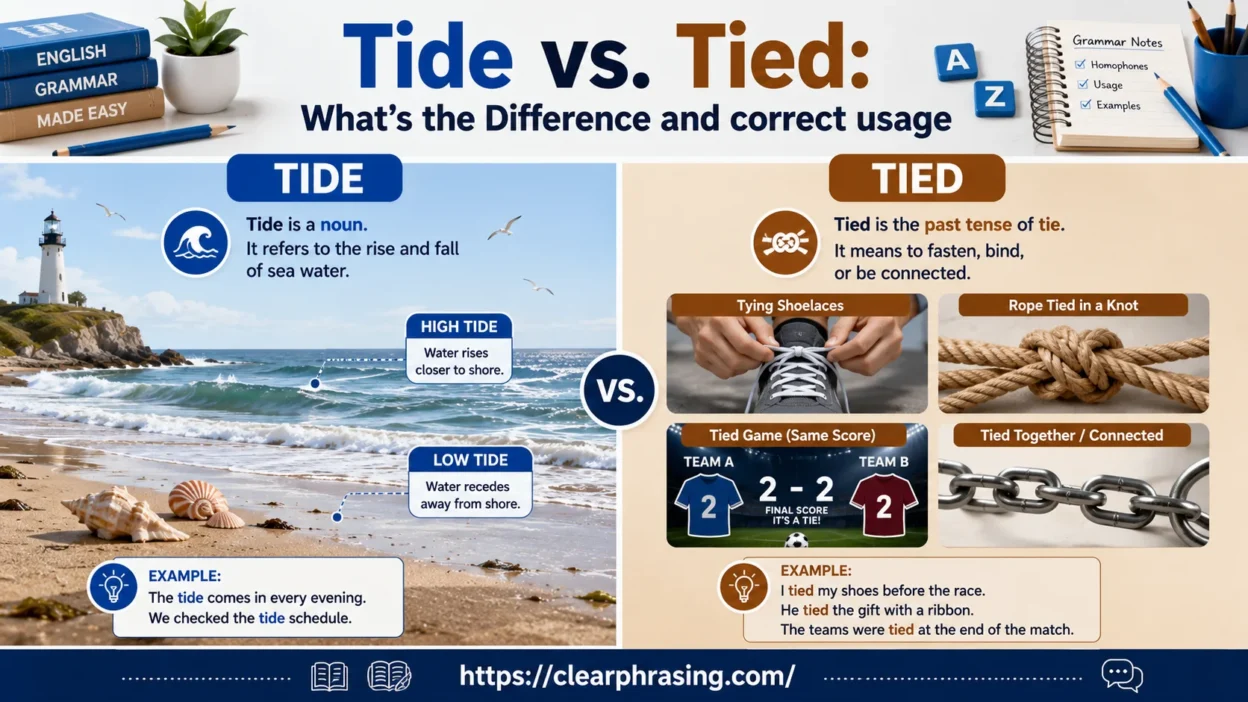
Tide vs. Tied: What’s the Difference and Correct Usage helps English learners understand the Difference between two words that sound alike but have different meanings.
This guide explains the Correct Usage, definition, meaning, usage, and distinction in modern English. As an English teacher, I have seen this confusion in writing, speaking, communication, education, and exams. Learning English grammar, grammar rules, and vocabulary helps you communicate clearly and correctly while avoiding common mistakes in the English language.
Tide refers to the rise and fall of sea levels in the sea, ocean, and oceans, caused by the gravitational pull of the moon and sun. It also describes the ebb and flow of a crowd or the stock market figuratively. Tied is the past tense of the verb tie, meaning to attach, bind, or fasten things with a rope, string, or knot, such as tying shoelaces or securing a package. Although tieing appears sometimes, tying is the correct spelling.
Quick Answer: Tide vs. Tied
The difference is straightforward:
- Tide is a noun that usually refers to the regular rise and fall of the sea. It can also describe a flow, trend, or changing situation.
- Tied is the past tense and past participle of the verb “tie.” It can also function as an adjective, meaning fastened, connected, or equal in score.
| Word | Part of Speech | Meaning | Example |
| Tide | Noun | The rise and fall of ocean water or a trend | The tide came in quickly. |
| Tied | Verb / Adjective | Fastened, connected, or equal | She tied her shoes before running. |
Quick Tip
If your sentence talks about water, waves, or changing trends, use tide.
If it talks about knots, connections, or equal scores, use tied.
Why Do People Confuse Tide and Tied?
Many English learners and even native speakers occasionally mix up these words. The confusion comes from several reasons.
They Sound Almost the Same
Both words are pronounced with the long “i” sound.
- Tide → /taɪd/
- Tied → /taɪd/
Since they are homophones, you cannot tell which word someone means simply by listening.
Their Spellings Differ by One Letter
The only spelling difference is that tied includes the letter e before the d.
Compare them:
- tide
- tied
That tiny change creates a completely different meaning.
Autocorrect Doesn’t Always Help
Because both are valid English words, spellcheck usually won’t catch the mistake.
For example:
❌ The boat was tied by the evening.
✔ The boat returned before the tide changed.
Context Is Everything
Understanding the topic of the sentence makes choosing the correct word much easier.
Ask yourself:
- Is this sentence about the sea or changing conditions?
- Or is it about fastening something or matching another score?
Once you answer that question, the correct word becomes obvious.
What Does “Tide” Mean?
Definition
Tide refers to the regular rise and fall of sea levels caused mainly by the gravitational pull of the Moon and, to a lesser extent, the Sun.
The word can also describe a powerful movement, flow, or gradual change in events.
Pronunciation
Tide
/taɪd/
Part of Speech
Noun
Although it occasionally appears as a verb in certain expressions, modern English uses it primarily as a noun.
Origin of the Word
The word tide comes from the Old English word tīd, which originally meant time, season, or period. Over time, its meaning shifted toward the regular movement of the sea because tides occur at predictable intervals.
Different Meanings of Tide
Ocean Tides
This is the most common meaning.
Example:
- The tide was high when the fishermen left the harbor.
A Flow or Movement
Sometimes tide describes something moving steadily.
Example:
- A tide of visitors entered the museum.
A Changing Trend
It often appears in business, politics, sports, and everyday conversations.
Example:
- Public opinion began to turn the tide.
Figurative Meaning
Writers often use tide to describe emotional or social changes.
Example:
- A tide of excitement swept through the crowd.
Examples of Tide in Everyday English
- We arrived before the high tide.
- The low tide exposed the rocks.
- A rising tide lifted every boat.
- Economic tides often change without warning.
- The charity campaign helped turn the tide against hunger.
What Does “Tied” Mean?
Definition
Tied is the past tense and past participle of the verb tie. It means something has been fastened, attached, connected, or finished equally.
Pronunciation
Tied
/taɪd/
Part of Speech
- Verb
- Adjective
Grammar Forms
| Verb Form | Word |
| Base Verb | Tie |
| Third Person | Ties |
| Present Participle | Tying |
| Past Tense | Tied |
| Past Participle | Tied |
Different Meanings of Tied
Fastened
Example:
- He tied the rope securely.
Connected
Example:
- Success is closely tied to preparation.
Equal Score
Example:
- Both teams tied the game.
Restricted or Committed
Example:
- She feels tied to her responsibilities.
Examples of Tied in Everyday English
- She tied her hair into a ponytail.
- They tied the packages with string.
- The election ended tied.
- Our schedules are tied together.
- The dog remained tied to the fence.
Tide vs. Tied: Side-by-Side Comparison
| Feature | Tide | Tied |
| Part of Speech | Noun | Verb and adjective |
| Main Meaning | Ocean movement or trend | Fastened or equal |
| Related To | Water, change, movement | Rope, knots, scores, relationships |
| Common Context | Nature, weather, business | Sports, daily life, work |
| Can Describe Equal Scores? | No | Yes |
| Connected to the Ocean? | Yes | No |
The Biggest Difference
Think of it this way:
- Tide belongs to nature and change.
- Tied belongs to actions and connections.
When Should You Use “Tide”?
Use tide whenever your sentence refers to water, movement, or changing situations.
Talking About the Ocean
Examples:
- We checked the tide chart before sailing.
- The tide reached its highest point at sunset.
- Strong tides can create dangerous currents.
Describing Trends
Businesses, governments, and journalists frequently use tide to describe changing situations.
Examples:
- The company hopes to turn the tide after several difficult months.
- Technology has changed the tide of modern communication.
Common Expressions with Tide
| Expression | Meaning |
| High tide | Highest sea level |
| Low tide | Lowest sea level |
| Turn the tide | Reverse a situation |
| Against the tide | Opposing popular opinion |
| Tide someone over | Help someone through a difficult period |
Example Sentences
- The children collected shells during low tide.
- Fresh ideas helped turn the tide.
- Volunteers created a tide of community support.
- The changing tide surprised inexperienced surfers.
When Should You Use “Tied”?
Choose tied whenever something has been fastened, connected, or finished equally.
Talking About Knots
Examples:
- She tied the ribbon perfectly.
- The campers tied the tent securely.
Equal Scores
Sports commentators use tied every day.
Examples:
- The teams were tied after overtime.
- Both players finished tied for first place.
Connected Things
Examples:
- Their success is tied to teamwork.
- The two projects are closely tied together.
Being Busy or Committed
People often use tied up to describe being occupied.
Examples:
- I’m tied up this afternoon.
- The manager has been tied up in meetings all day.
Common Expressions with Tied
| Expression | Meaning |
| Tied up | Busy or occupied |
| Tied down | Restricted by responsibilities |
| Tied together | Connected |
| Tied to | Linked with |
| Tied for first | Equal in ranking |
Common Mistakes People Make
Learning from mistakes is one of the fastest ways to improve your writing.
Mistake 1: Using tide Instead of tied
❌ She tide her shoes.
✔ She tied her shoes.
Mistake 2: Using tied for Ocean Water
❌ The tied was coming in.
✔ The tide was coming in.
Mistake 3: Confusing Idioms
❌ We finally tied the tide.
✔ We finally turned the tide.
Mistake 4: Confusing Sports Terminology
❌ The game finished tide.
✔ The game finished tied.
Mistake 5: Trusting Spellcheck Too Much
Spellcheck only checks whether a word exists. It doesn’t know whether you chose the correct word for your sentence.
Always read the sentence again and ask yourself:
- Does this sentence involve water or change?
- Or does it involve fastening or equality?
That simple question will help you choose the correct spelling almost every time.
Memory Tricks to Remember the Difference
Small memory tricks can make these words much easier to remember.
Remember “Tide”
Picture ocean waves moving toward the shore.
Think:
- Tide = Sea
- Tide = Waves
- Tide = Ocean
Whenever water comes to mind, tide is the correct choice.
Remember “Tied”
Picture tying your shoes before going outside.
Think:
- Tied = Knot
- Tied = Rope
- Tied = Fastened
If something is attached, connected, or equal, choose tied.
Real-Life Example Sentences
Tide Examples
- The tide rose faster than expected.
- Fishermen planned their trip around the high tide.
- Public support helped turn the tide of the campaign.
- Seasonal tides affect many coastal ecosystems.
- Investors watched the economic tide shift throughout the year.
Tied Examples
- Emma tied her backpack before hiking.
- Both runners tied for second place.
- Their futures remain closely tied together.
- The chef tied fresh herbs with kitchen string.
- The dog stayed tied to the tree until its owner returned.
Tide and Tied in Idioms and Everyday Expressions
Idioms often confuse learners because their meanings go beyond the literal definitions of the words. Understanding these expressions will help you sound more natural in everyday English.
Common Idioms with Tide
Turn the Tide
This expression means to change a situation for the better, especially after a difficult period.
Examples:
- The new coach helped turn the tide for the struggling team.
- Better planning turned the tide on the project.
Tide Someone Over
This means to provide enough help until something better happens.
Examples:
- This small loan should tide you over until payday.
- A quick snack will tide you over until dinner.
Against the Tide
This phrase means going against popular opinion or the usual direction.
Example:
- The company succeeded even though it was working against the tide.
Common Expressions with Tied
Tied Up
Means busy or occupied.
Example:
- I’m tied up all morning with meetings.
Tied Down
Means restricted by responsibilities or commitments.
Example:
- They aren’t ready to travel because they feel tied down by work.
Tied Together
Means closely connected.
Example:
- Education and opportunity are closely tied together.
Tied To
Means linked or dependent on something else.
Example:
- Employee bonuses are tied to company performance.
Grammar Notes: Why “Tide” and “Tied” Are Different
Although these words sound alike, their grammar is completely different.
Why “Tied” Is a Verb Form
The word tied comes from the verb tie.
It can serve three grammatical functions:
- Past tense verb
- Past participle
- Adjective
Examples
Past tense:
- She tied the package.
Past participle:
- The rope has been tied securely.
Adjective:
- Their scores are tied.
Why “Tide” Is Usually a Noun
Tide names a thing rather than an action.
It refers to:
- Ocean movement
- A flow of people
- A changing trend
- A figurative movement or shift
Because it is primarily a noun, it does not replace the verb tied.
British vs. American English
One question learners often ask is whether tide and tied differ between British and American English.
The answer is simple.
Spelling
There is no spelling difference.
- American English: tide, tied
- British English: tide, tied
Meaning
The meanings stay exactly the same in both varieties of English.
Pronunciation
Both dialects pronounce these words almost identically. Minor accent differences may exist, but they do not change the words themselves.
Read More: Eminent vs. Imminent: What’s the Difference?
Mini Quiz: Can You Choose the Correct Word?
Test your understanding before moving on.
Choose the correct word.
- The fishermen waited for the high ______.
- Tide
- Tied
- Sarah ______ her shoes before the race.
- Tide
- Tied
- The two teams finished ______.
- Tide
- Tied
- The storm helped turn the ______.
- Tide
- Tied
- The dog’s leash was ______ to the fence.
- Tide
- Tied
- We explored the beach during low ______.
- Tide
- Tied
- Their success is closely ______ to hard work.
- Tide
- Tied
- A rising ______ lifted every boat.
- Tide
- Tied
- The hikers ______ the rope around the tree.
- Tide
- Tied
- Public support helped ______ the tide.
- Turn
- Tie
Answer Key
| Question | Correct Answer |
| 1 | Tide |
| 2 | Tied |
| 3 | Tied |
| 4 | Tide |
| 5 | Tied |
| 6 | Tide |
| 7 | Tied |
| 8 | Tide |
| 9 | Tied |
| 10 | Turn |
Cheat Sheet
| If You Mean… | Use |
| Ocean water rising or falling | Tide |
| High or low sea level | Tide |
| A changing trend | Tide |
| Fastened with a knot | Tied |
| Connected to something | Tied |
| Equal score in sports | Tied |
| Busy (“tied up”) | Tied |
FAQs
Is tide or tied the correct word?
Both are correct, but they have different meanings. Tide relates to the movement of the sea, while tied is the past tense of tie, meaning something has been fastened or connected.
What is the difference between tide and tied?
Tide refers to the natural rise and fall of sea levels. Tied describes something that has been fastened, secured, or linked to something else.
Can tide and tied be used interchangeably?
No. Although they sound alike, they have different meanings and should never be used in place of one another.
Why do people confuse tide and tied?
They are homophones with very similar pronunciation. Many learners rely on sound instead of meaning, which leads to spelling mistakes.
Is tied the past tense of tie?
Yes. Tied is both the past tense and the past participle of the verb tie.
Is tieing a correct spelling?
No. In modern English, tying is the correct spelling. Tieing is considered incorrect in standard writing.
Can tide be used in a figurative way?
Yes. Besides describing sea levels, tide can refer to trends or changing situations, such as the tide of public opinion or the tide turned in our favor.
How can I remember the difference between tide and tied?
Think of tide as something related to the sea, and tied as something connected with a tie, rope, or knot.
Are tide and tied common in everyday English?
Yes. Tide is common in discussions about oceans, weather, and figurative expressions, while tied is frequently used in everyday conversations about fastening or connecting things.
How can I avoid mistakes with tide and tied?
Focus on the meaning before choosing the word. If you’re talking about the ocean or water levels, use tide. If you’re talking about fastening or connecting something, use tied.
Conclusion
Although Tide and Tied sound the same, they have completely different meanings and uses. Tide describes the natural movement of the sea or can be used figuratively to show changing situations, while Tied is the past tense of tie and refers to fastening or connecting something. Knowing this simple difference will help you write and speak more accurately.
From my experience teaching English, this is one of the easiest mistakes to fix once you focus on the meaning instead of the pronunciation. Practice using both words in everyday sentences, and you’ll quickly remember when each one fits. With regular reading and writing, choosing between tide and tied will become natural and improve your overall confidence in English.

Shamsa Kanwal is an English specialist and content writer at ClearPhrasing.com, where she helps readers navigate the English language with confidence. She enjoys breaking down grammar rules, spelling differences, vocabulary, and everyday writing challenges into simple, practical lessons that anyone can understand.
Her writing is focused on making learning approachable rather than overwhelming. Whether she’s explaining commonly confused words, punctuation rules, or grammar concepts, Shamsa believes that clear explanations and real-life examples are the key to effective learning.
Every article she writes is carefully researched, fact-checked, and edited to ensure it is accurate, easy to read, and genuinely helpful. Her goal is to create trustworthy resources that enable students, professionals, writers, and English learners to improve their communication skills and write with greater clarity.
Through her work at ClearPhrasing.com, Shamsa is committed to making English learning simpler, more practical, and accessible for readers around the world.