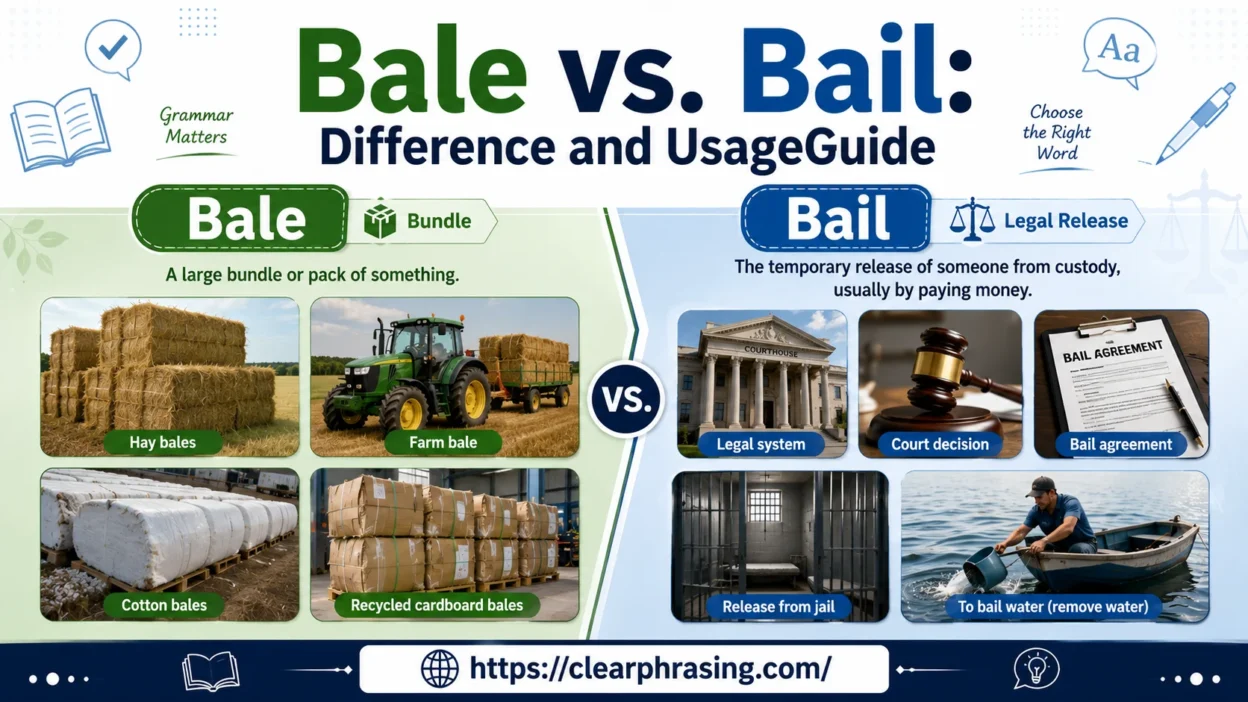
Bale vs. Bail: Difference and Usage Guide helps you understand these confusing homophones and use both words correctly with confidence every day.
If you have been scratching your head, puzzled about the correct use of bale and bail, you are not alone. These two words sound exactly alike but have different meanings. As a teacher, I often double-check them myself because they confuse English language learners and native speakers. The trick is understanding the right context, usage, and meaning through examples, grammar, pronunciation, and vocabulary.
Think of a large bundle of hay or cotton prepared for shipping and storage, while bail usually refers to money for release from jail before trial, or removing water from a boat with a bucket to prevent sinking. This guide will help you avoid mistakes in writing, speaking, and everyday communication.
Quick Answer: Bale vs. Bail
The difference is simple once you know the context.
- Bale refers to a tightly packed bundle of materials such as hay, cotton, paper, straw, or recycled cardboard. It can also mean to make such a bundle.
- Bail usually refers to temporary release from jail before trial. As a verb, it can also mean removing water from a boat, rescuing someone from difficulty, or leaving a commitment unexpectedly.
| Word | Meaning | Part of Speech | Common Context | Example |
| Bale | A tightly packed bundle | Noun, Verb | Farming, recycling, manufacturing | The workers loaded the hay bales onto the truck. |
| Bail | Temporary release from custody, remove water, rescue | Noun, Verb | Law, boating, everyday conversation | The judge granted bail after the hearing. |
Quick tip: Think bale = bundle and bail = jail. That simple memory trick solves most spelling mistakes.
Why People Confuse Bale and Bail
At first glance, these words don’t look very similar. However, when spoken aloud, they sound exactly the same.
Several factors make them easy to confuse.
- They are pronounced identically.
- Both contain four letters.
- Both function as nouns and verbs.
- Spell check often misses the error because both are correctly spelled English words.
- Many people learn them through conversation before seeing them in writing.
For example, someone might hear the sentence:
“The court refused bail.”
Without seeing the spelling, they may mistakenly write bale because the pronunciation is identical.
Likewise, someone unfamiliar with farming may write:
“The farmer moved twenty hay bails.”
The sentence contains the wrong spelling even though the pronunciation sounds correct.
That’s why understanding the meaning matters more than memorizing the spelling alone.
What Does “Bale” Mean?
The word bale refers to a large bundle of materials that has been tightly compressed and tied together for easier storage, transportation, or sale.
You’ll most often encounter bale in agriculture, recycling, textile production, and shipping industries.
Definition of Bale
Bale (noun): A compressed package of goods wrapped or tied together.
Bale (verb): To compress materials into bundles.
Unlike bail, bale has nothing to do with courts or legal matters.
Origin of Bale
The word bale comes from Middle English and earlier Germanic languages. For centuries, merchants and farmers have used the term to describe tightly wrapped goods prepared for transport.
Long before modern packaging existed, products such as wool, cotton, and straw traveled across countries in large bales because bundles were easier to move and protected valuable materials during shipping.
Bale as a Noun
A bale is simply a tightly packed bundle.
Common examples include:
- Hay bale
- Straw bale
- Cotton bale
- Paper bale
- Cardboard bale
- Fabric bale
- Clothing bale
- Plastic bale
Modern industries rely heavily on baling machines to compress materials. This reduces storage space and lowers transportation costs.
For example, recycling centers compress thousands of pounds of cardboard into compact bales every day before shipping them to paper mills.
Examples of Bale in Sentences
- The farmer stacked dozens of hay bales before the rain arrived.
- Every cotton bale was labeled before shipment.
- Workers loaded paper bales onto the delivery truck.
- The warehouse stored hundreds of fabric bales.
- Recycling companies compress cardboard into large bales.
Notice that every sentence involves a physical bundle.
Bale as a Verb
As a verb, bale means to create compressed bundles.
Examples include:
- Farmers bale hay after harvesting.
- Workers baled recycled paper.
- The company bales plastic waste every week.
- Machines automatically bale cotton before export.
Industries That Commonly Use Bale
| Industry | Example |
| Agriculture | Bale hay and straw |
| Cotton Production | Cotton bales |
| Recycling | Paper and cardboard bales |
| Textile Industry | Fabric bales |
| Shipping | Transporting compressed goods |
These industries depend on baling because compressed materials occupy less space and reduce shipping expenses.
Common Collocations with Bale
Native English speakers often pair bale with certain words.
Some of the most common include:
- Hay bale
- Straw bale
- Cotton bale
- Bale of paper
- Bale of clothing
- Round bale
- Square bale
- Bale wrapper
- Bale loader
- Bale press
Learning these natural word combinations improves both speaking and writing.
What Does “Bail” Mean?
Unlike bale, the word bail has several meanings depending on the situation. Although the definitions differ, they all share one thing in common: they have nothing to do with bundles.
Most people first encounter bail in legal news.
However, the word also appears in boating and everyday conversation.
Definition of Bail
Bail (noun): Money or security paid to allow someone to leave jail while waiting for trial.
Bail (verb): To secure someone’s temporary release, remove water from a boat, rescue someone from difficulty, or leave a commitment unexpectedly.
Context determines which meaning is intended.
Origin of Bail
The word bail comes from Old French and Latin words related to custody, care, and control. Over time, English adopted it into legal language before expanding its meaning into everyday expressions.
Today, bail appears in legal documents, newspapers, movies, and ordinary conversations.
Bail in Legal English
This is the most common meaning.
When a person is arrested, a judge may allow them to remain free until trial by requiring bail.
The amount depends on factors such as:
- Seriousness of the crime
- Flight risk
- Criminal history
- Public safety
- Local laws
If the defendant follows all court requirements, the bail money is generally returned according to the applicable legal process.
Common Legal Terms
- Post bail
- Grant bail
- Deny bail
- Bail hearing
- Bail bond
- Bail amount
- Bail conditions
- Release on bail
These expressions appear regularly in newspapers and court reports.
Legal Examples
- The judge granted bail after reviewing the evidence.
- She remained in custody because the court denied bail.
- His attorney requested a lower bail amount.
- The defendant posted bail the same afternoon.
- The court scheduled a bail hearing for Monday.
Each sentence relates to the legal system rather than physical objects.
Bail in Boating
Another meaning of bail involves removing water from a boat.
Small boats, canoes, and rowboats often collect rainwater or waves during use.
People bail water out using:
- Buckets
- Containers
- Pumps
- Scoops
Examples include:
- We stopped rowing to bail water from the canoe.
- She quickly bailed the boat after a large wave hit.
- Everyone helped bail out the flooded fishing boat.
Although this meaning isn’t as common as the legal one, it remains an important part of English vocabulary, especially in boating communities.
Bail in Everyday Conversation
Modern English also uses bail informally.
In casual conversation, it often means leaving suddenly, backing out of a plan, or helping someone escape a difficult situation.
Consider these examples:
- I had to bail on dinner because of work.
- Thanks for bailing me out when my car broke down.
- He decided to bail at the last minute.
- Her parents bailed her out financially after the business failed.
- Don’t bail on your teammates before the project is finished.
These informal expressions are extremely common in American English and appear frequently in movies, television shows, podcasts, and everyday conversations.
Bale vs. Bail: Side-by-Side Comparison
Understanding the differences becomes much easier when you compare the two words directly.
| Feature | Bale | Bail |
| Pronunciation | Same as bail | Same as bale |
| Primary Meaning | Compressed bundle | Temporary legal release |
| Other Meanings | Compress into bundles | Remove water, rescue, leave unexpectedly |
| Common Context | Agriculture, recycling, textiles | Law, boating, everyday speech |
| Part of Speech | Noun, Verb | Noun, Verb |
| Example | The farmer stacked hay bales. | The judge granted bail. |
Both words may sound identical, but their meanings never overlap. The surrounding context always tells you which spelling is correct.
Common Expressions Using Bale
Although bale has fewer meanings than bail, it appears in many industries and everyday discussions about farming, recycling, and manufacturing.
Hay Bale
A hay bale is a tightly packed bundle of dried grass used to feed livestock.
Example:
- The ranch stored hundreds of hay bales before winter.
Straw Bale
A straw bale contains dried stalks left after harvesting crops. People use straw bales for animal bedding, gardening, erosion control, and even eco-friendly construction.
Example:
- They built raised garden beds using straw bales.
Cotton Bale
Cotton producers compress harvested cotton into large bales before transporting it to textile mills.
Example:
- Each cotton bale weighed several hundred pounds.
Bale of Paper
Paper manufacturers bundle recycled paper into compact bales to save storage space.
Example:
- The warehouse received a bale of paper every morning.
Bale Wrapper
A bale wrapper is a machine that wraps hay or straw in plastic to protect it from moisture.
Example:
- The new bale wrapper reduced spoilage on the farm.
Common Expressions Using Bail
Unlike bale, the word bail appears in legal language and informal conversation.
Out on Bail
Someone released from jail while waiting for trial.
Example:
- The suspect is currently out on bail.
Post Bail
To pay the required amount for temporary release.
Example:
- His family managed to post bail that evening.
Jump Bail
To leave without appearing in court after being released.
Example:
- The defendant jumped bail and disappeared.
Grant Bail
When a judge allows release before trial.
Example:
- The court decided to grant bail after reviewing the evidence.
Bail Someone Out
To rescue someone from financial, personal, or practical trouble.
Example:
- Her brother bailed her out after the unexpected expenses.
Bail on Someone
To cancel plans or leave unexpectedly.
Example:
- Don’t bail on your friends at the last minute.
Bale vs. Bail in Everyday Sentences
Seeing both words in context makes the difference much easier to remember.
Examples Using Bale
- The farmer stacked the bales beside the barn.
- Workers compressed cardboard into large bales.
- We bought two bales of straw for the horses.
- The recycling center sold paper bales to manufacturers.
- Cotton bales filled the warehouse.
- They used a machine to bale the hay.
- Every bale was labeled before shipping.
- The truck carried twenty hay bales.
- Plastic waste was baled for recycling.
- The crew loaded the final bale before sunset.
Examples Using Bail
- The judge refused to grant bail.
- She posted bail the next morning.
- The lawyer requested a lower bail amount.
- We had to bail water from the canoe.
- Thanks for bailing me out yesterday.
- He decided to bail on the meeting.
- The defendant remained in jail because he couldn’t afford bail.
- They quickly bailed out the flooded boat.
- She didn’t want to bail halfway through the project.
- The court scheduled another bail hearing.
Bale vs. Bail in American and British English
One question many English learners ask is whether American and British English use these words differently.
The answer is simple. The spellings, meanings, and pronunciations remain the same in both varieties of English.
The only noticeable differences appear in legal procedures because court systems vary from country to country. However, the meaning of bail never changes.
| Feature | American English | British English |
| Bale | Same spelling and meaning | Same spelling and meaning |
| Bail | Same spelling and meaning | Same spelling and meaning |
| Pronunciation | Identical | Identical |
| Legal Usage | Based on U.S. courts | Based on U.K. courts |
Common Mistakes Writers Make
Because these words sound identical, writers often choose the wrong spelling.
Here are some of the most common mistakes.
| Incorrect | Correct | Why |
| The judge granted bale. | The judge granted bail. | Legal context |
| The farmer stacked hay bails. | The farmer stacked hay bales. | Agriculture |
| We had to bale water from the canoe. | We had to bail water from the canoe. | Boating |
| He paid his bale. | He paid his bail. | Court procedure |
| They bailed the hay yesterday. | They baled the hay yesterday. | Farming |
Why Spell Check Doesn’t Always Help
Spell-check software usually verifies spelling, not meaning.
Since bale and bail are both valid English words, many writing tools won’t flag the mistake.
That’s why proofreading for context is essential.
Memory Tricks to Remember Bale vs. Bail
Simple memory tricks can prevent future confusion.
Remember: Bale = Bundle
Both bale and bundle begin with the letter B.
If you’re talking about something wrapped together, choose bale.
Remember: Bail = Jail
Both words end with -ail.
If the sentence involves courts, prison, or legal release, use bail.
Picture the Situation
Imagine these scenes:
- A farmer lifting a hay bale.
- A judge discussing bail in a courtroom.
The visual difference makes the spelling easier to recall.
Real-Life Examples
Agriculture
Farmers use balers to compress hay after harvesting. Compact bales are easier to transport, store, and protect from weather.
Recycling
Recycling centers compress cardboard, aluminum cans, paper, and plastic into large bales before shipping them to processing plants.
Criminal Justice
Courts may grant bail so defendants can remain free while awaiting trial. Bail conditions often require attending every court hearing.
Everyday Conversation
People frequently say:
- “I have to bail.”
- “Don’t bail on us.”
- “Thanks for bailing me out.”
These expressions have become a natural part of everyday American English.
Quick Case Study: One Letter, Two Completely Different Meanings
Consider these two sentences.
The farmer loaded twenty bales onto the truck.
This sentence describes agriculture and transportation.
Now compare it with:
The lawyer requested lower bail for the defendant.
This sentence belongs to the legal system.
The pronunciation is identical, yet the meanings couldn’t be more different. One letter changes the entire message.
Quote to Remember
“Context is the key that unlocks the correct spelling of every homophone.”
When you understand the situation, choosing between bale and bail becomes easy.
Practice Quiz
Choose the Correct Word
- The farmer loaded several ______ onto the trailer.
- The judge agreed to lower the defendant’s ______.
- We had to ______ water from the canoe.
- The recycling plant compressed paper into ______.
- Don’t ______ on your teammates before the project ends.
Answers
- Bales
- Bail
- Bail
- Bales
- Bail
Key Takeaways
- Bale refers to a tightly packed bundle of materials such as hay, straw, cotton, paper, or cardboard.
- Bale can also mean to compress materials into bundles.
- Bail usually refers to temporary release from jail before trial.
- Bail also means removing water from a boat, rescuing someone from trouble, or backing out of a commitment.
- Although the two words sound identical, their meanings are completely unrelated.
- Reading the sentence in context is the easiest way to choose the correct spelling.
Read More: Illegible vs. Unreadable: What’s the Difference? and Usage Guide
FAQs
Q1. What is the main difference between bale and bail?
A bale is a large wrapped bundle of materials like hay or cotton. Bail usually means money paid to secure someone’s temporary release from jail or the act of removing water from a boat.
Q2. Why do people confuse bale and bail?
People confuse them because they are homophones. They sound the same but have completely different meanings and are used in different situations.
Q3. When should I use the word bale?
Use bale when talking about tightly packed bundles of goods, crops, hay, cotton, or other materials prepared for storage or transport.
Q4. When should I use the word bail?
Use bail when referring to legal release from jail or when talking about removing water from a boat.
Q5. Is bale related to farming?
Yes. Farmers often make bales of hay, straw, or cotton for easier handling, storage, and transportation.
Q6. Can bail have more than one meaning?
Yes. It can refer to court-ordered release from custody or the action of emptying water from a boat.
Q7. Are bale and bail interchangeable?
No. Although they sound alike, they cannot replace each other because their meanings are completely different.
Q8. How can I remember the difference between bale and bail?
Remember that bale is linked to bundles of farm products, while bail is linked to courts, jail, or boats.
Q9. Are bale and bail common in everyday English?
Yes. Bale appears in agriculture and shipping, while bail is common in legal discussions and boating.
Q10. How can I avoid mixing up bale and bail?
Practice reading example sentences, pay attention to the context, and remember the specific meaning of each word before using it.
Conclusion
Understanding the difference between bale and bail becomes much easier once you connect each word with its meaning instead of its pronunciation. Although they sound identical, bale refers to a tightly wrapped bundle of materials like hay or cotton, while bail is used in legal situations or for removing water from a boat. Paying attention to the context will help you choose the correct word every time.
The best way to master these homophones is through regular reading, writing, and practice. Over the years, I have noticed that students remember the difference more quickly when they associate bale with farming and bail with courts or boats. With a little repetition and real-life examples, you’ll avoid common mistakes and use both words naturally in everyday English.

Shamsa Kanwal is an English specialist and content writer at ClearPhrasing.com, where she helps readers navigate the English language with confidence. She enjoys breaking down grammar rules, spelling differences, vocabulary, and everyday writing challenges into simple, practical lessons that anyone can understand.
Her writing is focused on making learning approachable rather than overwhelming. Whether she’s explaining commonly confused words, punctuation rules, or grammar concepts, Shamsa believes that clear explanations and real-life examples are the key to effective learning.
Every article she writes is carefully researched, fact-checked, and edited to ensure it is accurate, easy to read, and genuinely helpful. Her goal is to create trustworthy resources that enable students, professionals, writers, and English learners to improve their communication skills and write with greater clarity.
Through her work at ClearPhrasing.com, Shamsa is committed to making English learning simpler, more practical, and accessible for readers around the world.