Illegible vs. Unreadable: What’s the Difference? and Usage Guide helps explain confusing writing terms in simple English for every reader today.
Many people think illegible and unreadable are similar, but their difference comes from their distinct meanings. This guide explains the meaning, meanings, and usage of both adjectives. Illegible usually describes writing, handwriting, doctor’s handwriting, scribbles, letters, actual letters, notes, print, a printed document, document, or any written text, texts, written content, or piece that is hard, difficult, or impossible to read or decipher because the style, structure, or appearance hides the words.
Unreadable describes content that is confusing, uses complex language, has a boring story, poor structure, or is poorly written, making it difficult to follow, understanding, enjoy, and convey information. As an example, I often tell my students that a seven-year-old child may produce poor writing, while a book with clear print can still be unreadable if it lacks sense.
Quick Answer
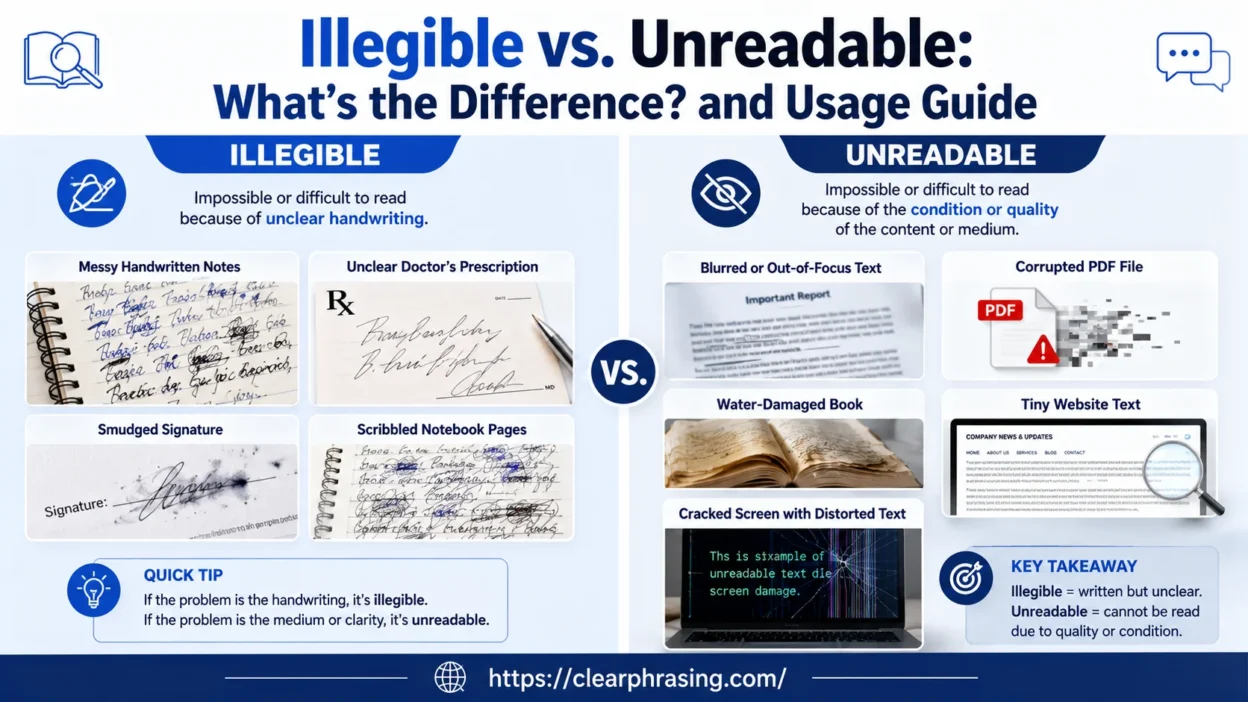
Illegible means the writing itself is impossible or very difficult to decipher because the letters are unclear.
Unreadable means something cannot be read or understood for any reason, including poor handwriting, damaged text, tiny fonts, blurry images, difficult language, or corrupted digital files.
Simple rule to remember: If the writing is unclear, use illegible. If the text cannot be read for any reason, use unreadable.
Illegible vs. Unreadable at a Glance
| Feature | Illegible | Unreadable |
| Meaning | Writing cannot be deciphered | Text cannot be read or understood |
| Main Use | Poor handwriting | Any reading problem |
| Common Contexts | Notes, signatures, prescriptions | Books, files, websites, documents |
| Handwriting | Yes | Yes |
| Printed Text | Rarely | Yes |
| Digital Text | Rarely | Yes |
| Difficult Content | No | Yes |
| Example | His signature was illegible. | The damaged file was unreadable. |
What Does Illegible Mean?
Illegible is an adjective that describes writing that cannot be read because the letters, words, or numbers are unclear. The problem lies with how the writing looks, not with the reader.
Most people encounter illegible writing in handwritten documents. Fast handwriting, poor penmanship, smudged ink, and overlapping letters often make words impossible to identify.
The word comes from the Latin legere, meaning “to read.” The prefix il- means “not,” so illegible literally means not readable because the writing itself lacks clarity.
Common Situations Where You Should Use Illegible
- Messy handwriting
- Doctor’s prescriptions
- Quickly written classroom notes
- Poorly signed legal documents
- Smudged handwritten letters
- Ancient handwritten manuscripts
Examples of Illegible
- The doctor’s prescription was illegible, so the pharmacist requested a new copy.
- His handwritten notes became illegible after the ink smeared.
- The signature was completely illegible.
- Years of fading made parts of the handwritten diary illegible.
- The student rewrote her assignment because several sentences were illegible.
Notice that every example focuses on unclear writing, not difficult ideas.
What Does Unreadable Mean?
Unreadable is a much broader adjective. It describes anything that cannot be read or understood regardless of the reason.
Sometimes the letters are perfectly clear. The problem may instead be damaged paper, tiny font sizes, poor formatting, blurry scans, technical language, or corrupted computer files.
Because of its wider meaning, unreadable appears in many more situations than illegible.
Common Situations Where You Should Use Unreadable
- Water-damaged documents
- Burned books
- Tiny website fonts
- Blurry photographs
- Corrupted PDF files
- Complex legal language
- Dense academic papers
- Extremely technical manuals
Examples of Unreadable
- The flood left the historical documents unreadable.
- The website uses such a tiny font that the text is almost unreadable.
- The PDF became unreadable after the file was corrupted.
- The novel wasn’t physically damaged, but its writing style felt unreadable to many readers.
- The old newspaper became unreadable because the ink faded over time.
Unlike illegible, unreadable can describe both physical and intellectual difficulty.
The Main Difference Between Illegible and Unreadable
Although both words involve reading problems, they focus on different causes.
| Aspect | Illegible | Unreadable |
| Primary Meaning | Writing is unclear | Text cannot be read |
| Main Cause | Poor handwriting | Any obstacle |
| Common Objects | Notes, signatures, letters | Books, files, screens, documents |
| Physical Appearance | Letters are unclear | May or may not be clear |
| Reading Problem | Deciphering letters | Reading or understanding |
| Scope | Narrow | Broad |
A simple way to think about it is this:
- Every illegible document is unreadable.
- Not every unreadable document is illegible.
For example, a burned letter is unreadable even if the handwriting was neat before the fire. Likewise, a complicated legal contract may be readable in appearance but unreadable for someone unfamiliar with legal terms.
When to Use Illegible
Choose illegible when the appearance of the writing prevents someone from reading it.
Use Illegible When Writing Is:
- Messy
- Poorly formed
- Smudged
- Scribbled
- Faded by ink
- Impossible to decipher
Everyday Examples
School
A student’s rushed exam answers become illegible because the letters overlap.
Healthcare
Doctors often write prescriptions quickly. Poor handwriting may make them illegible.
Business
A handwritten meeting note becomes illegible after coffee spills across the page.
Legal Documents
A witness signs a form with an illegible signature.
History
Historians sometimes struggle with illegible handwriting in centuries-old manuscripts.
When to Use Unreadable
Use unreadable whenever something cannot be read regardless of why.
Use Unreadable When Text Is:
- Damaged
- Blurry
- Too small
- Corrupted
- Poorly formatted
- Extremely difficult to understand
Everyday Examples
Technology
A corrupted Word document becomes unreadable.
Publishing
A printing error leaves several pages unreadable.
Photography
A blurry photo makes the street sign unreadable.
Books
Some readers describe highly technical books as unreadable because of dense language.
Web Design
Low color contrast makes website text unreadable for many visitors.
Can Something Be Both Illegible and Unreadable?
Yes. Some situations fit both descriptions.
Imagine a handwritten letter with messy writing that later becomes soaked in water.
The handwriting was already illegible, and the water damage makes the entire document unreadable.
Here are a few more examples.
| Situation | Correct Word | Why |
| Doctor’s handwriting | Illegible | Letters are unclear |
| Burned letter | Unreadable | Physical damage prevents reading |
| Tiny website font | Unreadable | Font size is too small |
| Smudged handwritten note | Both | Handwriting and damage affect reading |
| Blurry scanned document | Unreadable | Poor image quality |
| Child’s messy handwriting | Illegible | Letters are difficult to recognize |
| Corrupted PDF | Unreadable | File cannot be opened properly |
| Ancient faded manuscript | Both | Writing and age create reading problems |
Looking at the cause rather than the result usually helps you choose the correct word.
Common Mistakes People Make
Many English learners confuse these adjectives because both describe reading difficulties. However, using the wrong one can make your writing less precise.
Some common mistakes include:
- Calling every difficult book illegible instead of unreadable.
- Using unreadable when referring only to messy handwriting.
- Assuming both words always mean exactly the same thing.
- Ignoring whether the problem is the writing itself or another factor.
- Using illegible for technical documents that are easy to see but difficult to understand.
A good editor always asks one question:
Why can’t the reader read it?
If the letters themselves are unclear, choose illegible. If another problem prevents reading, unreadable is usually the better choice.
Why Writers, Students, and Professionals Should Know the Difference
Using the correct word improves clarity and credibility. Teachers, editors, lawyers, healthcare workers, researchers, and business professionals rely on precise language every day.
For example, saying that a prescription is illegible tells the pharmacist that the handwriting is unclear. Saying that a scanned medical record is unreadable suggests a technical or physical problem instead.
Choosing the right adjective helps readers understand the exact issue without unnecessary explanation. It also makes your writing more accurate, professional, and easier to trust.
Synonyms of Illegible
Choosing the right synonym depends on the context. Some words describe poor handwriting, while others emphasize faded or unclear text.
| Synonym | Best Use |
| Indecipherable | Writing cannot be decoded |
| Scribbled | Messy handwritten text |
| Scrawled | Quickly written handwriting |
| Unclear | General lack of clarity |
| Blurred | Smudged or faded writing |
| Incomprehensible | Difficult to understand in some contexts |
Synonyms of Unreadable
Since unreadable has a broader meaning, its synonyms also cover a wider range of situations.
| Synonym | Best Use |
| Incomprehensible | Difficult ideas or language |
| Indecipherable | Text cannot be understood |
| Corrupted | Damaged digital files |
| Blurred | Poor image quality |
| Obscure | Difficult writing style |
| Unclear | General readability issues |
Common Collocations
Illegible
These word combinations appear frequently in everyday English.
- Illegible handwriting
- Illegible signature
- Illegible prescription
- Illegible notes
- Illegible address
- Illegible label
Unreadable
These combinations are common in both spoken and written English.
- Unreadable document
- Unreadable file
- Unreadable manuscript
- Unreadable screen
- Unreadable font
- Unreadable text
- Unreadable novel
- Unreadable email
Using natural collocations makes your writing sound more fluent and professional.
Illegible vs. Unreadable in American and British English
There is no difference between American English and British English when it comes to the meanings of illegible and unreadable.
Both varieties of English define the words in the same way:
- Illegible refers to unclear handwriting or writing that cannot be deciphered.
- Unreadable refers to anything that cannot be read or understood for any reason.
The only difference you may notice is writing style or vocabulary around these words, not the words themselves.
Grammar Tips for Correct Usage
Both illegible and unreadable are adjectives. They describe nouns rather than actions.
Correct Usage
- The handwriting is illegible.
- His signature was illegible.
- The scanned file is unreadable.
- The instructions became unreadable after the pages were damaged.
Incorrect Usage
- ❌ He illegibled the note.
- ❌ She unreadabled the document.
Since these words are adjectives, they should follow linking verbs such as is, was, became, looks, and seems, or appear before nouns.
Memory Trick to Remember the Difference
Here’s an easy way to keep the meanings straight.
Illegible = Invisible Letters
If the letters themselves are difficult to recognize, the writing is illegible.
Unreadable = Unable to Read
If anything prevents reading, whether it’s damage, formatting, blurry text, or difficult language, it is unreadable.
Think of it this way:
- Messy handwriting → Illegible
- Any reading problem → Unreadable
This simple trick works in almost every situation.
Practice Quiz
Test your understanding by choosing the correct word.
The doctor’s handwriting was ________.
A. Illegible
B. Unreadable
Answer: Illegible
The rain damaged the old letter until it became completely ________.
A. Illegible
B. Unreadable
Answer: Unreadable
The tiny font on the website is almost ________.
A. Illegible
B. Unreadable
Answer: Unreadable
His signature is so messy that it looks ________.
A. Illegible
B. Unreadable
Answer: Illegible
The PDF file became ________ after it was corrupted.
A. Illegible
B. Unreadable
Answer: Unreadable
Real-Life Examples from Different Fields
Education
Teachers often ask students to rewrite assignments with illegible handwriting. Clear writing helps prevent grading mistakes and improves communication.
Healthcare
Pharmacists sometimes contact doctors when a prescription is illegible. Clear prescriptions reduce the risk of medication errors.
Law
Legal professionals must ensure that contracts remain readable for everyone involved. Damaged copies can become unreadable, creating unnecessary delays.
Publishing
Editors check books for formatting problems before publication. Poor printing can make pages unreadable, even when the writing itself is perfectly clear.
Business
Companies scan thousands of documents every year. Low-quality scans often become unreadable, making digital records difficult to use.
Technology
Software developers work to improve screen readability. Small fonts, poor contrast, or corrupted files can make digital text unreadable across different devices.
“Clear writing isn’t just about good grammar. It’s about making sure every reader can understand your message.”
Read More: Sociopath vs. Psychopath: Differences, Traits, Causes, and Myths
FAQs
Is illegible the same as unreadable?
No. Illegible means the writing or print cannot be read because the letters are unclear. Unreadable means the text can be read, but the content is difficult to understand or follow.
Can handwriting be unreadable instead of illegible?
Yes. If the handwriting is neat but the ideas are confusing, it can be unreadable. If you cannot make out the letters at all, it is illegible.
Why do people confuse illegible and unreadable?
Both words describe reading problems, so many people use them interchangeably. However, one refers to appearance, while the other refers to meaning and clarity.
Can a typed document be illegible?
Yes. A typed document can become illegible if the font is damaged, blurry, too small, or poorly printed, making the text impossible to read.
Can a book be readable but still difficult to enjoy?
Yes. A book may be perfectly readable because the words are clear, yet it may feel unreadable if the writing is confusing, poorly organized, or overly complex.
How can I make my writing more readable?
Use clear language, short sentences, logical structure, and simple vocabulary. Breaking long paragraphs into smaller ones also improves readability.
What is a common example of illegible writing?
A doctor’s handwritten prescription is one of the most common examples. The letters may be so unclear that readers struggle to recognize the words.
Does unreadable always mean impossible to understand?
Not always. It often means the content requires much more effort to understand because of poor organization, complex language, or unclear ideas.
Which word should I use in formal writing?
Choose illegible when talking about the appearance of writing or print. Choose unreadable when discussing the quality, clarity, or meaning of the content.
How can I remember the difference between illegible and unreadable?
Think of illegible as a problem with the letters and appearance. Think of unreadable as a problem with the message, organization, or writing style.
Conclusion
Knowing the difference between illegible and unreadable helps you choose the right word in both everyday and professional writing. Illegible focuses on how writing or print looks, while unreadable describes content that is difficult to understand or enjoy. Using each term correctly makes your communication clearer and more accurate.
As an English teacher, I have seen students improve quickly once they learn this simple distinction. Whether you are reading handwritten notes, reviewing a printed document, or writing your own content, recognizing the difference will help you avoid confusion and communicate with greater confidence.

Mariam Asghar is an English specialist and professional content writer at ClearPhrasing.com. She is dedicated to helping readers improve their English through clear, practical, and easy-to-understand content. Her areas of expertise include grammar, spelling, vocabulary, punctuation, sentence structure, and effective writing.
At ClearPhrasing.com, Mariam writes comprehensive, well-researched articles that simplify complex language concepts for students, professionals, writers, and English learners. She believes that strong communication begins with a solid understanding of the English language and strives to make every lesson accessible and engaging.
With a strong commitment to quality, accuracy, and continuous learning, Mariam ensures that each article is carefully researched, thoroughly reviewed, and written to help readers communicate with greater confidence and clarity.