By vs. Through: Difference and When Should You Use Each? helps you understand English prepositions for clearer writing and better everyday conversation.
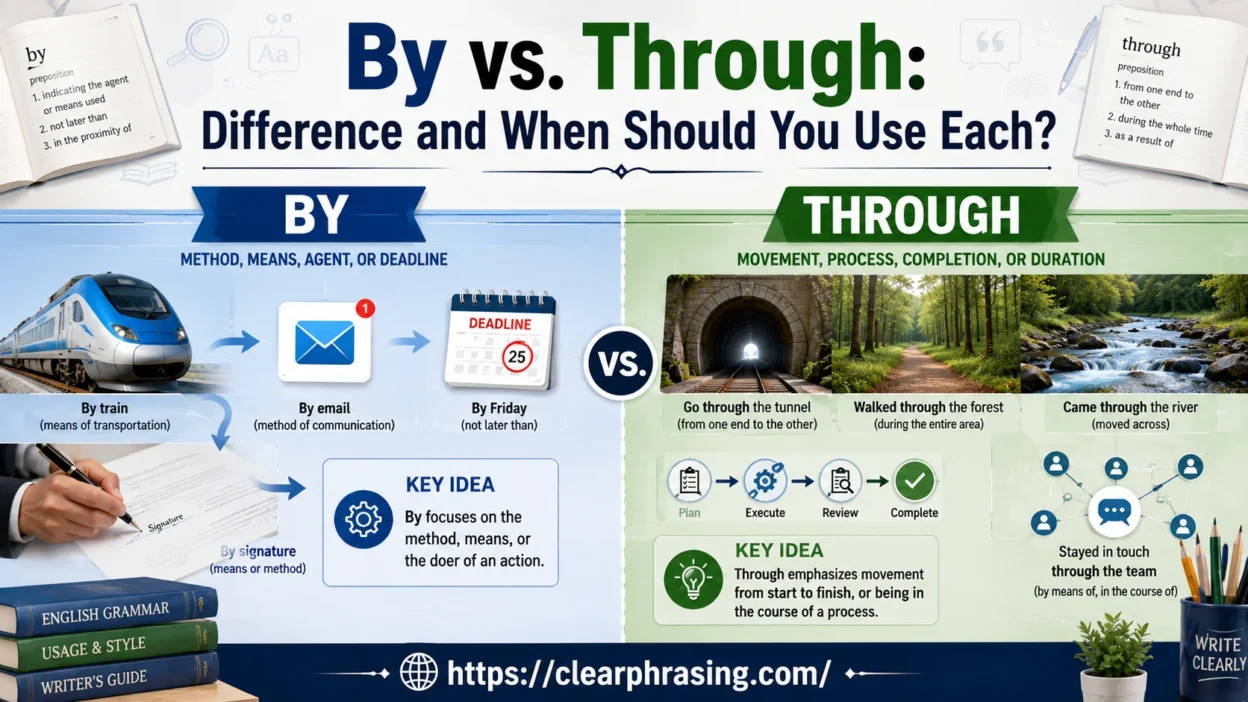
The main difference between by and through is how each preposition functions in the English language. These small words may seem interchangeable, but they create different meaning in a sentence. From my teaching experience, I have seen many learners face confusion until they notice the subtle differences and relationship between the two. By usually shows the method, means, or doer, while through emphasizes the process, steps, medium, or channel leading to a result.
For example, The cake was made by my mom, while I learned Spanish through reading books, practice, and dedication. This distinction helps you choose the correct, grammatically correct form with confidence and avoid common mistakes.
Quick Answer
The difference between by and through depends on what you want to express.
- Use by when you talk about a method, means, agent, transportation, deadline, measurement, or location.
- Use through when you describe movement, a process, a period of time, communication channels, or passing from one point to another.
Examples:
- I traveled by train.
- We walked through the forest.
- The report was written by Sarah.
- The company solved the issue through teamwork.
Although both words can sometimes describe how something happens, by usually focuses on the means, while through emphasizes the path or process.
What Does “By” Mean?
The preposition by has several meanings in English, but one idea connects them all. It usually tells you how something happens, who performs an action, or when something must happen.
Because it has many uses, by appears in everyday conversations, business writing, academic papers, and formal documents.
Definition of “By”
By is a preposition that commonly expresses:
- A method or means
- The person performing an action
- Transportation
- A deadline
- A measurement
- A location beside something
Core Meaning of “By”
The central idea of by is means or proximity. It answers questions like:
- How?
- Who?
- When?
- Next to what?
Once you understand this pattern, choosing by becomes much easier.
Common Uses of “By”
Showing a Method
Use by when explaining how something is done.
Examples
- She learned Spanish by practicing every day.
- You can unlock the phone by entering your password.
- They reduced costs by improving efficiency.
Showing the Person Who Performs an Action
In passive voice, by introduces the person or thing responsible for an action.
Examples
- The novel was written by George Orwell.
- The painting was created by a local artist.
- The decision was approved by the committee.
Showing a Deadline
Use by to indicate the latest acceptable time.
Examples
- Please submit your assignment by Friday.
- Finish the project by noon.
- I need your response by tomorrow morning.
Showing Location
By can mean next to or beside.
Examples
- She sat by the window.
- The café is by the river.
- Leave your shoes by the door.
Showing Measurement
Use by when comparing increases, decreases, or dimensions.
Examples
- Sales increased by 20%.
- The room measures ten feet by twelve feet.
- Prices dropped by five dollars.
Showing Transportation
When talking about travel, English usually uses by before the type of transportation.
Examples
- We traveled by bus.
- He goes to work by bicycle.
- They arrived by plane.
Examples of “By” in Everyday Sentences
| Sentence | Meaning |
| She solved the problem by herself. | Method |
| We traveled by train. | Transportation |
| The report was written by Alex. | Agent |
| Please reply by Monday. | Deadline |
| The hotel is by the beach. | Location |
| Production increased by 15%. | Measurement |
What Does “Through” Mean?
Unlike by, the preposition through usually emphasizes movement, passage, progress, or completion. It often suggests going from one point to another while passing inside or across something.
You will frequently hear through when people describe journeys, experiences, communication, or long processes.
Definition of “Through”
Through is a preposition that expresses:
- Movement from one side to another
- Passing inside something
- Completing a process
- Duration over time
- Communication channels
- Cause or means achieved through effort
Core Meaning of “Through”
The main idea behind through is passing within or progressing across something until reaching an end.
Ask yourself these questions:
- Did something move inside something else?
- Did someone complete a process?
- Did something happen over time?
If the answer is yes, through is often the correct choice.
Common Uses of “Through”
Movement from One Side to Another
This is the most common meaning.
Examples
- We walked through the tunnel.
- The river flows through the valley.
- Sunlight came through the window.
Passing Within Something
Sometimes movement happens inside an area rather than simply across it.
Examples
- She drove through the city.
- The hikers moved through the forest.
- A bird flew through the open door.
Completing a Process
Through often describes reaching a result after following several steps.
Examples
- They solved the conflict through discussion.
- She succeeded through determination.
- The company improved performance through better planning.
Showing Duration
Use through to describe something that continues during a period.
Examples
- It rained through the night.
- He worked through the weekend.
- Business remained strong through the summer.
Communication Channels
Sometimes through identifies the channel or intermediary.
Examples
- Contact us through our website.
- She found the job through a friend.
- The payment came through the bank.
Examples of “Through” in Everyday Sentences
| Sentence | Meaning |
| We walked through the park. | Movement |
| She succeeded through hard work. | Process |
| It snowed through December. | Duration |
| I heard the news through a colleague. | Communication |
| Light passed through the glass. | Passage |
By vs. Through: The Main Difference
Although these prepositions sometimes appear in similar contexts, they emphasize different ideas.
| Feature | By | Through |
| Main idea | Method or means | Movement or process |
| Focus | How something happens | The path or journey |
| Common use | Agent, transportation, deadline | Movement, completion, duration |
| Answers | How? Who? When? | Where through? How did the process happen? |
| Example | Sent by email | Sent through the company portal |
A simple way to remember the distinction is this:
- By focuses on the means.
- Through focuses on the route, process, or passage.
When to Use “By”
Choosing by becomes much easier once you recognize its common patterns.
Use “By” for Methods or Means
Whenever you explain how something happens, by is usually the right choice.
Examples
- She improved her English by reading every day.
- They saved money by buying in bulk.
- The team won by working together.
Use “By” Before the Person Who Performs an Action
This pattern commonly appears in passive constructions.
Examples
- The movie was directed by Christopher Nolan.
- The speech was delivered by the president.
- The software was developed by experienced engineers.
Use “By” for Deadlines
Deadlines always point to the latest acceptable time.
Examples
- Register by August 15.
- Complete the survey by tonight.
- Submit your application by the closing date.
Use “By” for Transportation
English uses by before most forms of transportation unless another determiner changes the structure.
Examples
- by train
- by bus
- by airplane
- by bicycle
- by boat
Compare
- We traveled by train. ✅
- We traveled on the train. ✅
- We traveled through train. ❌
Use “By” for Measurements
Examples
- The company’s revenue grew by 18%.
- Temperatures fell by five degrees.
- The fabric measures two meters by three meters.
Use “By” for Location
Use by when something is close to another object.
Examples
- Park by the entrance.
- The bookstore is by the library.
- She waited by the gate.
When to Use “Through”
While by focuses on the method, through highlights movement, progress, or completion.
Use “Through” for Movement
When someone or something travels from one side to another while passing inside an area, through is the correct choice.
Examples
- The children ran through the playground.
- We drove through the mountains.
- The rescue team climbed through the cave.
- The train passed through several small towns.
- Wind rushed through the open hallway.
Use “Through” for Completing a Process
Many achievements happen only after following several steps. In these cases, through emphasizes the journey rather than the method alone.
Examples
- She earned the promotion through consistent performance.
- The organization reduced waste through better planning.
- Students developed confidence through regular practice.
Use “Through” for Time Duration
Use through when something continues during an entire period.
Examples
- It rained through the night.
- She worked through the weekend.
- Business remained steady through the winter.
- The festival runs through July.
- He stayed focused through the meeting.
Use “Through” for Communication
Sometimes through refers to the channel, organization, or person that helps something happen.
Examples
- I found the job through LinkedIn.
- She contacted the manager through email support.
- The donation came through a local charity.
- They booked the trip through a travel agency.
- We received updates through the company portal.
Use “Through” for Cause or Circumstance
Use through when success or failure happens because of an experience, effort, or situation.
Examples
- He learned patience through experience.
- They succeeded through teamwork.
- The company grew through innovation.
- She recovered through determination.
- Trust developed through honest communication.
Side-by-Side Sentence Comparisons
| Sentence | Why It Is Correct |
| We traveled by bus. | By is used for transportation. |
| We drove through the tunnel. | Through shows movement inside something. |
| The book was written by Maya. | By identifies the writer. |
| They solved the problem through discussion. | Through shows the process. |
| Submit the report by Friday. | By indicates a deadline. |
| Light entered through the window. | Through expresses passage. |
| Sales increased by 12%. | By shows measurement. |
| She found the apartment through a friend. | Through shows an intermediary. |
Can “By” and “Through” Ever Mean the Same Thing?
Sometimes they can appear in similar sentences, but they usually highlight different ideas.
Consider these examples:
- The company expanded by hiring experienced staff.
- The company expanded through hiring experienced staff.
Both sentences are understandable. However, the first emphasizes the method, while the second highlights the process that led to growth.
Another example:
- She became fluent by practicing every day.
- She became fluent through daily practice.
Again, both work. The first focuses on what she did. The second focuses on the overall journey.
When both are possible, choose the one that best matches your intended meaning.
Common Mistakes with “By” and “Through”
Using “Through” for Transportation
❌ I traveled through train.
✅ I traveled by train.
Transportation almost always uses by.
Using “By” for Physical Movement
❌ We walked by the tunnel.
✅ We walked through the tunnel.
If movement happens inside something, choose through.
Confusing Method with Process
❌ They improved communication by teamwork.
✅ They improved communication through teamwork.
When teamwork is the ongoing process that creates the result, through sounds more natural.
Misusing Passive Voice
❌ The report was written through Sarah.
✅ The report was written by Sarah.
The agent performing an action is introduced with by.
Translating Directly from Another Language
Many languages use one preposition for several meanings. English does not.
Instead of translating word for word, learn how native speakers use these expressions.
Grammar Rules You Should Remember
- Use by to show a method, means, agent, transportation, measurement, deadline, or location.
- Use through to describe movement, passage, process, duration, or an intermediary.
- Ask yourself whether you’re describing how something happened or the path it followed.
- Learn common expressions instead of memorizing isolated rules.
- Read complete sentences to understand natural usage.
Common Collocations with “By”
These combinations appear frequently in English.
- by accident
- by chance
- by mistake
- by hand
- by email
- by phone
- by car
- by train
- by air
- by yourself
- by law
- by heart
- by design
- by the way
- by all means
Example Sentences
- I learned the poem by heart.
- She traveled by air.
- They met by chance.
- The mistake happened by accident.
Common Collocations with “Through”
These are equally common in everyday English.
- through the window
- through the tunnel
- through experience
- through practice
- through hard work
- through negotiation
- through education
- through the years
- through the process
- read through
- look through
- see through
- go through
- break through
Example Sentences
- He looked through the files.
- They succeeded through hard work.
- We walked through the forest.
- She read through the contract carefully.
By vs. Through in Business English
Business communication requires precise language.
Emails
- Please respond by Friday.
- Send the invoice through the client portal.
Meetings
- The issue was resolved through discussion.
- The proposal was approved by the board.
Reports
- Revenue increased by 18%.
- Growth occurred through strategic investments.
Customer Support
- Customers can contact us through live chat.
- Orders are confirmed by email.
By vs. Through in Academic Writing
Academic writing also distinguishes these prepositions carefully.
Correct Examples
- Data were collected by trained researchers.
- Participants were recruited through local schools.
- The results improved through repeated testing.
- The article was written by experienced linguists.
Using the correct preposition makes academic writing more accurate and professional.
Real-Life Conversation Examples
At Work
Manager: Please finish the report by 3:00 PM.
Employee: I’ll send it through the project system.
At School
Teacher: How did you improve your vocabulary?
Student: I learned it through daily reading.
While Traveling
Friend: How did you get here?
You: I came by train.
Online
Customer: How can I contact support?
Representative: You can reach us through our website.
Decision Guide: Which One Should You Choose?
If you’re unsure, ask yourself these questions.
- Are you talking about a method, transportation, a deadline, a measurement, or the person doing the action?
- Use by.
- Are you talking about movement, a journey, a process, time, or an intermediary?
- Use through.
This simple rule works in most situations.
Practice Exercise
Choose by or through.
- We traveled ___ bus.
- The river flows ___ the city.
- Please submit your work ___ Monday.
- She found the apartment ___ a friend.
- The novel was written ___ Jane Austen.
- Light entered ___ the window.
- He improved his pronunciation ___ regular practice.
- Sales increased ___ 10%.
- They walked ___ the tunnel.
- I received the payment ___ the bank.
Answer Key
- by
- through
- by
- through
- by
- through
- through
- by
- through
- through
Tips to Remember the Difference
- Think of by as the method.
- Think of through as the journey or process.
- If something moves inside another place, use through.
- If you’re talking about transportation, use by.
- If someone performs an action, introduce them with by.
- If success happens after effort or experience, through often sounds more natural.
A helpful memory trick is:
By = Means.
Through = Path.
Read More: Bale vs. Bail: Difference and Usage Guide
FAQs
Q1. What is the main difference between by and through?
By usually refers to the means, method, or person doing something, while through highlights a process, medium, or path that leads to a result.
Q2. Can by and through be used interchangeably?
Sometimes both are grammatically correct, but they often create different meanings or place emphasis on different parts of the action.
Q3. Is it correct to say “I learned English by reading books”?
Yes. This sentence focuses on the method you used to learn English.
Q4. Is “I learned English through reading books” also correct?
Yes. This version emphasizes the learning process and the experience that helped you improve.
Q5. When should I use by?
Use by when talking about a method, means, transportation, a deadline, an author, or the person who performs an action.
Q6. When should I use through?
Use through when describing a process, journey, experience, medium, channel, or movement from one point to another.
Q7. Which word is better for formal writing?
Neither is better in every situation. Choose the one that matches the meaning you want to express. Both are common in formal and academic writing.
Q8. Do native English speakers confuse by and through?
Native speakers usually choose them naturally, but English learners often confuse them because the meanings can overlap in some contexts.
Q9. Can through describe physical movement?
Yes. For example, “We walked through the park” shows movement from one side or area to another.
Q10. How can I remember the difference between by and through?
A simple trick is to remember that by points to the means or doer, while through focuses on the process, path, or experience that leads to the final result.
Conclusion:
Understanding the difference between by and through makes your English more accurate and natural. Although both prepositions can sometimes fit the same sentence, they do not always express the same idea. By usually points to the means or the person doing an action, while through highlights the process, experience, or path that leads to a result. Knowing this small distinction helps you avoid common grammar mistakes and communicate your ideas more clearly.
From my experience teaching English, I have found that students become more confident once they stop guessing and start thinking about the meaning they want to express. The more you read, write, and practice with real-life examples, the easier it becomes to choose the correct preposition. With regular practice, using by and through correctly will soon feel natural in both speaking and writing.

Mariam Asghar is an English specialist and professional content writer at ClearPhrasing.com. She is dedicated to helping readers improve their English through clear, practical, and easy-to-understand content. Her areas of expertise include grammar, spelling, vocabulary, punctuation, sentence structure, and effective writing.
At ClearPhrasing.com, Mariam writes comprehensive, well-researched articles that simplify complex language concepts for students, professionals, writers, and English learners. She believes that strong communication begins with a solid understanding of the English language and strives to make every lesson accessible and engaging.
With a strong commitment to quality, accuracy, and continuous learning, Mariam ensures that each article is carefully researched, thoroughly reviewed, and written to help readers communicate with greater confidence and clarity.