Counselling or Counseling: Correct Spelling, and Differences explains why both forms exist.
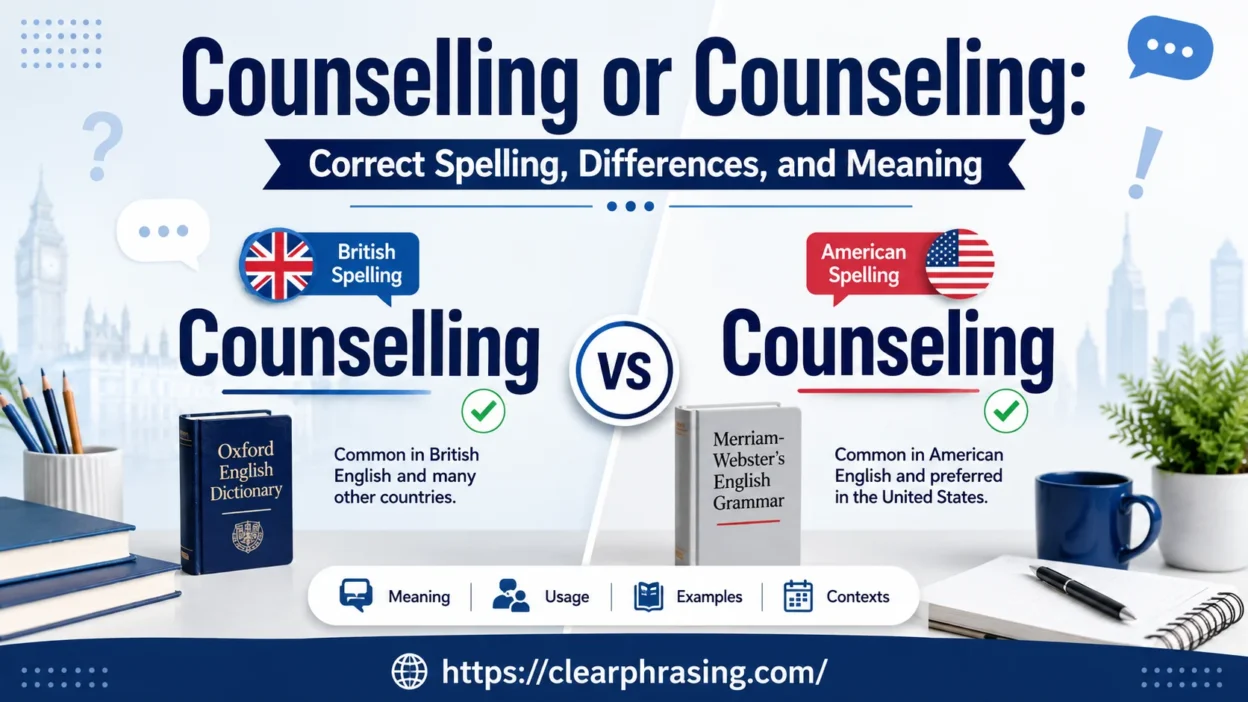
Counselling and Counseling have the same meaning and refer to the same word for offering guidance, advice, and services for psychological issues. The main difference is spelling based on regions. Counseling is used in American English, while counselling is common in British English. These regional spelling choices reflect language evolution, cultural identity, and different English conventions.
As an English teacher and writer, I have seen this confusion in professional article writing. I learned that consistency in writing matters, so I always follow one spelling style. Choosing British spelling or American spelling based on your audience helps you communicate correctly.
Quick Answer
Both “counselling” and “counseling” are correct spellings.
- Counseling is the preferred spelling in American English.
- Counselling is the preferred spelling in British English, Australian English, and most Canadian and New Zealand English.
- The meaning is exactly the same in both forms.
- Choose the spelling that matches your audience and remain consistent throughout your writing.
| Audience | Preferred Spelling |
| United States | Counseling |
| United Kingdom | Counselling |
| Australia | Counselling |
| Canada | Counselling (though Counseling also appears) |
| New Zealand | Counselling |
Understanding the Difference Between Counselling and Counseling
Many English words have different spellings depending on the country. Counselling and counseling belong to that group. They describe the same process of providing professional guidance, emotional support, or expert advice to help someone solve personal, educational, career, or mental health challenges.
The spelling changes because American English and British English follow different conventions when adding suffixes to words ending in L. This isn’t unique to counseling. You’ll notice similar differences in many everyday words.
What Does “Counseling” Mean?
Counseling refers to the process of helping people understand their problems, improve decision-making, and develop practical solutions. A trained professional, often called a counselor, guides clients through emotional, psychological, educational, or career-related concerns.
People commonly seek counseling for:
- Stress management
- Anxiety
- Depression
- Relationship challenges
- Career planning
- Academic decisions
- Family conflicts
- Addiction recovery
- Grief
- Personal growth
Although many people associate counseling only with mental health, it covers much more than therapy. Financial advisors, school counselors, career coaches, rehabilitation specialists, and marriage counselors all provide forms of counseling.
What Does “Counselling” Mean?
Counselling has the exact same definition. The only difference is spelling.
Readers in the United Kingdom, Australia, and several Commonwealth countries expect to see counselling rather than counseling. British dictionaries, universities, hospitals, and government agencies consistently use the double L spelling.
For example:
- Marriage counselling
- Career counselling
- School counselling
- Financial counselling
- Bereavement counselling
Nothing about the meaning changes.
Is There Any Difference in Meaning?
No.
The pronunciation stays the same.
The purpose stays the same.
The professional practice stays the same.
Only the regional spelling changes.
Think of it like these familiar examples:
| American English | British English |
| Color | Colour |
| Favorite | Favourite |
| Organize | Organise |
| Traveling | Travelling |
| Counseling | Counselling |
If your readers are American, counseling looks natural.
If your readers are British, counselling feels correct.
Counselling vs Counseling: The Main Difference
Many writers wonder whether one spelling is more professional than the other. It isn’t. Both spellings appear in respected universities, hospitals, research journals, and government publications. The deciding factor is simply where your audience lives.
American English
American English simplifies many spellings inherited from British English. As a result, counseling uses one L before the -ing ending.
Examples include:
- Mental health counseling
- Family counseling
- School counseling
- Career counseling
- Financial counseling
You’ll see this spelling throughout the United States in:
- Universities
- Hospitals
- Psychology associations
- Government agencies
- Medical journals
British English
British English keeps the doubled L when adding -ing.
Examples include:
- Counselling services
- Marriage counselling
- Bereavement counselling
- Student counselling
- Addiction counselling
This spelling appears throughout:
- England
- Scotland
- Wales
- Australia
- New Zealand
- Ireland
- Many Canadian institutions
Regional Spelling Comparison
| Country | Standard Spelling |
| United States | Counseling |
| United Kingdom | Counselling |
| Australia | Counselling |
| Canada | Counselling (most common) |
| New Zealand | Counselling |
Why Do Americans Spell It “Counseling”?
The answer lies in American spelling reforms.
American English often removes one L when a suffix is added to words ending with an unstressed final syllable. This spelling pattern became widely accepted through dictionaries and educational standards.
Here are several examples.
| American | British |
| Labeled | Labelled |
| Traveled | Travelled |
| Traveling | Travelling |
| Canceled | Cancelled |
| Counseling | Counselling |
Notice the pattern.
American English generally prefers one L, while British English often keeps two.
This doesn’t make either version more correct. It simply reflects two accepted writing systems.
Why Does British English Use “Counselling”?
British English follows a long-standing spelling convention that doubles the final L before adding endings such as -ing, -ed, or -or.
For example:
- Travel → Travelling
- Cancel → Cancelled
- Counsel → Counselling
This convention has remained consistent for generations across British educational systems and publishing standards.
If you’re writing for readers in the United Kingdom, using counselling matches their expectations and looks more natural.
What Is Counseling?
At its core, counseling is a collaborative process that helps individuals better understand themselves and overcome challenges. Rather than giving orders or making decisions for clients, counselors encourage discussion, reflection, and practical problem-solving.
A counseling session may focus on emotions, behavior, relationships, education, careers, finances, or life transitions.
Good counseling often helps people:
- Build confidence
- Improve communication
- Reduce stress
- Solve problems
- Make informed decisions
- Develop healthier habits
- Strengthen relationships
- Cope with major life changes
Modern counseling combines research, communication skills, empathy, and evidence-based techniques to support long-term well-being.
Purpose of Counseling
Every counseling relationship begins with a goal. That goal varies depending on the person’s situation.
Some people seek help after a major loss. Others want guidance before making an important career decision. Students may need academic support, while families might work on improving communication.
Common purposes include:
- Managing anxiety
- Improving emotional resilience
- Setting realistic goals
- Learning coping strategies
- Resolving conflict
- Increasing self-awareness
- Developing healthier relationships
- Planning educational or career paths
Effective counseling doesn’t solve problems for people. Instead, it equips them with the skills and confidence to solve problems independently.
Common Types of Counseling
Counseling exists in many professional settings.
Mental Health Counseling
Mental health counselors help individuals manage emotional and psychological challenges such as anxiety, depression, trauma, and chronic stress.
Marriage Counseling
Couples work with counselors to improve communication, rebuild trust, resolve disagreements, and strengthen relationships.
Family Counseling
Family counseling focuses on improving relationships among family members and resolving ongoing conflicts.
Career Counseling
Career counselors help people explore occupations, identify strengths, prepare resumes, improve interview skills, and make informed career decisions.
School Counseling
School counselors support students academically, socially, and emotionally while helping them prepare for higher education and future careers.
Academic Counseling
Academic counselors guide students in selecting courses, planning graduation requirements, and achieving educational goals.
Financial Counseling
Financial counselors assist individuals with budgeting, debt management, retirement planning, and responsible financial decision-making.
Substance Abuse Counseling
These professionals support people recovering from alcohol or drug addiction by developing treatment plans and relapse prevention strategies.
Grief Counseling
Grief counselors help individuals process loss after the death of a loved one or another significant life change.
Rehabilitation Counseling
Rehabilitation counselors work with individuals living with disabilities or recovering from injuries, helping them achieve greater independence and employment opportunities.
“The best counseling doesn’t tell people what to think. It helps them discover the best path forward for themselves.”
What Does a Counselor Do?
A counselor is a trained professional who helps people understand challenges, develop practical solutions, and improve their overall well-being. Rather than making decisions for clients, counselors encourage self-discovery and provide evidence-based guidance.
Depending on their specialization, counselors may work in schools, hospitals, private practices, rehabilitation centers, community organizations, businesses, or government agencies.
Primary Responsibilities
A counselor’s daily responsibilities may include:
- Listening without judgment
- Assessing a client’s needs
- Creating personalized support plans
- Teaching coping strategies
- Helping clients set realistic goals
- Monitoring progress over time
- Maintaining confidentiality
- Referring clients to other professionals when necessary
Successful counseling depends on trust, empathy, and open communication.
Essential Skills
Professional counselors typically possess:
- Active listening
- Empathy
- Critical thinking
- Problem-solving
- Communication skills
- Patience
- Ethical decision-making
- Cultural awareness
- Emotional intelligence
These skills allow counselors to support people from diverse backgrounds and life experiences.
Professional Qualifications
Requirements vary by country and specialization, but many counselors complete:
- A bachelor’s degree
- A master’s degree in counseling or psychology
- Supervised clinical experience
- Professional licensing or certification
- Continuing education throughout their careers
Healthcare counselors must also meet legal and ethical standards established by regulatory organizations in their country.
Counseling vs Therapy: Are They the Same?
Many people use counseling and therapy interchangeably. While they overlap, they are not always identical.
Counseling often focuses on specific problems, practical solutions, and shorter-term goals. Therapy may explore deeper emotional patterns, trauma, or long-term psychological conditions.
Key Similarities
Both counseling and therapy:
- Improve emotional well-being
- Encourage healthy communication
- Build coping strategies
- Support personal growth
- Maintain client confidentiality
- Use evidence-based techniques
Important Differences
| Feature | Counseling | Therapy |
| Primary Focus | Current challenges | Deeper emotional patterns |
| Duration | Often short to medium term | Frequently long term |
| Common Topics | Career, relationships, stress | Trauma, personality, mental illness |
| Goal | Problem-solving | Long-term emotional healing |
| Typical Providers | Counselors | Psychologists, psychotherapists, licensed therapists |
In reality, the distinction isn’t always clear. Many professionals combine counseling and therapeutic techniques depending on a client’s needs.
How to Use Counseling in a Sentence
When writing for an American audience, use counseling.
Everyday Examples
- She started counseling after changing careers.
- The university offers free counseling for students.
- Professional counseling helped him manage stress.
Professional Examples
- The hospital expanded its mental health counseling services.
- Employees can request confidential career counseling.
- Financial counseling improved their budgeting habits.
Academic Examples
- Researchers studied the effectiveness of online counseling.
- The report examined school counseling programs nationwide.
- Students benefited from academic counseling before graduation.
How to Use Counselling in a Sentence
Use counselling when writing in British English.
British English Examples
- The university provides confidential counselling services.
- She completed a degree in counselling psychology.
- Family counselling strengthened their communication.
Healthcare Examples
- The clinic specializes in grief counselling.
- Addiction counselling supports long-term recovery.
- Early counselling often improves treatment outcomes.
Educational Examples
- Students may request academic counselling before selecting courses.
- School counselling helps children overcome emotional challenges.
- Career counselling prepares graduates for employment.
Common Mistakes Writers Make
Although both spellings are correct, writers frequently make avoidable mistakes.
Mixing American and British Spellings
Don’t switch between counseling and counselling within the same article.
Incorrect
- The clinic offers counseling services and marriage counselling.
Correct (US)
- The clinic offers counseling services and marriage counseling.
Correct (UK)
- The clinic offers counselling services and marriage counselling.
Using the Wrong Regional Version
Always consider your audience.
If you’re writing for Americans, choose counseling.
If your readers are British or Australian, choose counselling.
Assuming One Spelling Is Wrong
This is perhaps the biggest misconception.
Neither spelling is incorrect.
Both appear in respected dictionaries, universities, government publications, and healthcare organizations.
Words Related to Counseling
Understanding related terms helps prevent additional spelling mistakes.
| Word | Meaning |
| Counsel | Advice or guidance |
| Counselor | American spelling for a professional counselor |
| Counsellor | British spelling for a professional counselor |
| Counseled | American past tense |
| Counselled | British past tense |
| Counseling | American noun |
| Counselling | British noun |
Counseling vs Counselling vs Counselor vs Counsellor
The same regional spelling pattern applies to related words.
| Word | American English | British English |
| Counseling | ✔ | Rare |
| Counselling | Rare | ✔ |
| Counselor | ✔ | Rare |
| Counsellor | Rare | ✔ |
| Counseled | ✔ | Rare |
| Counselled | Rare | ✔ |
Once you choose one style, use it consistently throughout your document.
Grammar Rule Behind the Spelling
The spelling difference comes from a well-established rule in English dialects.
American English often drops one L before adding suffixes when the final syllable isn’t stressed.
British English generally doubles the L.
Examples include:
| American | British |
| Traveled | Travelled |
| Traveling | Travelling |
| Labeled | Labelled |
| Canceled | Cancelled |
| Counseling | Counselling |
Learning this pattern helps you recognize similar spelling differences across many English words.
When Should You Use Each Spelling?
- For Academic Writing
Follow the spelling style required by your institution or publisher.
- For Medical Writing
Healthcare organizations usually follow their country’s standard English.
- For Business Writing
Match the spelling used by your company or intended audience.
- For International Audiences
If your audience comes from multiple countries, select one spelling style and apply it throughout the article.
Consistency matters more than the specific version you choose.
Real-World Examples
Many respected organizations demonstrate these spelling differences.
United States
American universities, hospitals, and healthcare providers typically publish:
- Counseling Center
- School Counseling Program
- Career Counseling Services
United Kingdom
British universities and healthcare organizations commonly publish:
- Student Counselling Service
- Counselling and Mental Health
- Bereavement Counselling
Both spellings appear in highly respected institutions because both are correct within their regional standards.
Tips to Remember the Correct Spelling
Remembering the correct version is easier with a few simple tricks.
- One L = United States.
- Two Ls = United Kingdom and most Commonwealth countries.
- Match your audience.
- Stay consistent throughout the document.
- Don’t switch spellings halfway through an article.
Read More: Myself vs My Self: Which Is Correct? Meaning & Grammar Rules
FAQs
What is the difference between counselling and counseling?
The difference between counselling and counseling is only in the spelling. Counselling is the preferred form in British English, while counseling is commonly used in American English. Both words have the same meaning and refer to the process of providing support, advice, and professional guidance.
Is counselling the correct spelling?
Yes, counselling is the correct spelling in British English. Countries such as the UK, Australia, and Canada commonly use this spelling style. However, it is not considered incorrect to use counseling when following American English rules.
Is counseling wrong in British English?
No, counseling is not wrong as a word, but it is less common in British English writing. It follows American spelling conventions, where many words use single consonants instead of double consonants.
Why does counseling have one “l” and counselling has two?
The difference comes from regional spelling rules. British English often keeps the double “l” in words like counselling, while American English simplifies some spellings by using a single “l” as seen in counseling.
Should I use counselling or counseling in academic writing?
You should choose the spelling based on your target audience, institution, or region. If you are writing for an American audience, use counseling. For British-based readers, counselling is usually the better choice.
Do counselling and counseling have different meanings?
No, both terms have the same meaning. They describe professional support that helps people manage personal, emotional, or psychological issues through guidance and communication.
Which spelling should international therapists use?
International therapists should consider their audience and location. Choosing one spelling style and maintaining consistency helps create professional and clear communication.
Is counselling more common worldwide than counseling?
The usage depends on the country. British English-speaking regions often prefer counselling, while the United States and some other areas use counseling more frequently.
Can I use both counselling and counseling in the same document?
It is better to avoid mixing both spellings in one document. Using one consistent spelling style makes your writing look more professional and organized.
How can I remember the difference between counselling and counseling?
A simple way to remember is that counselling with double “l” matches British English, while counseling with one “l” matches American English. Always check your audience before choosing.
Conclusion
Understanding the difference between counselling and counseling helps you make better spelling choices in professional and academic writing. Although the spelling changes between British and American English, the meaning remains the same. The important point is not choosing one as universally correct but using the version that matches your audience and writing purpose.
As an English teacher, I have noticed that many writers focus only on finding the “right” spelling but overlook consistency. A clear writing style builds confidence and improves communication. Once you understand these regional spelling differences, choosing between counselling and counseling becomes simple and natural.

Shamsa Kanwal is an English specialist and content writer at ClearPhrasing.com, where she helps readers navigate the English language with confidence. She enjoys breaking down grammar rules, spelling differences, vocabulary, and everyday writing challenges into simple, practical lessons that anyone can understand.
Her writing is focused on making learning approachable rather than overwhelming. Whether she’s explaining commonly confused words, punctuation rules, or grammar concepts, Shamsa believes that clear explanations and real-life examples are the key to effective learning.
Every article she writes is carefully researched, fact-checked, and edited to ensure it is accurate, easy to read, and genuinely helpful. Her goal is to create trustworthy resources that enable students, professionals, writers, and English learners to improve their communication skills and write with greater clarity.
Through her work at ClearPhrasing.com, Shamsa is committed to making English learning simpler, more practical, and accessible for readers around the world.