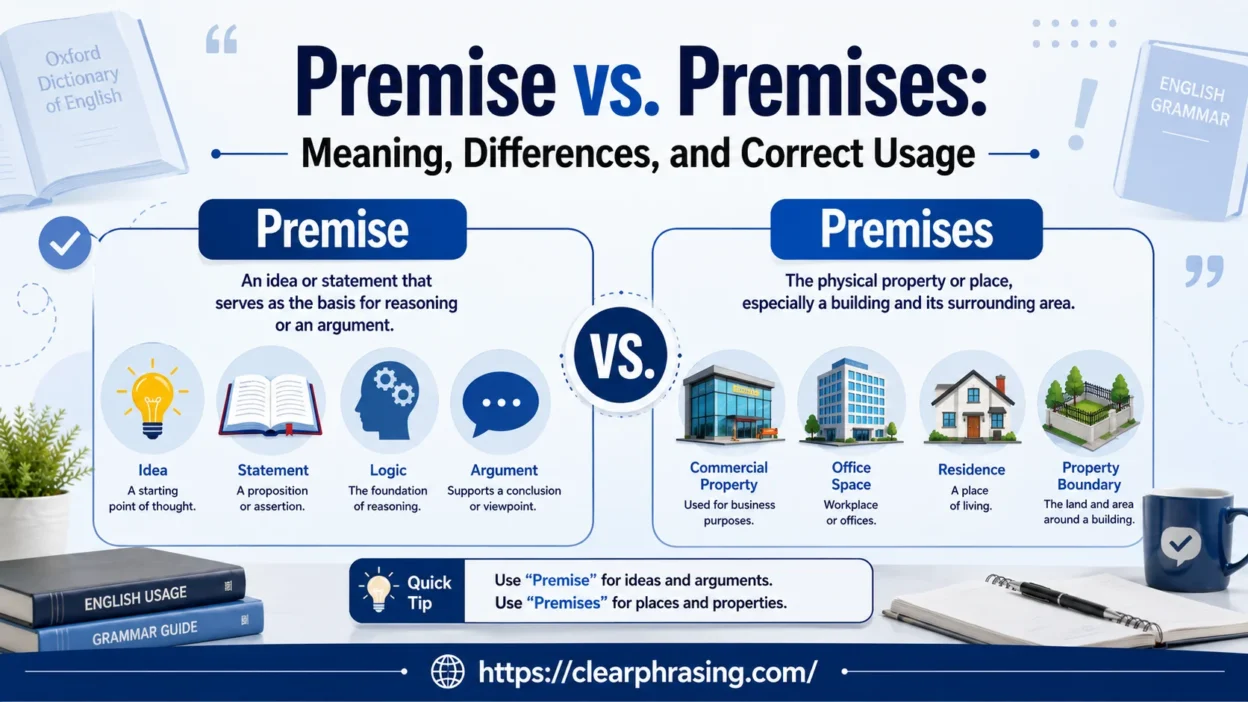
Premise vs. Premises: Meaning, Differences, and Correct Usage explains the difference, meaning, and correct usage of these commonly confused English words.
The premise vs premises pair often confuses English learners because a premise is an *idea, assumption, statement, or starting point for an argument or theory, while premises can be the plural form or refer to a property, building, business, or organization. As an English teacher, I have noticed many students pause mid-sentence, unsure of the right word choice.
Learning the grammar rules, checking the context, and studying examples make the distinction much easier to understand. Reading a book, article, or movie review also helps improve writing, communication, and everyday English language skills.
Quick Answer:
The difference is simple once you understand the context.
| Word | Meaning | Example |
| Premise | A single assumption, idea, or story concept | The novel has an exciting premise. |
| Premises | More than one assumption in logic | The conclusion follows from the premises. |
| Premises | A building, land, or business property | Visitors must remain on the premises. |
Remember this rule:
- Use premise when referring to one assumption or story idea.
- Use premises when referring to multiple assumptions.
- Use premises when referring to property, buildings, or land, even if it is only one location.
What Does “Premise” Mean?
Definition of Premise
A premise is a statement, assumption, or proposition that supports a conclusion. Outside logic, it also refers to the central idea behind a story, book, television show, or film.
Simply put, a premise answers the question:
“What is this argument or story based on?”
Whether you’re reading an academic paper or watching a movie, every strong idea begins with a clear premise.
Origin and Etymology
The word premise comes from the Latin praemissa, meaning things sent before or something stated beforehand.
Originally, the term appeared in legal and philosophical writing before becoming common in literature and everyday English.
Common Uses of Premise
A single premise appears in several situations.
In writing
The premise introduces the central idea before the story develops.
Example:
The movie’s premise involves astronauts discovering life beneath Europa’s frozen surface.
In logic
A premise provides evidence supporting a conclusion.
Example:
- All mammals breathe air.
- Dolphins are mammals.
- Therefore, dolphins breathe air.
The first two statements are premises.
In everyday conversation
People often use premise when discussing ideas or assumptions.
Example:
The entire proposal is based on a flawed premise.
What Does “Premises” Mean?
Premises as the Plural of Premise
When discussing logic, premises is simply the plural form of premise.
Example:
- Every valid argument contains one or more premises.
- The conclusion depends on accurate premises.
Premises as Property or Buildings
This is where many learners become confused.
In legal and business English, premises means a piece of land together with its buildings.
Examples include:
- office premises
- school premises
- factory premises
- hospital premises
- business premises
Although the property may be a single location, English traditionally treats it as premises.
Example:
Smoking is prohibited on these premises.
Why “Premises” Is Grammatically Plural but Refers to One Location
Historically, the legal term referred to everything included in a property description rather than just one building.
That historical usage remains today.
So you would say:
✅ on the premises
❌ on the premise
Premise vs. Premises: The Key Differences
| Feature | Premise | Premises |
| Meaning | One assumption or idea | Multiple assumptions or a property |
| Number | Singular | Plural |
| Common Fields | Writing, philosophy, debate | Logic, law, business, real estate |
| Example | The documentary has a fascinating premise. | Employees cannot leave the premises during emergencies. |
The easiest way to remember the difference is to ask yourself whether you’re discussing an idea or a place.
When to Use “Premise”
In Books, Movies, and Stories
Authors develop stories around a central premise.
Examples:
- A detective who can read memories solves impossible crimes.
- Two strangers wake up in different centuries every morning.
- A city loses gravity for one hour every day.
Each sentence describes a story premise.
In Logical Arguments
Arguments rely on premises to support conclusions.
For example:
- Birds have feathers.
- Penguins are birds.
- Therefore, penguins have feathers.
Without sound premises, even a convincing conclusion becomes weak.
In Academic Writing
Researchers often explain the premise behind an experiment before presenting findings.
Example:
The study begins with the premise that sleep influences memory retention.
Example Sentences
- The novel has an original premise.
- Her argument starts with a false premise.
- The documentary explores an unusual scientific premise.
- Every research project begins with a clear premise.
When to Use “Premises”
Referring to Multiple Assumptions
Some arguments require several premises.
Example:
- All squares have four sides.
- Every rectangle has opposite sides equal.
- Therefore, every square is a rectangle.
These supporting statements are the premises.
Referring to Land, Buildings, or Business Property
Businesses frequently use the word premises.
Examples include:
- company premises
- retail premises
- educational premises
- industrial premises
Example sentence:
Security cameras monitor every entrance to the premises.
Example Sentences
- Visitors must sign in before entering the premises.
- The lawyer inspected the commercial premises.
- Police searched the premises after receiving a warrant.
- The argument depends on accurate premises.
Premise vs. Premises in Logic
What Is a Logical Premise?
A logical premise is a statement accepted as true for the purpose of an argument.
Example:
Every human needs water.
This statement functions as a premise.
What Are Logical Premises?
Complex arguments often require multiple premises.
Example:
Premise 1:
All birds lay eggs.
Premise 2:
Robins are birds.
Conclusion:
Robins lay eggs.
Each supporting statement contributes to the final conclusion.
Deductive vs. Inductive Reasoning
| Deductive Reasoning | Inductive Reasoning |
| Starts with general rules | Starts with observations |
| Leads to certain conclusions if premises are true | Leads to probable conclusions |
| Common in mathematics | Common in science |
Strong reasoning always begins with reliable premises.
Premise vs. Premises in Literature and Creative Writing
What Makes a Strong Story Premise?
An effective premise creates curiosity immediately.
Strong story premises usually include:
- a central conflict
- an interesting character
- meaningful stakes
- a unique situation
For example:
Every midnight, a forgotten language becomes the only language people can speak.
That single idea encourages readers to discover what happens next.
Premise vs. Plot
These terms are related but different.
| Premise | Plot |
| Core idea | Sequence of events |
| Usually one sentence | Entire story |
| Answers “What if?” | Answers “What happens?” |
Premise vs. Theme
A theme expresses the story’s deeper message.
Example:
| Premise | Theme |
| A robot raises a child. | Love makes a family. |
Premise vs. Synopsis
A synopsis summarizes the entire story.
A premise introduces only the central concept.
Premises in Legal, Business, and Real Estate English
Why Contracts Use “Premises”
Legal documents define the property involved in an agreement as the premises.
This wording avoids ambiguity by covering buildings, land, parking areas, and other included spaces.
Meaning of “On the Premises”
This phrase means inside or within the property boundaries.
Examples:
- No pets allowed on the premises.
- Customers must remain on the premises during the inspection.
Meaning of “Off the Premises”
This phrase refers to something occurring outside the property.
Examples:
- Off-premises parking
- Off-premises catering
- Off-premises alcohol sales
Common Business Signs and Notices
You have probably seen these notices:
- No Smoking on the Premises
- CCTV in Operation on These Premises
- Unauthorized Persons Must Leave the Premises
- No Food or Drink Beyond This Point
Common Phrases Using Premise and Premises
| Phrase | Meaning |
| Story premise | Main story idea |
| Basic premise | Fundamental assumption |
| False premise | Incorrect assumption |
| Working premise | Temporary assumption |
| On the premises | Inside a property |
| Off the premises | Outside the property |
| Commercial premises | Business property |
| Residential premises | Housing property |
Premise vs. Premises: Grammar Rules
Singular and Plural Forms
| Form | Correct |
| Singular | Premise |
| Plural | Premises |
Subject-Verb Agreement
Correct:
- The premise is convincing.
- The premises are logically sound.
Is “Premises Is” Ever Correct?
When premises refers to multiple assumptions, use a plural verb.
Example:
The premises are valid.
When premises refers to property, usage varies in legal writing because the noun names a single property. However, in modern standard English, plural agreement is the safest and most widely accepted choice.
Example:
The premises are secured by surveillance cameras.
Why “Premises” Can Refer to One Property
This is a historical legal convention that has survived into modern English.
Think of premises as referring to the entire property and everything included within it.
Common Mistakes and How to Avoid Them
Many learners accidentally mix these words.
Here are the most common errors.
| Incorrect | Correct |
| The movie has an amazing premises. | The movie has an amazing premise. |
| Employees stayed on the premise. | Employees stayed on the premises. |
| His conclusion comes from one premises. | His conclusion comes from one premise. |
| The premise are incorrect. | The premises are incorrect. |
A simple trick is to ask:
Am I talking about an idea or a location?
That question usually reveals the correct choice.
Premise vs. Premises vs. Plot
How They Differ
| Word | Meaning |
| Premise | Central idea |
| Premises | Supporting assumptions or property |
| Plot | Events that unfold throughout the story |
Examples from Fiction
Imagine a science fiction novel.
Premise
Humans discover a planet where time moves backward.
Plot
Scientists explore the world, uncover mysteries, survive conflicts, and ultimately decide whether to stay or return home.
The premise starts the story. The plot tells it.
Premise vs. Assumption vs. Proposition
| Word | Meaning | Best Used For |
| Premise | Foundational statement | Logic and writing |
| Assumption | Accepted belief | Everyday reasoning |
| Proposition | Statement that may be true or false | Formal logic |
Choosing the correct term makes your writing clearer and more precise.
Real-World Examples
Business Example
A manufacturing company posts signs stating:
Safety glasses must be worn on the premises.
Here, premises refers to the factory property.
Academic Example
A philosophy professor explains:
Every conclusion depends upon valid premises.
The discussion focuses on logical reasoning rather than physical property.
Fiction Example
A publisher describes a novel:
Its premise explores what happens when memories become a global currency.
The word refers to the story’s central idea.
Legal Example
A lease agreement states:
The tenant shall maintain the premises in good condition.
The word covers the rented property as defined in the contract.
Memory Tricks to Remember the Difference
Easy Mnemonic for Premise
Think:
One idea = one premise.
Easy Mnemonic for Premises
Think:
Property has many parts, so it uses premises.
Visual Association Technique
Picture a movie poster when you see premise.
Picture a building with a fence when you see premises.
The mental image makes the distinction much easier to remember.
Read More: Counselling or Counseling: Correct Spelling, and Differences
FAQs
What is the difference between premise and premises?
A premise is an idea, assumption, or statement that supports an argument or theory. Premises can be the plural of premise, but the word also refers to a building, property, or business location.
Is premises always the plural of premise?
No. While premises is the plural form of premise, it also has a separate meaning that refers to land, buildings, or property owned or occupied by someone.
When should I use premise?
Use premise when talking about a logical statement, an assumption, the main idea of a story, or the foundation of an argument.
When should I use premises?
Use premises when referring to multiple logical statements or to a physical property, office, school, shop, or business location.
Why do people confuse premise and premises?
They look almost identical, and many learners assume the final -s only makes the word plural. However, premises also has its own separate meaning related to property.
Can premise be used in everyday English?
Yes. It often appears in conversations about books, movies, debates, and academic writing where people discuss ideas or arguments.
What does business premises mean?
Business premises refers to the building, office, store, warehouse, or land where a company operates.
Is premise a noun or a verb?
Premise is mainly used as a noun. Although it can be a verb in formal writing, that usage is uncommon in everyday English.
How can I remember the difference?
Think of premise as an idea and premises as a place. This simple memory trick helps you choose the correct word in most situations.
Which form is more common in formal writing?
Both are common, but they are used in different contexts. Premise is frequent in academic and analytical writing, while premises often appears in legal, business, and property-related documents.
Conclusion
Understanding premise and premises is easier once you focus on the context instead of just the spelling. Although the words differ by only one letter, they describe different ideas in English. Choosing the correct form makes your writing clearer and prevents misunderstandings.
From my experience teaching English, this is one of the easiest grammar points to master with regular practice. Read authentic examples, pay attention to context, and ask yourself whether you are talking about an idea or a place. That simple habit will help you use premise and premises correctly in both speaking and writing.

Ayesha Siddiqa is an English specialist and professional content writer at ClearPhrasing.com. She is passionate about making the English language easy to understand through clear, accurate, and engaging content. Her expertise includes English grammar, spelling, vocabulary, punctuation, word usage, and writing techniques.
At ClearPhrasing.com, Ayesha creates well-researched, reader-friendly articles designed to help students, professionals, writers, and English learners strengthen their language skills. She focuses on providing practical explanations, real-world examples, and up-to-date guidance that readers can confidently apply in everyday communication.
Committed to accuracy and clarity, Ayesha ensures that every article meets high editorial standards and delivers reliable, easy-to-follow information that empowers readers to write and communicate with confidence.