To Funny or Too Funny: Correct Spelling, Meaning, and Usage helps English learners avoid common mistakes with to and too in daily writing.
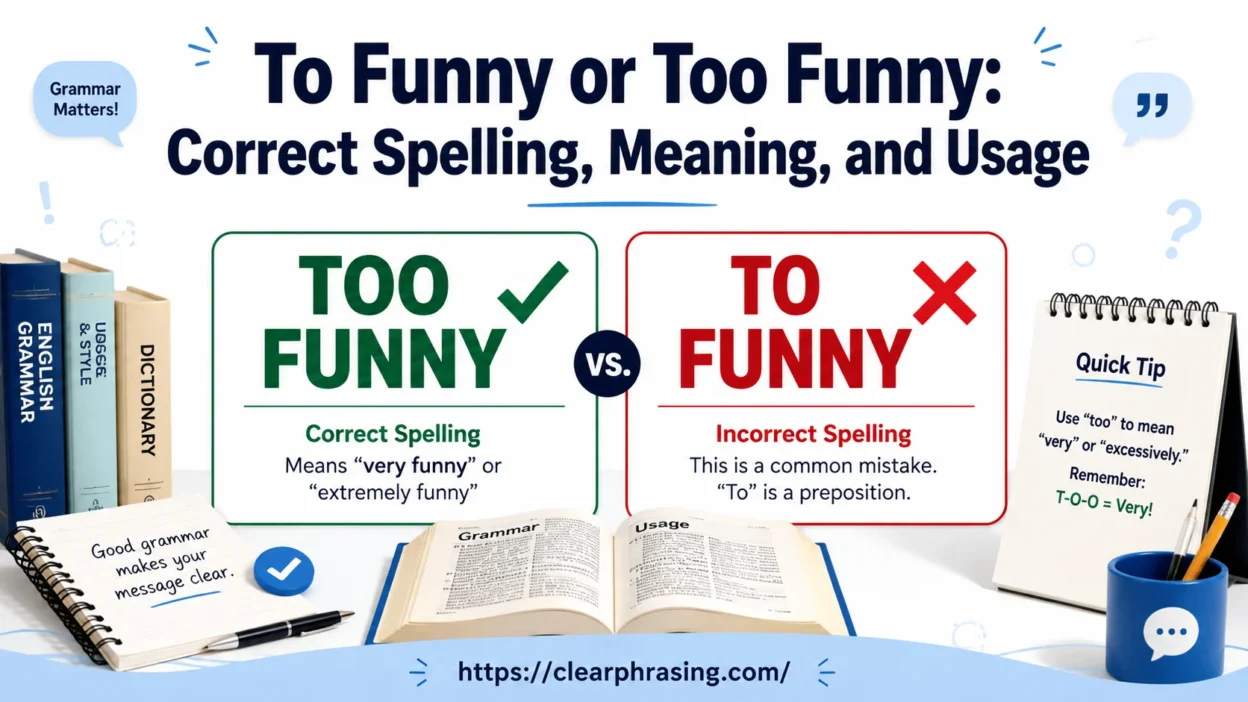
The correct spelling is too funny, while to funny is incorrect because it does not follow English grammar, grammar rules, or spelling rules. Good word choice, proofreading, and editing improve accuracy, clarity, communication, meaning, context, vocabulary, and proper usage. From my teaching experience, regular learning helps students avoid this common typo.
A student, Anastacia from Russia, once asked a question after listening to the All Ears English podcast. I explained that in spoken English and everyday English, funny can mean amusing, hilarious, or even strange, depending on the context clues and interpretation. Always compare different meanings, discover the right context, and learn through English, language learning, and English vocabulary for correct usage.
Quick Answer
The correct phrase is “too funny.”
❌ To funny — Incorrect
✅ Too funny — Correct
Use too before an adjective when you mean very, extremely, or more than expected.
Examples
- That’s too funny.
- Your story is too funny.
- That video was too funny to ignore.
- His joke was too funny, and everyone laughed.
A simple trick is to remember that too has an extra O, which represents something extra. Since too means more than enough or very, the extra letter makes perfect sense.
What Does “Too Funny” Mean?
The expression means that something is extremely funny, very amusing, or so funny that it causes a strong reaction. People often use it when they laugh much harder than expected or find something unexpectedly hilarious.
For example:
- Your imitation was too funny.
- The comedian’s performance was too funny.
- That prank was too funny to forget.
In everyday conversation, the phrase usually expresses excitement rather than suggesting that something is excessively funny in a negative way.
For example, if someone says:
“That’s too funny!”
they usually mean:
- That’s hilarious.
- I can’t stop laughing.
- That’s one of the funniest things I’ve heard today.
Context matters. Sometimes too keeps its original meaning of more than necessary, while in casual speech it often acts as a stronger version of very.
Is “To Funny” Ever Correct?
No.
The phrase “to funny” is grammatically incorrect because to cannot modify an adjective.
Consider these examples.
❌ That movie is to funny.
✅ That movie is too funny.
The mistake happens because people hear the words instead of thinking about their grammatical functions.
The word too is an adverb, and adverbs modify adjectives.
The word to has completely different jobs.
It can:
- Show direction.
- Introduce an infinitive verb.
- Connect parts of a sentence.
For example:
- I walked to the park.
- She wants to dance.
- Give the letter to him.
Notice that to is never used to describe an adjective like funny, happy, large, or expensive.
Whenever you’re describing how funny something is, too is the correct choice.
Too vs. To: What’s the Difference?
Although they sound identical, to and too have different meanings and grammatical roles.
| Word | Part of Speech | Meaning | Example |
| Too | Adverb | Very, excessively, also | That’s too funny. |
| To | Preposition / Infinitive Marker | Shows direction or introduces a verb | I want to laugh. |
Here are a few comparisons.
| Sentence | Correct |
| That’s too funny. | ✅ |
| That’s to funny. | ❌ |
| I want to laugh. | ✅ |
| We drove to school. | ✅ |
| She went to work. | ✅ |
A helpful question to ask yourself is:
Can I replace the word with “very”?
If the answer is yes, then too is probably the correct word.
For example:
That’s very funny.
Since that sentence works, you should write:
That’s too funny.
Why People Write “To Funny”
Even experienced writers occasionally make this mistake. There are several reasons why it happens so often.
They Sound Exactly the Same
English contains many homophones, which are words that sound alike but have different meanings.
Examples include:
- Their, there, they’re
- Your, you’re
- Two, to, too
- Hear, here
Because to and too have identical pronunciation, many people rely on sound rather than grammar when writing.
Typing Too Quickly
Most grammar mistakes happen during fast typing.
When someone writes a text message or social media comment, they often type the first word that comes to mind.
Instead of writing:
That’s too funny.
they accidentally type:
That’s to funny.
The mistake usually goes unnoticed because both words are spelled correctly.
Spell Check Doesn’t Always Catch It
Grammar checkers are helpful, but they aren’t perfect.
Since to is a correctly spelled English word, many spelling programs won’t identify it as an error.
That’s why proofreading remains important.
English Learners Memorize Words First
Many learners study vocabulary before learning sentence structure.
As a result, they recognize both words but don’t always know when each one should be used.
Once they understand the grammar rule, the mistake usually disappears.
How to Use “Too Funny” Correctly
The phrase too funny fits naturally into many situations.
Everyday Conversation
People often use it while talking with friends and family.
Examples include:
- You’re too funny.
- That joke was too funny.
- Your little brother is too funny.
These examples sound relaxed and natural.
Social Media
The expression appears constantly in comments and captions.
Examples include:
- This meme is too funny.
- That video is too funny.
- I can’t stop laughing because this is too funny.
Emails
Although business writing is generally more formal, too funny works well when the conversation is friendly.
For example:
Your presentation included a story that was too funny. Everyone enjoyed it.
Storytelling
Writers frequently use the phrase to describe humorous moments.
Example:
The audience laughed so hard because the ending was too funny.
Using the phrase correctly helps your writing sound natural and fluent.
Examples of “Too Funny” in Sentences
Reading examples is one of the fastest ways to remember grammar rules.
Here are several correct sentences.
- That commercial was too funny.
- The children thought the puppet show was too funny.
- Your story is too funny.
- His reaction was too funny.
- The comedian was too funny last night.
- That scene became too funny to ignore.
- Our teacher told a story that was too funny.
- Everyone agreed the joke was too funny.
- The prank turned out to be too funny.
- Your dog is too funny when he runs.
Notice that every sentence uses too directly before the adjective funny.
That pattern never changes.
Examples of Incorrect “To Funny” Usage
Many mistakes look almost correct because only one letter is wrong.
Incorrect | Correct | Explanation |
| That’s to funny. | That’s too funny. | Too modifies the adjective. |
| You’re to funny. | You’re too funny. | Use the adverb too. |
| It was to funny. | It was too funny. | Too shows degree. |
| This movie is to funny. | This movie is too funny. | To cannot modify adjectives. |
| That joke became to funny. | That joke became too funny. | Too is required before funny. |
Reading your work one final time usually catches these errors before you publish or send your writing.
Common Expressions Using “Too”
Once you understand too funny, you’ll recognize the same grammar pattern in many other expressions.
Some common examples include:
- Too much
- Too many
- Too late
- Too early
- Too expensive
- Too difficult
- Too heavy
- Too loud
- Too bright
- Too slow
- Too hot
- Too cold
- Too busy
- Too funny
In every example, too adds the meaning of more than desired, more than expected, or simply very in casual speech.
The rule stays consistent, making it easy to apply in everyday writing.
Common Mistakes Related to “Too”
Many English learners confuse to, too, and two because they all sound the same. However, each word has a different meaning and grammatical function. Learning the difference will improve both your writing and your confidence.
| Word | Meaning | Example |
| To | Shows direction or introduces a verb | I went to the library. |
| Too | Means also, very, or excessively | That joke was too funny. |
| Two | The number 2 | She owns two dogs. |
Compare these examples:
- I want to eat.
- I ate too much pizza.
- I bought two pizzas.
Although the pronunciation is identical, the meanings are completely different. Taking a second to think about the sentence will help you choose the correct word.
Grammar Rule Behind “Too Funny”
Understanding the grammar makes this rule easy to remember.
In the sentence:
The movie was too funny.
Each word has a specific job.
| Word | Part of Speech |
| The | Article |
| Movie | Noun |
| Was | Verb |
| Too | Adverb |
| Funny | Adjective |
The adjective funny describes the noun movie.
The adverb too modifies the adjective funny by increasing its intensity.
English uses many adverbs before adjectives, including:
- Very funny
- Really funny
- Quite funny
- Extremely funny
- Surprisingly funny
- Incredibly funny
- Too funny
Notice that to never appears in this list because it is not an adverb.
A simple formula is:
Too + Adjective
Examples:
- Too cold
- Too hot
- Too noisy
- Too expensive
- Too funny
Whenever you describe the degree of an adjective, too is the correct choice.
“Too Funny” in American and British English
The phrase too funny is correct in both American English and British English.
There is no difference in spelling or grammar between the two varieties of English.
American speakers often use the phrase in everyday conversation.
For example:
- That’s too funny!
- You’re too funny.
- This video is too funny.
British speakers also understand and use the expression, although they may sometimes choose alternatives such as:
- Really funny
- Absolutely hilarious
- Quite amusing
- Brilliantly funny
Regardless of regional preference, to funny is always incorrect.
Real-Life Examples from Everyday English
Native English speakers use too funny naturally in many situations.
You’ll hear it in:
- Movies
- Television shows
- Podcasts
- YouTube videos
- Social media comments
- Workplace conversations
- Family discussions
- Comedy performances
Examples include:
- That interview was too funny.
- Your comment is too funny.
- The kids thought the magician was too funny.
- This commercial is too funny.
- The ending of the movie was too funny.
These examples sound natural because too correctly modifies the adjective funny.
Synonyms for “Too Funny”
Repeating the same expression can make your writing sound repetitive. Fortunately, English offers plenty of alternatives.
| Expression | Best Used For |
| Hilarious | Everyday writing |
| Extremely funny | Formal writing |
| Absolutely hilarious | Casual conversation |
| Laugh-out-loud funny | Reviews |
| Side-splitting | Entertainment |
| Comical | Literature |
| Humorous | Professional writing |
| Witty | Clever humor |
| Entertaining | General writing |
| Amusing | Neutral tone |
Using different expressions keeps your writing fresh while communicating the same idea.
Memory Tricks to Never Confuse “To” and “Too”
Small memory tricks often work better than memorizing grammar rules.
The Extra “O” Means Extra
The word too has one extra letter.
That extra O reminds you that too means extra, more than enough, or very.
Replace It with “Very”
Ask yourself this question:
Can I replace the word with “very”?
If the answer is yes, use too.
Example:
That’s very funny.
Therefore:
That’s too funny.
Read the Sentence Aloud
Reading aloud helps you notice awkward wording.
Ask yourself whether you’re describing intensity or direction.
If you’re describing intensity, choose too.
Memorize Common Expressions
Practice these phrases until they become automatic.
- Too funny
- Too much
- Too many
- Too expensive
- Too difficult
- Too loud
- Too cold
- Too late
The more often you see them, the easier they become to remember.
Common Situations Where Writers Make This Mistake
People usually make this error during informal writing because they’re focused on speed instead of grammar.
| Situation | Incorrect | Correct |
| Text message | That’s to funny. | That’s too funny. |
| Social media | You’re to funny. | You’re too funny. |
| It was to funny. | It was too funny. | |
| School assignment | The story became to funny. | The story became too funny. |
| Blog comment | This is to funny. | This is too funny. |
A quick proofreading session before publishing or sending your writing will catch nearly all of these mistakes.
Case Study: One Letter Can Change Your First Impression
Imagine two coworkers sending feedback after a company presentation.
Person A writes:
Your presentation was to funny.
Person B writes:
Your presentation was too funny.
Although the difference is only one letter, the second sentence immediately looks more polished and grammatically correct.
Small grammar mistakes rarely change your message, but they can influence how readers perceive your attention to detail. Whether you’re writing an email, a report, or a social media post, using the correct word shows that you care about clear communication.
“Strong writing isn’t about using difficult words. It’s about choosing the right ones.”
Read More: Payed or Paid Off: Correct Spelling, Meaning, and Usage
FAQs
Is too funny the correct phrase in English?
Yes. Too funny is the correct phrase when you mean something is extremely amusing or hilarious. It follows standard English grammar and is widely used in both speech and writing.
Is to funny ever grammatically correct?
No. To funny is not considered correct English. In most cases, it is a spelling mistake, and too funny is the correct form.
What does too funny mean?
Too funny means something is extremely funny or so amusing that it makes people laugh a lot.
Why do people confuse to and too?
People confuse these words because they sound the same. However, they have different meanings and grammatical uses.
Can native English speakers make this mistake?
Yes. Native speakers sometimes type to instead of too, especially when writing quickly or informally.
Is too funny suitable for formal writing?
Yes, it is grammatically correct, but it is more common in casual conversations than in formal or academic writing.
How can I remember the difference between to and too?
Remember that too has an extra “o,” which can remind you that it means “also” or “more than enough.”
Can funny have more than one meaning?
Yes. Funny can mean humorous, but it can also describe something strange, unusual, or suspicious depending on the context.
What are other commonly confused words like to and too?
Other common pairs include your/you’re, their/there/they’re, its/it’s, and then/than.
What is the best way to master to and too?
Practice using them in sentences, read English regularly, and proofread your writing to catch spelling mistakes before sharing your work.
Conclusion
Understanding the difference between to funny and too funny helps you write with greater confidence and accuracy. Since too funny is the only correct expression, remembering this simple rule will prevent a common spelling mistake and improve your English writing.
As an English teacher, I’ve found that students learn this rule much faster when they read real examples and use the phrase in everyday conversations. With regular practice and careful proofreading, choosing the correct form soon becomes second nature.

Ayesha Siddiqa is an English specialist and professional content writer at ClearPhrasing.com. She is passionate about making the English language easy to understand through clear, accurate, and engaging content. Her expertise includes English grammar, spelling, vocabulary, punctuation, word usage, and writing techniques.
At ClearPhrasing.com, Ayesha creates well-researched, reader-friendly articles designed to help students, professionals, writers, and English learners strengthen their language skills. She focuses on providing practical explanations, real-world examples, and up-to-date guidance that readers can confidently apply in everyday communication.
Committed to accuracy and clarity, Ayesha ensures that every article meets high editorial standards and delivers reliable, easy-to-follow information that empowers readers to write and communicate with confidence.