He and I or He and Me: Difference, Usage, and Examples helps you choose he, him, I, and me with clear English grammar rules.
Choosing the right pronoun may seem confusing, but the choice depends on the role in a sentence. The subject pronoun performs the action, while the object pronoun receives it. Good grammar usage, pronoun agreement, sentence structure, communication, speaking, and writing all improve with practice.
In my English class, students often heard different forms and questioned their meaning. I explain that he and I went to the store, but she gave the book to him and me. This quick guide with examples makes the difference easy to understand, improves daily writing, encourages smart word choice, avoids every mistake, and builds confidence in the language. Language Resources also help learners practice.
Quick Answer:
Both forms relate to correct grammar, but they are not interchangeable.
| Phrase | Correct Use | Example |
| He and I | Used when both people perform an action | He and I completed the assignment. |
| Him and me | Used when both people receive an action | The teacher praised him and me. |
Remember this simple rule:
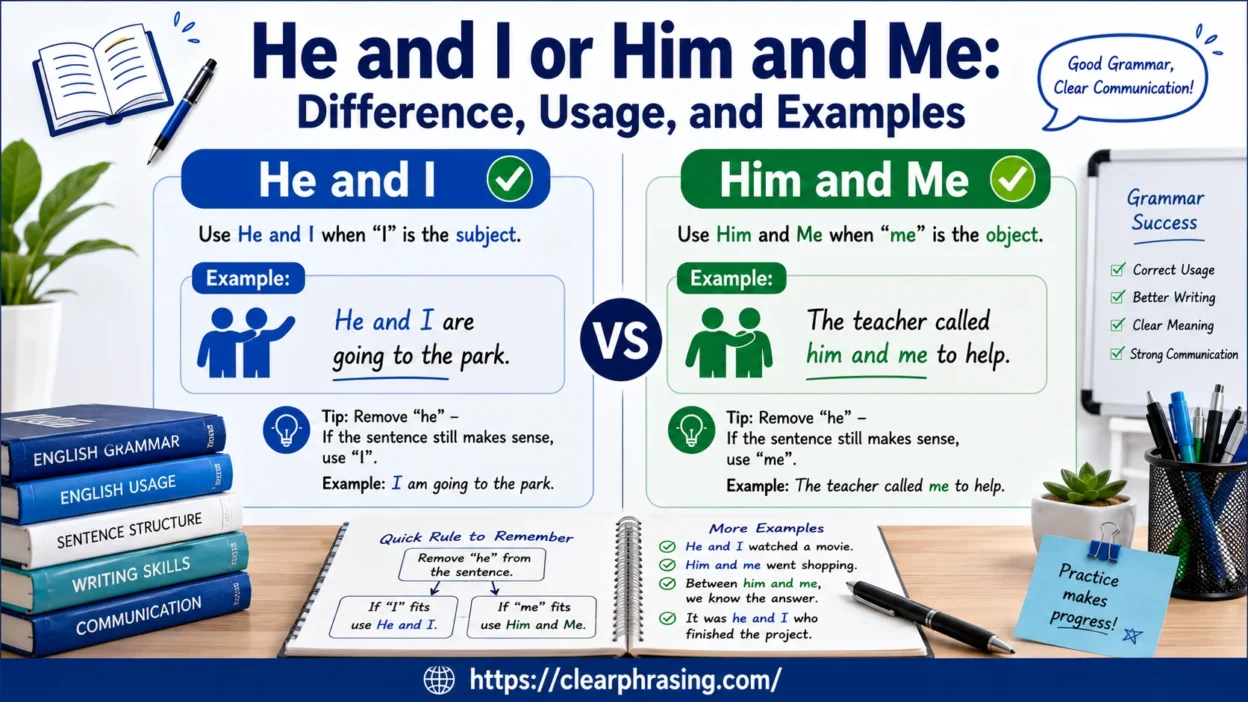
He and I = the people doing something.
Him and me = the people receiving something.
Example:
✅ He and I went to the store.
Remove “he”:
✅ I went to the store.
The sentence still works, so he and I is correct.
Example:
✅ The manager contacted him and me.
Remove “him”:
✅ The manager contacted me.
The sentence still works, so him and me is correct.
Understanding He and I vs. Him and Me Grammar Rules
Pronouns replace nouns and help sentences sound smoother. Instead of repeating names, English uses words like he, him, I, and me.
However, pronouns change depending on their position in a sentence.
Compare:
- John completed the report.
- He completed the report.
Here, he replaces John because John performs the action.
Now look at this:
- The manager called John.
- The manager called him.
Here, him replaces John because John receives the action.
The same rule applies to he and I and him and me.
What Does He and I Mean in English Grammar?
“He and I” contains two subject pronouns. Subject pronouns perform actions in sentences.
Common subject pronouns include:
| Subject Pronoun | Example |
| I | I wrote the article. |
| You | You finished the work. |
| He | He opened the door. |
| She | She answered the question. |
| We | We joined the meeting. |
| They | They completed the project. |
Because he and I are subjects, they can appear together when both people do something.
Examples:
- He and I work in the same office.
- He and I planned the event.
- He and I discussed the problem.
- He and I will attend the conference.
In each example, both people perform the action.
A simple question can help:
Who is doing the action?
If the answer is “he” and “I,” use he and I.
What Does He and Me Mean in English Grammar?
In standard English, “he and me” is usually incorrect because “he” is a subject pronoun while “me” is an object pronoun.
The correct object form is:
him and me
Pronouns change forms when they receive an action.
| Subject Form | Object Form |
| he | him |
| I | me |
Examples:
Subject:
- He and I completed the task.
Object:
- The manager thanked him and me.
You would not say:
❌ The manager thanked he.
❌ The manager thanked I.
You say:
✅ The manager thanked him.
✅ The manager thanked me.
Therefore:
❌ The manager thanked he and me.
✅ The manager thanked him and me.
When to Use He and I Correctly
He and I as the Subject of a Sentence
The most common use of he and I appears when both people perform an action.
Examples:
- He and I started a business.
- He and I traveled together last year.
- He and I solved the problem.
- He and I prepared the presentation.
The phrase comes before the verb because it acts as the subject.
Try removing “he”:
He and I prepared the presentation.
Becomes:
I prepared the presentation.
Since the sentence sounds correct, he and I is the right choice.
He and I After Linking Verbs
Linking verbs such as is, are, was, and were can make pronoun choices confusing.
Examples:
- It was he and I who completed the project.
- It is he and I who made the decision.
Traditional grammar considers these structures correct because the phrase functions as a subject complement.
However, everyday speech often sounds more natural with:
- It was him and me who completed the project.
For formal writing, academic work, and professional communication, understanding the traditional rule helps you choose the appropriate style.
When to Use Him and Me Correctly
Him and Me After Action Verbs
Object pronouns receive actions from verbs.
Examples:
- The company invited him and me.
- The teacher helped him and me.
- The manager selected him and me.
- They contacted him and me yesterday.
The action moves from the subject toward the object.
Example:
The manager contacted him and me.
The manager performed the action.
Him and me received it.
Him and Me After Prepositions
Prepositions always use object pronouns.
Common prepositions include:
- with
- for
- between
- from
- beside
Examples:
- The conversation stayed between him and me.
- She worked with him and me.
- The message was sent to him and me.
- This gift is from him and me.
A very common mistake is:
❌ Between he and I
The correct version is:
✅ Between him and me
The word “between” requires object forms.
Why People Say Him and I Instead of He and I or Him and Me
Many people use “him and I” because they think “I” sounds more educated or formal than “me.”
However, grammar does not depend on which word sounds more impressive. It depends on the job the pronoun performs.
Incorrect:
❌ Him and I went to the meeting.
Correct:
✅ He and I went to the meeting.
Why?
Because they performed the action.
Another example:
Incorrect:
❌ The teacher spoke with him and I.
Correct:
✅ The teacher spoke with him and me.
The phrase follows the preposition “with,” so it needs object pronouns.
Easy Tricks to Remember He and I vs. Him and Me
Remove the Other Person
This is the easiest test.
Example:
He and I completed the project.
Remove “he.”
I completed the project.
Correct.
Example:
The client thanked him and me.
Remove “him.”
The client thanked me.
Correct.
Remember “I Do, Me Receives”
Use this memory trick:
I = I perform the action.
Me = something happens to me.
Examples:
- I called him.
- He called me.
The same idea applies:
- He and I called them.
- They called him and me.
Common Mistakes With He and I and Him and Me
Using Me as a Subject
Incorrect:
❌ Me and John went shopping.
Correct:
✅ John and I went shopping.
The subject performs the action, so use I.
Using I After a Preposition
Incorrect:
❌ The secret is between him and I.
Correct:
✅ The secret is between him and me.
“Between” requires an object.
Using He Instead of Him as an Object
Incorrect:
❌ The company invited he and me.
Correct:
✅ The company invited him and me.
The verb “invited” affects the object.
Choosing Pronouns Based on Sound
Many people choose pronouns by what sounds natural. However, grammar requires you to look at sentence function.
Ask:
- Who performs the action?
- Who receives the action?
The answer usually reveals the correct pronoun.
He and I vs. Him and Me Comparison Table
| Feature | He and I | Him and Me |
| Pronoun type | Subject pronouns | Object pronouns |
| Sentence role | Performs action | Receives action |
| Position | Usually before the verb | After verbs or prepositions |
| Example | He and I agreed. | She called him and me. |
Real-Life Examples of He and I vs. Him and Me
Workplace Examples
Correct:
- He and I created the marketing plan.
- The client emailed him and me.
Incorrect:
- Him and I created the marketing plan.
- The client emailed he and I.
Social Examples
Correct:
- He and I watched a movie.
- They invited him and me to dinner.
Incorrect:
- Me and him watched a movie.
- They invited he and I to dinner.
Academic Examples
Correct:
- He and I studied for the exam.
- The professor contacted him and me.
Correct pronoun use makes your communication sound more polished and professional.
Personal Experience: Why Students Confuse He and I and Him and Me
Many learners struggle with these pronouns because they focus on memorizing sentences instead of understanding grammar roles. They often believe that “I” sounds more formal, so they replace “me” with “I” even when the sentence requires an object pronoun.
The easiest solution is learning the difference between subjects and objects. Once you understand that subjects perform actions and objects receive actions, these choices become much clearer.
Read More: Response or Respond: Difference, Meaning, and Examples
FAQs
Is “He and I” always grammatically correct?
No. “He and I” is correct only when both people are the subject of the sentence and perform the action. For example, “He and I are working on the project.”
If the phrase receives the action instead, use “him and me.” Saying “She invited him and me” is correct because both pronouns are objects.
When should I use “him and me” instead of “he and I”?
Use “him and me” whenever the phrase acts as the object of a verb or preposition. It receives the action instead of performing it.
A quick test is to remove the other person. If you would naturally say “She called me,” then “She called him and me” is also correct.
Why do people often say “he and I” even when it’s wrong?
Many people learn that “he and I” sounds more formal, so they use it in every situation. This habit is called hypercorrection.
Understanding the role of the pronoun in the sentence is more important than trying to sound formal.
How can I quickly check which form is correct?
Remove the other person’s name or pronoun and read the sentence again. If “I” sounds correct, use “he and I.” If “me” sounds right, use “him and me.”
This simple trick works in most everyday conversations and writing situations.
Is “me and him” grammatically wrong?
Not always. The pronouns themselves are correct when they function as objects, but many style guides prefer “him and me” instead of “me and him.”
In casual speech, people may say either form, but formal writing usually follows the standard order.
Can I use these rules in formal writing?
Yes. These subject and object pronoun rules apply to essays, business emails, academic papers, and professional communication.
Using the correct form makes your writing clearer and shows strong grammar skills.
Do native English speakers make this mistake?
Yes. Even native speakers frequently confuse “he and I” and “him and me,” especially in casual conversation.
Because the phrases sound similar, many people rely on habit instead of grammar rules.
Does punctuation affect whether I use “he and I” or “him and me”?
No. Commas, periods, and other punctuation marks do not change which pronoun is correct.
Only the grammatical role of the phrase in the sentence determines whether you should use “he and I” or “him and me.”
Are these rules the same in American and British English?
Yes. Both American English and British English follow the same grammatical rule for subject and object pronouns.
You may notice small style differences, but the correct choice between “he and I” and “him and me” remains the same.
What is the easiest way to remember the difference?
Think about who is doing the action. If you are performing it, use “he and I.” If the action happens to you, use “him and me.”
With a little practice, the correct choice becomes natural in both speaking and writing.
Conclusion
Choosing between “he and I” and “him and me” becomes much easier once you understand the difference between a subject and an object. Instead of memorizing phrases, focus on the role each pronoun plays in the sentence. A simple test removing the other person from the sentence can help you find the correct answer in seconds.
From years of teaching English, I’ve found that this small grammar point causes confusion for learners of every level. The good news is that regular practice with real examples quickly builds confidence. Once you master this rule, your speaking and writing will sound clearer, more natural, and grammatically correct.

Shamsa Kanwal is an English specialist and content writer at ClearPhrasing.com, where she helps readers navigate the English language with confidence. She enjoys breaking down grammar rules, spelling differences, vocabulary, and everyday writing challenges into simple, practical lessons that anyone can understand.
Her writing is focused on making learning approachable rather than overwhelming. Whether she’s explaining commonly confused words, punctuation rules, or grammar concepts, Shamsa believes that clear explanations and real-life examples are the key to effective learning.
Every article she writes is carefully researched, fact-checked, and edited to ensure it is accurate, easy to read, and genuinely helpful. Her goal is to create trustworthy resources that enable students, professionals, writers, and English learners to improve their communication skills and write with greater clarity.
Through her work at ClearPhrasing.com, Shamsa is committed to making English learning simpler, more practical, and accessible for readers around the world.