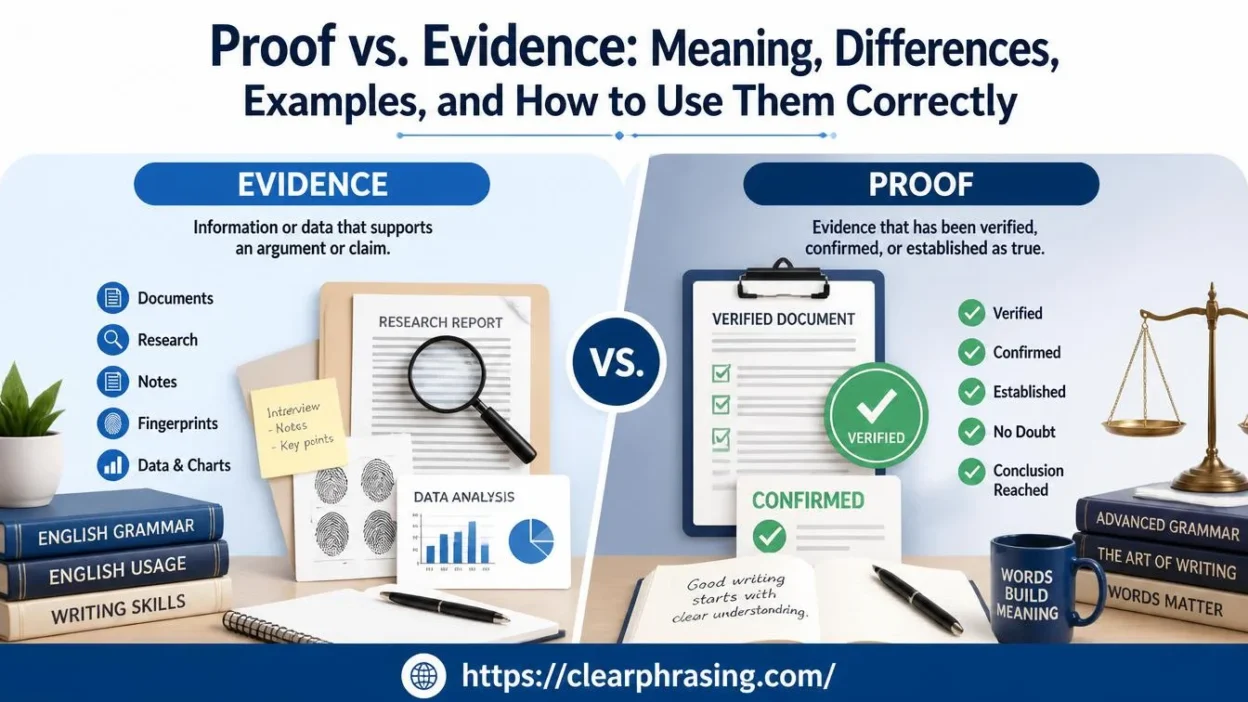
Proof vs. Evidence: Meaning, Differences, Examples explains the definition, evidence meaning, and proof meaning in common language and legal terminology.
Although they seem interchangeable in ordinary speech, their relationship is different. Evidence includes information, facts, documentation, testimony, documentary evidence, and other material used to establish the truth. When enough reliable evidence comes together, it can produce proof and remove doubt.
In law, evidence collection, evidence evaluation, and the burden of proof guide every trial, court proceedings, and judgment. Lawyers, judges, and witnesses examine documents, claims, and legal evidence to determine facts under the legal standard. From my teaching experience, comparing evidence and proof is like putting a puzzle together. Every piece matters before a court reaches a court decision based on credible evidence and conclusive proof.
Quick Answer:
The main difference between proof and evidence is the level of certainty they provide.
| Word | Meaning | Main Purpose |
| Proof | Something that confirms a fact or shows something is true | Establishes certainty |
| Evidence | Facts, information, or objects that support a claim | Provides support or reasons |
Simple rule to remember:
- Evidence helps you believe something is true.
- Proof shows that something is true.
For example:
- A photograph showing someone at a location is evidence that they were there.
- A signed legal document confirming an agreement can be proof of that agreement.
Evidence can be questioned, examined, or interpreted. Proof usually leaves little room for doubt.
What Does Proof Mean?
Proof means information or evidence that completely establishes the truth of something. It provides a final confirmation rather than just suggesting that something might be true.
The meaning of proof depends on the context. In mathematics, proof follows strict rules and demonstrates that a statement must be correct. In everyday situations, proof often means something that confirms a claim.
For example:
- A receipt is proof that you bought an item.
- A passport stamp is proof that you traveled to a country.
- A mathematical proof shows why a formula works.
Proof answers the question: “Can we confirm this beyond doubt?”
Examples of Proof in Sentences
Here are some examples showing how people use proof correctly:
- “The security footage provided proof that the employee arrived on time.”
- “Scientists need more than one observation before they consider something proven.”
- “Her bank statement was proof of the payment.”
In each example, proof confirms or verifies something.
What Does Evidence Mean?
Evidence refers to facts, information, objects, or observations that help support an opinion, argument, or conclusion.
Evidence does not always provide complete certainty. Instead, it gives people reasons to accept an idea as likely true.
For example, a scientist collecting temperature records, satellite images, and research data gathers evidence to support a scientific explanation. That evidence becomes stronger as more reliable information supports the same conclusion.
Evidence answers the question:
“What information supports this idea?”
Examples of Evidence in Sentences
- “The researcher collected evidence from several studies.”
- “The lawyer presented evidence during the trial.”
- “Dark clouds were evidence that a storm might arrive soon.”
The evidence gives clues, but additional information may still be needed.
Types of Evidence
Evidence appears in many forms. Different fields use different types of evidence depending on their goals.
| Type of Evidence | Meaning | Example |
| Direct evidence | Information that clearly shows a fact | Video recording of an event |
| Indirect evidence | Information that suggests a conclusion | Fingerprints found at a location |
| Physical evidence | Tangible objects that support a claim | Documents, tools, DNA samples |
| Scientific evidence | Data collected through research and testing | Laboratory results |
| Digital evidence | Information stored electronically | Emails, computer files, online records |
Each type of evidence has different strengths. A video recording may provide stronger evidence than a rumor, but experts still evaluate whether the information is reliable.
Proof vs. Evidence: Key Differences Explained
The easiest way to understand proof vs. evidence is to look at their purpose.
Evidence builds an argument. Proof completes it.
Imagine putting together a puzzle. Each puzzle piece represents evidence. One piece gives you information, but it does not show the entire picture. Once all the pieces fit together, you can clearly see the final image. That complete picture is similar to proof.
| Difference | Proof | Evidence |
| Purpose | Confirms something | Supports something |
| Certainty | Usually complete | Can vary in strength |
| Common use | Mathematics, confirmation, verification | Law, science, research |
| Question answered | “Is this definitely true?” | “Why might this be true?” |
| Can it be challenged? | Usually harder to challenge | Often examined and debated |
Proof vs. Evidence in Law
The legal world provides one of the clearest examples of the difference between proof and evidence.
Lawyers usually talk about evidence, not proof. Courts examine evidence and decide whether it is strong enough to support a conclusion.
Examples of legal evidence include:
- Witness statements
- Security recordings
- Documents
- DNA samples
- Financial records
- Digital messages
A lawyer does not simply say, “I have proof.” Instead, they present evidence and allow the court to determine whether that evidence proves the claim.
Case Study: Evidence in a Criminal Investigation
Imagine investigators discover fingerprints at a crime scene.
The fingerprints are evidence because they suggest a connection between a person and the location.
However, fingerprints alone may not prove exactly what happened. Investigators may need additional evidence, such as video footage, witness accounts, or other records.
Together, multiple pieces of evidence can create a stronger case.
Proof vs. Evidence in Science
Science usually depends on evidence, not absolute proof.
Scientists collect observations, perform experiments, analyze results, and compare findings. A scientific idea becomes more accepted when large amounts of reliable evidence support it.
For example:
- Scientists use temperature measurements, ice core samples, and climate models as evidence when studying climate change.
- Medical researchers use clinical trial results as evidence when evaluating treatments.
Scientific evidence must be:
- Reliable
- Repeatable
- Based on careful observation
- Supported by data
Unlike mathematics, science often deals with changing information. New evidence can improve or update scientific understanding.
Proof vs. Evidence in Everyday Life
You use proof and evidence every day without realizing it.
Consider these situations:
| Situation | Evidence | Proof |
| Buying something online | Order confirmation email | Official receipt |
| Arriving somewhere | Location photo | Verified travel record |
| Completing work | Draft documents | Final signed approval |
| Learning a fact | Articles and sources | Confirmed information |
The difference depends on how much certainty the information provides.
Common Mistakes When Using Proof and Evidence
Many English learners confuse these words because their meanings overlap. Here are common mistakes and corrections.
Mistake: Using Proof When You Mean Evidence
Incorrect:
“Scientists found proof after one small experiment.”
Better:
“Scientists found evidence after one small experiment.”
Why?
A single experiment usually provides evidence. Scientists need repeated research before making stronger conclusions.
Mistake: Saying “An Evidence”
Many learners incorrectly use evidence as a countable noun.
Incorrect:
“I found an evidence.”
Correct:
“I found evidence.”
The word evidence is usually uncountable.
You can say:
- “A piece of evidence”
- “Several pieces of evidence”
- “Some evidence”
Mistake: Assuming Evidence Always Proves Something
Evidence does not automatically equal proof.
For example:
A person sees dark clouds and says rain will come. The clouds are evidence of possible rain, but they do not prove rain will definitely happen.
Proof vs. Evidence: Grammar and Usage Rules
Is Proof Countable?
The word proof can be both countable and uncountable depending on meaning.
Uncountable use:
- “There is no proof that the rumor is true.”
Countable use:
- “The mathematician presented a proof of the theory.”
In mathematics, a proof means a specific logical explanation.
Is Evidence Countable?
Evidence is generally uncountable.
Correct:
- “The police collected evidence.”
- “The researcher found strong evidence.”
Incorrect:
- “The police collected an evidence.”
If you want to count evidence, use:
- “A piece of evidence”
- “Two pieces of evidence”
Memory Trick for Proof vs. Evidence
Remember this simple phrase:
Evidence explains. Proof confirms.
Another way:
- Evidence is the path leading to the answer.
- Proof is reaching the final destination.
When you have information that points toward something, think evidence. When you have confirmation that removes doubt, think proof.
Read More: To Funny or Too Funny: Correct Spelling, Meaning, and Usage
Real-Life Examples of Proof vs. Evidence
| Situation | Evidence | Proof |
| A missing package | Delivery photo, tracking updates | Confirmed delivery record |
| A student’s research | Books, studies, articles | Verified conclusion |
| A payment dispute | Bank messages, emails | Official transaction record |
| A scientific discovery | Experimental results | Established conclusion after verification |
FAQs
What is the main difference between proof and evidence?
Evidence is the information, facts, or materials used to support a claim, while proof is the final level of certainty created when evidence becomes strong enough to establish something as true.
Can evidence exist without proof?
Yes, evidence can exist without proof. A person may have documents, statements, or facts, but they may not be strong enough to completely prove a claim.
Is proof stronger than evidence?
Yes, proof is generally considered stronger because it represents evidence that has successfully established a fact with a high level of certainty.
Why do people confuse proof and evidence?
People often confuse these words because they are used interchangeably in everyday conversations. However, legal and academic contexts treat them differently.
What are examples of evidence?
Examples of evidence include photographs, documents, witness testimony, records, data, and physical objects that help support an argument or investigation.
What are examples of proof?
Proof can include strong evidence that conclusively establishes a fact, such as verified records, reliable testimony, or evidence accepted by a court.
Does a court use proof or evidence?
Courts use evidence during legal proceedings. Judges evaluate that evidence to decide whether a party has met the required standard of proof.
Can one piece of evidence become proof?
Yes, a single piece of evidence can sometimes become proof if it is reliable, relevant, and strong enough to establish the required fact.
Why is evidence important in legal cases?
Evidence allows courts to examine facts objectively. Without evidence, decisions could depend on assumptions, opinions, or unsupported claims.
How can understanding proof and evidence improve writing?
Knowing the difference helps writers choose accurate words, build stronger arguments, and present information in a clearer and more convincing way.
Conclusion
Understanding the difference between proof and evidence helps you communicate more clearly in both everyday and legal situations. Evidence provides the information, facts, and details needed to support a claim, while proof represents the stronger result that comes after evidence successfully establishes certainty. Whether you are studying law, writing an argument, or improving your English usage, knowing how these terms work together prevents confusion and improves accuracy.
From my experience teaching English and explaining complex terms, I have found that people often remember concepts better when they connect them with simple examples. Think of evidence as individual puzzle pieces and proof as the completed picture. When each piece fits correctly, the final understanding becomes stronger, clearer, and more convincing.

Shamsa Kanwal is an English specialist and content writer at ClearPhrasing.com, where she helps readers navigate the English language with confidence. She enjoys breaking down grammar rules, spelling differences, vocabulary, and everyday writing challenges into simple, practical lessons that anyone can understand.
Her writing is focused on making learning approachable rather than overwhelming. Whether she’s explaining commonly confused words, punctuation rules, or grammar concepts, Shamsa believes that clear explanations and real-life examples are the key to effective learning.
Every article she writes is carefully researched, fact-checked, and edited to ensure it is accurate, easy to read, and genuinely helpful. Her goal is to create trustworthy resources that enable students, professionals, writers, and English learners to improve their communication skills and write with greater clarity.
Through her work at ClearPhrasing.com, Shamsa is committed to making English learning simpler, more practical, and accessible for readers around the world.