Response or Respond: Difference, Meaning, and Examples explains why many English learners and fluent writers stumble over these words.
They look and sound similar, but each has a different role in grammar and communication. From my teaching experience, following one simple rule builds confidence, improves clarity, and helps people write better in emails, essays, and everyday conversation.
This guide uses plain language, examples, tables, and real scenarios to explain the difference. Whether you are replying, describing a reaction, or giving a response, choosing the correct noun or verb makes your writing stronger. With regular practice, you will understand, apply, and remember the correct term every time.
Quick Answer:
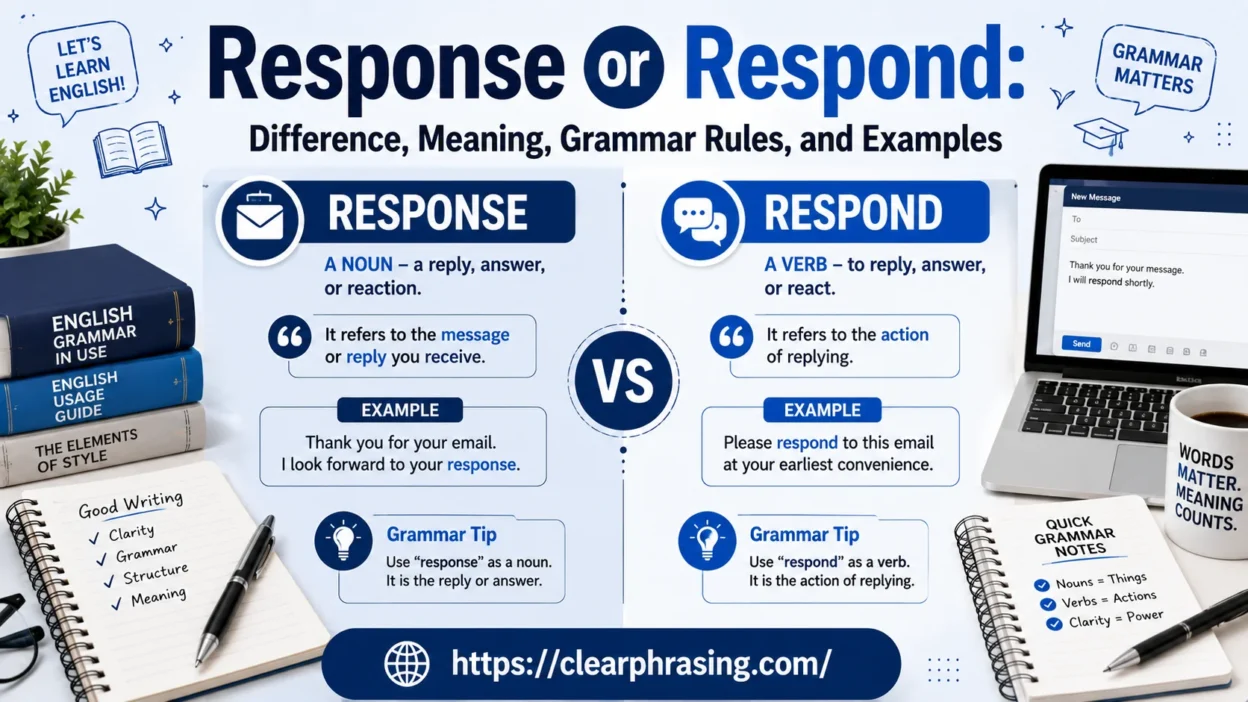
Response and respond are both correct words, but they have different grammatical roles.
| Word | Part of Speech | Meaning | Example |
| Response | Noun | An answer, reply, or reaction | “I received your response yesterday.” |
| Respond | Verb | To answer, reply, or react | “I will respond to your message soon.” |
A simple memory trick:
- Use response when you are talking about the answer itself.
- Use respond when you are talking about the action of answering.
Examples:
✅ “Thank you for your response.”
(You are thanking someone for the answer.)
✅ “Please respond to my email.”
(You are asking someone to take action.)
Response or Respond: Understanding the Basic Difference
The biggest difference between response and respond comes from grammar.
A response is a thing. It is something you receive, give, write, or wait for.
A respond is an action. It is something you do.
Think of it like this:
- A response is the message inside an envelope.
- To respond is the act of sending that envelope.
The words belong to the same family, but they perform different jobs.
| Sentence | Correct Word | Reason |
| I am waiting for your ___ | Response | You need a noun. |
| Please ___ before Friday | Respond | You need a verb. |
| Her ___ was surprising | Response | It describes an answer or reaction. |
| She didn’t ___ to my question | Respond | It describes an action. |
Understanding this small difference prevents many common English mistakes.
What Does Response Mean?
Response means an answer, reaction, or reply that happens because of something someone says, asks, or does.
It is a noun, which means you can usually place words like a, an, the, my, your, his, her, their before it.
Examples:
- “The customer’s response was positive.”
- “I appreciate your quick response.”
- “The team studied the patient’s response to the treatment.”
A response does not always have to be spoken. It can also be written, emotional, physical, or scientific.
Different Uses of Response in English
Response in Everyday Conversations
In daily communication, response refers to the answer someone gives after receiving information.
Examples:
- “I asked him a question, but I didn’t get a response.”
- “Her response made everyone laugh.”
- “His response showed that he understood the problem.”
A response can be short or detailed.
For example:
A person asking, “Are you coming tonight?”
Possible responses:
- “Yes.”
- “No, I’m busy.”
- “I’ll let you know later.”
All of these are responses.
Response in Professional Communication
In workplaces, response is commonly used in emails, meetings, customer service, and official documents.
Examples:
- “We are waiting for your response regarding the proposal.”
- “The company issued a response to customer complaints.”
- “Thank you for your response to our request.”
Professional writing often uses response because it sounds formal and clear.
Response as a Reaction
Sometimes response does not mean an answer. It can mean a reaction to something.
Examples:
- “The audience’s response was amazing.”
- “The body’s response to exercise changes over time.”
- “The emergency team had a quick response.”
In these sentences, response describes how someone or something reacts.
What Does Respond Mean?
Respond means to answer, react, or reply to something.
Unlike response, it is a verb because it shows an action.
Examples:
- “Please respond to my question.”
- “She responded politely.”
- “The company responded to the complaint.”
The word usually appears after subjects such as:
- I respond
- You respond
- They respond
- He responds
- She responded
Common Uses of Respond in English
Respond to a Question
When someone answers a question, they respond.
Examples:
- “The student responded correctly.”
- “She responded to the teacher’s question.”
- “He didn’t respond when I called his name.”
Respond to Messages and Emails
Modern communication often uses respond when talking about digital conversations.
Examples:
- “Please respond to this email.”
- “I’ll respond to your message later.”
- “Why haven’t you responded yet?”
This usage is common in business and personal communication.
Respond Emotionally or Physically
Respond can also describe reactions.
Examples:
- “The crowd responded with excitement.”
- “Children often respond differently to change.”
- “The patient responded well to the medicine.”
Here, respond describes a reaction rather than a simple answer.
Response vs Respond Grammar Rules
Learning a few grammar patterns makes choosing the correct word easier.
Use Response After Possessive Words
Words like my, your, his, her, our, their usually come before nouns.
Examples:
✅ “I appreciate your response.”
❌ “I appreciate your respond.”
✅ “Her response was honest.”
❌ “Her respond was honest.”
Use Respond After “To”
The phrase respond to is extremely common.
Examples:
✅ “I need to respond to this email.”
✅ “She responded to my question.”
Do not replace respond with response in these structures.
Incorrect:
❌ “I need to response to this email.”
Correct:
✅ “I need to respond to this email.”
Response or Respond Examples in Real Sentences
| Incorrect Sentence | Correct Sentence | Explanation |
| Please response quickly. | Please respond quickly. | An action requires a verb. |
| Thank you for your respond. | Thank you for your response. | After “your,” use a noun. |
| I received his respond yesterday. | I received his response yesterday. | A received item is a response. |
| She didn’t response to me. | She didn’t respond to me. | The sentence needs an action word. |
Common Mistakes When Using Response and Respond
Many English learners make mistakes with these words because they focus on meaning but ignore grammar.
Mistake: Using Response as a Verb
Incorrect:
“Please response to my request.”
Why it is wrong:
Response cannot describe an action. It is a noun.
Correct:
“Please respond to my request.”
Mistake: Using Respond as a Noun
Incorrect:
“I am waiting for your respond.”
Why it is wrong:
The sentence needs a thing that you are waiting for.
Correct:
“I am waiting for your response.”
Mistake: Confusing Response With Reply
Although response and reply are similar, they are not always interchangeable.
A reply usually means answering someone directly.
A response has a broader meaning. It can include answers, reactions, or results.
Compare:
- “She replied to my text.”
- “His response to the situation was calm.”
The first example focuses on communication. The second focuses on reaction.
Response or Respond in Formal Writing
Using the correct word matters in professional and academic writing.
A small grammar mistake can make your message appear less polished.
Common professional examples:
Emails
Correct:
“Thank you for your response. We will review the information.”
Correct:
“Please respond by Monday.”
Business Communication
Correct:
“We appreciate your response regarding this issue.”
Correct:
“Our team will respond within 24 hours.”
Academic Writing
Correct:
“The study examined participants’ responses to different questions.”
Correct:
“Researchers observed how students responded to the new method.”
Word Family: Respond, Response, Responsive, Responsibility
Understanding related words improves vocabulary.
| Word | Meaning | Example |
| Respond | To answer or react | “She responded quickly.” |
| Response | An answer or reaction | “His response was helpful.” |
| Responsive | Reacting quickly | “The website is responsive.” |
| Responsibility | A duty or obligation | “It is your responsibility.” |
These words come from the same Latin root related to answering or reacting.
Easy Memory Tricks for Response or Respond
Remember: Response Is a Thing
If you can use:
- a response
- the response
- my response
- your response
then you need response.
Example:
“I liked her response.”
Remember: Respond Is an Action
If someone needs to do something, use respond.
Example:
“You should respond soon.”
A helpful pattern:
- “I need your ___.” → response
- “I need you to ___.” → respond
Case Study: Why Correct Word Choice Matters
Imagine a customer service employee writing an email.
Incorrect:
“Thank you for your respond. We will response tomorrow.”
The meaning is understandable, but the grammar sounds incorrect.
Improved:
“Thank you for your response. We will respond tomorrow.”
The second version sounds professional because each word performs the correct grammatical role.
Small grammar choices create a stronger impression.
Read More: Proof vs. Evidence: Meaning, Differences, Examples
FAQs
Is response a noun and respond a verb?
Yes. Response is a noun that means an answer or reaction, while respond is a verb that means to reply or react. Remembering this simple rule will help you avoid one of the most common grammar mistakes.
When should I use respond instead of response?
Use respond when you are talking about an action. For example, “Please respond to my email.” Use response when you mean the answer itself, such as “Her response was helpful.”
Why do people confuse respond and response?
Both words come from the same Latin root, respondere, and they look and sound very similar. Because they are closely related in meaning, many English learners and even experienced writers mix them up.
Can I use response as a verb?
No. Response is only a noun in standard English. If you need an action word, use respond instead.
Are respond and response used in formal writing?
Yes. Both words are common in business emails, academic writing, scientific studies, news articles, and everyday communication. Choosing the correct one makes your writing more professional and precise.
How can I remember the difference easily?
A simple memory trick is that respond ends with -d, reminding you to do something, while response ends with -se, representing the finished answer or result.
Is response always written after a or the?
Not always, but it often follows articles like a, an, or the because it is a noun. For example, “The response was immediate.”
Can respond describe emotional reactions?
Yes. You can respond to emotions, situations, questions, feedback, or emergencies. The verb simply describes the act of reacting or replying.
Which word is more common in everyday English?
Both appear frequently in daily conversations. You usually use respond when asking someone to reply and response when talking about the reply that was given.
Will using the correct word improve my writing?
Absolutely. Using respond and response correctly makes your sentences clearer, more natural, and easier to understand. It also shows a stronger command of English grammar in both formal and informal writing.
Conclusion
Understanding the difference between respond and response is a small grammar lesson that makes a big difference in everyday communication. Although the words share the same origin and are closely connected in meaning, they serve different grammatical purposes. Once you remember that respond is the action and response is the result, choosing the right word becomes much easier. This simple distinction helps you write more accurately and speak with greater confidence.
As an English teacher, I have seen students improve quickly once they stop memorizing rules and start noticing how these words appear in real conversations, emails, books, and articles. Regular practice with examples is the fastest way to build confidence and avoid common mistakes. Over time, using respond and response correctly will become natural, making your English clearer, more professional, and more effective in every situation.

Mariam Asghar is an English specialist and professional content writer at ClearPhrasing.com. She is dedicated to helping readers improve their English through clear, practical, and easy-to-understand content. Her areas of expertise include grammar, spelling, vocabulary, punctuation, sentence structure, and effective writing.
At ClearPhrasing.com, Mariam writes comprehensive, well-researched articles that simplify complex language concepts for students, professionals, writers, and English learners. She believes that strong communication begins with a solid understanding of the English language and strives to make every lesson accessible and engaging.
With a strong commitment to quality, accuracy, and continuous learning, Mariam ensures that each article is carefully researched, thoroughly reviewed, and written to help readers communicate with greater confidence and clarity.