Too Short or To Short: Correct Spelling, Meaning, and Usage explains the correct form and helps English learners avoid a common mistake in English writing.
Use up and down arrow keys to resize the meta box pane.
Many students confuse to short with too short because English grammar has tricky rules and exceptions. As an English teacher, I remind learners that too shows excess or more than desired, while to is a preposition or part of an infinitive verb showing direction or action. Using the correct spelling improves clarity, communication, professional writing, and English usage.
A simple example is a dress that is too short for a formal event or pants that do not reach your ankles. A quick tip is to replace too with overly or excessively. The only rarely correct use of to short appears in financial contexts, where an investor may plan to short a stock. Learning this difference helps you write correctly and avoid embarrassing mistakes.
Quick Answer
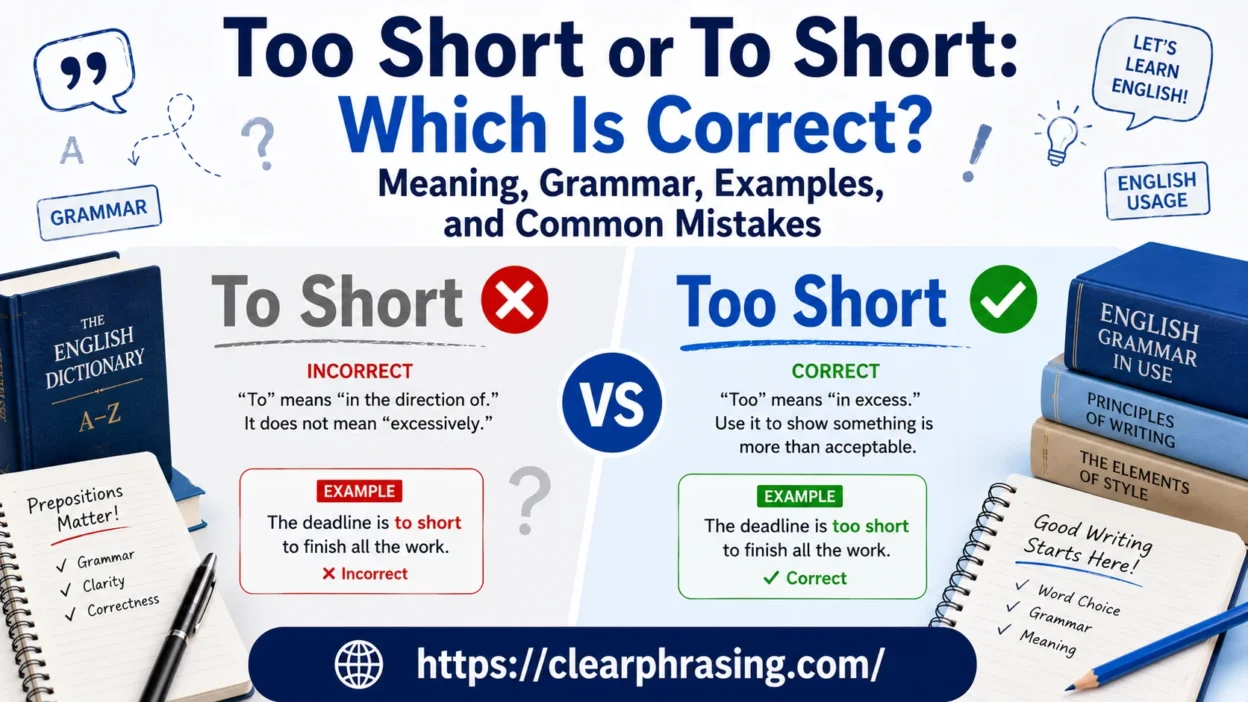
The correct phrase is too short when you mean not long enough, not tall enough, or shorter than desired.
❌ To short — Incorrect
✅ Too short — Correct
Examples:
- The presentation was too short.
- My pants are too short.
- The movie felt too short.
- The meeting was too short to discuss everything.
The word too means excessively or more than needed, while to is usually a preposition or part of an infinitive verb.
Understanding the Difference Between “Too” and “To”
Although these words sound identical, they serve completely different grammatical purposes.
What Does “Too” Mean?
Too is an adverb.
It usually means:
- Excessively
- More than necessary
- Also or as well
Examples:
- The coffee is too hot.
- The room is too small.
- She came too.
- The assignment is too difficult.
When too modifies an adjective, it tells you that something exceeds an acceptable limit.
What Does “To” Mean?
To has two primary functions.
It can act as a preposition.
Examples:
- Go to school.
- Walk to the store.
- Give the book to Sarah.
It can also introduce an infinitive verb.
Examples:
- I want to eat.
- They hope to travel.
- We decided to leave.
Notice that to never means excessively.
Why “Too Short” Is Correct
The phrase too short follows a common English grammar pattern.
Too + adjective
Examples include:
- too big
- too expensive
- too heavy
- too loud
- too slow
- too short
Here, too modifies the adjective short and tells readers that something is shorter than desired.
Consider these examples:
- The dress is too short.
- The speech was too short.
- The ladder is too short.
- My vacation felt too short.
Each sentence expresses excess—not enough length, height, or duration.
Why “To Short” Is Usually Incorrect
Many people accidentally type to short because to and too sound alike.
However, grammar doesn’t depend on pronunciation.
The sentence below is incorrect.
❌ The movie was to short.
The corrected version is:
✅ The movie was too short.
Whenever you’re describing something as insufficient in size, length, height, or duration, too is always the correct word.
Too Short Meaning
The phrase too short simply means something does not meet the required or desired length, height, duration, or size.
Depending on the context, it can describe many different things.
Height
- He’s too short to reach the top shelf.
- The child is too short for the ride.
Length
- The rope is too short.
- This cable is too short to connect the devices.
Time
- Our vacation was too short.
- The interview felt too short.
Clothing
- These jeans are too short.
- My sleeves became too short after washing.
Writing
- The report is too short for a graduate-level assignment.
- Your answer is too short to earn full marks.
Grammar Rule Behind “Too Short”
Learning one simple grammar pattern prevents hundreds of mistakes.
Too + Adjective
Formula:
Too + adjective
Examples:
- too tall
- too cold
- too noisy
- too bright
- too fast
- too short
This pattern appears constantly in spoken and written English.
Too + Adjective + To + Verb
English also uses another common structure.
Too + adjective + to + verb
Examples:
- The box is too heavy to lift.
- The soup is too hot to eat.
- He’s too tired to work.
- She’s too short to reach the shelf.
- The bridge is too narrow to cross safely.
Notice how too comes before the adjective, while to introduces the infinitive verb.
When Can “To” Appear Before “Short”?
This question creates confusion because readers sometimes see to close to the word short.
The key is understanding that to belongs to another part of the sentence.
Infinitive Structures
Examples:
- We need to shorten the meeting.
- They plan to shorten production time.
- Engineers worked to shorten delivery schedules.
Here, to belongs with the verb shorten, not the adjective short.
Prepositional Uses
Sometimes to appears near short because of sentence structure.
Example:
The manager referred to short training sessions during the meeting.
In this sentence, to connects with referred, not with short.
Too Short in Different Contexts
Everyday Conversation
People frequently use too short while discussing clothing, vacations, movies, and daily life.
Examples:
- Your haircut is too short.
- The movie was too short.
- Lunch break was too short.
Academic Writing
Teachers often comment on assignments using this phrase.
Examples:
- The essay is too short.
- Your explanation is too short to support the argument.
Business Communication
Professionals also use it regularly.
Examples:
- The deadline is too short.
- The proposal is too short for executive review.
- The presentation was too short to answer every question.
Emails
Example:
Thank you for your draft. However, the executive summary is too short and needs additional supporting details.
Text Messages
- That concert was too short!
- Our call ended too short for my liking.
Social Media
You’ll often see captions like:
- Life’s too short for negativity.
- Weekends are too short.
- Summer is too short.
Common Mistakes and How to Fix Them
| Incorrect | Correct | Reason |
| To short | Too short | Too means excessively. |
| Life is to short. | Life is too short. | Wrong homophone. |
| My dress is to short. | My dress is too short. | Too modifies the adjective. |
| The speech was to short. | The speech was too short. | Grammar correction. |
| Vacation was to short. | Vacation was too short. | Correct spelling is too. |
Too Short vs Short
These phrases aren’t interchangeable.
| Short | Too Short |
| Simply describes length. | Shows insufficient length. |
| Neutral description. | Negative evaluation. |
| Doesn’t imply a problem. | Suggests a problem exists. |
Compare these sentences:
- The bridge is short.
- The bridge is too short for large trucks.
The second sentence indicates a limitation.
Too Short vs Very Short
Many learners assume these phrases mean the same thing.
They don’t.
| Very Short | Too Short |
| Describes degree. | Describes excess or inadequacy. |
| Neutral observation. | Indicates something isn’t sufficient. |
Example:
- The meeting was very short.
- The meeting was too short to discuss the budget.
The first sentence simply describes duration.
The second explains that the duration created a problem.
Too Short vs Not Long Enough
Both expressions communicate similar ideas.
However, they aren’t always interchangeable.
| Too Short | Not Long Enough |
| More natural in conversation. | Slightly more descriptive. |
| Stronger emphasis. | Softer wording. |
Examples:
- The ladder is too short.
- The ladder is not long enough.
Both are correct.
Common Expressions with “Too Short”
Native speakers use these phrases every day.
- Life is too short.
- Far too short.
- A little too short.
- Slightly too short.
- Much too short.
- Too short to notice.
- Too short to reach.
- Too short to qualify.
- Too short for the shelf.
- Too short for the job.
Real-Life Example Sentences
Everyday Examples
- My sleeves are too short after drying.
- The leash is too short.
- This movie was too short.
School Examples
- Your essay is too short.
- The answer is too short for full credit.
- The conclusion feels too short.
Workplace Examples
- The presentation was too short.
- Our deadline is too short.
- The proposal seems too short for approval.
Travel Examples
- Our vacation was too short.
- The layover was too short.
- The hotel stay felt too short.
Shopping Examples
- These curtains are too short.
- The necklace is too short.
- This belt is too short.
Mini Dialogue Examples
Conversation One
Emma: Did you like the movie?
Liam: Yes, but it was too short.
Conversation Two
Teacher: Why did you lose marks?
Student: My answer was too short.
Conversation Three
Customer: These pants don’t fit.
Sales Associate: Are they too tight?
Customer: No. They’re too short.
Memory Tricks to Never Confuse Them Again
Remember the Extra Letter
The word too has one extra O.
Think of that extra letter as representing extra or more than enough.
Extra O = Extra meaning.
Ask Yourself One Question
Replace the word with excessively.
If the sentence still makes sense, use too.
Example:
The meeting was excessively short.
Since the meaning works, too short is correct.
Visual Reminder
- Too = Excess
- To = Direction or infinitive
That simple distinction solves most mistakes instantly.
Related Grammar Mistakes
If you confuse too short and to short, you might also mix up these common pairs:
- To vs Too vs Two
- Too Much vs So Much
- Too Many vs So Many
- Too Long vs Long Enough
- Then vs Than
- Your vs You’re
- Its vs It’s
- Accept vs Except
Learning these differences improves both writing accuracy and confidence.
Read More: He and I or He and Me: Difference, Usage, and Examples
FAQs
Q1: Is to short ever correct?
Yes, but only in rare financial contexts, such as to short a stock. In normal writing, too short is the correct form.
Q2: Which is correct, to short or too short?
Too short is correct when something is not long enough. To short is usually a grammar mistake.
Q3: What does too short mean?
It means something is shorter than needed, expected, or desired.
Q4: Why do people write to short by mistake?
Because to and too sound the same, many writers confuse them when spelling.
Q5: Is too short grammatically correct?
Yes. It is the proper phrase for describing insufficient length, height, or amount.
Q6: How can I remember the difference?
Think of too as meaning “more than enough” or “excessively.” If that idea fits, use too.
Q7: Can too short describe people?
Yes. It can describe a person’s height or the length of clothing, hair, or other objects.
Q8: Is to short acceptable in academic writing?
No. Unless you are discussing short-selling in finance, it is considered incorrect.
Q9: Does too short only refer to length?
No. It can describe height, time, distance, or any amount that is less than required.
Q10: How can I avoid this grammar mistake?
Proofread your writing, remember that too expresses excess, and practice using the phrase in everyday sentences.
Conclusion
Understanding the difference between to short and too short is one of the easiest ways to improve your English. Although the words sound alike, they have completely different jobs in a sentence. In almost every situation, too short is the correct choice because it means something is not long enough or is excessively short. I have seen many students make this mistake, but once they learn the simple rule, they rarely repeat it.
The best way to remember the correct form is to practice with real examples and read your sentences carefully before writing or publishing them. Paying attention to small details like this strengthens your grammar, improves your confidence, and makes your writing clearer and more professional. Over time, choosing too short instead of to short will become natural, helping you communicate accurately in both everyday and formal English.

Mehwish Imtiaz is an English specialist and professional blog writer at ClearPhrasing.com. She specializes in grammar, spelling, vocabulary, punctuation, and writing improvement. With a strong passion for clear communication and language education, she creates reader-friendly articles that help students, professionals, and English learners understand complex language topics with ease.
Her writing focuses on accuracy, simplicity, and practical usage, ensuring that every article provides clear explanations and real-world examples. At ClearPhrasing.com, Mehwish is committed to publishing well-researched, original content that helps readers write more confidently and communicate more effectively in everyday and professional English.