Affect vs Effect: Difference, Meaning, and Correct Usage helps learners understand the difference between affect and effect through simple grammar, examples, and correct usage.
Many learners commonly encounter confusion because these words have a similar sound, spelling, and pronunciation. As an English teacher, I have seen students mistakenly use them in conversations and writing, even though the meaning becomes easy with regular practice.
Usually, affect is a verb that means to influence or produce change, while effect is a noun that refers to the resulting change. Their meanings are closely related but different. Learning the rules, examples, and common homophones like right, rite, sick, sic, tall, and toll helps you avoid confused usage and write better English.
Quick Answer
| Word | Part of Speech | Meaning | Example |
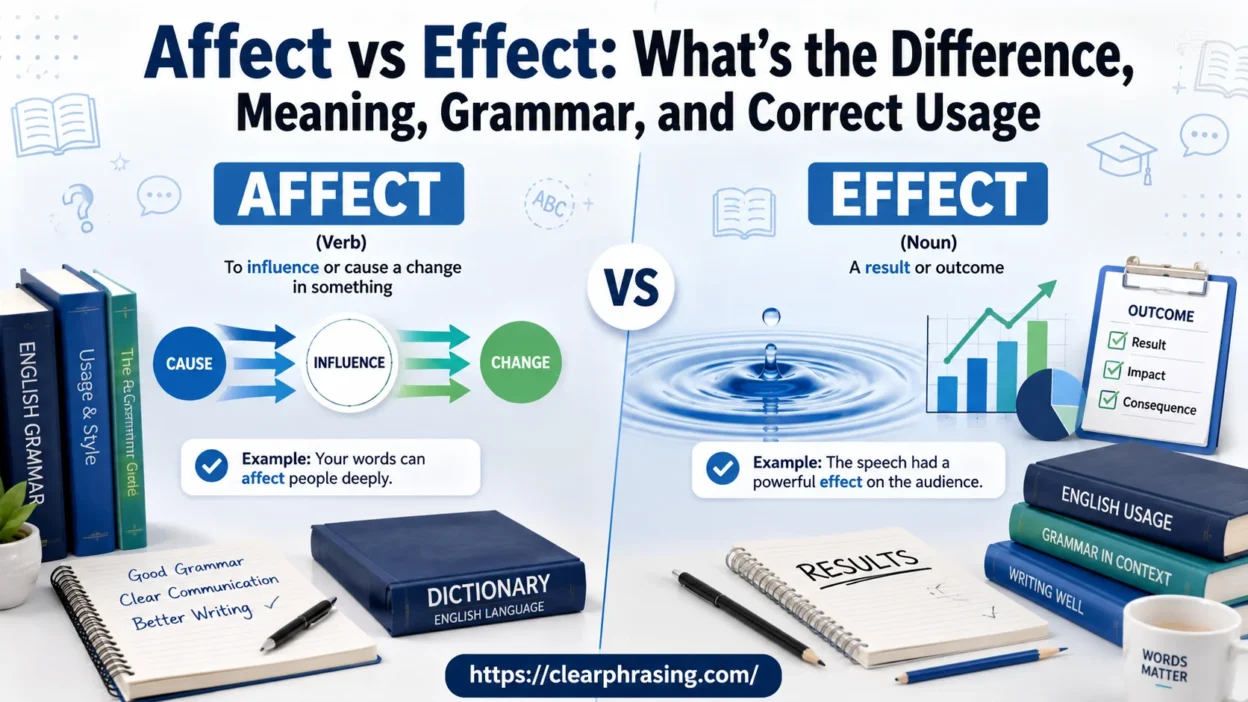
| Affect | Usually a verb | To influence or change something | The storm affected our travel plans. |
| Effect | Usually a noun | The result or outcome of a change | The storm had a major effect on travel. |
The easiest way to remember the difference is:
- Affect = Action (Verb)
- Effect = End Result (Noun)
If something changes another thing, use affect. If you’re talking about the result of that change, use effect.
What Does Affect Mean?
Definition of Affect
Affect usually means to influence, change, or make a difference to someone or something. In everyday English, it almost always functions as a verb, so it describes an action rather than a thing. Whenever one person, event, or condition changes another, affect is typically the correct choice.
When to Use Affect
Use affect whenever you describe something that influences another person, object, event, or situation.
Common situations include:
- Health
- Education
- Business
- Weather
- Technology
- Sports
- Relationships
- Finance
Examples of Affect
- Lack of sleep affects concentration.
- Heavy rain affected traffic this morning.
- Your attitude affects your success.
- Inflation affects grocery prices.
- Exercise positively affects mental health.
- Poor communication affects teamwork.
Words Similar to Affect
Depending on the sentence, you can sometimes replace affect with:
- Influence
- Change
- Alter
- Modify
- Shape
- Impact
For example:
- Good leadership affects employee morale.
- Good leadership influences employee morale.
Although the wording changes slightly, the meaning remains nearly the same.
What Does Effect Mean?
Definition of Effect
Effect usually means the result, consequence, or outcome of an action. Unlike affect, it generally functions as a noun. Instead of describing something that changes another thing, effect names what happens after the change occurs.
When to Use Effect
Use effect whenever you talk about the result of an action, event, or decision.
You’ll often see effect after words like:
- Have
- Cause
- Produce
- Create
- Positive
- Negative
- Significant
- Immediate
Examples of Effect
- The medicine had an immediate effect.
- Exercise has a positive effect on health.
- The new law produced a noticeable effect.
- The teacher saw the effect of daily reading.
- Pollution has harmful effects on wildlife.
- The policy had little effect on spending.
Common Expressions with Effect
Several everyday expressions use effect because they describe results.
- Cause and effect
- Side effect
- Ripple effect
- Greenhouse effect
- Special effects
- Take effect
- In effect
- Have an effect on
Examples:
- The new rules take effect next month.
- Every medicine has possible side effects.
- One late shipment created a ripple effect across the supply chain.
The Main Difference Between Affect and Effect
Although the two words look alike, they serve different grammatical purposes.
| Feature | Affect | Effect |
| Part of speech | Usually a verb | Usually a noun |
| Meaning | To influence or change | The result of a change |
| Answers | What caused the change? | What happened because of it? |
| Example | The drought affected crops. | The drought had a serious effect on crops. |
A simple example makes the distinction clear.
Imagine you throw a stone into a calm lake.
The stone affects the water because it creates movement.
The ripples are the effect because they are the result of that action.
Think of it this way:
- Affect causes the change.
- Effect is the change.
Affect vs Effect in Simple English
Here’s another easy way to understand the difference.
You study every evening before an exam.
Your studying affects your knowledge.
Your higher test score is the effect.
Or imagine watering a plant.
Water affects the plant’s growth.
Healthy leaves and flowers are the effect.
Once you begin thinking in terms of cause and result, choosing the correct word becomes much easier.
When to Use Affect
In School Writing
Teachers often ask students to explain why something happened. Since you’re describing a cause or influence, affect is usually the correct choice.
Examples:
- Regular attendance affects academic performance.
- Practice affects writing skills.
In Business Writing
Companies frequently discuss factors that influence profits, customers, or employees.
Examples:
- Rising costs affect company profits.
- Customer reviews affect buying decisions.
In Science
Scientists often describe how one variable changes another.
Examples:
- Temperature affects chemical reactions.
- Sunlight affects plant growth.
In Everyday Conversation
Native speakers naturally use affect when talking about change.
Examples:
- Coffee affects my sleep.
- Loud noise affects my concentration.
- Bad weather affected our weekend plans.
When to Use Effect
In Reports
Reports often focus on outcomes rather than actions, so effect is usually the correct choice. Whether you’re writing about business, education, or science, use effect when describing the result of something.
Examples:
- The new policy had a positive effect on employee productivity.
- The training program had a measurable effect on performance.
- The price reduction had an immediate effect on sales.
In Academic Writing
Researchers commonly discuss the results of studies and experiments. In these situations, effect refers to the outcome that researchers observe.
Examples:
- Scientists studied the effect of air pollution on public health.
- Researchers measured the effect of exercise on heart health.
- The experiment showed the long-term effect of temperature changes.
In Everyday English
People regularly use effect in daily conversations when talking about results.
Examples:
- The movie had a powerful effect on the audience.
- The medicine had little effect after two days.
- Her speech had a positive effect on the entire team.
Affect vs Effect in Different Contexts
Education
Teachers often explain how one action influences learning and what results follow.
Example:
Regular homework affects student understanding, while consistent practice has a positive effect on exam scores.
Healthcare
Doctors use both words frequently.
Example:
Smoking affects lung function, and its long-term effects can include serious respiratory diseases.
Business
Companies analyze both causes and outcomes.
Example:
Customer service affects brand reputation, and excellent service has a lasting effect on customer loyalty.
Technology
Software updates often improve device performance.
Example:
A software update affects system speed, and the effect is usually faster performance and better security.
Environment
Environmental scientists study relationships between human activities and nature.
Example:
Pollution affects rivers, forests, and wildlife. Its effects include poor water quality, habitat loss, and declining biodiversity.
Sports
Athletes constantly look for ways to improve performance.
Example:
Daily training affects endurance, and the effect becomes clear during competitions.
Common Phrases with Affect and Effect
Some expressions appear so often that it’s worth learning them as complete phrases.
| Phrase | Meaning | Example |
| Have an effect on | Produce a result | Exercise has a positive effect on health. |
| Cause and effect | Relationship between actions and results | Science explains cause and effect. |
| Side effects | Secondary results | Drowsiness is a common side effect. |
| Ripple effect | One event causes many others | One delay created a ripple effect. |
| Greenhouse effect | Warming caused by trapped heat | Scientists study the greenhouse effect. |
| Take effect | Become active | The new policy takes effect next month. |
| In effect | Currently operating | The law is now in effect. |
| Special effects | Visual effects in films | The movie won awards for its special effects. |
Rare Exceptions You Should Know
Most of the time, affect is a verb and effect is a noun. However, English includes two important exceptions.
Affect as a Noun
In psychology and psychiatry, affect refers to a person’s visible emotional expression.
Examples:
- The patient displayed a flat affect.
- Doctors observed limited affect during the interview.
Unless you’re reading medical or psychological writing, you probably won’t encounter this meaning very often.
Effect as a Verb
Although uncommon, effect can also function as a verb. In formal English, it means to bring about, to accomplish, or to make something happen.
Examples:
- The committee effected several important reforms.
- The agreement effected significant changes.
- The new policy effected lasting improvements.
This usage appears mainly in legal documents, government reports, and formal business writing.
Affect vs Effect in Grammar
Choosing the correct word becomes much easier once you understand its grammatical role.
| Grammar Point | Affect | Effect |
| Usually functions as | Verb | Noun |
| Describes | Action or influence | Result or outcome |
| Commonly follows | Subject | Articles, adjectives, and prepositions |
| Example | Stress affects sleep. | Stress has an effect on sleep. |
A simple grammar test can help.
Ask yourself these questions:
- Is the word describing an action? Use affect.
- Is the word naming a result? Use effect.
Memory Tricks to Remember Affect and Effect
You don’t need complicated grammar rules to remember these words. A few simple tricks work surprisingly well.
A Means Action
The word Affect starts with the letter A, and it usually describes an Action.
Example:
Heat affects plants.
E Means End Result
The word Effect starts with E, and it usually refers to the End result.
Example:
Heat had a harmful effect on the plants.
Remember the Word RAVEN
Many English teachers use the mnemonic RAVEN.
- R = Remember
- A = Affect
- V = Verb
- E = Effect
- N = Noun
This simple trick helps many learners avoid mistakes.
Common Mistakes Writers Make
Many mistakes happen because people choose the word that sounds right instead of checking its grammatical function.
| Incorrect | Correct |
| The weather had a bad affect. | The weather had a bad effect. |
| Stress has a negative affect. | Stress has a negative effect. |
| The news effected my mood. | The news affected my mood. |
| Exercise effects your health. | Exercise affects your health. |
| The medicine affected immediately. | The medicine took effect immediately. |
Before finishing your writing, check whether you’re describing an action or a result.
Practice Sentences
Choose the correct word before looking at the answer.
- The heavy rain ______ traffic all morning.
- The new medicine had an immediate ______.
- Lack of sleep ______ your concentration.
- The new policy had little ______ on spending.
- Rising prices ______ consumer confidence.
Answers
- affected
- effect
- affects
- effect
- affect
Quick Quiz
Which sentence is correct?
A. The weather had a bad affect.
B. The weather had a bad effect.
Answer: B
Which word describes an action?
A. Affect
B. Effect
Answer: A
Which word names a result?
A. Affect
B. Effect
Answer: B
Read More: Forty or Fourty: Correct Spelling, Meaning, and Usage
FAQs
What is the main difference between affect and effect?
Affect is usually a verb that means “to influence,” while effect is usually a noun that means “the result of something.” This is the most common rule in everyday English.
Although both words are closely related, remembering their usual roles in a sentence will help you choose the correct one with confidence.
Can affect ever be a noun?
Yes. In psychology, affect can be used as a noun to describe a person’s emotional expression or mood.
However, this meaning is uncommon in everyday writing, so most learners only need to remember affect as a verb.
Can effect be used as a verb?
Yes. Effect can be a verb meaning “to bring about” or “to make happen.”
This use is mostly found in formal, legal, academic, or business writing, so it is much less common than the noun form.
Why do people confuse affect and effect?
People often confuse them because they look alike and sound almost the same. Their related meanings also add to the confusion.
With regular reading, writing, and practice, the difference becomes much easier to remember.
Is affect always followed by an object?
In most cases, yes. Since affect is usually a transitive verb, it commonly acts on someone or something.
For example, “The weather affected our plans” clearly shows what received the action.
How can I remember affect vs effect?
A simple memory trick is that Affect starts with A for Action, while Effect starts with E for End result.
This quick reminder works well for most everyday situations and helps reduce mistakes.
Which word is more common in academic writing?
Both words appear frequently, but they serve different purposes. Affect often describes influence, while effect explains outcomes or results.
Using the correct word makes academic writing clearer and more professional.
Are affect and effect homophones?
They are near-homophones because their pronunciation is very similar, especially in fast speech.
Even though they sound alike, their meanings and grammatical roles are usually different.
Can I replace affect with effect?
No. In most sentences, they cannot replace each other because one is generally a verb and the other is generally a noun.
Always check whether your sentence needs an action or a result before choosing the word.
How can I stop making mistakes with affect and effect?
Read quality English regularly and write your own example sentences using both words. Reviewing your mistakes also helps.
In my teaching experience, students improve much faster when they practice both words in real conversations instead of only memorizing grammar rules.
Conclusion
Understanding affect and effect does not have to be difficult. Once you remember that affect usually shows an action and effect usually describes the result, most sentences become much easier to understand. Instead of relying only on memory tricks, try reading authentic English, noticing how each word is used, and creating your own examples. Small, consistent practice builds lasting confidence.
After teaching English for many years, I have found that learners improve the fastest when they focus on meaning rather than memorizing rules alone. Every mistake is an opportunity to learn, and each correct sentence strengthens your understanding. With regular practice, careful proofreading, and real-life usage, choosing between affect and effect will soon become natural in both speaking and writing.

Shamsa Kanwal is an English specialist and content writer at ClearPhrasing.com, where she helps readers navigate the English language with confidence. She enjoys breaking down grammar rules, spelling differences, vocabulary, and everyday writing challenges into simple, practical lessons that anyone can understand.
Her writing is focused on making learning approachable rather than overwhelming. Whether she’s explaining commonly confused words, punctuation rules, or grammar concepts, Shamsa believes that clear explanations and real-life examples are the key to effective learning.
Every article she writes is carefully researched, fact-checked, and edited to ensure it is accurate, easy to read, and genuinely helpful. Her goal is to create trustworthy resources that enable students, professionals, writers, and English learners to improve their communication skills and write with greater clarity.
Through her work at ClearPhrasing.com, Shamsa is committed to making English learning simpler, more practical, and accessible for readers around the world.