Sweetie or Sweety, or Sweatie: Correct Spelling, and Differences explains which spelling is correct and helps you avoid common mistakes every day.
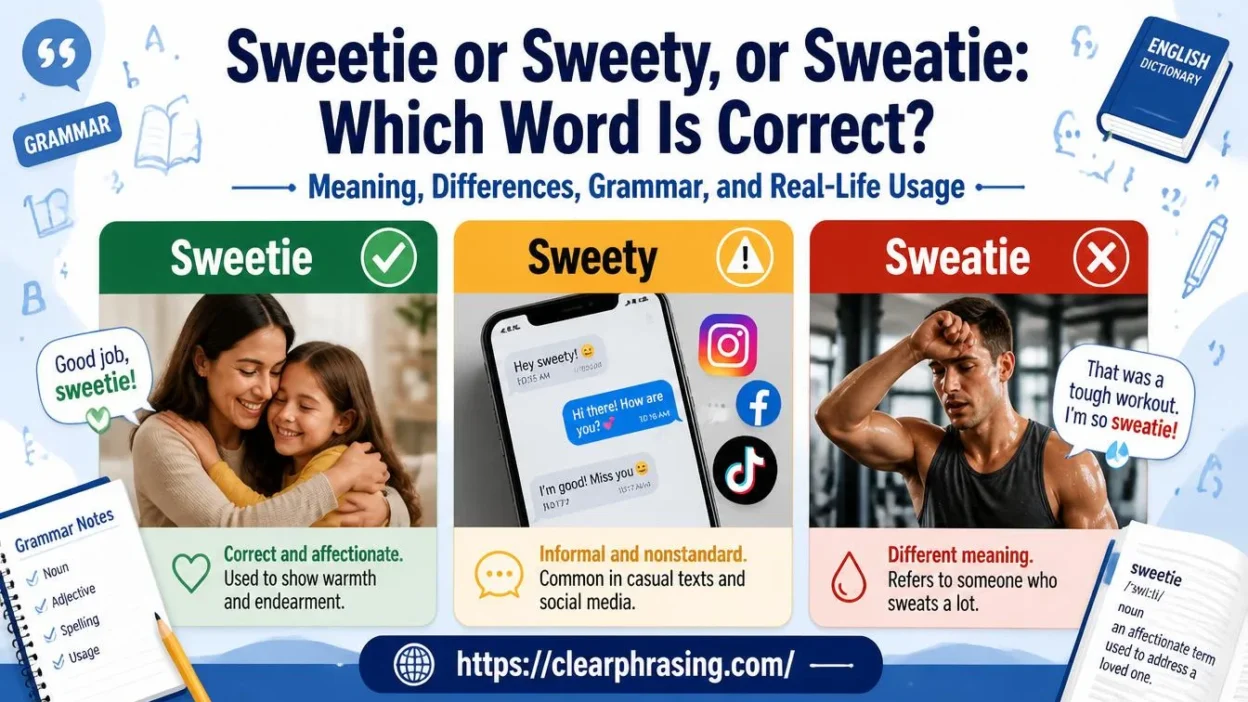
The English language has many words spelled differently that sound the same, causing confusion. Sweetie is the correct spelling, while Sweety is an informal nickname or pet name. Sweatie is generally incorrect despite its similar pronunciation. From my teaching experience, students often question the right version when writing messages, emails, or social media posts.
Understanding context, meaning, usage, vocabulary, and grammar helps you choose the right word. Reading examples, checking spellings, and practicing communication improve understanding and build confidence in personal and professional situations. A small change in spelling can create different impressions, so careful practice makes everyday English more natural and clear.
Quick Answer
If you’re wondering which spelling is correct, here’s the short answer.
| Word | Correct? | Meaning | Best Used In |
| Sweetie | ✅ Yes | A term of affection for someone you care about | Everyday conversation, writing, messages |
| Sweety | ✅ Informal | A casual or playful spelling of Sweetie | Text messages and social media |
| Sweatie | ⚠️ Usually No | Someone who is sweaty or a humorous internet joke | Rare informal situations only |
The safest choice is “Sweetie.” It is the standard English spelling recognized by dictionaries and used in both spoken and written English. Although Sweety appears frequently online, it remains an informal variation. Sweatie should almost never replace Sweetie because it usually refers to someone covered in sweat.
What Does Sweetie Mean?
Definition of Sweetie
Sweetie is a noun used as a term of endearment. People say it to express affection, kindness, love, or friendliness toward another person.
It often replaces someone’s name during a conversation.
For example:
- Good morning, sweetie!
- Thanks for helping me, sweetie.
- Sleep well, sweetie.
The word carries warmth rather than romance alone. Parents use it with children. Couples use it affectionately. Grandparents, teachers, and even customer service workers sometimes use it to sound friendly.
Origin of the Word
The word sweetie developed from the adjective sweet, which has described pleasant people and things for centuries. English speakers later added the suffix -ie to create a more affectionate nickname.
Many English nicknames follow this pattern.
Examples include:
- Bird → Birdie
- John → Johnny
- Sweet → Sweetie
Over time, Sweetie became one of the most common affectionate expressions in English.
Part of Speech
Sweetie is mainly used as a countable noun.
Examples include:
- She is such a sweetie.
- You’re my sweetie.
- Thanks, sweetie.
Although rare, it can occasionally function as a nickname rather than a regular noun.
When People Use Sweetie
People commonly say Sweetie in situations like these:
- Between romantic partners
- Parents talking to children
- Grandparents speaking lovingly
- Close friends joking kindly
- Caregivers comforting someone
- Friendly conversations
It creates a warm, welcoming tone.
What Does Sweety Mean?
Is Sweety a Real Word?
This question causes a surprising amount of confusion.
The spelling Sweety appears in many text messages, Instagram captions, birthday cards, and online comments. However, most major English dictionaries do not list it as the preferred spelling.
Instead, dictionaries recommend Sweetie.
That doesn’t mean Sweety never appears. Language changes over time, especially online. Many people intentionally write Sweety because they think it looks shorter or cuter.
Why People Write Sweety
Several reasons explain its popularity.
- Autocorrect sometimes suggests it.
- Many non-native English speakers learn it from social media.
- Friends copy each other’s spelling.
- It looks visually simpler.
- Some cultures have adopted it as a nickname.
Because of these factors, Sweety has become common on the internet despite not being the standard spelling.
Should You Use Sweety?
That depends on your audience.
It may work in:
- Personal chats
- WhatsApp messages
- Instagram comments
- Birthday wishes
- Friendly conversations
Avoid it in:
- Academic writing
- Business emails
- Job applications
- Professional documents
- Formal letters
Using Sweetie instead always looks more polished.
Examples
- Happy Birthday, Sweety! ❤️
- Miss you, Sweety.
- Good night, Sweety.
Although these examples are common online, replacing Sweety with Sweetie would make them grammatically standard.
What Does Sweatie Mean?
Is Sweatie an English Word?
Unlike Sweetie, the word Sweatie usually refers to someone who is sweaty.
Imagine someone exercising at the gym.
You could jokingly say:
“You’re looking pretty sweatie today.”
Here, the meaning relates to sweat—not affection.
Why People Mistakenly Write Sweatie
Typing quickly often leads to mistakes.
The keyboard places several letters close together, making accidental spellings common.
People also confuse the pronunciation because all three words sound similar in rapid speech.
Internet Humor
Online communities occasionally use Sweatie sarcastically.
For example:
“Listen, sweatie…”
The joke works because readers expect Sweetie, but the writer intentionally changes it to Sweatie for humorous effect.
This style appears mainly in memes and internet humor.
Should You Ever Use Sweatie?
In normal writing, no.
Unless you’re literally describing someone who is sweaty or intentionally making a joke, Sweatie is almost always the wrong choice.
Sweetie vs. Sweety vs. Sweatie
| Feature | Sweetie | Sweety | Sweatie |
| Standard English | ✅ Yes | ⚠️ Informal | ❌ No |
| Dictionary Recognition | ✅ Yes | Limited | Rare |
| Affectionate Meaning | ✅ Yes | ✅ Usually | ❌ No |
| Professional Writing | ✅Yes | ❌ Avoid | ❌ Avoid |
| Social Media | ✅ Common | ✅ Very Common | Occasionally as humor |
| Recommended Choice | ⭐ Best | Casual only | Rarely appropriate |
Which One Should You Use?
Choosing the right word becomes easy once you know the context.
Everyday Conversations
Use Sweetie.
It sounds natural, friendly, and grammatically correct.
Examples include:
- Hi, sweetie!
- Are you okay, sweetie?
- Thanks, sweetie.
Text Messages
You can use either Sweetie or Sweety if you’re chatting with friends or family.
However, Sweetie still looks more polished.
Romantic Messages
Sweetie remains the preferred spelling.
Examples include:
- I love you, sweetie.
- Good morning, sweetie.
- Sweet dreams, sweetie.
Family Conversations
Parents frequently use Sweetie with children because it sounds caring without feeling overly formal.
Professional Communication
Avoid all affectionate nicknames unless your workplace culture clearly accepts them.
If you need one, Sweetie is the only acceptable spelling.
Why People Confuse These Words
Several factors contribute to the confusion.
Similar Pronunciation
All three spellings sound nearly identical.
English contains many words where pronunciation doesn’t reveal the correct spelling.
Examples include:
- Their, There, and They’re
- Brake and Break
- Principal and Principle
Autocorrect
Phones sometimes replace correctly spelled words with commonly typed alternatives.
Always proofread before sending important messages.
Social Media
Millions of users casually write Sweety, making it appear correct even though dictionaries prefer Sweetie.
Popularity doesn’t always equal correctness.
Regional Habits
Some countries use Sweety much more frequently than others.
This creates the impression that both spellings are equally accepted, although style guides continue recommending Sweetie.
Grammar Rules You Should Know
Sweetie Is a Common Noun
It functions like any other noun.
Examples include:
- My sweetie is waiting outside.
- She’s a real sweetie.
Capitalization
Capitalize Sweetie only when it begins a sentence or forms part of a nickname.
Correct examples:
- Sweetie, dinner is ready.
- My sweetie loves chocolate.
Incorrect example:
- My Sweetie loves chocolate.
Possessive Form
The possessive follows standard grammar.
Examples include:
- My sweetie’s birthday is tomorrow.
- The sweetie’s toy is missing.
Plural Form
Although uncommon, the plural exists.
Examples include:
- You two are sweeties.
- Those little sweeties helped everyone.
Case Study: One Small Spelling Mistake
A small online gift shop once printed hundreds of greeting cards that read:
Happy Birthday, Sweatie!
Customers expected Sweetie, but the typo completely changed the meaning. Instead of sounding affectionate, the message accidentally suggested someone was sweaty.
The business corrected the design, reprinted the cards, and updated its proofreading process. This simple mistake shows how one extra letter can change the entire tone of a message.
“The right word doesn’t just improve grammar. It preserves your intended meaning.”
Common Mistakes and How to Avoid Them
Even advanced English speakers occasionally confuse Sweetie, Sweety, and Sweatie because the words sound nearly identical. The key is to remember that pronunciation doesn’t always determine correct spelling.
The following table highlights the mistakes people make most often.
| Incorrect | Correct | Why |
| Good morning, Sweatie. | Good morning, Sweetie. | Sweatie refers to someone who is sweaty or is used humorously. |
| Thanks, Sweety, for your help. (Formal email) | Thanks, Sweetie, for your help. | Sweetie is the standard English spelling. |
| My Sweatie loves flowers. | My Sweetie loves flowers. | Wrong meaning. |
| Dear Sweety (Business letter) | Dear Mr. Smith | Avoid affectionate nicknames in professional writing. |
| You’re such a Sweatie. | You’re such a Sweetie. | Completely changes the intended meaning. |
Tips to Avoid Mistakes
- Choose “Sweetie” whenever you’re unsure.
- Proofread text messages before sending them.
- Don’t assume a social media spelling is grammatically correct.
- Check a reliable dictionary if you have doubts.
- Remember that one extra letter can change the meaning entirely.
Examples in Everyday English
Seeing words in context makes them much easier to remember.
Romantic Conversation
Correct
- Good morning, Sweetie.
- I can’t wait to see you tonight, Sweetie.
- You’re my favorite person, Sweetie.
Parent Talking to a Child
- Come here, Sweetie.
- Great job today, Sweetie.
- I’m proud of you, Sweetie.
Friends
- Thanks for helping me, Sweetie.
- You’re the sweetest friend ever.
Customer Service
Some customer service representatives use affectionate language to create a warm atmosphere.
Examples include:
- What can I help you with today, Sweetie?
- Have a wonderful day, Sweetie.
This usage is common in some regions but may sound too personal in professional environments.
Casual Text Messages
You’ll often see both spellings online.
Examples include:
- Happy Birthday, Sweetie! 🎂
- Miss you, Sweetie!
- Good night, Sweety! ❤️
Although Sweety is common online, Sweetie remains the recommended spelling.
Examples in Literature, Movies, and Pop Culture
The word Sweetie appears frequently in English-speaking media because it instantly conveys warmth and affection.
You’ll hear it in:
- Romantic movies
- Family television shows
- Children’s books
- Novels
- Greeting cards
- Song lyrics
Characters often say things like:
- “Come here, sweetie.”
- “It’s okay, sweetie.”
- “Don’t worry, sweetie.”
In contrast, Sweety appears mostly in:
- Instagram captions
- Facebook comments
- WhatsApp chats
- Online usernames
- Informal birthday wishes
Meanwhile, Sweatie usually appears in memes or humorous internet posts where the incorrect spelling is intentional.
Is Sweety Grammatically Wrong?
Not exactly.
A better description is that Sweety is an informal alternative spelling rather than the standard English form.
Most major dictionaries recognize Sweetie as the correct spelling.
That means:
In Formal Writing
Use Sweetie.
In Academic Writing
Use Sweetie.
In Professional Emails
Use Sweetie if an affectionate nickname is appropriate, though avoiding nicknames altogether is often better.
In Personal Messages
Either spelling may appear, but Sweetie is still the safer choice.
Can Sweatie Ever Be Correct?
Yes—but only in limited situations.
If you’re describing someone who is covered in sweat, the humorous adjective Sweatie might appear in informal speech or online jokes.
For example:
- After the marathon, everyone looked sweatie.
Even here, many writers would simply choose sweaty, which is the standard adjective.
Because of this, Sweatie rarely belongs in serious writing.
Synonyms for Sweetie
Sometimes repeating the same word sounds repetitive. These alternatives can add variety.
| Romantic | Friendly | Family | Informal |
| Sweetheart | Dear | Honey | Babe |
| Darling | Friend | Pumpkin | Love |
| My Love | Buddy | Angel | Cutie |
| Beloved | Pal | Sunshine | Hun |
Choose the nickname that matches your relationship and audience.
Words Commonly Confused with Sweetie
Several affectionate expressions look or sound similar.
Sweet
An adjective describing pleasant taste or personality.
Example
- She’s a sweet person.
Sweetheart
A stronger expression of affection.
Example
- You’re my sweetheart.
Honey
A common nickname among couples and family members.
Dear
Suitable in both formal and informal writing depending on context.
Darling
Often used romantically or affectionately.
Babe
Popular in casual relationships.
Love
Frequently heard in British English as a friendly form of address.
Cutie
Usually refers to someone considered attractive or adorable.
Regional Differences
English varies around the world, but Sweetie remains the preferred spelling in Standard English.
American English
Sweetie is the standard choice in speech and writing.
British English
Sweetie is also the accepted spelling, although Love is another common affectionate term.
Australian English
Australians generally use Sweetie in informal conversations.
Indian English
Both Sweetie and Sweety appear regularly. However, schools and grammar guides still recommend Sweetie.
Online English
Social media has increased the popularity of Sweety, especially in usernames, greetings, and birthday messages.
How Dictionaries Define These Words
Leading English dictionaries consistently recognize Sweetie as the standard spelling.
The word is defined as:
- A lovable person
- A dear person
- A term of affection
- Someone who is kind or pleasant
Most dictionaries either omit Sweety or identify it as an informal variation.
Sweatie generally isn’t listed as a standard synonym for Sweetie because it carries a different meaning.
Real-Life Usage Trends
Modern communication has changed how people spell affectionate words.
General usage patterns show:
- Sweetie dominates books, newspapers, magazines, and professional writing.
- Sweety appears frequently in texts, social media, and greeting posts.
- Sweatie remains uncommon outside humorous online content.
The popularity of a spelling doesn’t automatically make it standard English. Writers should still consider their audience and purpose.
Memory Tricks to Never Confuse Them Again
Simple memory devices can help you remember the correct spelling.
Trick One
Think of the word Sweet.
Add -ie.
Sweet + ie = Sweetie
Trick Two
If the word contains sweat, it probably relates to being sweaty.
That points to Sweatie, not affection.
Trick Three
When writing anything important, ask yourself:
Would this appear in a dictionary?
If yes, choose Sweetie.
Expert Writing Tips
Professional writers pay attention to small details because readers notice them.
Follow these best practices:
- Use Sweetie in standard English.
- Reserve Sweety for casual conversations if you prefer it.
- Avoid Sweatie unless you’re intentionally making a joke.
- Proofread before publishing.
- Match your language to your audience.
These habits improve both clarity and credibility.
Read More: Compound vs Complex Sentence: Difference and Correct Usage
FAQs
Is Sweetie or Sweety the correct spelling?
Sweetie is the standard and most widely accepted spelling in English. Sweety is sometimes used informally but is less common.
Is Sweatie a real English word?
Sweatie is generally considered a misspelling when someone means Sweetie. It is not the correct spelling for the affectionate term.
Can I use Sweety instead of Sweetie?
Yes, some people use Sweety as an informal variation, especially in personal messages, but Sweetie is the preferred spelling.
What does Sweetie mean?
Sweetie is a term of endearment used for someone you care about, such as a partner, child, family member, or close friend.
Why do people confuse Sweetie, Sweety, and Sweatie?
The words look and sound similar, so many people type the wrong spelling, especially in quick texts or social media posts.
Is Sweetie appropriate in professional communication?
Generally, no. Sweetie is best reserved for personal or friendly conversations unless your workplace culture makes it appropriate.
How can I remember the correct spelling?
Think of sweet + ie. Since Sweetie comes from the word sweet, adding -ie makes it easy to remember.
Does Sweety appear in dictionaries?
Most major English dictionaries recognize Sweetie as the standard form. Sweety is much less common and is often treated as a variant or informal usage.
Can using Sweatie change the meaning of my message?
Yes. Because Sweatie is usually seen as a spelling mistake, it may confuse readers or make your message appear less polished.
Which spelling should I use in everyday English?
For almost every situation, choose Sweetie. It is the correct, widely recognized, and most natural spelling in modern English.
Conclusion
Choosing between Sweetie, Sweety, and Sweatie becomes much easier once you understand how each spelling is used. While Sweetie is the accepted and most widely used spelling in modern English, Sweety appears as an informal variation in some regions and online conversations. Sweatie, however, is usually a misspelling and should be avoided in most situations. Knowing this small difference helps you write with greater accuracy and confidence.
As an English teacher, I’ve noticed that learners often focus on pronunciation and overlook spelling. A single extra letter can completely change how your writing is perceived. Whether you’re sending a text, writing an email, or posting on social media, choosing the correct word shows attention to detail and makes your message sound more natural. With a little practice, you’ll never have to second-guess which spelling to use again.

Shamsa Kanwal is an English specialist and content writer at ClearPhrasing.com, where she helps readers navigate the English language with confidence. She enjoys breaking down grammar rules, spelling differences, vocabulary, and everyday writing challenges into simple, practical lessons that anyone can understand.
Her writing is focused on making learning approachable rather than overwhelming. Whether she’s explaining commonly confused words, punctuation rules, or grammar concepts, Shamsa believes that clear explanations and real-life examples are the key to effective learning.
Every article she writes is carefully researched, fact-checked, and edited to ensure it is accurate, easy to read, and genuinely helpful. Her goal is to create trustworthy resources that enable students, professionals, writers, and English learners to improve their communication skills and write with greater clarity.
Through her work at ClearPhrasing.com, Shamsa is committed to making English learning simpler, more practical, and accessible for readers around the world.