Assignation or Assignment: Difference, Meaning, and Usage helps English learners understand both words and use them correctly every day.
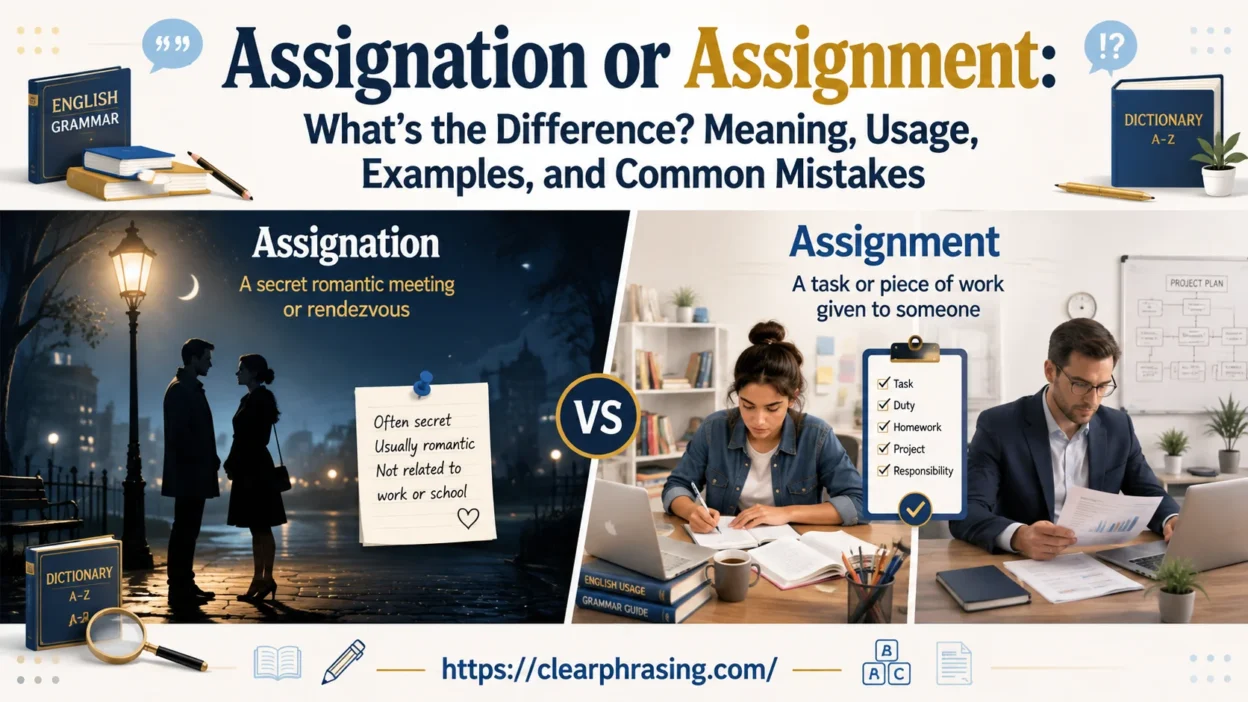
As an English teacher, I have seen many students confuse these words because they share the root word, assign. An assignment is a task for a person, group, or team at school, work, or in an organization. It may also have a legal meaning involving property and ownership transfer. Assignation, however, usually means a secret meeting, romantic rendezvous, or private arrangement.
Learning the correct meaning, usage, context, and grammar helps you avoid common mistakes, improve communication skills, and build confidence in English writing and speaking.
Quick Answer:
If you’re talking about homework, a work task, a project, or a legal transfer, the correct word is assignment.
If you’re referring to a secret or private meeting, especially one between lovers, the correct word is assignation.
| Word | Meaning | Common Usage | Modern Frequency |
| Assignation | A secret meeting, usually romantic | Literature, historical writing | Rare |
| Assignment | A task, duty, project, or legal transfer | Education, business, law, daily English | Very common |
Quick takeaway: In almost every modern situation, assignment is the word you need. Reserve assignation for historical, literary, or romantic contexts.
What Does Assignation Mean?
Definition of Assignation
An assignation is a planned meeting that takes place privately or secretly. Traditionally, the word describes a romantic meeting between two people who don’t want others to know about it.
Modern dictionaries still recognize this meaning, although the word has become uncommon in everyday conversation.
For example:
- They arranged a secret assignation after sunset.
- The novel revolves around a mysterious midnight assignation.
- The detective uncovered evidence of several hidden assignations.
Unlike many English words, assignation carries a specific emotional tone. It often suggests secrecy, mystery, or forbidden romance rather than an ordinary appointment.
Origin of the Word Assignation
The word comes from the Latin verb assignare, meaning to mark out, appoint, or allot. It entered English through French during the Middle Ages.
Originally, the word simply meant an appointment or arrangement. Over the centuries, English speakers gradually narrowed its meaning until it became closely associated with secret romantic meetings.
That historical shift explains why the word sounds formal and old-fashioned today.
Why the Meaning Changed Over Time
Language evolves as people repeatedly use words in certain situations.
During the seventeenth and eighteenth centuries, writers often used assignation in stories involving secret relationships between nobles and lovers. Eventually, readers began associating the word almost exclusively with those situations.
Today, if someone says they have an assignation, most native English speakers picture a confidential romantic meeting rather than a business appointment.
Where You Might Still See Assignation
Although rare in everyday English, the word still appears in certain types of writing.
You’ll commonly find it in:
- Historical fiction
- Mystery novels
- Victorian literature
- Classic romance stories
- Academic discussions of literature
- Historical biographies
Because of its literary tone, journalists, teachers, and business professionals rarely use it.
Examples of Assignation in Sentences
Correct examples include:
- The lovers planned an assignation beneath the old bridge.
- Her diary described every secret assignation.
- The king’s hidden assignation became public years later.
- The novel opens with an unexpected assignation at midnight.
Notice that every example involves privacy or secrecy rather than work or school.
What Does Assignment Mean?
Definition of Assignment
An assignment is a task, responsibility, project, or piece of work that someone receives to complete.
It’s one of the most frequently used nouns in English because it applies to education, business, law, journalism, engineering, healthcare, and many other fields.
Examples include:
- homework assignment
- writing assignment
- work assignment
- research assignment
- legal assignment
- project assignment
Unlike assignation, this word carries no emotional or romantic meaning.
Assignment as a Task
The most familiar meaning involves work someone must complete.
Examples:
- Finish today’s assignment before dinner.
- The manager gave everyone a new assignment.
- Completing the assignment early impressed the supervisor.
Whether you’re a student or an employee, you’ll hear this meaning regularly.
Assignment in Education
Schools and universities use assignment every day.
Common academic assignments include:
- Essays
- Research papers
- Presentations
- Reading tasks
- Science projects
- Group work
- Book reports
- Lab reports
Teachers assign these activities to help students practice skills and demonstrate understanding.
Example
“Submit your assignment before Friday at 5 p.m.”
That’s a sentence every student recognizes.
Assignment in Business
Businesses use assignment to describe responsibilities delegated to employees.
Examples include:
- customer support assignment
- overseas assignment
- marketing assignment
- project assignment
- field assignment
Managers often divide large projects into smaller assignments so each team member has a clear responsibility.
Case Study
A software company launches a new mobile application.
Instead of asking every developer to handle everything, the project manager creates separate assignments.
- One developer builds the login system.
- Another designs the user interface.
- A third tests security.
- A fourth writes technical documentation.
Each assignment contributes to the final product without creating confusion.
Assignment in Law
Legal professionals use assignment differently.
In law, an assignment is the transfer of rights, property, contracts, or benefits from one person or organization to another.
Examples include:
- assignment of copyright
- assignment of lease
- assignment of debt
- assignment of trademark rights
This meaning appears regularly in contracts and legal agreements.
Assignment in Project Management
Modern organizations rely heavily on assignments to organize work.
Project management software tracks assignments by showing:
- Task owner
- Due date
- Priority
- Progress
- Status
- Dependencies
Without clearly defined assignments, projects often miss deadlines and create unnecessary confusion.
Examples of Assignment in Sentences
- My history assignment is due tomorrow.
- The editor handed me a difficult writing assignment.
- She accepted an overseas assignment for six months.
- The lawyer prepared the assignment of intellectual property rights.
- Every student completed the reading assignment before class.
Assignation vs. Assignment: Side-by-Side Comparison
Although these words look alike, their meanings differ dramatically.
| Feature | Assignation | Assignment |
| Main Meaning | Secret meeting | Task, duty, transfer |
| Modern Usage | Rare | Extremely common |
| Typical Context | Literature, romance | School, work, law |
| Tone | Historical, literary | Neutral and professional |
| Used in Daily Conversation | Rarely | Constantly |
| Used in Education | No | Yes |
| Used in Business | Almost never | Frequently |
| Used in Legal Writing | Rare | Very common |
Key fact: One incorrect word can completely change the meaning of your sentence.
Compare these examples:
❌ My professor gave me an assignation.
✅ My professor gave me an assignment.
The first sentence accidentally suggests something completely different from what the writer intended.
Why People Confuse Assignation and Assignment
Nearly Identical Spelling
The two words differ by only a few letters.
When reading quickly, it’s easy to overlook the difference.
That’s why many spelling mistakes involve these words.
Shared Latin Roots
Both words ultimately come from the Latin assignare, meaning to assign or appoint.
Because they evolved from the same origin, they still resemble each other.
However, their meanings gradually separated over hundreds of years.
Similar Pronunciation
Their pronunciation also contributes to the confusion.
Many English learners hear only the beginning of each word and assume they’re variants of the same term.
They’re not.
Each has its own accepted meaning.
Spellcheck Doesn’t Explain Meaning
Modern spellcheck tools usually verify spelling.
They don’t explain vocabulary.
If you mistakenly write assignation instead of assignment, your document may contain no spelling errors even though the sentence is incorrect.
That’s why understanding meaning matters more than relying on software.
When to Use Assignation
Historical Writing
Historical documents often describe secret meetings using assignation.
For example:
- The queen arranged a confidential assignation with her adviser.
The word fits naturally because it matches the historical setting.
Literary Contexts
Novelists frequently choose assignation because it creates atmosphere.
Compare these two sentences:
- They met secretly.
- They arranged an assignation.
The second sentence immediately feels more dramatic and mysterious.
Discussions of Older English
Language experts sometimes use the word when discussing older forms of English vocabulary.
Since its modern usage is limited, it often appears in dictionaries, etymology books, and literary analysis rather than everyday conversation.
Situations Where It Sounds Natural
You should consider assignation only when writing about:
- Historical romance
- Classic literature
- Secret meetings
- Victorian fiction
- Medieval history
- Literary criticism
In every other situation, assignment is almost certainly the correct choice.
When to Use Assignment
School and College Work
In education, assignment is always the correct choice when you’re talking about work a teacher or instructor asks students to complete.
Common academic assignments include:
- Essays
- Research papers
- Reading exercises
- Presentations
- Math problems
- Science projects
- Lab reports
- Group projects
Examples
- I submitted my English assignment before the deadline.
- The professor assigned a research assignment on climate change.
- Every student completed the homework assignment.
Workplace Tasks
Businesses use assignment to describe duties given to employees or teams.
Examples include:
- Sales assignment
- Marketing assignment
- Client assignment
- Overseas assignment
- Emergency assignment
- Daily assignment
Example
A manager might say:
“Your next assignment is to prepare the quarterly sales report.”
This sounds natural in professional English. Replacing assignment with assignation would be incorrect.
Legal Transfers
Law uses assignment in a specialized way. It refers to transferring rights or property from one party to another.
Examples include:
- Assignment of copyright
- Assignment of patent rights
- Assignment of a lease
- Assignment of debt
- Assignment of contractual rights
This legal meaning has existed for centuries and remains common in contracts today.
Everyday Conversation
Outside of school and work, people still use assignment to describe any responsibility someone receives.
Examples:
- My weekend assignment is organizing the garage.
- She completed every assignment before lunch.
- The volunteer accepted a new assignment at the shelter.
In modern English, assignment is one of the most useful and versatile nouns.
Real-Life Examples in Context
Understanding vocabulary becomes easier when you see it in real situations.
Education
✅ Correct
“The teacher collected every student’s assignment.”
❌ Incorrect
“The teacher collected every student’s assignation.”
Office Communication
✅ Correct
“The marketing assignment must be completed by Friday.”
Literature
✅ Correct
“The lovers planned an assignation beneath the moonlight.”
Legal Writing
✅ Correct
“The contract includes an assignment of intellectual property rights.”
Everyday Conversation
Correct:
- I finished my assignment.
- She received a new work assignment.
- The novel described a secret assignation.
Notice how each word naturally fits a different situation.
Common Mistakes and How to Avoid Them
Many learners accidentally choose the wrong word because they focus on spelling instead of meaning.
| Incorrect Sentence | Correct Sentence | Why |
| My teacher gave me an assignation. | My teacher gave me an assignment. | Teachers assign work, not secret meetings. |
| I completed my assignation yesterday. | I completed my assignment yesterday. | Assignment means work to complete. |
| The novel described an assignment between lovers. | The novel described an assignation between lovers. | Assignation refers to a secret meeting. |
| We scheduled an assignment tonight. | We scheduled an assignation tonight. | Assignment doesn’t mean appointment. |
Tips to Avoid the Mistake
- Think about school or work. Choose assignment.
- Think about a secret meeting. Choose assignation.
- If you’re unsure, assignment is almost always correct in modern English.
- Read your sentence aloud. If it sounds unusual, double-check the word.
Grammar Tips
Parts of Speech
Both words are countable nouns.
Examples:
- one assignment
- two assignments
- one assignation
- several assignations
Plural Forms
| Singular | Plural |
| Assignment | Assignments |
| Assignation | Assignations |
Common Sentence Patterns
Correct:
- complete an assignment
- receive an assignment
- submit an assignment
- finish an assignment
- arrange an assignation
- plan an assignation
These verb combinations sound natural to native speakers.
Common Phrases and Collocations
Assignation
Because the word is uncommon, only a few collocations appear regularly.
Common examples include:
- secret assignation
- romantic assignation
- clandestine assignation
- midnight assignation
- private assignation
Assignment
This word appears in hundreds of common expressions.
Frequently used collocations include:
- homework assignment
- writing assignment
- reading assignment
- class assignment
- work assignment
- project assignment
- overseas assignment
- daily assignment
- assignment deadline
- assignment submission
- assignment brief
- assignment sheet
- assignment instructions
Learning these natural word pairings helps your English sound more fluent.
Synonyms and Related Words
Assignation Synonyms
Depending on the context, similar words include:
- rendezvous
- tryst
- secret meeting
- private meeting
- clandestine meeting
- romantic encounter
Assignment Synonyms
Useful alternatives include:
- task
- duty
- project
- responsibility
- mission
- job
- allocation
- designation
- work item
Although these words overlap, none replaces assignment in every situation.
Assignation vs. Assignment in American and British English
One question many English learners ask is whether American and British English use these words differently.
The answer is simple.
Both American English and British English use assignment with the same meaning.
Likewise, assignation still refers to a secret meeting in both varieties of English.
The only noticeable difference is frequency. Since assignation sounds old-fashioned, speakers in both countries rarely use it outside literature, historical discussions, or formal writing.
Word Origins and Etymology
Origin of Assignation
Assignation entered English through French and ultimately traces back to the Latin word assignare, meaning “to appoint” or “to allot.”
Over time, English narrowed its meaning until it referred almost exclusively to a secret meeting.
Origin of Assignment
Assignment comes from the same Latin root but retained its broader meaning.
Instead of becoming specialized, it continued to describe something assigned to another person.
That’s why the word remains useful across education, business, law, government, journalism, healthcare, and technology.
How Their Meanings Diverged
Although both words share the same origin, centuries of usage shaped them differently.
Think of them as two siblings who started in the same place but followed different careers.
One became common in daily life.
The other settled into literature and history.
Memory Trick to Remember the Difference
Here’s an easy way to remember the two words.
Remember the Double S in Assignment
Think of:
School = Assignment
Both words contain a prominent “ss” sound and are closely connected in everyday life.
For assignation, think of the word:
Secret
A secret meeting is an assignation.
This simple association helps many learners choose the correct word instantly.
Read More: You Too or You To: Which Is Correct? and Differences
FAQs
1. What is the difference between assignation and assignment?
An assignment is a task or duty given to someone to complete, while an assignation usually refers to a secret meeting, especially a romantic one. Although both words come from the same root, they have very different meanings.
2. Is assignation still used in modern English?
Yes, but it is uncommon. Most native English speakers use assignation only in historical, literary, or formal contexts. In everyday English, the word is rarely used.
3. Can assignment have a legal meaning?
Yes. In legal English, assignment can mean the transfer of ownership, rights, or property from one person or organization to another.
4. Why do people confuse assignation and assignment?
People often confuse them because they have similar spelling and both come from the verb assign. However, their meanings and usage are completely different.
5. When should I use assignment instead of assignation?
Use assignment when talking about schoolwork, workplace tasks, projects, or legal transfers. Avoid using assignation unless you specifically mean a secret meeting.
6. Does assignation always have a romantic meaning?
In most modern contexts, yes. It commonly refers to a secret romantic meeting or an illicit relationship, although older texts may use it differently.
7. Which word is more common in everyday English?
Assignment is far more common. You will regularly see it in schools, workplaces, business communication, and academic writing.
8. How can I remember the difference easily?
Think of assignment as a task you must complete. Remember assignation as a secret appointment or rendezvous between people.
9. Can using assignation instead of assignment change the meaning of a sentence?
Absolutely. Replacing assignment with assignation can completely change the meaning and may confuse or surprise native English speakers.
10. How can I avoid mixing up these two words?
Practice reading real examples, pay attention to context, and remember that assignment relates to work or study, while assignation usually relates to a secret meeting.
Conclusion
Understanding the difference between assignation and assignment helps you communicate more clearly and avoid common English mistakes. Although the two words share the same root, they are not interchangeable. Assignment is the correct choice for schoolwork, workplace tasks, projects, and even certain legal situations involving the transfer of rights or property. Assignation, on the other hand, is an uncommon word that usually refers to a secret meeting, often with a romantic meaning. Choosing the right word makes your writing more accurate and prevents confusion for your readers.
From my experience as an English teacher, this is one of those vocabulary pairs that students often misunderstand simply because the words look alike. The best way to remember them is to focus on their context rather than their spelling. Reading authentic examples, practicing with your own sentences, and paying attention to how native speakers use each word will strengthen your vocabulary over time. Once you master this distinction, you’ll write and speak with greater confidence in both academic and professional English.

Ayesha Siddiqa is an English specialist and professional content writer at ClearPhrasing.com. She is passionate about making the English language easy to understand through clear, accurate, and engaging content. Her expertise includes English grammar, spelling, vocabulary, punctuation, word usage, and writing techniques.
At ClearPhrasing.com, Ayesha creates well-researched, reader-friendly articles designed to help students, professionals, writers, and English learners strengthen their language skills. She focuses on providing practical explanations, real-world examples, and up-to-date guidance that readers can confidently apply in everyday communication.
Committed to accuracy and clarity, Ayesha ensures that every article meets high editorial standards and delivers reliable, easy-to-follow information that empowers readers to write and communicate with confidence.