
Rein or Reign: Differences, Meaning, and Correct Usage can confuse many learners because these words have the same pronunciations but different meanings.
Rein refers to the straps used on a horse for control, while reign means maintaining power or ruling over a particular community of people. These homophones have an identical sound, but their meanings are completely different. Reins can also be used figuratively in phrases like take the reins, meaning to take responsibility or leadership.
Many writers get confused by these words and search “reins or reigns” because this common mistake appears in emails, writing, and professional reports. A king or queen can reign, but a rider uses rein to guide a horse.
Avoiding spelling errors improves credibility in academic settings and prevents careless word mixups.
Quick Answer:
Rein is correct when you mean control, restraint, or the straps used to control a horse. Reign is correct when you mean rule, authority, or a period of ruling. It can also describe something that dominates or prevails.
| Word | Meaning | Common Use | Example |
| Rein | Control, restraint, or a horse’s strap | rein in, free rein | The company needs to rein in spending. |
| Reign | Rule, authority, or dominance | reign over, reign supreme | The king’s reign lasted 25 years. |
| Rain | Water falling from clouds | Weather | Heavy rain delayed the game. |
| A simple memory rule is: |
Rein controls. Reign rules. Rain falls.
What Does “Rein” Mean?
Rein has a literal connection to horses. A rein is a strap attached to a horse’s bridle that allows a rider to guide, slow, or control the animal. That physical meaning later developed into several figurative expressions about controlling people, actions, emotions, and situations.
Rein as a Noun
As a noun, rein can refer to the strap used to control a horse.
For example:
- The rider held the rein firmly.
- She pulled gently on the reins.
- The horse responded to the rider’s reins.
The plural reins also appears in figurative expressions involving leadership or control.
For example: - She took the reins of the company.
- He handed the reins to his successor.
- The new director now holds the reins.
In these examples, nobody is literally riding a horse. The expression borrows the image of holding reins to represent being in control.
Rein as a Verb
As a verb, rein means to control, restrain, or limit something.
Examples include:
- The company needs to rein in its expenses.
- She tried to rein in her anger.
- The manager asked the team to rein in unnecessary spending.
- He struggled to rein in his excitement.
The expression rein in comes directly from the physical act of controlling a horse with reins. When a rider pulls back on the reins, the horse slows down or stops. English later applied that same idea to abstract things such as spending, emotions, behavior, and expectations.
What Does “Reign” Mean?
Reign belongs to the language of rulers and authority. As a noun, it usually means the period during which a king, queen, emperor, or another monarch rules.
For example:
- Queen Victoria’s reign lasted from 1837 to 1901.
- The country changed significantly during his reign.
- The palace was constructed during the king’s reign.
Unlike rein, the central idea behind reign isn’t restraint. It’s authority and rule.
Reign as a Verb
As a verb, reign means to rule or exercise authority.
Examples:
- The queen reigned for many years.
- The dynasty reigned over the region for generations.
- The emperor reigned during a period of major political change.
The verb can also have a figurative meaning. In modern English, something can reign when it dominates or prevails.
For example: - The team continues to reign supreme.
- Silence reigned throughout the room.
- Confusion reigned after the announcement.
Here, nobody is necessarily wearing a crown. Reign simply conveys the idea of dominance or prevailing influence.
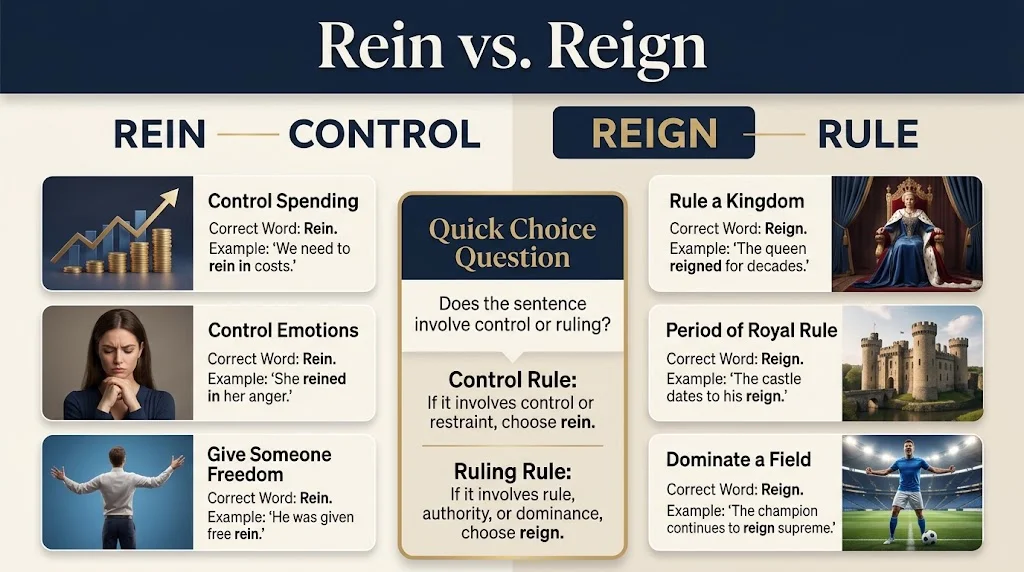
Rein vs. Reign: What Is the Difference?
The clearest way to understand rein vs. reign is to focus on the type of power involved.
Rein = control something.
Reign = rule over something.
If you rein in spending, you’re trying to control it. If a monarch reigns over a kingdom, that ruler holds authority over it.
| Meaning | Correct Word | Example |
| Control spending | Rein | We need to rein in costs. |
| Control emotions | Rein | She reined in her anger. |
| Give someone freedom | Rein | He was given free rein. |
| Rule a kingdom | Reign | The queen reigned for decades. |
| Period of royal rule | Reign | The castle dates to his reign. |
| Dominate a field | Reign | The champion continues to reign supreme. |
| A useful question can settle the choice quickly: | ||
| Does the sentence involve control or ruling? | ||
| If it involves control or restraint, choose rein. | ||
| If it involves rule, authority, or dominance, choose reign. |
Why Do Rein and Reign Sound the Same?
Rein and reign are homophones. They have the same pronunciation but different spellings and meanings. In standard English, both are pronounced /reɪn/.
That shared sound explains why people often confuse them in writing. When you hear the phrase rein in your spending, you don’t see the spelling. Context has to supply the meaning.
Written English removes that uncertainty. That’s why choosing the correct spelling matters.
Rein, Reign, and Rain
There are actually three common homophones in this group:
- Rein = control or restraint
- Reign = rule or dominance
- Rain = water falling from clouds
Consider these examples: - The manager tried to rein in expenses.
- The queen’s reign lasted several decades.
- Heavy rain flooded the streets.
The pronunciation may be similar, but the meanings are completely separate.
“Rein In” or “Reign In”: Which Is Correct?
The correct expression is rein in.
When you mean to control, restrict, or reduce something, use rein in.
Examples:
- The company needs to rein in unnecessary expenses.
- The government introduced measures to rein in spending.
- She tried to rein in her temper.
- The coach told the player to rein in his aggression.
- Consumers are trying to rein in household costs.
Reign in is incorrect when you mean control or restraint.
The reason is easy to remember. A rider uses reins to control a horse. Therefore, something you bring under control is reined in.
Why “Reign In” Is a Common Mistake
The mistake usually happens because reign sounds appropriate when the sentence involves power. However, the phrase isn’t about ruling. It’s about bringing something under control.
Compare:
company needs to rein in its spending.
company wants to control spending.
The company continues to reign as an industry leader.
The company dominates its industry.
The meanings point to different words.
“Free Rein” or “Free Reign”: Which Is Correct?
The standard expression is free rein.
Free rein means complete freedom to act, decide, create, or develop without strict control.
Examples:
- The designer was given free rein over the project.
- The director gave the writers free rein to develop the story.
- The children had free rein to choose their activities.
- She was given free rein to redesign the website.
The expression comes from horse riding. Giving a horse free rein means allowing it greater freedom of movement rather than tightly controlling it.
Is “Free Reign” Ever Used?
You may encounter free reign in modern writing because people associate reign with authority and freedom. However, free rein remains the established expression when you mean unrestricted freedom.
For formal, academic, professional, and carefully edited writing, free rein is the safer and standard choice.
Common Expressions With “Rein”
Several English expressions use rein because the word carries the basic idea of control.
Rein In
Meaning: To control, restrict, or reduce something.
Example: The company must rein in operating costs.
Free Rein
Meaning: Complete freedom to act or decide.
Example: The artist was given free rein to develop the design.
Take the Reins
Meaning: Take control or assume leadership.
Example: She took the reins after the previous manager retired.
Hand Over the Reins
Meaning: Transfer control or leadership.
Example: The founder eventually handed over the reins to his successor.
Hold the Reins
Meaning: Be in control.
Example: The new director now holds the reins.
These expressions all connect back to the same image: someone controlling a horse by holding its reins.
Common Expressions With “Reign”
The word reign appears in expressions connected with ruling, authority, and dominance.
Reign Over
Meaning: Rule or exercise authority over someone or something.
Example: The dynasty reigned over the territory for generations.
Reign Supreme
Meaning: Be the most dominant or successful.
Example: The champion continues to reign supreme.
During Someone’s Reign
Meaning: During the period when a particular ruler held power.
Example: Several major buildings were constructed during the king’s reign.
Reign of Terror
Meaning: A period marked by extreme violence, fear, or oppressive rule.
Example: The dictator’s reign of terror eventually ended.
These expressions consistently point toward rule or dominance, which makes reign the appropriate spelling.
Rein or Reign in Business Writing
Both words can appear naturally in professional and business communication.
Use rein when discussing control:
- The company needs to rein in costs.
- Management is trying to rein in unnecessary spending.
- The department must rein in its budget.
- Executives need to rein in excessive growth.
Use reign when discussing dominance or leadership: - The company continues to reign supreme in its market.
- The founder’s reign as CEO lasted more than a decade.
- The brand has reigned as the market leader for years.
The distinction is subtle but useful. Rein describes the act of controlling something. Reign describes the position or state of ruling or dominating.
Rein or Reign in Everyday English
You don’t need to discuss medieval kings or horseback riding to use these words correctly.
Rein commonly appears with:
- spending
- costs
- emotions
- expectations
- behavior
- enthusiasm
- production
- growth
- impulses
Reign commonly appears with: - monarchs
- kingdoms
- rulers
- champions
- dominant teams
- market leaders
- powerful influences
- silence
- confusion
For example, you might say:
She had to rein in her excitement.
But you could say:
Her team continues to reign supreme.
The first sentence describes control. The second describes dominance.
Rein vs. Reign Examples in Sentences
Examples With Rein
- The manager had to rein in the department’s spending.
- She struggled to rein in her frustration.
- The rider held the reins tightly.
- The designer was given free rein over the project.
- The new CEO took the reins of the company.
- The coach asked the player to rein in his temper.
- The board wants to rein in administrative costs.
Examples With Reign
- The monarch’s reign lasted more than three decades.
- Queen Victoria reigned over Britain from 1837 to 1901.
- The dynasty reigned over the region for generations.
- The athlete continues to reign supreme.
- Confusion reigned after the unexpected announcement.
- The company has reigned supreme in its market for years.
- The palace was completed during the ruler’s reign.
Rein vs. Reign: A Real-World Context
Imagine a sports team that has dominated its league for several seasons. A sports writer might say:
The champions continue to reign supreme.
Here, reign works because the team dominates its competition.
Now imagine that the same team has developed serious financial problems. Management decides to reduce unnecessary expenses. A business report might say:
The club must rein in its spending.
Here, rein works because management wants to control costs.
You can even use both words in one sentence:
The club continues to reign supreme, but its executives must rein in rising costs.
The team dominates the competition → reign.
The executives control expenses → rein.
Rein vs. Reign Grammar Guide
Both words can function as nouns and verbs, but their grammatical patterns differ.
Rein as a Noun
Common patterns include:
- the reins
- hold the reins
- take the reins
- hand over the reins
- free rein
Example:
The new director took the reins after the previous director retired.
Rein as a Verb
Common patterns include:
- rein in something
- rein somebody in
- reined in
Examples:
The company needs to rein in spending.
The coach tried to rein the player in.
Reign as a Noun
Common patterns include:
- the reign of + ruler
- during someone’s reign
- a long reign
- a short reign
- the final years of a reign
Example:
The kingdom prospered during the king’s reign.
Reign as a Verb
Common patterns include:
- reign over
- reign supreme
- reign as
- silence/confusion/chaos reigns
Examples:
The queen reigned over the kingdom.
The champion reigned supreme.
Confusion reigned after the announcement.
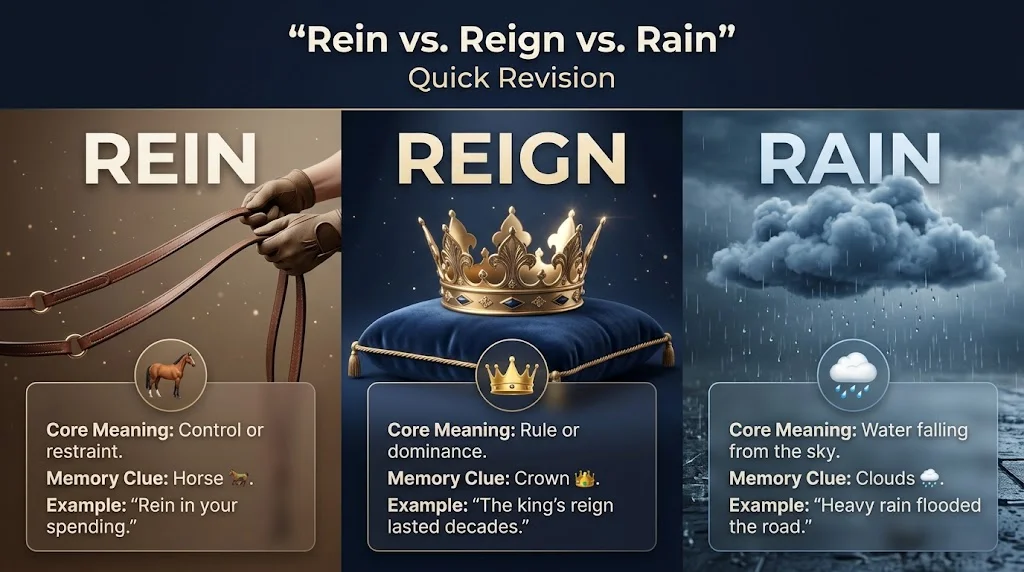
Rein, Reign, and Rain: Comparison
| Word | Core Meaning | Memory Clue | Example |
| Rein | Control or restraint | Horse | Rein in your spending. |
| Reign | Rule or dominance | Crown | The king’s reign lasted decades. |
| Rain | Water falling from the sky | Clouds | Heavy rain flooded the road. |
| A quick visual memory method works well: | |||
| Rein → horse → control | |||
| Reign → crown → rule | |||
| Rain → clouds → weather |
How to Remember
Think about a horse when you see rein.
A rider uses reins to control a horse. Therefore, rein connects with control and restraint.
Think about a crown when you see reign.
A monarch reigns over a kingdom. Therefore, reign connects with ruling and authority.
The two most useful phrases make the distinction even easier:
rein in → control
reign supreme → dominate
If you remember those two phrases, you’ll avoid many common spelling errors.
Key Insights
- Rein is connected with control, restraint, and guidance.
- Reign is connected with rule, authority, and dominance.
- Rain refers to water falling from clouds.
- Rein and reign are homophones, so they sound alike but have different meanings and spellings.
- Rein in means to control or reduce something.
- Free rein means complete freedom to act or decide.
- Take the reins means to take control or leadership.
- Reign supreme means to dominate or be the most successful.
- The easiest memory trick is: Rein → horse → control; Reign → crown → rule; Rain → clouds → weather.
- When you’re unsure, ask yourself: Am I talking about control or ruling? Control points to rein; ruling or dominance points to reign.
Read More: Accommodate or Accommodate For: Correct Spelling & Differences
Quick Comparison Chart
| Feature | Rein | Reign |
| Pronunciation | /reɪn/ | /reɪn/ |
| Word type | Noun and verb | Noun and verb |
| Core idea | Control | Rule |
| Literal connection | Horse equipment | Royal authority |
| Noun meaning | Strap used to control a horse | Period of ruling |
| Verb meaning | Control or restrain | Rule or dominate |
| Common phrase | rein in | reign supreme |
| Another common phrase | free rein | reign over |
| Memory clue | Horse | Crown |
My Personal Experience
In my experience as an English language specialist, I’ve noticed that rein and reign often confuse learners because they sound exactly alike. When I teach these words, I don’t ask students to memorize complicated definitions. Instead, I connect rein with a horse and reign with a ruler. That simple mental picture usually makes the difference click.
I’ve also seen students write phrases such as “reign in your spending” because they associate the word with power or authority. Once I explain that rein in means bringing something under control, they begin recognizing the correct usage more naturally.
Over the years, I’ve learned that showing learners how a word works in a real sentence is far more effective than giving them a definition alone.
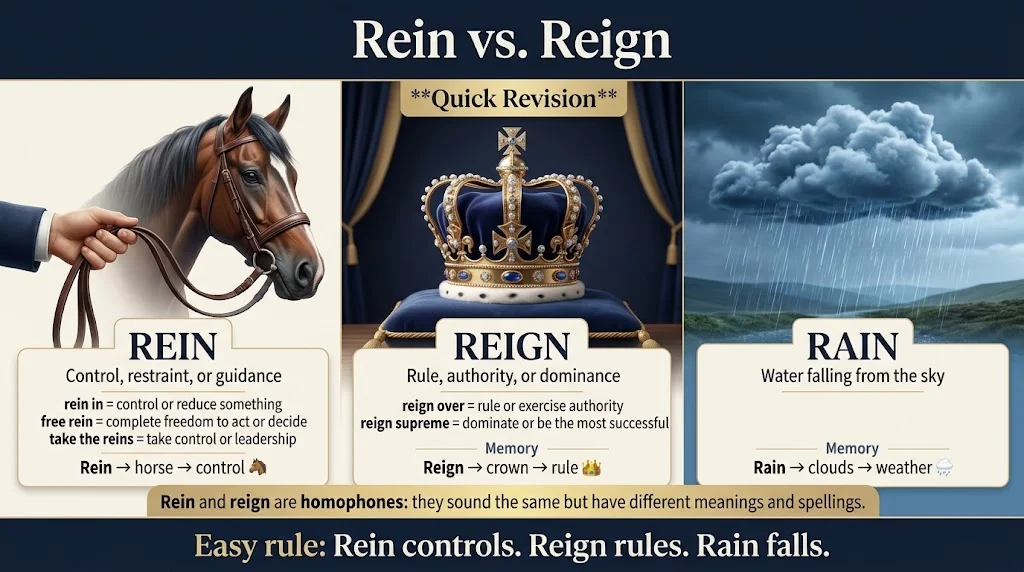
Quick Revision:
- Rein = control, restraint, or guidance.
- Reign = rule, authority, or dominance.
- Rain = water falling from the sky.
- Rein in = control or reduce something.
- Free rein = complete freedom to act or decide.
- Take the reins = take control or leadership.
- Reign over = rule or exercise authority.
- Reign supreme = dominate or be the most successful.
- Rein → horse → control 🐎
- Reign → crown → rule 👑
- Rain → clouds → weather 🌧️
- Rein and reign are homophones: they sound the same but have different meanings and spellings.
Easy rule: Rein controls. Reign rules. Rain falls.
🎯 Test Yourself: Rein, Reign, or Rain?
Choose the correct word to complete each sentence.
1. The company needs to ______ its spending before costs become too high.
a) reign
b) rein
c) rain
2. The queen’s ______ lasted for more than 40 years.
a) rein
b) rain
c) reign
3. We had to cancel the picnic because of heavy ______.
a) rain
b) rein
c) reign
4. The new manager decided to take the ______ of the department.
a) reigns
b) reins
c) rains
5. The champion continues to ______ supreme in the competition.
a) rein
b) rain
c) reign
✍️ Quick Challenge
Match each word with its main idea:
- Rein → __________
- Reign → __________
- Rain → __________
Choices: Control • Rule • Weather
Answers
- b) rein
- c) reign
- a) rain
- b) reins
- c) reign
FAQs
What is the main difference between rein and reign?
Rein relates to control, especially the straps used to guide a horse. Reign refers to the period when a king, queen, or ruler holds power over a country or group of people.
Are rein and reign pronounced the same?
Yes, rein and reign have the same pronunciation. They are homophones, which means they sound identical but have different meanings and spellings.
How can I remember when to use rein?
Think of a horse’s rein as something you hold to control movement. If the sentence involves guidance, restraint, or taking control, rein is usually the correct choice.
When should I use the word reign?
Use reign when discussing rulers, authority, or a period of leadership. For example, a queen may reign over a kingdom for many years.
Is “take the reins” or “take the reigns” correct?
The correct phrase is “take the reins.” It means accepting control, responsibility, or leadership in a situation.
Can rein be used in a figurative way?
Yes, rein can describe control beyond horses. Phrases like “keep a tight rein on spending” mean to manage or limit something carefully.
Why do people confuse rein and reign?
People confuse them because they sound exactly alike and both connect with the idea of control. However, their meanings and contexts are different.
Is “the king took the reins of the country” correct?
Usually, no. A king reigns over a country because he holds power. However, “took the reins” means taking charge or assuming responsibility.
What are some common mistakes with rein and reign?
Common mistakes include writing “take the reigns” or using “reign” when talking about controlling an object or situation.
How can I avoid mixing up rein and reign?
Look at the context. If you see horses, guidance, or control, choose rein. If you see rulers, kingdoms, or authority, choose reign.
Conclusion
Understanding rein and reign becomes easier when you focus on their meanings instead of only their pronunciation. Although these words sound the same, one connects with control and guidance, while the other represents leadership and authority. Learning this small difference can make your writing more accurate and professional.
As an English teacher, I have seen how simple word choices can affect clarity. Once you connect rein with holding control and reign with ruling power, this common confusion disappears. A little attention to context helps you use both words confidently in everyday communication and formal writing.

Mariam Asghar is an English specialist and professional content writer at ClearPhrasing.com. She is dedicated to helping readers improve their English through clear, practical, and easy-to-understand content. Her areas of expertise include grammar, spelling, vocabulary, punctuation, sentence structure, and effective writing.
At ClearPhrasing.com, Mariam writes comprehensive, well-researched articles that simplify complex language concepts for students, professionals, writers, and English learners. She believes that strong communication begins with a solid understanding of the English language and strives to make every lesson accessible and engaging.
With a strong commitment to quality, accuracy, and continuous learning, Mariam ensures that each article is carefully researched, thoroughly reviewed, and written to help readers communicate with greater confidence and clarity.