Should I vs. Shall I: Difference, Meaning, Usage, and Examples helps English learners understand two grammatically correct modal verbs with different meaning, formality, and usage.
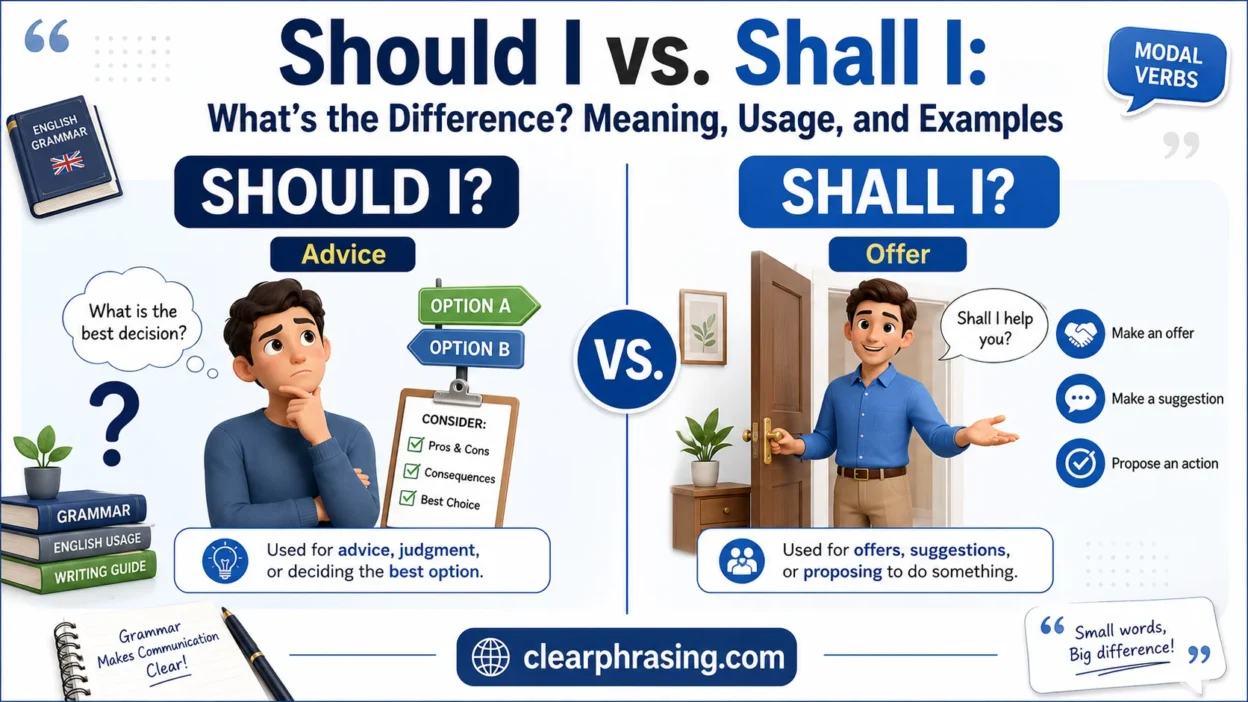
Should I usually asks for advice, a suggestion, or an opinion about the best course of action, while shall I often makes a polite offer, shows willingness, or seeks approval. These forms aren’t always interchangeable, so understanding their distinct nuances, grammar rules, and context helps you speak, write, and communicate clearly.
In formal contexts, shall can express intention or offering, while should can express obligation or advice. For example, “Should I learn Spanish?” asks whether it’s a good idea, while “Shall I open the window?” asks whether it’s okay.
From my experience teaching English speaking skills, I’ve found that real examples help a language learner distinguish these little helpers without complex grammar jargon. This improves fluency, vocabulary, and confidence when asking questions.
Quick Answer
The easiest way to remember the difference is this:
Should I = Is this a good idea?
Shall I = Do you want me to do this?
“Should I…?” usually asks for advice, guidance, or an opinion about a possible action.
“Shall I…?” commonly makes an offer, suggestion, or proposal about an action. It can also ask what action the speaker should take next.
| Expression | Main purpose | Typical meaning | Example |
| Should I…? | Ask for advice | Is this a good or appropriate idea? | “Should I apply for the job?” |
| Shall I…? | Offer or propose an action | Do you want me to do this? | “Shall I open the window?” |
There is some overlap. Context matters.
In everyday American English, “Should I…?” is generally more common when someone wants guidance. “Shall I…?” is grammatical but may sound formal, deliberate, or somewhat British depending on the situation.
In British English, “Shall I…?” remains a natural way to make an offer or ask about the next action.
Quick Comparison Chart
| Feature | Should I | Shall I |
| Core idea | Advice or guidance | Offer or proposed action |
| Common question | “Is this a good idea?” | “Do you want me to do this?” |
| Main focus | Judgment | Action |
| Everyday American English | Very common | Less common |
| British English | Common | More naturally used |
| Typical tone | Neutral | Polite, formal, deliberate, or conversational depending on context |
| Example | “Should I call him?” | “Shall I call him?” |
| Best memory aid | Advice | Offer |
What Does “Should I” Mean?
“Should I” uses the modal verb should to ask for advice or guidance. The speaker usually hasn’t decided what to do and wants another person’s judgment.
Consider this example:
“Should I take the new job?”
The speaker isn’t necessarily asking whether the listener wants them to take the job. Instead, they’re asking whether taking it would be a wise, sensible, or beneficial decision.
The basic grammatical structure is:
Should + I + base verb…?
Examples include:
- “Should I stay?”
- “Should I leave?”
- “Should I call him?”
- “Should I apologize?”
- “Should I accept the offer?”
- “Should I wait until tomorrow?”
Notice that the verb following should stays in its base form.
You say:
- Should I go?
- Should I call?
- Should I wait?
Not:
- “Should I to go?”
- “Should I going?”
- “Should I called?”
When Should I Be Used?
The expression works particularly well when you’re looking for a recommendation.
Asking for Advice
Suppose you’re considering whether to buy a particular laptop. You might ask:
“Should I buy this laptop?”
You’re asking someone to assess the decision. You want an opinion about whether the purchase makes sense.
Similarly:
“Should I accept the invitation?”
The question asks whether accepting would be a good choice.
Asking What Is Appropriate
Should I can also ask about proper behavior.
For example:
“Should I bring a gift to the dinner?”
Here, you’re asking whether bringing a gift would be appropriate.
Another example:
“Should I introduce myself first?”
The speaker wants guidance about social behavior.
Asking About the Best Choice
When several options exist, should I naturally frames a question about the better choice.
For example:
“Should I take the train or drive?”
The speaker wants advice.
The same pattern works for decisions involving work, education, travel, finances, relationships, and everyday plans.
Asking About Expected Behavior
“Should” can also refer to what someone is expected to do.
For example:
“Should I submit the form today?”
Depending on context, this could mean:
- Is today the deadline?
- Is submitting today expected?
- Would today be the appropriate time?
The surrounding situation determines the precise shade of meaning.
What Does “Shall I” Mean?
“Shall I…?” has a different flavor. It often presents an action for consideration rather than asking whether that action is generally wise.
The structure is:
Shall + I + base verb…?
Examples:
- “Shall I open the window?”
- “Shall I help you?”
- “Shall I call a taxi?”
- “Shall I start the meeting?”
- “Shall I send the report?”
- “Shall I make some coffee?”
In many situations, shall I means something close to “Would you like me to…?”
For example:
“Shall I carry that bag?”
This usually means:
“Would you like me to carry that bag?”
The speaker is offering to perform an action.
When Should You Use “Shall I”?
There are several common uses worth knowing.
Making an Offer
This is one of the clearest uses.
“Shall I help you with those boxes?”
The speaker offers assistance.
The question isn’t primarily about whether helping would be a wise personal decision. The speaker is asking whether the listener wants the action.
Asking About the Next Action
“Shall I” can also ask whether the speaker should proceed.
For example:
“Shall I send the email now?”
This can mean:
“Would you like me to send the email now?”
The speaker is ready to act and wants confirmation.
Making a Suggestion
Although shall we is particularly common for suggestions involving “we,” shall I can also introduce a proposed action.
For example:
“Shall I begin?”
This suggests that the speaker is ready to start and wants the other person to indicate whether they should proceed.
Offering Something
You can use “shall I” for simple offers:
“Shall I get you some water?”
The speaker isn’t asking, “Is drinking water a good decision?” They’re offering to get water.
That difference becomes important when you compare it with should I.
Should I vs. Shall I: The Main Difference
The clearest distinction concerns intention.
Should I usually centers on advice.
Shall I usually centers on action, an offer, or a proposal.
Compare these sentences:
“Should I call the doctor?”
This asks whether calling the doctor is advisable.
Now consider:
“Shall I call the doctor?”
This usually asks whether the speaker should make the call now or whether the listener wants the speaker to make it.
The verb call hasn’t changed. The speaker’s purpose has.
“Should I?” Asks for Advice
Imagine that you’ve received a job offer but you’re unsure whether to accept it.
You might ask a friend:
“Should I take the job?”
You’re seeking an opinion.
You could be weighing:
- salary
- working hours
- location
- career growth
- company culture
- commute
- long-term opportunities
The question invites judgment.
“Shall I?” Makes an Offer
Now imagine you’re sitting with someone whose phone is ringing.
You might ask:
“Shall I answer it?”
You’re offering to perform the action.
The focus has moved from “Is this wise?” to “Would you like me to do this?”
That’s the practical difference.
Should I vs. Shall I Examples Side by Side
Seeing the expressions in similar contexts makes the distinction much easier.
| Situation | Should I…? | Shall I…? |
| Calling someone | “Should I call Sarah?” | “Shall I call Sarah?” |
| Opening a window | “Should I open the window?” | “Shall I open the window?” |
| Sending an email | “Should I send the report?” | “Shall I send the report?” |
| Waiting | “Should I wait here?” | “Shall I wait here?” |
| Ordering food | “Should I order now?” | “Shall I order now?” |
| Starting work | “Should I start?” | “Shall I start?” |
| Offering assistance | “Should I help?” | “Shall I help?” |
The first column generally asks for judgment or advice.
The second column often asks whether the speaker should go ahead with an action.
However, these aren’t rigid mathematical formulas. Natural English relies heavily on context.
Should I vs. Shall I in Real-Life Situations
The distinction becomes much clearer when you place both expressions into realistic conversations.
Should I vs. Shall I at Work?
Imagine an employee has finished a report.
They could ask:
“Should I send the report to the client?”
This may mean:
Do you think I ought to send it?
Perhaps the employee isn’t sure whether the report needs another review.
Now consider:
“Shall I send the report to the client?”
This can sound like:
Would you like me to send it now?
The second version suggests readiness to act.
Another workplace example:
“Should I schedule another meeting?”
This asks whether another meeting would be useful.
“Shall I schedule another meeting?”
This sounds more like an offer to handle the scheduling.
That distinction can make workplace communication more precise.
Should I vs. Shall I at Home?
Suppose your friend looks cold.
You could ask:
“Shall I close the window?”
That’s an offer.
You could also ask:
“Should I close the window?”
That may sound like you’re asking whether closing it is the appropriate thing to do.
In many casual American conversations, however, the difference may feel subtle because context supplies much of the meaning.
Should I vs. Shall I in Social Situations?
Imagine you’re attending a dinner party.
You might ask:
“Should I bring a dessert?”
You’re asking whether bringing dessert would be appropriate.
But if you’re already holding a dessert and asking the host what to do, you might say:
“Shall I put this in the kitchen?”
You’re asking whether the host wants you to perform that action.
The context makes the intention clear.
Should I vs. Shall I in British and American English
Regional usage adds another layer to the discussion.
How British English Uses “Shall I?”
British English retains shall more strongly in everyday speech than American English does.
A British speaker might naturally say:
1.“Shall I open the door?”
2.“Shall I get you a cup of tea?”
3.“Shall I give you a hand?”
These expressions don’t necessarily sound stiff or old-fashioned in British English.
They can sound perfectly ordinary.
How American English Uses “Should I?”
In everyday American English, should I is often the more familiar choice when someone wants advice.
For example:
1.“Should I call her?”
2.“Should I wait?”
3.“Should I bring anything?”
Americans also frequently use alternatives such as:
- “Do you want me to…?”
- “Would you like me to…?”
- “Do you think I should…?”
- “Can I…?”
So an American speaker might say:
“Do you want me to open the window?”
where a British speaker might comfortably say:
“Shall I open the window?”
Neither construction is inherently wrong.
Is “Shall I” Old-Fashioned?
Not necessarily.
Its naturalness depends on region, context, relationship, and tone.
In some American contexts, “Shall I?” can sound formal or slightly theatrical. In British English, the same phrase may sound completely normal.
The mistake is assuming that something less common in one variety of English must be incorrect.
Frequency and correctness aren’t the same thing.
Should I vs. Shall I: Grammar Rules
Both should and shall function as modal verbs.
That means they follow specific grammatical patterns.
Sentence Structure With Should I
The standard structure is:
Should + subject + base verb
Examples:
- “Should I go?”
- “Should I stay?”
- “Should I call?”
- “Should I wait?”
- “Should I tell her?”
The main verb doesn’t take to.
Incorrect:
“Should I to call him?”
Correct:
“Should I call him?”
The main verb also doesn’t take -ing.
Incorrect:
“Should I calling him?”
Correct:
“Should I call him?”
Sentence Structure With Shall I
The pattern is similar:
Shall + subject + base verb
Examples:
- “Shall I go?”
- “Shall I stay?”
- “Shall I call?”
- “Shall I wait?”
- “Shall I tell her?”
Again, don’t add to after the modal.
Incorrect:
“Shall I to call him?”
Correct:
“Shall I call him?”
Don’t use the -ing form either.
Incorrect:
“Shall I calling him?”
Correct:
“Shall I call him?”
Why Does the Verb Stay in the Base Form?
Modal verbs such as should and shall are followed by the base form of another verb.
That’s why these patterns work:
- should go
- should call
- should wait
- shall go
- shall call
- shall wait
This rule remains consistent even when the sentence becomes longer.
“Should I call the manager before lunch?”
“Shall I send the revised document this afternoon?”
Should I vs. Shall I vs. Will I
These three expressions can look similar because they all contain modal verbs. Their purposes differ considerably.
| Question | Main idea |
| Should I go? | Is going a good idea? |
| Shall I go? | Do you want me to go? |
| Will I go? | Am I going to go? / Is it likely that I will go? |
Consider a travel example.
“Should I travel tomorrow?”
You’re asking for advice.
“Shall I travel tomorrow?”
This can ask whether you should proceed, although the phrase may sound formal or context-dependent.
“Will I travel tomorrow?”
This asks about the future event itself.
These questions shouldn’t be treated as interchangeable.
Should I vs. Shall I vs. Can I vs. May I
English has several ways to ask about an action. Each one carries a different purpose.
| Expression | Typical purpose | Example |
| Should I…? | Ask for advice | “Should I leave now?” |
| Shall I…? | Offer or propose an action | “Shall I carry that?” |
| Can I…? | Ask about ability or informal permission | “Can I leave now?” |
| May I…? | Ask for permission, often formally | “May I leave now?” |
Look at the difference in one situation:
Should I leave?
Is leaving the right choice?
Shall I leave?
Would you like me to leave?
Can I leave?
Am I allowed to leave?
May I leave?
Do I have permission to leave?
The four questions may appear in similar situations, but they don’t ask exactly the same thing.
Common Mistakes With Should I and Shall I
Using “Shall I” Whenever You Mean “Should I”
This mistake happens when learners assume shall is simply a more formal version of should.
It isn’t.
Compare:
“Should I accept the offer?”
This asks for advice.
“Shall I accept the offer?”
This can sound like you’re asking whether you should proceed. In some contexts, it may sound formal or unusual because the decision belongs primarily to the speaker.
When you want someone’s opinion about a decision, should is usually clearer.
Assuming “Shall” Is Always More Polite
Shall can sound polite, especially when making an offer.
For example:
“Shall I help you with that?”
Yet politeness doesn’t define its meaning.
The sentence is primarily an offer.
A speaker can be equally polite while saying:
“Would you like me to help you with that?”
Don’t confuse tone with grammatical function.
Treating “Shall” as Incorrect in American English
This is another common misconception.
“Shall I?” is not grammatically wrong in American English.
It simply occurs less often in casual American speech than several alternatives.
You may encounter it in formal contexts, literature, legal language, speeches, or deliberate stylistic writing.
Using “Should I” When You Mean an Offer
Suppose someone is carrying several heavy boxes.
You want to help.
“Shall I carry one?”
works naturally as an offer.
“Should I carry one?”
can instead sound as though you’re asking someone to decide whether carrying a box would be a good idea.
The difference is subtle but useful.
Confusing Advice With Permission
This mistake can create real misunderstandings.
Compare:
“Should I enter?”
This asks whether entering is advisable.
“May I enter?”
This asks for permission.
“Shall I enter?”
This can ask whether the speaker should proceed.
Three similar questions. Three different intentions.
How to Choose Between Should I and Shall I
When you’re unsure, use this simple decision process.
Are you asking whether an action is a good idea?
→ Use Should I…?
“Should I apply for this position?”
Are you offering to perform an action?
→ Use Shall I…?
“Shall I send the application?”
Are you asking for permission?
→ Consider Can I…? or May I…?
“May I leave early?”
Are you asking about a future event?
→ Consider Will I…?
“Will I need to bring my passport?”
This approach works because it focuses on meaning rather than memorization.
The most important point isn’t the number of times you hear one form compared with the other.
It’s the intention behind the question.
A Practical Case Study: One Conversation, Two Meanings
Imagine that Alex has just finished writing an important report.
Alex asks a manager:
“Should I send the report to the client?”
The manager might respond:
“Yes. It looks ready.”
Alex was asking for professional judgment.
Now imagine that the manager has already approved the report. Alex is sitting at the computer with the email open.
Alex says:
“Shall I send the report to the client?”
Here, Alex isn’t necessarily questioning the quality of the report. Alex is asking whether the manager wants the email sent now.
That tiny shift matters.
The first question concerns whether sending is a good idea.
The second concerns whether Alex should carry out the action.
Practical Examples of Should I vs. Shall I
Here are some natural examples you can use as models.
Advice
- “Should I take the earlier train?”
- “Should I tell my manager?”
- “Should I accept the invitation?”
- “Should I wait another day?”
- “Should I buy this one?”
Offers
- “Shall I carry your bag?”
- “Shall I open the window?”
- “Shall I make some coffee?”
- “Shall I call a taxi?”
- “Shall I book the table?”
Asking What to Do Next
- “Shall I start the presentation?”
- “Shall I send the document?”
- “Shall I wait outside?”
- “Shall I close the door?”
- “Shall I contact the supplier?”
Context can make some of these examples overlap with should I. That’s normal. Natural language isn’t a collection of perfectly sealed compartments.
Read More: “What Have You Done” vs. “What Did You Do”: Difference & Usage
FAQs
What is the main difference between “Should I” and “Shall I”?
“Should I” usually asks for advice or an opinion, while “Shall I” often offers to do something or asks for approval.
Is “Should I” grammatically correct?
Yes. “Should I” is grammatically correct and commonly used when asking what action would be best.
Is “Shall I” grammatically correct?
Yes. “Shall I” is correct, especially when making a polite offer or asking what someone wants you to do.
When should I use “Should I”?
Use “Should I” when you want advice about a decision, such as, “Should I apply for this job?”
When should I use “Shall I”?
Use “Shall I” when offering to do something, such as, “Shall I carry your bag?”
Does “Should I” ask for advice?
Yes. It commonly asks whether a particular choice is sensible, suitable, or recommended.
Does “Shall I” make a polite offer?
Yes. “Shall I” can politely offer help or an action, such as, “Shall I open the door?”
Is “Shall I” more formal than “Should I”?
Generally, yes. “Shall I” can sound more formal or traditional, while “Should I” is very common in everyday English.
Can “Should I” and “Shall I” be interchangeable?
Not always. They may both ask about an action, but “Should I” focuses more on advice, while “Shall I” focuses more on an offer or approval.
Which sounds more natural in everyday English?
“Should I” is usually more common for asking for advice. “Shall I” remains natural when making an offer, especially in polite or formal situations.
Conclusion
Knowing when to use Should I and Shall I can make your English sound more natural and confident. Although both forms ask questions about an action, they serve different purposes. Should I is generally used when you want advice, guidance, or an opinion about a decision. Shall I, on the other hand, often presents an offer, suggestion, or request for approval. Paying attention to the situation and the speaker’s intention makes the difference much easier to recognize.
As an English teacher, I’ve noticed that learners often remember grammar rules but still hesitate when choosing between similar expressions. The best way to build confidence is to notice these forms in real conversations and practice them in your own sentences. Once you understand the purpose behind each question, Should I and Shall I stop feeling confusing and become simple, useful parts of everyday English.

Ayesha Siddiqa is an English specialist and professional content writer at ClearPhrasing.com. She is passionate about making the English language easy to understand through clear, accurate, and engaging content. Her expertise includes English grammar, spelling, vocabulary, punctuation, word usage, and writing techniques.
At ClearPhrasing.com, Ayesha creates well-researched, reader-friendly articles designed to help students, professionals, writers, and English learners strengthen their language skills. She focuses on providing practical explanations, real-world examples, and up-to-date guidance that readers can confidently apply in everyday communication.
Committed to accuracy and clarity, Ayesha ensures that every article meets high editorial standards and delivers reliable, easy-to-follow information that empowers readers to write and communicate with confidence.