Verbiage vs. Verbage: Correct Spelling, Difference,and Usage explains why verbiage is the correct spelling and verbage is an incorrect spelling in the English language.
Both American English and British English have multiple spellings for some terms, but this is not one of them. The first known use dates to 1721, and Merriam-Webster lists the first definition as an abundance of words or a profusion of words with obscure content, while the second definition describes a manner of expressing oneself.
The French noun came from the older French verb verbier, meaning chatter. As an English teacher, I remind students to remember that wordiness, excess of words, and excess verbiage share the same meaning, making the phrase redundant. Clear grammar, careful writing, and good word choice come from the right choice of words, not a pretentious word or unnecessary words.
Quick Answer
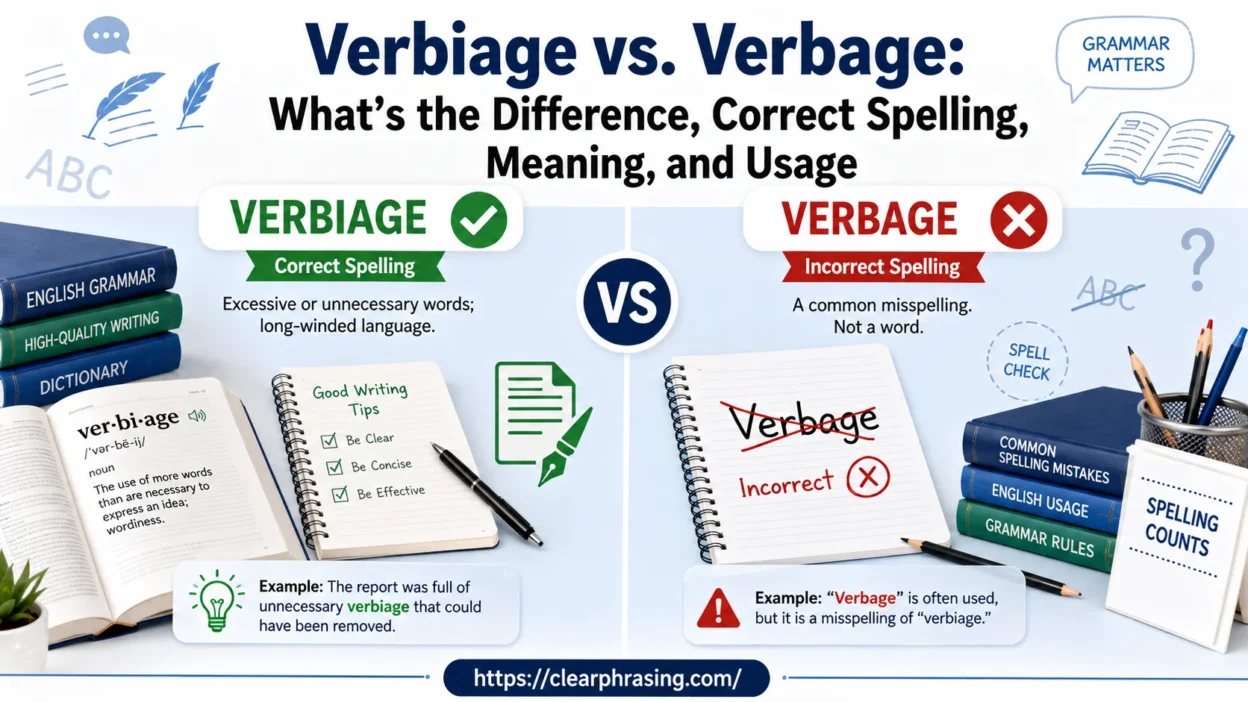
The correct spelling is verbiage.
Although verbage appears in online discussions and informal writing, it is generally considered a nonstandard variant or misspelling. In professional, academic, business, and formal writing, you should always use verbiage.
| Feature | Verbiage | Verbage |
| Standard English spelling | ✅ Yes | ❌ No |
| Accepted in formal writing | ✅ Yes | ❌ No |
| Used by professional editors | ✅ Yes | ❌ Rarely |
| Recommended choice | ✅ Always | ❌ Avoid |
| Correct: The editor removed unnecessary verbiage from the report. | ||
| Incorrect: The editor removed unnecessary verbage from the report. |
What Does Verbiage Mean?
Verbiage is a noun that refers to the words used in speech or writing. Depending on the context, it can either describe the wording of a document or suggest that too many unnecessary words have been used. Because the meaning changes with context, readers should always consider the surrounding sentence before deciding whether the word has a neutral or negative sense.
Definition
Most dictionaries define verbiage as:
- The language or wording used in spoken or written communication.
- An excessive number of words that make writing longer than necessary.
- Wordy or unnecessarily complicated language.
Although many people assume the word always carries criticism, modern English frequently uses verbiage in a neutral way to refer to the wording of contracts, policies, advertisements, or legal documents.
Pronunciation
The standard pronunciation is:
vur-bee-ij
The final sound explains why many people mistakenly spell the word as verbage. Since English spelling doesn’t always match pronunciation, this confusion is understandable, but the accepted spelling remains verbiage.
Origin and Etymology
The word verbiage entered English during the early eighteenth century from the French word verbiage. That French term ultimately comes from the Latin word verbum, meaning word.
Originally, writers used verbiage to criticize language that contained unnecessary or excessive wording. As English evolved, the word gradually developed a broader meaning. Today, it may simply describe the wording of a document without implying that the writing is too long.
Language changes over time, and verbiage is an excellent example of how meanings expand while still preserving their original sense.
Traditional Meaning vs. Modern Usage
Historically, verbiage almost always carried a negative meaning.
For example:
The report contained so much verbiage that readers struggled to identify the main point.
Today, however, many professionals use the word neutrally.
For example:
Please review the contract’s verbiage before signing.
Both meanings are correct. The surrounding context tells readers which meaning the writer intends.
Neutral and Negative Examples
Neutral usage
- We updated the verbiage in the employee handbook.
- The legal team approved the contract verbiage yesterday.
- Marketing revised the website verbiage before publication.
Negative usage - The speech contained unnecessary verbiage.
- Good editors remove excessive verbiage.
- Clear writing avoids unnecessary verbiage whenever possible.
These examples show why context matters. The same word can either describe wording objectively or criticize writing for using too many words.
Is Verbage a Real Word?
This question appears surprisingly often because verbage is common on websites, discussion forums, and social media. Seeing a word repeatedly can make it seem correct, but frequency doesn’t determine whether a spelling becomes standard English.
Most major dictionaries recognize verbiage as the accepted spelling. Some dictionaries mention verbage only because many people use it, but they generally label it as nonstandard, less common, or simply a spelling variant that should be avoided in formal writing.
Why Do People Use “Verbage”?
Several factors explain why the incorrect spelling continues to appear.
- People naturally spell words the way they hear them.
- The pronunciation hides the extra i.
- English contains many familiar words ending in -age, such as message, package, and storage.
- Fast typing and autocorrect sometimes reinforce the mistake.
- Incorrect spellings spread quickly through blogs, forums, and social media.
When millions of people repeat the same spelling mistake, it begins to look familiar. However, familiarity does not make it correct.
Should You Use Verbage?
If you’re writing for school, work, publishing, journalism, or business communication, the answer is simple.
No.
Always choose verbiage because it is the spelling recognized by editors, dictionaries, publishers, and educational institutions.
Use verbiage in:
- Academic essays
- Business emails
- Research papers
- Website content
- News articles
- Marketing materials
- Legal documents
- Professional reports
Using the standard spelling improves your credibility and helps readers focus on your ideas rather than your spelling.
Can Verbage Ever Be Acceptable?
You may occasionally see verbage in informal settings, including:
- Text messages
- Social media comments
- Online forums
- Personal blogs
- Casual conversations
Even in these situations, many readers still view verbage as incorrect. Unless you’re directly quoting someone, verbiage remains the better choice.
Verbiage vs. Verbage: Side-by-Side Comparison
| Feature | Verbiage | Verbage |
| Correct spelling | ✅ Yes | ❌ No |
| Dictionary recognition | Standard | Usually nonstandard |
| Appropriate in academic writing | ✅ Yes | ❌ No |
| Suitable for business writing | ✅ Yes | ❌ No |
| Suitable for legal writing | ✅ Yes | ❌ No |
| Common online | Yes | Yes |
| Preferred by editors | ✅ Yes | ❌ No |
| Best choice | Verbiage | Avoid |
| The comparison makes the decision easy. While both spellings appear online, only verbiage meets the standards expected in professional and academic English. |
Why Do People Misspell Verbiage as Verbage?
English spelling isn’t always predictable, and verbiage is one of those words that sounds simpler than it looks. Several linguistic and practical factors contribute to the confusion.
Pronunciation Confusion
Most speakers pronounce verbiage without clearly emphasizing the second i. As a result, listeners often assume the spelling should be verbage because that’s exactly how the word sounds.
This type of mistake is called phonetic spelling, where people write words according to pronunciation instead of their dictionary spelling.
Influence of Similar Words
English contains hundreds of words ending in -age, including:
- Message
- Package
- Mileage
- Storage
- Coverage
- Heritage
Because these words follow a familiar pattern, many writers unconsciously apply the same spelling pattern to verbiage.
Fast Typing Habits
People often type quickly without checking every word. If a spelling mistake goes unnoticed or gets copied into future documents, it becomes a habit that’s difficult to break.
Online Influence
The internet exposes readers to billions of words every day. Since user-generated content isn’t always edited, incorrect spellings spread rapidly. Repeated exposure makes verbage appear more acceptable than it actually is, even though professional dictionaries continue to recommend verbiage.
How Major Dictionaries Treat Verbiage and Verbage
Leading dictionaries consistently recognize verbiage as the standard spelling.
Merriam-Webster
Merriam-Webster lists verbiage as the accepted spelling and explains that it may refer either to wording or to an excessive use of words depending on the context.
American Heritage Dictionary
American Heritage recognizes verbiage as the standard form while acknowledging both its neutral and negative meanings.
Cambridge Dictionary
Cambridge primarily defines verbiage as language containing more words than necessary while also recognizing broader modern usage.
Dictionary.com
Dictionary.com identifies verbiage as the correct spelling and explains its historical development and current meanings.
Oxford English Dictionary
The Oxford English Dictionary records verbiage as the established English spelling and traces its history back several centuries through documented usage.
What the Evidence Shows
Although dictionaries differ slightly in wording, they reach the same conclusion.
- Verbiage is the accepted spelling.
- Verbage is generally treated as nonstandard or a misspelling.
- Professional writers, editors, publishers, and educators overwhelmingly recommend verbiage.
When you’re unsure which spelling to use, trust the major dictionaries. Doing so keeps your writing accurate, consistent, and professional.
What Style Guides Recommend
Professional style guides exist to promote consistency and clarity. Although each guide has its own rules for punctuation, capitalization, and citations, they all agree on one point: use verbiage, not verbage.
AP Style
The Associated Press (AP) Stylebook favors standard dictionary spellings. If you’re writing for newspapers, online news sites, or press releases, verbiage is the correct choice.
Chicago Manual of Style
The Chicago Manual of Style, widely used in publishing, also follows standard dictionary usage. Editors using Chicago style expect to see verbiage in manuscripts and professional publications.
MLA and APA Style
Both MLA and APA recommend standard American English spellings. Since verbiage is the accepted form in major dictionaries, it should be used in essays, research papers, and academic writing.
The Best Choice for Professional Writing
Whether you’re writing for school, work, or publication, the safest option is always verbiage. Choosing the standard spelling helps you avoid unnecessary corrections and strengthens your credibility.
When to Use Verbiage
Knowing the correct spelling is only part of the story. You should also understand when verbiage fits naturally within a sentence.
Academic Writing
In research papers and essays, verbiage often refers to the wording of a document or to unnecessarily wordy language.
Examples
- The professor recommended simplifying the paper’s verbiage.
- The revised policy uses clearer verbiage than the previous version.
Business Communication
Companies frequently use verbiage when discussing contracts, proposals, employee manuals, and marketing materials.
Examples
- The legal department approved the contract verbiage.
- Marketing updated the website verbiage before launching the campaign.
Legal Writing
Lawyers often discuss the exact verbiage of agreements because even a small wording change can affect meaning.
Example
- Both parties agreed to revise the verbiage before signing the contract.
Journalism
Editors value concise writing. They may use verbiage when discussing wording or criticizing articles that contain unnecessary language.
Example
- The editor removed excessive verbiage to improve readability.
Everyday English
Although less common in casual conversation, verbiage still appears when people discuss wording.
Example
- I like the verbiage on the invitation because it sounds warm and welcoming.
When You Should Avoid Verbiage
Even though verbiage is correct, it isn’t always the clearest word. Sometimes a simpler alternative communicates your message more effectively.
Instead of writing:
The verbiage of the email was updated.
You might write:
The wording of the email was updated.
Likewise, instead of:
The contract contains difficult verbiage.
You could write:
The contract contains difficult language.
Clear writing focuses on helping readers understand the message quickly. If another word communicates the same idea more naturally, use it.
Common Alternatives to Verbiage
| Alternative | Best Used For | Example |
| Wording | General writing | The wording is easy to understand. |
| Language | Formal documents | The language is clear and precise. |
| Text | Documents and websites | Update the text before publishing. |
| Copy | Marketing | The advertising copy needs revision. |
| Content | Digital media | The website content was rewritten. |
| Terminology | Technical subjects | Medical terminology can be complex. |
| Vocabulary | Language learning | Her vocabulary continues to grow. |
| Expression | Style and tone | His expression sounded more natural. |
| Choosing the right synonym often makes your writing more precise and easier to read. |
Examples of Verbiage in Sentences
Seeing words in context is one of the fastest ways to learn how to use them correctly.
Professional Examples
- The manager approved the final verbiage for the company handbook.
- The proposal’s verbiage accurately reflects our goals.
- The contract verbiage protects both parties.
Academic Examples
- The researcher simplified the verbiage without changing the meaning.
- The instructor encouraged students to avoid unnecessary verbiage.
- Clear verbiage improves academic writing.
Business Examples
- We updated the product verbiage to match the new branding.
- Customers appreciated the simpler verbiage on the website.
- The revised verbiage reduced customer confusion.
Everyday Examples
- I like the verbiage on the greeting card.
- The instructions use simple verbiage that’s easy to follow.
- His speech included too much verbiage.
Incorrect Examples Using Verbage
The following sentences contain the nonstandard spelling.
❌ The company changed the verbage on its website.
✅ The company changed the verbiage on its website.
❌ Please review the legal verbage before signing.
✅ Please review the legal verbiage before signing.
❌ The report contains unnecessary verbage.
✅ The report contains unnecessary verbiage.
Replacing verbage with verbiage immediately makes these sentences suitable for professional writing.
Verbiage in Positive and Negative Contexts
One reason this word causes confusion is that it doesn’t always carry the same tone.
Neutral Meaning
Here, verbiage simply means wording.
- The brochure’s verbiage reflects the company’s values.
- The agreement contains updated verbiage.
Negative Meaning
Here, verbiage refers to unnecessary words.
- The article suffers from excessive verbiage.
- Strong editing removes unnecessary verbiage.
Understanding the context helps you interpret the intended meaning correctly.
Common Collocations with Verbiage
The word frequently appears with certain adjectives and nouns.
- Excessive verbiage
- Legal verbiage
- Technical verbiage
- Corporate verbiage
- Marketing verbiage
- Flowery verbiage
- Promotional verbiage
- Complex verbiage
Learning these common word combinations will make your English sound more natural.
Words Commonly Confused with Verbiage
Although they are related, these words have different meanings.
| Word | Meaning |
| Verbosity | Using too many words when fewer would do. |
| Vocabulary | The collection of words a person knows. |
| Terminology | Specialized words used in a field. |
| Diction | A person’s choice of words. |
| Jargon | Technical language understood by a specific group. |
| Phraseology | The characteristic way words and phrases are arranged. |
Verbiage vs. Verbosity
People often use these terms interchangeably, but they aren’t identical.
| Verbiage | Verbosity |
| Refers to wording or excessive wording. | Refers only to being wordy. |
| Can be neutral or negative. | Almost always negative. |
| Often describes documents. | Usually describes a writing or speaking style. |
| If you’re discussing the wording of a contract, verbiage is the better choice. If you’re criticizing someone for using far too many words, verbosity is usually more accurate. |
Memory Trick to Remember the Correct Spelling
A simple trick can help you remember the correct form.
Think of the word verb. Now add -iage instead of -age.
Verb + iage = Verbiage
Another helpful reminder is this:
If the word relates to “verb,” don’t forget the extra “i.”
This quick memory trick makes it much easier to avoid writing verbage.
Read More: Affect vs Effect: Difference, Meaning, and Correct Usage
FAQs
Q1: Is verbiage or verbage the correct spelling?
Verbiage is the correct spelling in standard English. Although many people write verbage, dictionaries and style guides recognize it as a misspelling rather than an accepted variant.
If you want your writing to look professional, always use verbiage. This is especially important in academic, business, and formal communication where spelling accuracy matters.
Q2: Why do people spell verbiage as verbage?
Many writers shorten the word because it sounds similar when spoken. They may also confuse it with words like garbage, baggage, or postage, which follow a similar spelling pattern.
Over time, this pronunciation has caused many spelling mistakes. However, the accepted spelling has remained verbiage.
Q3: What does verbiage actually mean?
Traditionally, verbiage means using more words than necessary. It often refers to unnecessary or overly complicated wording.
Today, some people also use it to mean the wording or language used in a document or conversation, although the original meaning is still widely recognized.
Q4: Can I use verbage in formal writing?
No. You should avoid verbage in essays, reports, emails, articles, and professional documents because it is considered incorrect by major dictionaries.
Using verbiage instead shows that you understand standard English spelling and helps build credibility with readers.
Q5: Is verbiage used in business communication?
Yes. The word frequently appears in corporate settings when discussing the wording of emails, contracts, presentations, or marketing materials.
Even so, plain words like language, text, or wording are often clearer and easier for readers to understand.
Q6: Is verbiage an American or British English word?
The spelling verbiage is correct in both American English and British English. There is no regional difference that makes verbage acceptable.
Whether you are writing for a US or UK audience, you should always choose verbiage.
Q7: How can I remember the correct spelling of verbiage?
A simple memory trick is to remember that verbiage contains the letters “iage,” just like the dictionary spelling. If you see verbage, think of it as a common typo.
Reading the word regularly and using spellcheck can also help reinforce the correct form.
Q8: Is verbiage always a negative word?
Not always. It originally had a negative sense of unnecessary wordiness, but modern usage sometimes refers simply to the wording of a document.
The meaning often depends on the context and the writer’s intention.
Q9: What words can I use instead of verbiage?
Depending on the sentence, you can use wording, language, text, phrasing, expression, or terms.
Choosing a simpler alternative can make your writing more natural and easier to read.
Q10: Should I avoid using verbiage altogether?
Not necessarily. The word is correct and useful when discussing excessive wording or the wording of a document.
However, if a simpler word communicates your idea just as well, using that option often creates clearer and stronger writing.
Conclusion
Understanding the difference between verbiage and verbage helps you avoid one of the most common English spelling mistakes. While verbiage is the only accepted spelling, verbage continues to appear because of pronunciation habits and confusion with similar-looking words. Knowing this distinction makes your writing more accurate and professional.
From my experience teaching English for many years, I have found that students remember this rule best when they focus on dictionary usage instead of how the word sounds. Whenever you write, choose verbiage, keep your language clear, and prefer simple wording over unnecessary complexity. Those small choices improve both your grammar and your overall writing style.

Ayesha Siddiqa is an English specialist and professional content writer at ClearPhrasing.com. She is passionate about making the English language easy to understand through clear, accurate, and engaging content. Her expertise includes English grammar, spelling, vocabulary, punctuation, word usage, and writing techniques.
At ClearPhrasing.com, Ayesha creates well-researched, reader-friendly articles designed to help students, professionals, writers, and English learners strengthen their language skills. She focuses on providing practical explanations, real-world examples, and up-to-date guidance that readers can confidently apply in everyday communication.
Committed to accuracy and clarity, Ayesha ensures that every article meets high editorial standards and delivers reliable, easy-to-follow information that empowers readers to write and communicate with confidence.