Accommodate or Accommodate For: Correct Spelling, and Differences often causes confusion because accommodate is a commonly misspelled word.
The correct spelling contains two double letters, making it easy to forget one pair. In my teaching experience, I’ve seen this spelling mistake in academic writing, business reports, and formal emails.
A useful memory trick is to remember that accommodate has room for two pairs of letters. Regular proofreading and spelling practice can improve your writing accuracy, English proficiency, and overall language skills.
The usage of accommodate and accommodate for also differs by context and meaning. Accommodate commonly means making room or adjusting something to fit needs, such as a hotel accommodating 200 guests. Accommodate for can describe adjustments made for a particular reason or situation.
Understanding the verb, preposition, sentence structure, and English usage helps you choose the correct form. As an English teacher, I encourage learners to connect each word with its practical context, purpose, and meaning.
Quick Answer:
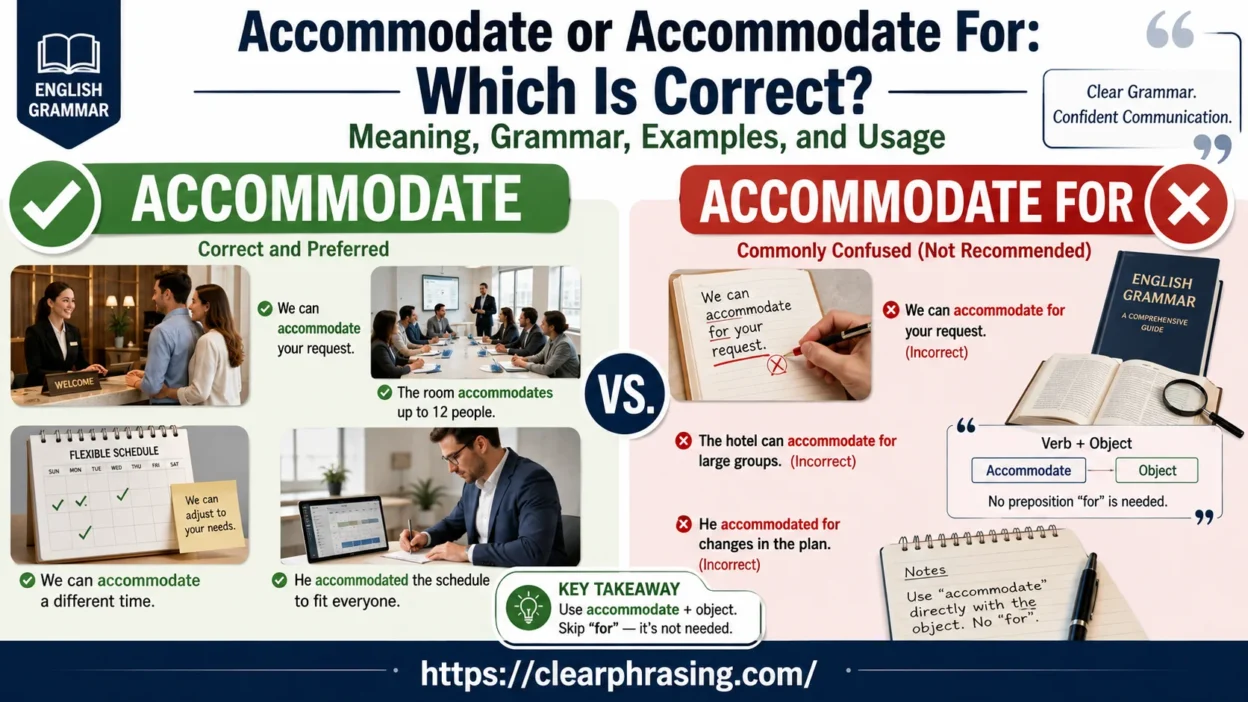
Accommodate is normally the correct choice when the verb means to adjust to something, make room for something, meet someone’s needs, or provide space for someone.
The usual structure is:
accommodate + person, thing, need, request, change, or requirement
For example:
- The hotel can accommodate 300 guests.
- The schedule can accommodate everyone’s availability.
- The company agreed to accommodate her request.
- This room can accommodate a large conference table.
- The software can accommodate additional users.
In these sentences, adding for would normally be unnecessary.
However, for can appear near accommodate when it serves another grammatical purpose. For example, “The hotel can accommodate a room for the wedding party” has a different structure. The preposition belongs to the phrase that follows the object rather than forming the standard verb phrase “accommodate for.”
A useful rule is simple:
Use “accommodate” when you mean adjust, fit, house, or meet a need. Use “allow for” when you mean make provision for something or take it into consideration.
Quick Comparison
| Phrase | Correct? | Main Use | Example |
| accommodate guests | Yes | Provide space or service | The hotel accommodates 200 guests. |
| accommodate needs | Yes | Meet needs | The policy accommodates employee needs. |
| accommodate requests | Yes | Meet requests | We can accommodate your request. |
| accommodate changes | Yes | Adjust to changes | The system accommodates changes. |
| accommodate for guests | Usually no | Unnecessary construction | Avoid this when “guests” is the direct object. |
| allow for guests | Yes | Make provision for guests | The plan allows for additional guests. |
| make accommodations for guests | Yes | Provide adjustments | The hotel makes accommodations for guests. |
What Does Accommodate Mean?
The verb accommodate has several closely related meanings. Although these meanings appear in different situations, they all involve some form of making room, adapting, or providing what is needed.
Accommodate Means “Make Room For”
One common meaning involves physical space.
If a place can hold a particular number of people or objects, you can say that it accommodates them.
For example:
- The auditorium can accommodate 1,000 people.
- The parking area can accommodate 50 cars.
- The apartment can comfortably accommodate a family of four.
- The conference room can accommodate 20 employees.
Notice the grammatical structure. The object follows accommodate directly.
Correct: The hall accommodates 500 guests.
Usually incorrect: The hall accommodates for 500 guests.
The verb already expresses the idea of having enough space or capacity. Adding for doesn’t improve the sentence.
Accommodate Means “Meet Someone’s Needs”
Accommodate can also mean to adjust something so that it works for another person.
Consider this example:
Manager changed the employee’s schedule to accommodate her childcare needs.
He didn’t simply provide physical space. The manager adjusted an arrangement to meet a particular need.
This meaning appears frequently in schools, workplaces, hotels, restaurants, and customer service.
Examples include:
- The restaurant can accommodate dietary restrictions.
- The school tries to accommodate students’ learning needs.
- The employer agreed to accommodate his request.
- The hotel can accommodate guests with special requirements.
Accommodate Means “Adjust to a Change”
Another important meaning involves adapting plans or systems.
For example:
- We moved the meeting to accommodate everyone’s schedule.
- The project timeline was revised to accommodate the delay.
- The website was redesigned to accommodate mobile users.
- The policy needs to change to accommodate new regulations.
Here, accommodate means adjust something so it can work successfully under changed circumstances.
Accommodate Means “Provide Lodging”
In travel and hospitality, accommodate can mean provide a place to stay.
For example:
- The resort can accommodate 400 guests.
- The hotel can accommodate large families.
- The inn can accommodate overnight visitors.
This use is especially common in descriptions of hotels, resorts, camps, and other lodging facilities.
Why Is “Accommodate For” So Commonly Confused?
The confusion comes partly from English verbs that genuinely require for.
Consider these expressions:
- allow for unexpected problems
- account for additional costs
- plan for delays
- prepare for emergencies
- provide for future needs
Because these phrases contain for, writers sometimes transfer the same pattern to accommodate.
That creates sentences such as:
The schedule needs to accommodate for the delay.
The intended meaning is understandable. Yet standard edited English normally prefers:
The schedule needs to accommodate the delay.
Or, if the intended meaning is “make provision for”:
The schedule needs to allow for the delay.
The distinction becomes much easier once you focus on the meaning of each verb instead of trying to memorize every preposition separately.
Accommodate vs. Accommodate For: Grammar Difference
Accommodate commonly works as a transitive verb. That means it can take a direct object.
The basic structure looks like this:
Subject + accommodate + object
Examples:
- The hotel accommodates guests.
- The policy accommodates employees.
- The system accommodates new users.
- The schedule accommodates changes.
- The venue accommodates large groups.
The noun or noun phrase after accommodate receives the action directly.
That’s why these sentences don’t normally require for.
Compare the Structures
| Verb | Common Structure | Example |
| accommodate | accommodate + object | The system accommodates new users. |
| allow for | allow for + object | The budget allows for unexpected costs. |
| account for | account for + object | Labor accounts for 30% of the cost. |
| prepare for | prepare for + object | We prepared for heavy traffic. |
| plan for | plan for + object | They planned for possible delays. |
| provide for | provide for + object | The policy provides for future expansion. |
The verbs may seem similar because they can all describe planning or adjustment. Their grammatical patterns aren’t identical.
When Can “For” Appear With “Accommodate”?
It’s important not to turn a useful grammar rule into an absolute rule.
The phrase “accommodate for” isn’t a useful standard replacement for accommodate in ordinary modern usage when the object directly follows the verb. However, for can legitimately occur elsewhere in a sentence involving accommodate.
Consider:
The company can accommodate the new employee with a private office for meetings.
Here, for meetings modifies office. It doesn’t create the verb phrase accommodate for.
Another example:
The venue can accommodate 200 guests for the evening event.
Here, for the evening event describes the occasion. It doesn’t mean that accommodate for is functioning as a two-word verb.
This distinction matters because English sentences often place prepositional phrases near verbs. Proximity doesn’t automatically mean that the preposition belongs to the verb.
Accommodate vs. Allow For
This is one of the most important comparisons to understand.
Accommodate
Accommodate usually means adjust to, make room for, fit, or meet the needs of something or someone.
The schedule accommodates remote employees.
The schedule has been arranged in a way that works for them.
Allow For
Allow for usually means make provision for, consider, or include something when planning.
The schedule allows for unexpected delays.
The schedule contains enough flexibility to deal with delays.
The meanings overlap slightly in some situations. Still, the emphasis differs.
| Expression | Core Meaning | Example |
| accommodate | Adjust to or meet a need | The plan accommodates new requirements. |
| allow for | Make provision for something | The plan allows for unexpected delays. |
| account for | Explain or represent a portion | These expenses account for 20% of the budget. |
A quick memory trick helps:
Accommodate = adjust.
Allow for = make room in your plan.
Accommodate vs. Account For
Writers also confuse accommodate with account for.
These verbs can appear in business and planning contexts. Their meanings remain different.
Accommodate means to adapt or make room for something.
The software can accommodate additional customers.
Account for can mean explain something.
The report must account for the unexpected increase in costs.
It can also mean constitute or represent a portion of something:
Online sales account for nearly half of the company’s revenue.
Replacing one expression with the other can completely change the meaning.
Correct Sentence Patterns With Accommodate
Learning common patterns gives you a more reliable grasp of the verb.
Accommodate + Person
Use this structure when someone receives the adjustment, space, or service.
- The hotel can accommodate 200 guests.
- The school works hard to accommodate students.
- The restaurant can accommodate large groups.
Accommodate + Need
This pattern often appears in education, employment, healthcare-related services, and customer support.
- The program accommodates different learning needs.
- The company accommodates employees’ scheduling needs.
- The facility accommodates accessibility needs.
Accommodate + Request
This construction works well in professional communication.
- We were happy to accommodate your request.
- The manager agreed to accommodate the customer’s request.
- The team couldn’t accommodate every request.
Accommodate + Change
Use this form when an existing arrangement needs adjustment.
- The system can accommodate the change.
- The schedule was revised to accommodate the change.
- The building design can accommodate future changes.
Accommodate + Requirement
This pattern appears frequently in technical, business, and formal writing.
- The software can accommodate new requirements.
- The facility was designed to accommodate safety requirements.
- The proposal must accommodate regulatory requirements.
Accommodate in Different Contexts
Accommodate in Business and Workplace English
Business writing often uses accommodate when discussing schedules, employee needs, customer requests, and operational changes.
For example:
We can accommodate your preferred meeting time.
This sounds natural and professional.
Compare it with:
We can accommodate for your preferred meeting time.
The second version adds an unnecessary for.
In workplace communication, concise grammar matters because unclear wording can make a simple request sound less polished.
Accommodate in Education
Schools and universities frequently need to adjust systems around different student needs.
Examples include:
- The course accommodates different learning styles.
- The instructor adjusted the deadline to accommodate the student’s circumstances.
- The classroom can accommodate additional students.
- The program accommodates students with varying levels of experience.
The verb works especially well when the sentence focuses on adjustment or inclusion.
Accommodate in Travel and Hospitality
Hotels, restaurants, and event venues use accommodate when discussing capacity and guest needs.
Examples:
- The hotel can accommodate 150 guests.
- The restaurant can accommodate parties of ten.
- The venue accommodates large conferences.
- The resort can accommodate families with young children.
Capacity is one of the clearest situations in which accommodate takes a direct object.
Accommodate in Scheduling
Scheduling creates another common source of confusion.
Suppose three departments need to attend a meeting. You might write:
We changed the meeting time to accommodate everyone’s availability.
That’s natural because the schedule has been adjusted to meet a need.
You could also say:
We added extra time to allow for questions.
Here, allow for works because the sentence means that the schedule includes additional time in anticipation of questions.
The two verbs perform different jobs.
Common Mistakes
Adding “For” Automatically
Incorrect or awkward:
The hotel can accommodate for 300 guests.
Better:
The hotel can accommodate 300 guests.
The verb already takes 300 guests as its object.
Confusing Accommodate With Allow For
Less appropriate:
The budget needs to accommodate for unexpected expenses.
If the intended meaning is to include money for expenses that might occur, use:
The budget needs to allow for unexpected expenses.
If the intended meaning is that the budget itself must be adjusted to handle those expenses, you could use:
The budget needs to accommodate unexpected expenses.
The choice depends on the intended meaning.
Confusing Accommodate With Account For
Incorrect meaning:
The report should accommodate the increase in expenses.
If you mean that the report should explain the increase, account for is more precise:
The report should account for the increase in expenses.
If you mean the plan should adapt to the increase, accommodate may be appropriate:
The budget should accommodate the increase in expenses.
One word changes the relationship between the action and the expense.
Confusing Accommodate With Accommodation
These words share the same root but have different grammatical roles.
Accommodate is a verb:
The hotel can accommodate 100 guests.
Accommodation is a noun:
The hotel provides comfortable accommodation.
You can’t freely substitute one for the other.
Accommodate vs. Make Accommodations For
There’s an important difference between accommodate and make accommodations for.
Both can be correct.
Consider:
The school accommodates students with disabilities.
You can also write:
The school makes accommodations for students with disabilities.
The second expression uses the noun accommodations rather than the verb accommodate.
This distinction explains why some writers mistakenly produce accommodate for. They may blend two legitimate structures:
accommodate someone
and
make accommodations for someone
The result is an unnecessary hybrid.
Think of them as separate grammatical patterns:
- accommodate students
- make accommodations for students
Not:
- accommodate for students
Real-World Examples
Consider these practical situations.
Case Study: A Hotel Booking
A customer wants to reserve rooms for a large family.
Natural:
Can your hotel accommodate a family of 12?
The hotel is being asked whether it can provide enough space or suitable arrangements.
Awkward:
Can your hotel accommodate for a family of 12?
The for isn’t needed after accommodate.
Case Study: A Business Meeting
A manager needs to change a meeting because several employees work remotely.
Natural:
We moved the meeting online to accommodate remote employees.
The meeting arrangement changed to meet their needs.
Now consider a different situation:
We scheduled an extra 15 minutes to allow for technical problems.
Here, allow for means the schedule anticipates a possible problem.
Both sentences are correct because the verbs express different ideas.
Case Study: Project Planning
A software company expects its user base to grow.
Natural:
The platform must accommodate thousands of additional users.
The system needs enough capacity to handle them.
If the company is discussing risk planning, a different expression may work better:
The project timeline should allow for unexpected development issues.
The first sentence focuses on capacity. The second focuses on planning for possibilities.
How to Remember the Difference
Here’s a simple memory rule:
Accommodate takes what you are adjusting for directly.
You accommodate:
- people
- needs
- requests
- changes
- requirements
- circumstances
- users
- groups
- guests
So you can say:
The schedule accommodates employees.
The software accommodates new users.
The hotel accommodates guests.
When you mean “make provision for”, think of allow for instead:
The schedule allows for delays.
The budget allows for unexpected costs.
The plan allows for future changes.
This distinction will prevent most accommodate or accommodate for mistakes.
Practice Quiz:
Choose the expression that best completes each sentence.
Question One
The conference center can ______ 800 attendees.
Answer: accommodate
The conference center can accommodate 800 attendees.
The verb takes 800 attendees directly.
Question Two
The budget should ______ unexpected repair costs.
Answer: allow for
The budget should allow for unexpected repair costs.
Here, the meaning involves planning for possible expenses.
Question Three
The company changed the schedule to ______ employees with young children.
Answer: accommodate
The company changed the schedule to accommodate employees with young children.
The schedule was adjusted to meet their needs.
Question Four
The software needs to ______ additional users.
Answer: accommodate
The software needs to accommodate additional users.
The system must have the capacity to handle them.
Question Five
The itinerary should ______ traffic delays.
Answer: allow for
The itinerary should allow for traffic delays.
The sentence focuses on anticipating possible delays.
Question Six
The restaurant can ______ large parties.
Answer: accommodate
The restaurant can accommodate large parties.
The restaurant has enough space or resources for them.
Read More: Would You Be Available vs. Will You Be Available: Difference
FAQs
Is “Accommodate” the Correct Spelling?
Yes. Accommodate is the correct spelling. A common mistake is writing “acommodate,” which leaves out one m.
Why Is “Accommodate” So Often Misspelled?
The word has two sets of double letters: cc and mm. Because they appear close together, writers often remember one pair and forget the other.
What Does “Accommodate” Mean?
Accommodate can mean making room for someone, providing a place to stay, or adjusting something to meet particular needs.
Is “Accommodate For” Grammatically Correct?
Accommodate for can be used when referring to an adjustment made because of a particular situation or reason. However, accommodate alone is more common.
What Is the Difference Between “Accommodate” and “Accommodate For”?
Accommodate generally means to make room or adjust something. Accommodate for emphasizes making an adjustment because of a specific condition or circumstance.
Can “Accommodate” Be Used for People?
Yes. For example, you can say, “The hotel can accommodate 200 guests.” It means the hotel has enough space or facilities for them.
Is “Acommodate” Ever Correct?
No. Acommodate is a misspelling. The correct form is accommodate, with both cc and mm.
How Can I Remember the Spelling of “Accommodate”?
Remember that accommodate has room for two pairs of letters: cc and mm. This simple memory trick can make the spelling easier to recall.
Which Form Is More Common: “Accommodate” or “Accommodate For”?
Accommodate is much more common in everyday and formal English. Use accommodate for only when the context specifically calls for that construction.
What Is the Best Way to Avoid Spelling “Accommodate” Wrong?
Focus on the two double-letter pairs, cc and mm, and check the word during proofreading. Regular spelling practice also builds confidence.
Conclusion
Accommodate is one of those English words that looks more difficult than it really is. Once you remember its two double-letter pairs, cc and mm, the spelling becomes much easier. The key is to recognize that “acommodate” is incorrect and that accommodate is the standard spelling.
The difference between accommodate and accommodate for depends more on usage and context than spelling. In most situations, accommodate is the natural choice for making room or meeting someone’s needs. Understanding the meaning behind each form will help you write with greater accuracy and confidence.

Mehwish Imtiaz is an English specialist and professional blog writer at ClearPhrasing.com. She specializes in grammar, spelling, vocabulary, punctuation, and writing improvement. With a strong passion for clear communication and language education, she creates reader-friendly articles that help students, professionals, and English learners understand complex language topics with ease.
Her writing focuses on accuracy, simplicity, and practical usage, ensuring that every article provides clear explanations and real-world examples. At ClearPhrasing.com, Mehwish is committed to publishing well-researched, original content that helps readers write more confidently and communicate more effectively in everyday and professional English.