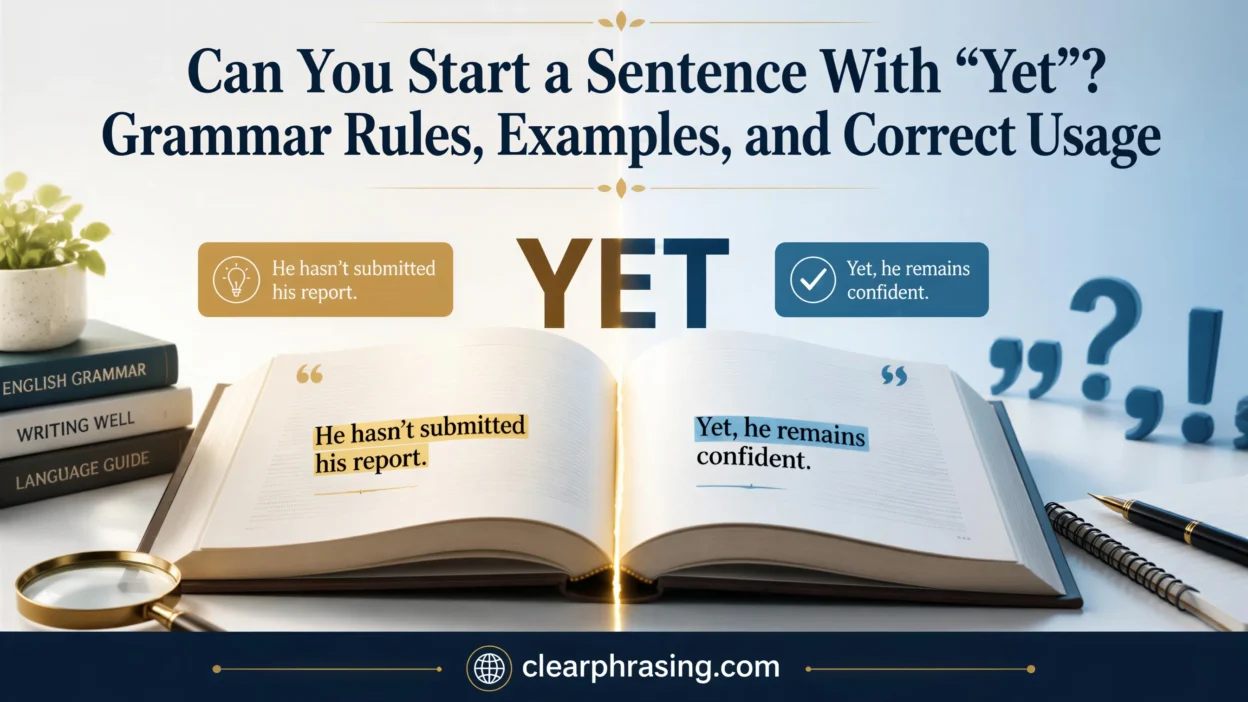
Can You Start a Sentence With “Yet”? Grammar and Correct Usage is easier to understand when you see yet as a flexible sentence opener.
In modern English grammar, this grammar rule isn’t absolute. The English language changes through language evolution, so traditional grammar guidelines can allow some wiggle room. Yet can show contrast, connect a previous thought, or create a surprising turn.
In academic writing, comma usage deserves attention. When “yet” starts a sentence, a comma may follow it when yet works as an introductory word. However, comma placement, comma rules, and comma exceptions depend on sentence structure and meaning. Understanding commas after “yet”, sentence punctuation, parentheses, and parenthetical punctuation can prevent confusion.
As a teacher, I’ve noticed that students often feel puzzled by this conundrum because they’ve heard the rule time and time again. A practice sheet with clear examples can build knowledge, improve understanding, and strengthen correct usage. Regular practice and assessment help learners use yet naturally.
Quick Answer:
Yes, you can start a sentence with “yet.”
When yet means “but,” “nevertheless,” or “despite that,” it can introduce a sentence that contrasts with the previous idea.
For example:
- The evidence looked convincing. Yet one important detail was missing.
- The device is inexpensive. Yet it performs surprisingly well.
- She studied for weeks. Yet the exam still surprised her.
- The instructions seem simple. Yet many readers misunderstand them.
In these examples, yet connects the new sentence to the previous one by creating contrast.
However, don’t assume that every sentence beginning with yet automatically sounds good. The contrast should make sense. If the relationship between the two ideas feels weak or artificial, another transition may work better.
What Does “Yet” Mean at the Beginning of a Sentence?
The meaning of yet depends on how you use it. This small word does several jobs in English, which explains some of the confusion surrounding it.
When yet begins a sentence as a conjunction, it usually introduces something unexpected or contrary to what came before.
Compare:
The restaurant had excellent reviews. Yet the food disappointed us.
The first sentence creates a positive expectation. The second sentence overturns it.
That’s the power of yet. It puts two ideas into tension.
“Yet” as a Coordinating Conjunction
As a conjunction, yet can connect contrasting clauses:
The task was difficult, yet everyone completed it.
It can also introduce a new sentence:
The task was difficult. Yet everyone completed it.
The meaning remains essentially the same. The punctuation and sentence structure change.
This distinction matters because starting with a conjunction doesn’t automatically make a sentence grammatically wrong.
“Yet” as an Adverb
Yet also functions as an adverb. In this role, it often relates to time, expectation, continuation, or emphasis.
For example:
- I haven’t finished yet.
- Has the package arrived yet?
- We haven’t received an answer yet.
- That was her best performance yet.
- We may yet find a solution.
So these two sentences use yet differently:
Yet the results were surprising.
Here, yet means something like “nevertheless.”
The results haven’t arrived yet.
Here, yet refers to time up to the present.
That difference matters when you’re deciding how to structure a sentence.
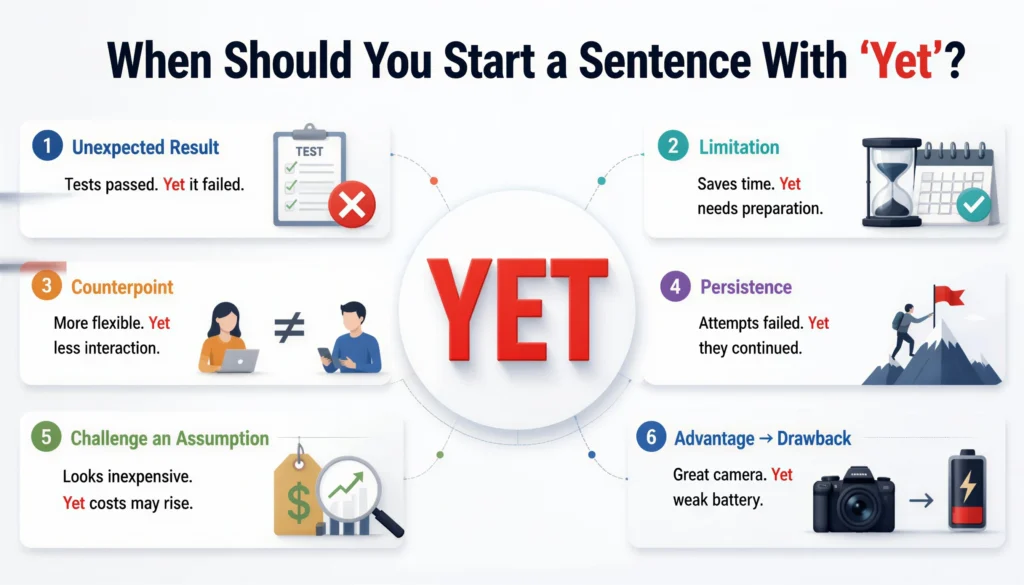
When Should You Start a Sentence With “Yet”?
Starting a sentence with yet works particularly well when the previous sentence establishes an expectation and the next sentence challenges it.
To Introduce an Unexpected Result
The software passed every laboratory test. Yet it failed during real-world use.
The second sentence surprises the reader because the first sentence suggests success.
To Introduce a Limitation
The new method saves considerable time. Yet it requires careful preparation.
Here, yet prevents the first statement from sounding like the whole story.
To Present a Counterpoint
Online learning offers greater flexibility. Yet some students struggle without face-to-face interaction.
The second sentence balances the first rather than simply contradicting it.
To Show Persistence
Several attempts had failed. Yet the researchers continued.
Here, yet highlights persistence despite an unfavorable situation.
To Challenge an Assumption
The proposal appears inexpensive. Yet the long-term costs could be substantial.
The second sentence asks the reader to reconsider the first impression.
To Shift From an Advantage to a Drawback
The phone has an impressive camera. Yet its battery life is disappointing.
This structure works especially well in reviews, comparisons, reports, and analytical writing.
Does “Yet” Need a Comma at the Beginning of a Sentence?
Usually, no comma follows sentence-initial “yet” when it functions as a coordinating conjunction.
Write:
Yet the problem remains unresolved.
Not:
Yet, the problem remains unresolved.
The comma isn’t normally needed simply because yet appears at the beginning.
Compare it with however:
Yet the evidence remains limited.
However, the evidence remains limited.
The punctuation differs because the words have different grammatical behavior in these constructions.
When a Comma Can Appear After “Yet”
A comma may appear later in the sentence because another element requires punctuation.
For example:
Yet, despite several warnings, the problem continued.
Here, the commas surround the interrupting phrase despite several warnings. The punctuation isn’t simply a rule saying “put a comma after yet.”
Likewise:
Yet after months of testing, the researchers found another problem.
The comma follows the introductory phrase after months of testing.
The practical rule is simple: don’t automatically place a comma after sentence-initial “yet.” Examine the entire sentence instead.
Can You Start a Paragraph With “Yet”?
Yes. Yet can begin a paragraph when the paragraph deliberately contrasts with the preceding discussion.
For example:
The first trial produced encouraging results. The treatment reduced symptoms in most participants.
Yet the second trial produced a very different outcome. Researchers found little evidence of the same effect.
The opening yet immediately tells readers that the discussion is changing direction.
This technique works particularly well when a paragraph introduces:
- a counterargument
- a limitation
- an unexpected finding
- a conflicting result
- an important qualification
- a different interpretation
However, paragraph openings need stronger logical connections than ordinary sentence transitions. If readers can’t tell what yet contrasts with, the transition feels loose.
Repeatedly starting paragraphs with yet can also become predictable. Good prose needs rhythm. Sometimes however, nevertheless, despite this, or a direct sentence without a transition will work better.
Can You Start a Sentence With “Yet” in Formal Writing?
Yes.
Sentence-initial yet isn’t inherently informal. You can use it in essays, academic writing, reports, professional documents, journalism, and other formal contexts.
For example:
The study identified a consistent relationship between the variables. Yet the limited sample size prevents a definitive conclusion.
That sentence is formal, precise, and grammatically sound.
The important point is that formal writing doesn’t mean avoiding ordinary grammatical structures. Good formal writing depends on clarity, accuracy, logical organization, and appropriate tone.
A writer who avoids every sentence-initial conjunction may actually produce stiff or repetitive prose.
Academic Example
Previous research supports this explanation. Yet the available evidence does not establish causation.
Business Example
The new system reduces processing time. Yet employees require additional training before implementation.
Report Example
Sales increased during the first quarter. Yet overall profit remained below expectations.
In each case, yet performs useful logical work. It isn’t there merely to sound sophisticated.
“Yet” vs. “But”: What’s the Difference?
Yet and but often have almost the same basic meaning. Both can introduce contrast.
Compare:
The instructions were simple, but many users made mistakes.
The instructions were simple. Yet many users made mistakes.
Both are correct.
The difference is mainly one of effect and placement.
| Feature | Yet | But |
| Main meaning | Contrast | Contrast |
| Sentence-initial use | Yes | Yes |
| Common tone | Slightly more emphatic | Direct and conversational |
| Typical effect | Highlights an unexpected contrast | Presents a straightforward contrast |
| Can join clauses | Yes | Yes |
| Example | The plan looked safe. Yet it failed. | The plan looked safe, but it failed. |
But is extremely common and often sounds more natural in everyday conversation.
Yet can make the contrast feel sharper:
She had little experience. Yet she solved the problem quickly.
The reader feels the tension between little experience and solved the problem quickly.
Still, don’t treat yet as a fancy replacement for but. Choose the word that best matches the relationship between your ideas.
“Yet” vs. “However”: Which One Should You Use?
This comparison causes another common punctuation problem.
Consider:
The results looked promising. Yet several problems remained.
Now compare:
The results looked promising. However, several problems remained.
Both sentences work. The difference lies partly in grammatical function.
Yet can function as a coordinating conjunction that expresses contrast. However commonly functions as a linking adverb that connects ideas across sentences or clauses.
That’s why these patterns differ:
Yet the problem remained.
However, the problem remained.
Adding both together usually creates unnecessary duplication:
Yet, however, the problem remained.
A cleaner sentence chooses one:
Yet the problem remained.
or:
However, the problem remained.
Punctuation should follow the grammatical role of the transition rather than a vague idea that every transition needs a comma.
“Yet” vs. “Nevertheless” and “Still”
These words overlap, but they aren’t identical.
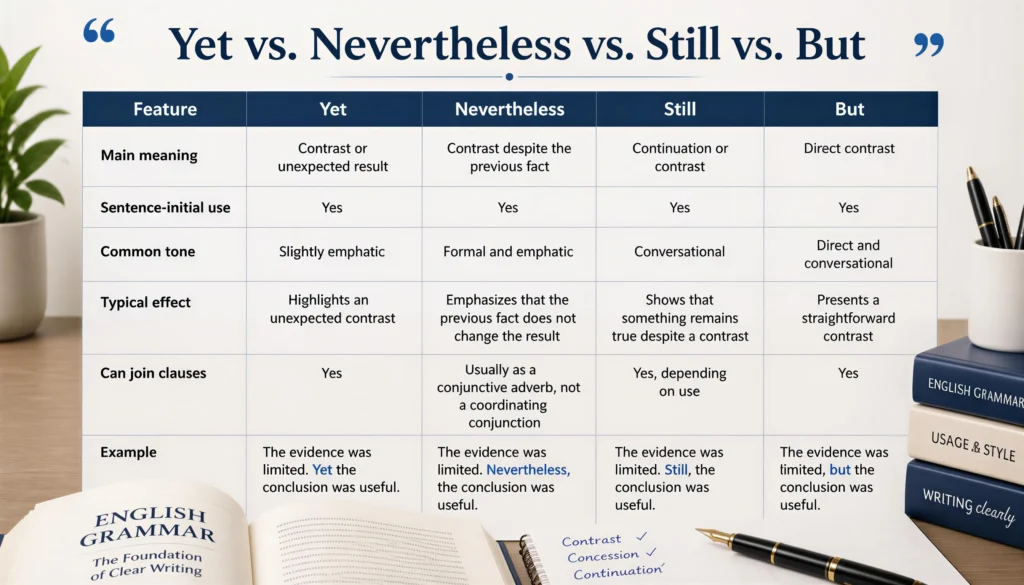
| Word | Main idea | Example |
| Yet | Contrast or unexpected result | The evidence was limited. Yet the conclusion was useful. |
| Nevertheless | Contrast despite the previous fact | The evidence was limited. Nevertheless, the conclusion was useful. |
| Still | Continuation or contrast | The evidence was limited. Still, the conclusion was useful. |
Yet is compact and direct.
Nevertheless often sounds more formal and strongly emphasizes that the second point remains true despite the first.
Still can sound more conversational and may emphasize persistence rather than direct contradiction.
The best choice depends on the relationship you want the reader to notice.
Does Starting With “Yet” Create a Sentence Fragment?
No. The word “yet” doesn’t determine whether a sentence is complete.
A complete sentence can begin with yet:
Yet the revised proposal solves the original problem.
The sentence contains a subject, the revised proposal, and a verb, solves. It expresses a complete thought.
Now look at this:
Yet another serious concern.
That’s a noun phrase, not a complete sentence.
You could make it complete:
Yet another serious concern emerged.
The problem in the first example isn’t that yet starts the phrase. The problem is that the phrase lacks the grammatical structure needed for a complete sentence.
What About Intentional Fragments?
Writers sometimes use fragments deliberately in advertising, fiction, dialogue, headlines, and other creative contexts.
For example:
The plan seemed perfect. Yet another problem.
That may work as a deliberate rhetorical fragment in a particular style. However, formal prose usually benefits from a complete construction:
The plan seemed perfect. Yet another problem emerged.
Context determines whether a fragment is a mistake or a stylistic choice.
Common Mistakes
Adding an Unnecessary Comma
A common mistake is:
Yet, the results were disappointing.
In ordinary sentence-initial conjunction use, write:
Yet the results were disappointing.
Using “Yet” Without a Real Contrast
Consider:
The office opens at 9 a.m. Yet the meeting starts at 10 a.m.
There’s no obvious contradiction. The two facts can easily coexist.
A better use would be:
The office opens at 9 a.m. Yet customers often arrive before the doors open.
Now the second statement introduces an unexpected situation.
Using “Yet” Too Often
Compare:
The product is affordable.
1.Yet it lacks several features.
2.Yet the design is attractive.
3.Yet the battery lasts only six hours.
The repeated pattern becomes monotonous.
Vary the structure:
The product is affordable. Yet it lacks several features. The design is attractive, although the battery lasts only six hours.
Good writing isn’t just grammatically correct. It has rhythm.
Combining “Yet” and “However”
Avoid constructions such as:
Yet, however, the evidence remains unclear.
Usually, one transition is enough:
Yet the evidence remains unclear.
or:
However, the evidence remains unclear.
Confusing the Two Main Uses of “Yet”
Compare:
Yet the results surprised the researchers.
Here, yet expresses contrast.
The results haven’t arrived yet.
Here, yet refers to time.
These uses aren’t interchangeable. The first connects ideas. The second indicates that something hasn’t happened up to the present.
More Examples of Sentences Beginning With “Yet”
The easiest way to understand the construction is to see it in different contexts.
Everyday English
- Yet nobody complained.
- Yet she continued working.
- Yet the store remained busy.
- Yet we found a way to finish on time.
Academic Writing
- Yet the available evidence remains insufficient.
- Yet this interpretation overlooks an important variable.
- Yet the findings do not support that conclusion.
Business Writing
- Yet the company hasn’t addressed the underlying issue.
- Yet customers continue to report the same problem.
- Yet the proposed solution could increase operating costs.
Analytical Writing
- Yet the numbers tell a different story.
- Yet one important factor deserves closer attention.
- Yet the apparent improvement may not represent a lasting change.
Strong Contrast
- The process looked complicated. Yet it took less than ten minutes.
- The device was inexpensive. Yet its performance rivaled more expensive models.
- The forecast predicted clear skies. Yet heavy rain arrived by noon.
Notice the pattern: the sentence before yet creates an expectation. The sentence after it disrupts that expectation.
Other Important Uses of “Yet”
The word yet has several meanings beyond sentence-initial contrast.
“Yet” Meaning “Up to Now”
I haven’t received the email yet.
She hasn’t finished the assignment yet.
This use commonly appears in negative statements.
“Yet” in Questions
Have you finished yet?
Has the package arrived yet?
The question often carries an expectation that the event will happen.
“Yet” Meaning “Another” or “Again”
We discovered yet another problem.
The printer has broken down yet again.
Here, yet adds emphasis.
“May Yet”
We may yet find an answer.
This construction suggests that something remains possible.
“Have Yet to”
The company has yet to announce the final decision.
This means the announcement hasn’t happened but is expected.
These uses demonstrate why you shouldn’t memorize a single definition of yet. Its meaning changes according to its grammatical role and position.
A Practical Test for Using “Yet” at the Beginning of a Sentence
Before you start a sentence with yet, ask yourself these questions:
- Is there a clear contrast?
- Does the new sentence relate directly to the previous idea?
- Does “yet” mean something like “but” or “nevertheless”?
- Is the sentence grammatically complete?
- Have you avoided an unnecessary comma after “yet”?
- Would “but,” “however,” “still,” or “nevertheless” work better?
- Have you already used “yet” several times nearby?
- Does the sentence sound natural when read aloud?
If the answers make sense, there’s no grammatical reason to avoid the construction simply because yet appears at the beginning.
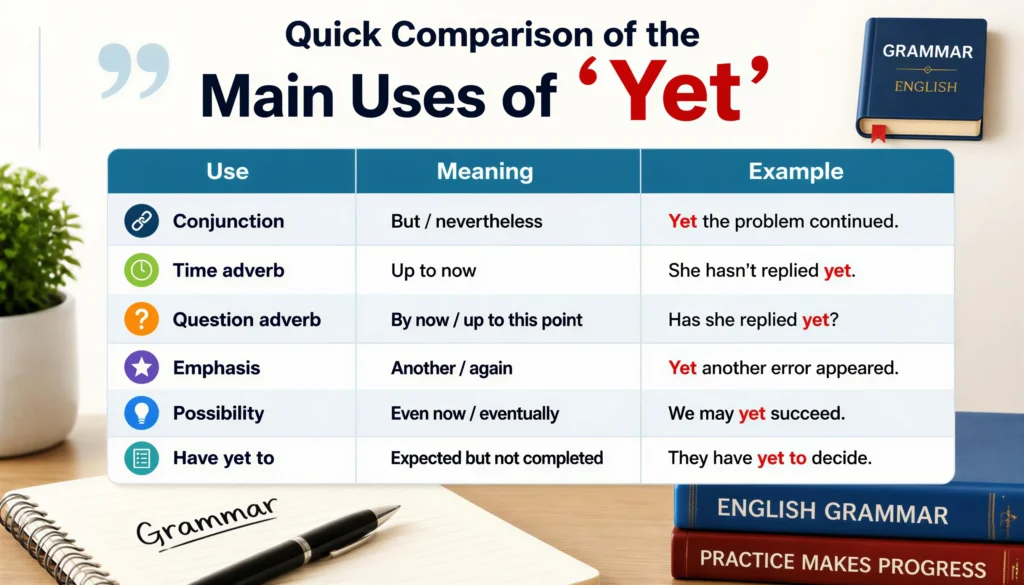
Quick Comparison of the Main Uses of “Yet”
| Use | Meaning | Example |
| Conjunction | But / nevertheless | Yet the problem continued. |
| Time adverb | Up to now | She hasn’t replied yet. |
| Question adverb | By now / up to this point | Has she replied yet? |
| Emphasis | Another / again | Yet another error appeared. |
| Possibility | Even now / eventually | We may yet succeed. |
| Have yet to | Expected but not completed | They have yet to decide. |
These aren’t merely stylistic variations. The grammatical function changes the meaning and often affects where yet appears in the sentence.
Why the “Never Start With Yet” Rule Is Misleading
Many students hear some version of this advice:
“Never start a sentence with a conjunction.”
Taken literally, that’s too broad.
English allows writers to begin sentences with conjunctions when the structure and relationship between ideas work. The more useful lesson is this: don’t start a sentence with a conjunction merely to create a dramatic pause or because you don’t know how to connect the ideas.
Starting with yet can actually make prose more readable.
Compare:
The product performed well in testing. However, the company discovered a serious manufacturing problem.
with:
The product performed well in testing. Yet the company discovered a serious manufacturing problem.
Both are correct. The second has a slightly tighter, more immediate contrast.
The choice should depend on meaning, rhythm, emphasis, and context, not an absolute prohibition.
Key Insights
- Yet can start a sentence.
- Yet usually expresses contrast.
- Yet can mean but or nevertheless.
- Sentence-initial yet usually needs no comma.
- Yet can function as a conjunction.
- Yet can also function as an adverb.
- Yet works in formal writing.
- Yet works in academic writing.
- Yet can introduce an unexpected result.
- Yet can present a counterpoint.z
- Yet can introduce a limitation.
- Yet can challenge an assumption.
- Avoid using yet when there is no clear contrast.
- Avoid combining yet and however unnecessarily.
- Yet can also mean up to now.
Practice Section:
Choose the sentence that uses yet correctly.
The test was difficult. Yet, she passed easily.
The test was difficult. Yet she passed easily.
The product is affordable. Yet it performs well.
The product is affordable. Yet, it performs well.
The weather looked clear. Yet heavy rain arrived.
The weather looked clear. Yet, heavy rain arrived.
The evidence was limited. Yet the conclusion was useful.
The evidence was limited. Yet, the conclusion was useful.
The instructions seemed simple. Yet many users made mistakes.
The instructions seemed simple. Yet, many users made mistakes.
Complete the Sentences
The plan looked promising. Yet ________.
She studied for weeks. Yet ________.
The device was inexpensive. Yet ________.
The task seemed easy. Yet ________.
The results were encouraging. Yet ________.
Quick Check
Before using yet at the beginning of a sentence, ask yourself:
- Does it show a clear contrast?
2. Does it connect naturally to the previous idea?
3. Does the sentence remain complete and clear?
4. Have I avoided an unnecessary comma after yet?
5. Am I avoiding overuse of yet?
Read More: What Are Possessive Nouns? Definition, and Common Mistakes
FAQs
Can You Start a Sentence With “Yet” in Formal Writing?
Yes. You can start a sentence with “yet” in formal writing when it creates a clear connection with the previous idea. It often introduces contrast or highlights an unexpected result.
The important point is not whether yet appears at the beginning. Instead, focus on whether the sentence flows naturally and communicates the intended relationship.
Should You Put a Comma After “Yet” at the Beginning of a Sentence?
A comma after yet can be used when the word functions as an introductory element. For example: “Yet, the results were different.” However, the comma isn’t always necessary.
Look at the sentence as a whole rather than applying a rigid rule. Modern punctuation allows some flexibility, especially when the sentence remains clear without the comma.
Is Starting a Sentence With “Yet” Grammatically Correct?
Yes, starting a sentence with yet is grammatically acceptable. The idea that you should never begin a sentence with certain conjunctions comes largely from traditional teaching rather than an absolute rule of English grammar.
You should still consider context, tone, and readability. In formal or academic writing, use yet when it adds a meaningful contrast instead of using it simply to vary sentence openings.
What Does “Yet” Mean at the Beginning of a Sentence?
At the beginning of a sentence, yet usually introduces a contrast with something stated previously. It tells the reader that the next idea may be surprising, unexpected, or different from what came before.
For example, “The task looked difficult. Yet, she completed it quickly.” The second sentence contrasts with the expectation created by the first.
Can You Start a Sentence With “Yet” in Academic Writing?
Yes. Yet can work well in academic writing when you need to introduce a contrasting observation, result, or argument. It can make the relationship between ideas easier to follow.
However, academic writing still requires precision. Don’t begin several consecutive sentences with yet, because repetition can make your writing feel mechanical and weaken its impact.
Is “Yet” the Same as “However” at the Beginning of a Sentence?
Yet and however can both introduce contrast, but they aren’t always interchangeable. Yet often creates a stronger sense of unexpected contrast, while however can sound more neutral.
For example, “The evidence was limited. Yet, the researchers continued.” The word yet emphasizes the unexpected decision more strongly.
When Should You Avoid Starting a Sentence With “Yet”?
You should avoid beginning with yet when the connection to the previous sentence isn’t clear. If the reader has to stop and figure out what you’re contrasting, another sentence structure may work better.
You should also avoid overusing it. A strong transition should clarify your ideas, not become a repeated habit throughout your writing.
Can “Yet” Begin a Sentence in Professional Writing?
Yes. Professional writing can use yet at the beginning when the transition serves a clear purpose. Reports, articles, essays, and other professional texts can all use this structure.
The key is maintaining a natural writing style. If yet helps the reader understand a contrast quickly, there’s no grammatical reason to avoid it simply because it starts the sentence.
Is “Yet” a Conjunction When It Starts a Sentence?
Yet can function as a coordinating conjunction, especially when it joins two independent clauses. It can also function differently depending on the sentence, including as an adverb expressing contrast.
Its position and meaning determine its grammatical role. That’s why you shouldn’t judge its correctness solely by where it appears in the sentence.
How Can I Use “Yet” Naturally in My Writing?
Start by connecting yet to a clear contrast. Read the previous sentence, identify the expectation it creates, and then decide whether yet effectively introduces the different idea.
As an English teacher, I’ve found that students use yet more confidently when they focus on meaning rather than memorizing a strict prohibition. Once you understand its function, using it at the beginning of a sentence becomes much more natural.
Conclusion
Starting a sentence with “yet” is grammatically acceptable, and you don’t need to treat it as a forbidden construction. English has never been as rigid as some traditional classroom rules suggest. When yet introduces a meaningful contrast, it can create a smooth transition and give the next idea extra emphasis.
The real skill lies in understanding correct usage. Think about the relationship between your sentences, the tone of your writing, and the effect you want to create. If the second idea contrasts with the first, yet may be exactly the transition you need. You can use it in everyday writing as well as in more formal contexts, provided the sentence remains clear and natural.
Don’t let an old rule make your writing unnecessarily stiff. Use yet with purpose, pay attention to punctuation, and avoid repeating it too often. With regular practice, you’ll quickly recognize when starting a sentence with yet strengthens your writing and when another transition would work better.

Mariam Asghar is an English specialist and professional content writer at ClearPhrasing.com. She is dedicated to helping readers improve their English through clear, practical, and easy-to-understand content. Her areas of expertise include grammar, spelling, vocabulary, punctuation, sentence structure, and effective writing.
At ClearPhrasing.com, Mariam writes comprehensive, well-researched articles that simplify complex language concepts for students, professionals, writers, and English learners. She believes that strong communication begins with a solid understanding of the English language and strives to make every lesson accessible and engaging.
With a strong commitment to quality, accuracy, and continuous learning, Mariam ensures that each article is carefully researched, thoroughly reviewed, and written to help readers communicate with greater confidence and clarity.