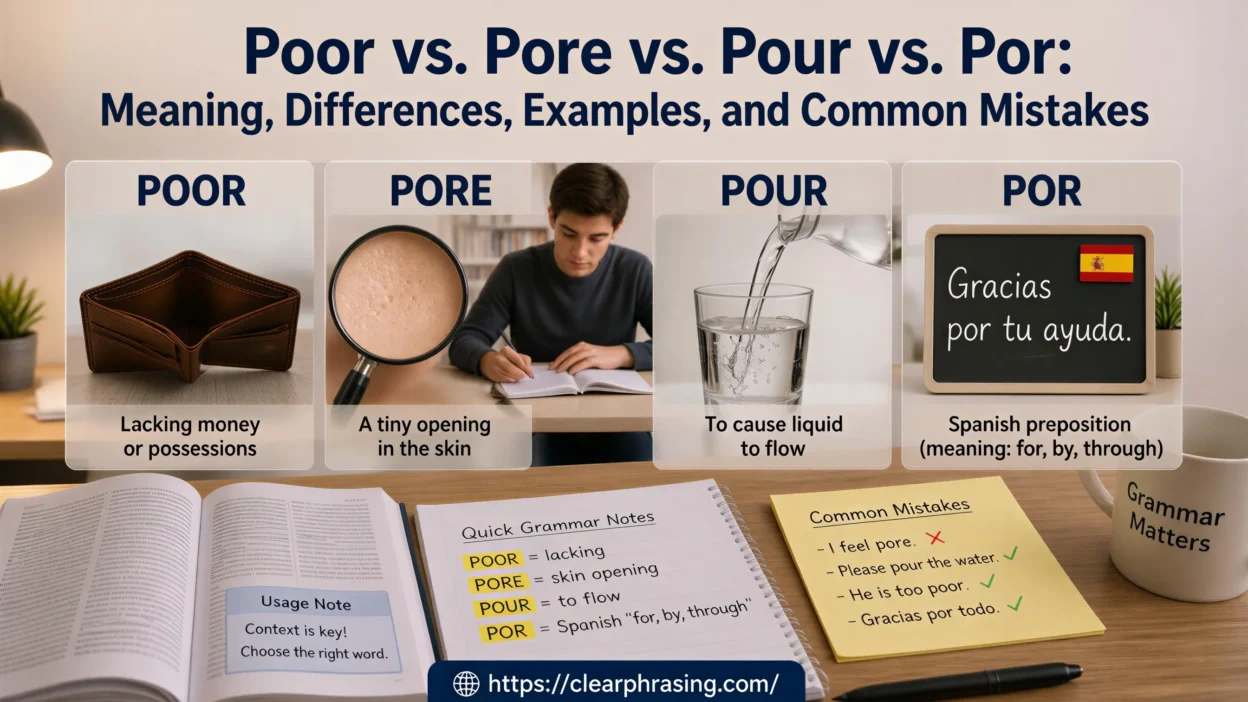
Poor vs. Pore vs. Pour vs. Por: Meaning, Differences, and Examples can seem confusing because these homophones may sound alike, but their spellings, meanings, and grammatical roles differ.
Poor is an adjective for lacking money, resources, or wealth, or describing low quality. Pour is a verb meaning to make a liquid flow, such as pouring water from a jug into a glass, or to give freely.Pore can be a noun meaning a small opening on the surface of the skin. As a verb, it means to study or read something carefully and with great attention.
When you pore over a book, you are reading it intently. In my teaching experience, learners often get confused and start mixing up pore and pour because they sound similar. A simple rule of thumb helps: use poor for money or quality, pour for liquid, and pore for careful study.Por is not the usual English word in this group, although its similar spelling can create confusion.
These words aren’t interchangeable, even when they sound identical in some accents. Clear examples, memory tricks, and attention to context can help you understand the differences and choose correctly. Careful writing, spelling, grammar, and punctuation reduce mistakes, while a spell checker or human proofreader can keep your work polished.
Quick Answer:
- Poor means having little money, being low in quality, inadequate, or unfortunate.
- Pore means a tiny opening in a surface. As a verb, it means to study or examine something carefully.
- Pour means to make a liquid or another flowing substance move from one place to another.
- Por isn’t normally the standard English spelling of any of these words. It is especially common as a Spanish preposition with several possible meanings.
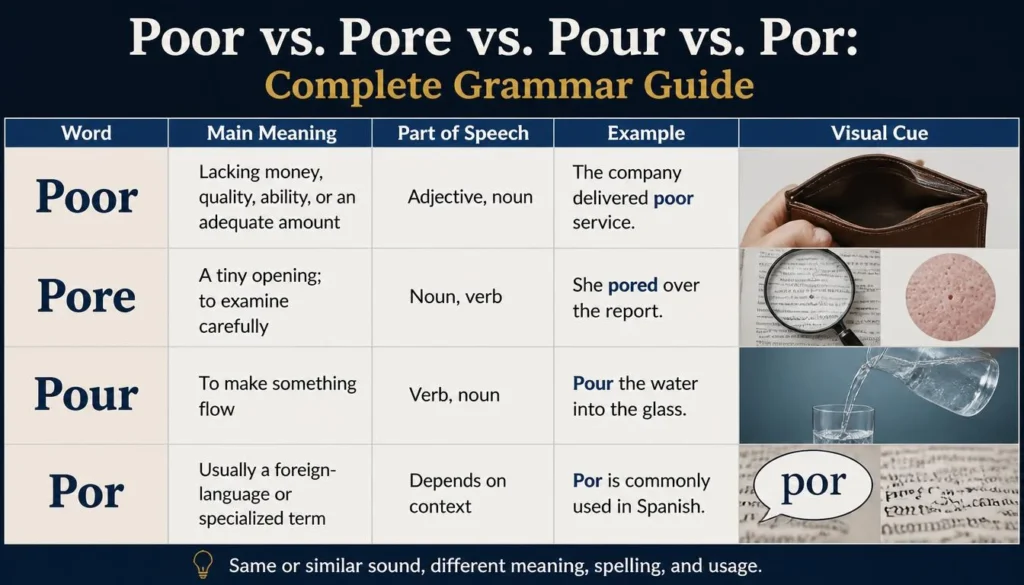
| Word | Main Meaning | Part of Speech | Example |
| Poor | Lacking money, quality, ability, or an adequate amount | Adjective, noun | The company delivered poor service. |
| Pore | A tiny opening; to examine carefully | Noun, verb | She pored over the report. |
| Pour | To make something flow | Verb, noun | Pour the water into the glass. |
| Por | Usually a foreign-language or specialized term | Depends on context | Por is commonly used in Spanish. |
The most important distinction to remember is simple:
Poor = lack or low quality
Pore = tiny opening or careful study
Pour = flow
Por = usually not the English word you need
What Does Poor Mean?
Poor is an adjective with several meanings. Although people often associate it with poverty, the word has a much wider range of uses.
One common meaning describes someone who has little money or few material resources.
The family grew up poor but worked hard to improve their circumstances.
However, poor can also describe something that performs badly or fails to meet an expected standard.
The restaurant received poor reviews.
Here, poor doesn’t mean the restaurant has little money. It means the quality was unsatisfactory.
Poor as an Adjective
You can use poor to describe:
- A financial condition
- Low quality
- Weak performance
- Insufficient resources
- Inadequate results
- Bad judgment
- Unfortunate circumstances
- Lack of productivity
Consider these examples:
- He comes from a poor family.
- The project produced poor results.
- She showed poor judgment.
- The soil is poor and needs more nutrients.
- They received poor customer service.
- That’s a poor excuse for missing the meeting.
Notice how the meaning changes according to the noun that follows it.
1.Poor quality means low quality.
2.Poor judgment means bad judgment.
3.Poor soil means soil that doesn’t support healthy growth well.
Merriam-Webster lists meanings of poor that include lacking material possessions, being inferior in quality, being inadequate, and being deserving of sympathy.
Poor as a Noun
Poor can also function as a noun in the expression the poor.
The program provides assistance to the poor.
Here, the poor refers collectively to people who have limited financial resources.
You generally won’t use poor as a standalone countable noun in ordinary sentences. For example, instead of saying “a poor” to mean a poor person, English normally uses a poor person.
Common Expressions With Poor
You’ll often encounter poor in fixed combinations such as:
- poor quality
- poor performance
- poor health
- poor judgment
- poor decision
- poor excuse
- poor communication
- poor results
- poor condition
- poor service
These combinations are useful because they give you a strong context clue.
If a sentence discusses quality, performance, judgment, or results, there’s a good chance that poor is the word you need.
What Does Pore Mean?
Pore has two important meanings that seem unrelated at first.
As a noun, a pore is a tiny opening in a surface, especially the skin.
As a verb, pore means to examine or study something closely and carefully.
Pore as a Noun
The tiny openings in your skin are called pores.
The cream is designed to keep pores from becoming clogged.
The word can also describe tiny openings in other materials.
Water can pass through the pores of the material.
In this sense, pore refers to an opening through which a liquid, gas, or other substance may pass.
The plural form is pores.
- Singular: pore
- Plural: pores
Pore as a Verb
The verb pore has a completely different meaning.
When you pore over something, you examine it closely, usually because you want to understand or check its details.
She pored over the contract before signing it.
You might pore over:
- A book
- A report
- A contract
- Research
- Financial records
- Maps
- Historical documents
- Exam notes
- Data
The word suggests careful and sustained attention.
For example:
The researchers pored over thousands of records.
This doesn’t mean they poured liquid onto the records. It means they examined them carefully.
Why Is It “Pore Over,” Not “Pour Over”?
This is one of the most common mistakes involving these words.
When you mean study or examine carefully, the correct expression is:
pore over
I spent three hours poring over my notes.
Using pour over changes the meaning.
Pour over can literally mean to cause a liquid to flow over something.
She poured water over the plants.
The distinction becomes clear when you picture the action:
- Pore over a document → examine it closely.
- Pour water over a document → make water flow across it.
Pore vs. Poring
Pay attention to the spelling when pore becomes a present participle.
Pore → poring
She is poring over the documents.
The spelling doesn’t become pooring.
Compare:
- pore → poring
- pour → pouring
That’s an easy distinction to miss when you rely on pronunciation.
What Does Pour Mean?
Pour is primarily a verb. It describes making a liquid or another flowing substance move from one place to another.
Pour the milk into the bowl.
You can pour:
- Water
- Milk
- Juice
- Coffee
- Tea
- Sauce
- Oil
- Soup
- Paint
The object doesn’t always have to be liquid. English also uses pour figuratively when something arrives or moves in a large, continuous amount.
Pour as a Verb
Here are several straightforward examples:
- Pour some water into the glass.
- She poured coffee into her mug.
- He poured the sauce over the pasta.
- They poured the paint into a bucket.
The central idea is flowing from one place to another.
Figurative Uses of Pour
English frequently extends the physical idea of flowing into figurative expressions.
For example:
Fans poured into the stadium.
Nobody is literally pouring people from a container. The sentence means that large numbers of people entered quickly and continuously.
You can also say:
- pour money into a project
- pour out your feelings
- pour your heart out
- pour in
- pour down
Consider:
Investors poured money into the new company.
Here, pour emphasizes the large or continuous amount of money being provided.
Pour as a Noun
Although pour is much more common as a verb, it can also function as a noun.
He gave the guest a generous pour.
In this use, a pour refers to an amount of liquid served by pouring.
For most English learners, though, the verb is the more important form to master.
What Does Por Mean?
This is where the four-way comparison needs an important qualification.
Por isn’t normally the standard English spelling of poor, pore, or pour.
If you write por when you mean one of those English words, you’ve probably chosen the wrong spelling.
However, por is a real word in other languages. It is especially familiar to English speakers who encounter Spanish.
Is Por an English Word?
In ordinary English writing, you shouldn’t use por as a replacement for:
- poor
- pore
- pour
For example:
❌ Please por the water into the cup.
✅ Please pour the water into the cup.
Likewise:
❌ She por over her notes every night.
✅ She pores over her notes every night.
What Does Por Mean in Spanish?
Spanish por is a preposition with several meanings. Depending on the sentence, it can correspond to English words such as:
- by
- for
- through
- because of
- per
The correct English translation depends heavily on context.
For example, Spanish learners quickly discover that por and para don’t map neatly onto one single English preposition each. Their meanings depend on how they’re used.
So if you see por in an English-language sentence, don’t automatically assume it’s a misspelling. It may be an intentional Spanish word or part of a proper name.
When Might You See Por in English?
You may encounter por in:
- Spanish sentences
- Spanish names and expressions
- Translated material
- Specialized terminology
- Names of organizations or places
- Foreign-language quotations
The key is context.
If you’re writing an ordinary English sentence and you mean to make liquid flow, use pour. If you mean careful study, use pore.
Key Differences
The fastest way to compare these words is to focus on their central ideas.
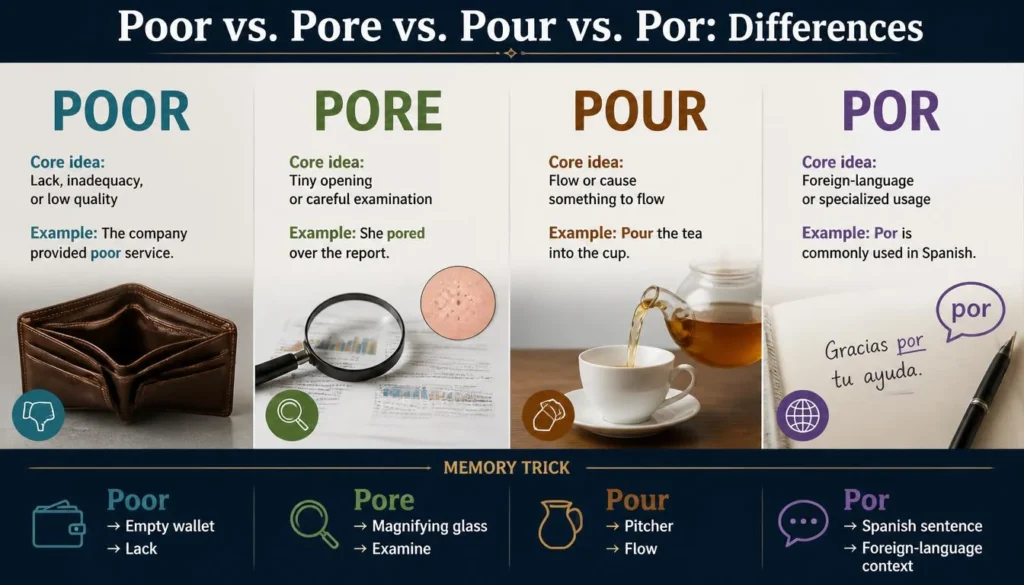
| Word | Think of This Idea | Example |
| Poor | Lack, inadequacy, or low quality | The company provided poor service. |
| Pore | Tiny opening or careful examination | She pored over the report. |
| Pour | Flow or cause something to flow | Pour the tea into the cup. |
| Por | Foreign-language or specialized usage | Por is commonly used in Spanish. |
A useful memory trick is to associate each spelling with an image.
Poor → an empty wallet
Pore → a magnifying glass over a document or a tiny skin opening
Pour → liquid flowing from a pitcher
Por → a Spanish-language sentence
That mental picture can make the spelling stick much faster than memorizing four definitions.
Pronunciation
Pronunciation creates much of the confusion surrounding these words.
In many varieties of English, poor, pore, and pour have the same or very similar pronunciation. However, pronunciation isn’t identical across all English accents.
That matters because English spelling often preserves distinctions that speech doesn’t always reveal.
Are Poor, Pore, and Pour Homophones?
In many accents, they function as homophones or near-homophones.
A homophone is a word that sounds the same as another word while having a different meaning and spelling.
For example:
- pore → tiny opening / examine carefully
- pour → make liquid flow
- poor → lacking or inadequate
The pronunciation alone won’t reliably tell you which spelling belongs in a sentence.
That’s why context matters so much.
Does Por Sound the Same?
There’s no single answer because por can belong to another language.
Spanish pronunciation differs from English pronunciation. The word may also appear in names or specialized contexts where pronunciation varies.
Therefore, it’s better not to treat por as simply a fourth English homophone.
Poor vs. Pore vs. Pour in Real Sentences
Seeing these words in context makes their differences much clearer.
Examples With Poor
- The company has a poor reputation.
- He received a poor grade on the test.
- The region has poor soil.
- She made a poor decision.
- The hotel offered poor customer service.
In every case, poor describes something lacking, inadequate, inferior, or unfortunate.
Examples With Pore
- The skin contains millions of tiny pores.
- She pored over the instructions.
- He spent the afternoon poring over historical records.
- The researcher pored over the data before publishing the findings.
The first example uses pore as a noun. The others use it as a verb.
Examples With Pour
- Pour the water slowly.
- She poured coffee into the mug.
- Rain poured down throughout the afternoon.
- The crowd poured through the entrance.
- He poured his energy into the project.
The meaning consistently involves flow, movement, or a large continuous amount.
Examples With Por
- Por can appear naturally in a Spanish sentence.
- A proper name may contain por.
- A specialized term may preserve the spelling por.
However, don’t use por as a shortcut when you actually mean poor, pore, or pour in standard English.
Common Mistakes With Poor, Pore, Pour, and Por
Mistake: Writing “Pour” When You Mean “Pore”
❌ She poured over the report.
If you mean that she studied the report carefully:
✅ She pored over the report.
The verb pore carries the idea of close examination.
Mistake: Writing “Pore” When You Mean “Pour”
❌ Pore the milk into the glass.
If you’re transferring milk from one container to another:
✅ Pour the milk into the glass.
The physical movement of liquid requires pour.
Mistake: Writing “Poor” When You Mean “Pore”
❌ He poor over his notes every evening.
✅ He pores over his notes every evening.
The present-tense verb needs pores because the subject is he.
Mistake: Using “Por” as an English Spelling
❌ Por the water into the bowl.
✅ Pour the water into the bowl.
Unless por belongs to a foreign-language expression, name, or specialized term, it isn’t the spelling you want in ordinary English.
How to Remember the Difference Between Poor, Pore, Pour, and Por
You don’t need a complicated mnemonic. Four simple associations are enough.
Poor = Lack
Think:
poor → not enough
- Poor quality
- Poor performance
- Poor family
- Poor results
Pore = Study or Opening
Think:
pore → pores in your skin
pore over → study carefully
This connection helps you remember both meanings of the word.
Pour = Flow
Think of a pitcher tipping over a glass.
Pour → liquid flows.
This is the easiest of the four to visualize.
Por = Check the Context
When you see por, ask:
Is this actually an English word here?
If it’s Spanish or another specialized usage, por may be correct. Otherwise, check whether you really mean poor, pore, or pour.
A Quick Decision Guide
When you’re unsure, follow this simple process:
Does the sentence describe low quality, poverty, inadequacy, or an unfortunate condition?
Use poor.
Does it refer to a tiny opening?
Use pore.
Does it mean examining or studying something carefully?
Use pore, usually in pore over.
Does something flow from one place to another?
Use pour.
Does the sentence intentionally use a foreign-language or specialized term?
Por may be correct.
This approach works better than trying to remember pronunciation because the meaning determines the spelling.
A Short Case Study: “Pore Over” vs. “Pour Over”
Imagine a student preparing for a difficult exam.
She spends three hours reading her textbook, checking definitions, comparing examples, and reviewing difficult sections.
You could say:
She pored over her textbook all evening.
Now imagine a different scene. She accidentally knocks a glass of water across the textbook.
You could say:
She poured water over her textbook.
The sounds are close. The actions couldn’t be more different.
That’s exactly why this pair causes so many mistakes. Pore over describes mental attention. Pour over describes physical movement of liquid.
Key Insights
- Poor describes low quality, limited resources, poverty, or inadequacy.
- Pore has two meanings: a tiny opening in the skin or the act of studying something carefully.
- Pour means to make a liquid flow from one place to another and can also have figurative uses.
- Por is not normally a standard English word in this comparison; it commonly appears as a Spanish preposition or in specialized contexts.
- Pore over means to examine or study something closely, while pour over usually refers to liquid flowing over something.
- Poor, pore, and pour sound the same or very similar in many English accents, so context and spelling matter more than pronunciation.
- A simple memory trick works well: poor = lack, pore = study/opening, pour = flow, por = foreign-language context.
- Spell checkers may not catch these errors because all three main English words are correctly spelled words.
- The best way to distinguish them is to identify the meaning and grammatical function required by the sentence.
- Real-world examples and short practice exercises can help English learners remember these words more effectively than memorizing definitions alone.
My Personal Experience
As an English language specialist, I’ve spent years helping learners become more confident with words that create small but noticeable errors in their writing.
In my classroom, I’ve found that students often remember pronunciation faster than spelling, especially when several words sound alike. I usually encourage them to pause and look at the meaning of the sentence before choosing a word. With pairs such as poor, pore, and pour, I guide learners to connect each spelling with a clear idea and then practice using the words in everyday situations.
This approach has worked far better than asking students to memorize definitions in isolation. Over time, I’ve seen learners become more accurate when they focus on context, meaning, and English usage rather than relying only on sound. That experience has taught me that a simple explanation, followed by practical examples, can turn a confusing spelling choice into an easy decision.
Quick Quiz
Choose the correct word in each sentence.
- The restaurant received ___ reviews.
- She spent hours ___ing over the contract.
- Please ___ the juice into the glass.
- The skin contains millions of tiny ___s.
- The company delivered ___ customer service.
- He ___ed water over the plants.
- The researchers ___ed over the historical records.
- The Spanish word ___ has several meanings.
- The soil is too ___ to support healthy crops.
- She ___ed coffee into everyone’s cup.
Answer Key
- poor — describes low-quality reviews or a negative assessment.
- poring — means studying or examining carefully.
- pour — means making the liquid flow.
- pores — means tiny openings.
- poor — describes inadequate service.
- poured — describes moving water from one place to another.
- pored — means examined carefully.
- por — this is the Spanish word.
- poor — describes soil with inadequate quality or fertility.
- poured — describes transferring coffee by letting it flow.
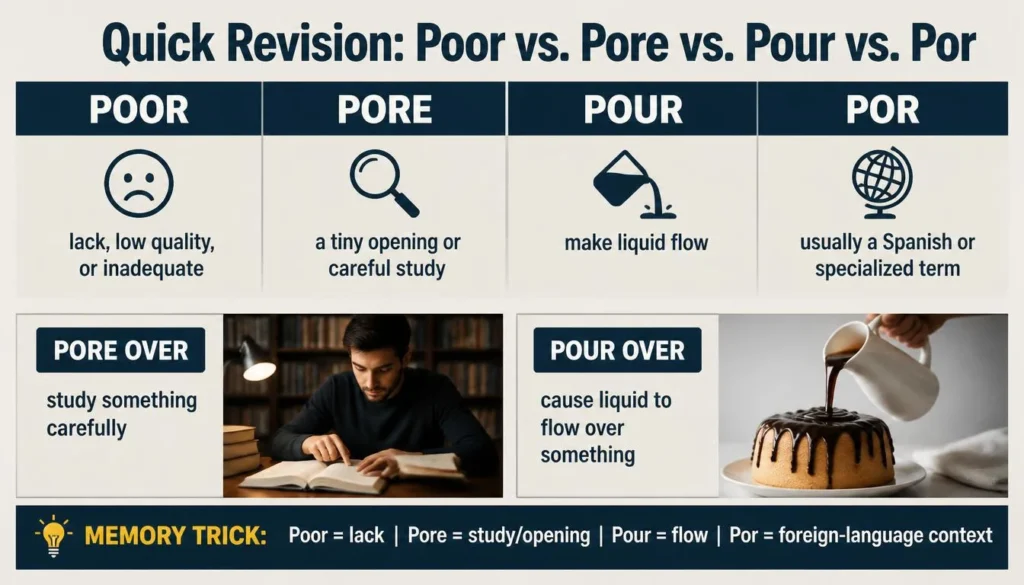
Quick Revision
- Poor → lack, low quality, or inadequate.
- Pore → a tiny opening or careful study.
- Pour → make liquid flow.
- Por → usually a Spanish or specialized term.
- Pore over → study something carefully.
- Pour over → cause liquid to flow over something.
- Memory trick: Poor = lack | Pore = study/opening | Pour = flow | Por = foreign-language context.
Read More: Mad vs. Angry: Meaning, Difference, Usage, and Examples
FAQs
Is poor a synonym for bad?
Not always. Poor can mean low quality, so you can say, “The service was poor,” when something isn’t good. It can also describe someone who has little money or few resources. The exact meaning depends on the sentence and context.
How do you remember the difference between poor and pour?
Think of pour whenever you can picture liquid moving. You pour water into a glass, pour coffee into a cup, or pour sauce over food. Poor, on the other hand, usually relates to money, resources, or quality.
Does pore only relate to skin?
No. As a noun, a pore is a tiny opening in the skin. As a verb, pore means to study or examine something carefully. For example, “She pored over her notes before the exam.”
What does pore over mean?
Pore over means to read, study, or examine something with close attention. You might pore over a book, a report, a map, or a manuscript. It suggests that you’re concentrating carefully rather than simply looking at something quickly.
Are poor, pore, and pour homophones?
Yes. Poor, pore, and pour are commonly treated as homophones because they have the same or nearly the same pronunciation in many varieties of English. Their meanings and spellings, however, are completely different.
Is por an English word?
Por isn’t normally used as an English word in this group. You may encounter it in another language or as part of a name, but it shouldn’t replace poor, pore, or pour in standard English sentences.
Is pouring over a book correct?
Usually, no. If you mean studying a book carefully, the correct phrase is pore over a book. Pouring over a book would literally suggest that you’re spilling or directing some liquid onto the book, which is probably not what you mean.
Why do people confuse pore and pour?
The main reason is pronunciation. When two words sound alike, your brain can focus on the sound while overlooking the spelling. I’ve seen this happen often in English writing. Learning the meaning and function of each word makes the choice much easier.
Can a spell checker distinguish poor, pore, and pour?
Not reliably. A spell checker may recognize all three as correctly spelled words, even when you’ve chosen the wrong one for your sentence. That’s why understanding context matters. A human reader can often spot the mistake from the meaning of the sentence.
What is the easiest way to use these words correctly?
Use poor for low quality, little money, or limited resources. pour when liquid flows or when something is given freely. Use pore when you mean a tiny opening in the skin or careful study. If you remember those three connections, these commonly confused words become much easier to handle.
Conclusion
Poor, pore, pour, and por may look deceptively similar, but they don’t do the same job. Poor can describe limited money, resources, or quality. Pore can refer to a tiny opening in the skin or the act of studying something closely. Pour deals with liquid flow and can also describe giving something freely. Por doesn’t normally belong in this standard English set.
The easiest way to avoid confusion is to connect each spelling with a mental picture. Picture a poor neighborhood when you think about limited resources. Imagine a glass of water when you see pour. Then picture yourself sitting at a desk, carefully examining a book, when you see pore. These simple associations can make the differences stick without forcing you to memorize complicated rules.
As an English teacher, I’ve found that learners often remember these words better when they use them in real sentences instead of studying isolated definitions. Try making three sentences of your own: one with poor, one with pour, and one with pore. Once the words become part of your everyday writing, the confusion starts to fade naturally.
Ultimately, pronunciation alone isn’t enough to choose the right spelling. You need to look at what the word means and how it functions in the sentence. When you pay attention to context, the choice becomes much clearer. With a little practice, you won’t have to second-guess whether you should poor, pore, or pour your way through your next sentence.

Shamsa Kanwal is an English specialist and content writer at ClearPhrasing.com, where she helps readers navigate the English language with confidence. She enjoys breaking down grammar rules, spelling differences, vocabulary, and everyday writing challenges into simple, practical lessons that anyone can understand.
Her writing is focused on making learning approachable rather than overwhelming. Whether she’s explaining commonly confused words, punctuation rules, or grammar concepts, Shamsa believes that clear explanations and real-life examples are the key to effective learning.
Every article she writes is carefully researched, fact-checked, and edited to ensure it is accurate, easy to read, and genuinely helpful. Her goal is to create trustworthy resources that enable students, professionals, writers, and English learners to improve their communication skills and write with greater clarity.
Through her work at ClearPhrasing.com, Shamsa is committed to making English learning simpler, more practical, and accessible for readers around the world.