Racket or Racquet: Correct Spelling, Meaning, and Usage can confuse learners, beginners, and seasoned players because both spellings describe the same sports equipment.
Racket is the standard spelling and usual spelling for the paddle-like device used in tennis, badminton, and other net games. This racket sport tool has a handle, round frame or oval frame, and tightly laced strings. Racquet is a common variant and alternative form, so both spellings share the same meaning and are often interchangeable.
The difference mainly involves usage, preference, spelling, and regional differences. In general English, racket is the more common spelling, while racquet appears more often in formal sports contexts, sports writing, names, and certain particular racket sports, including squash and racquetball.
The history of racquet traces back to a misspelling of a French word that entered English in the 19th century. Today, racket remains the preferred spelling across the English-speaking world, especially in North America and the United States.
Racket also has meanings outside sports, including a loud, distressing noise, commotion, or a dishonest, profitable business practice. Racquet has no such definitions outside sports.
Quick Answer
Racket and racquet are both correct spellings when referring to sports equipment.
For general US English, racket is usually the best choice.
You can write:
- tennis racket
- badminton racket
- squash racket
- racket sport
You can also write:
- tennis racquet
- badminton racquet
- squash racquet
- racquet sport
The meaning doesn’t normally change.
Merriam-Webster lists racquet as a variant of racket, while Cambridge defines racquet as a racket. Both sources support the use of the two forms for sports equipment.
Bottom line: Use racket as your general choice in US English. Don’t assume racquet is a spelling mistake.
What’s the Difference?
The main difference is spelling and usage preference, not the sports equipment itself.
A racket or racquet typically has a handle, a frame, and a strung or similar hitting surface. Players use it to strike a ball or shuttlecock.
Both spellings can refer to equipment used in sports such as:
- Tennis
- Badminton
- Squash
- Racquetball
- Other racket sports
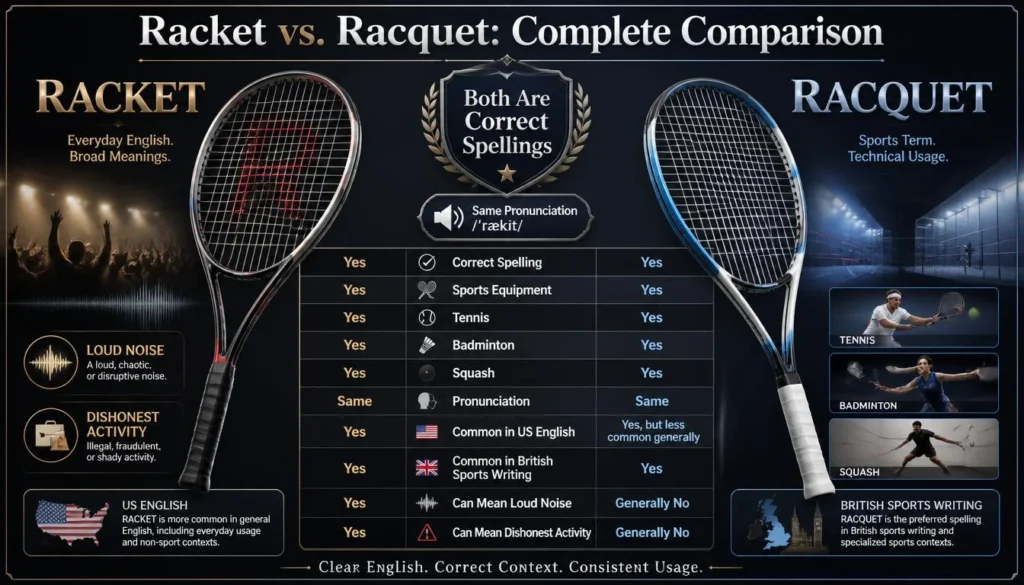
Here’s a quick comparison:
| Feature | Racket | Racquet |
| Correct spelling | Yes | Yes |
| Sports equipment | Yes | Yes |
| Tennis | Yes | Yes |
| Badminton | Yes | Yes |
| Squash | Yes | Yes |
| Pronunciation | Same | Same |
| Common in US English | Yes | Yes, but less common generally |
| Common in British sports writing | Yes | Common |
| Can mean loud noise | Yes | Generally no |
| Can mean dishonest activity | Yes | Generally no |
So if someone writes tennis racquet, there’s no need to grab a red pen and mark it wrong.
The spelling may differ, but the equipment doesn’t.
Is Racket Correct in American English?
Yes. Racket is completely correct in American English.
In fact, it’s the most practical spelling for general US writing when you mean sports equipment. You don’t need to add the c and qu simply to make the word look more formal.
For example:
- I bought a new tennis racket.
- Her badminton racket has a broken string.
- He left his squash racket at the club.
- The coach inspected every racket before practice.
All four sentences use standard English.
Why Racket Is a Good US English Choice
American English often favors simpler spellings when multiple accepted forms exist. Racket fits naturally into everyday American writing.
It also works across several meanings:
Sports:
She bought a new racket.
Noise:
The neighbors are making a racket.
Dishonest activity:
The authorities uncovered a financial racket.
The surrounding words tell you which meaning applies.
That makes racket a flexible word with a surprisingly broad range.
Is Racquet Correct?
Yes. Racquet is also correct.
This point deserves emphasis because many people assume the spelling must be wrong simply because racket looks more familiar.
It isn’t wrong.
Merriam-Webster recognizes racquet as a variant spelling. Cambridge also defines racquet as another form of racket.
For example:
- She bought a new tennis racquet.
- His racquet needs new strings.
- The player carried two racquets onto the court.
- The shop specializes in squash racquets.
These sentences are grammatically correct.
The important question isn’t whether racquet is legitimate. It is.
The better question is when should you choose it?
Tennis Racket or Tennis Racquet?
Both tennis racket and tennis racquet are correct.
For general US English, tennis racket is usually the simpler choice. However, tennis racquet appears frequently in sports writing, product descriptions, club terminology, and other specialized contexts.
Compare:
She bought a new tennis racket before the tournament.
and:
She bought a new tennis racquet before the tournament.
The meaning remains the same.
Which Tennis Spelling Should You Use?
If you’re writing an article for a broad American audience, tennis racket is a sensible default.
Choose tennis racquet when:
- A publication’s style guide uses it.
- A sports organization uses it.
- A brand or product uses it.
- You’re following established terminology.
- You’re writing for an audience accustomed to that spelling.
The important thing is consistency.
Switching between racket and racquet without a reason can make polished writing look careless.
Badminton Racket or Badminton Racquet?
Both badminton racket and badminton racquet can be used.
For American English, badminton racket is a clear and natural choice.
Examples include:
- I need a new badminton racket.
- She accidentally broke her badminton racket.
- The player adjusted the strings on his racquet.
- He keeps his badminton racquet in a protective case.
The word racquet doesn’t suddenly describe different equipment.
A badminton player isn’t choosing between two completely different objects. The difference is primarily the spelling.
Why Context Matters
A reader familiar with American English will understand badminton racket immediately.
Someone accustomed to sports terminology that favors racquet may naturally write badminton racquet instead.
Neither choice changes the sport.
That’s why correcting one form simply because the other is preferred in your region can create unnecessary confusion.
Squash Racket or Squash Racquet?
Once again, both forms are found in English.
You can write:
- squash racket
- squash racquet
Both refer to the equipment used to play squash.
For general US writing, squash racket is a straightforward option.
However, specialized sports organizations and publications may prefer racquet. When that happens, follow the established terminology rather than changing it just for the sake of uniformity.
This is especially important when you’re dealing with official names, brands, organizations, or titles.
A proper name should retain its actual spelling.
Racket Sport or Racquet Sport?
Both racket sport and racquet sport occur in English.
The difference becomes more noticeable across regional varieties of English. Racket sport is especially natural in American English, while racquet sport has strong usage in British English and sports contexts.
For example:
American English:
She enjoys playing racket sports.
Alternative form:
She enjoys playing racquet sports.
Neither sentence refers to a different category.
Tennis, badminton, and squash don’t change because the writer chooses one spelling instead of the other.
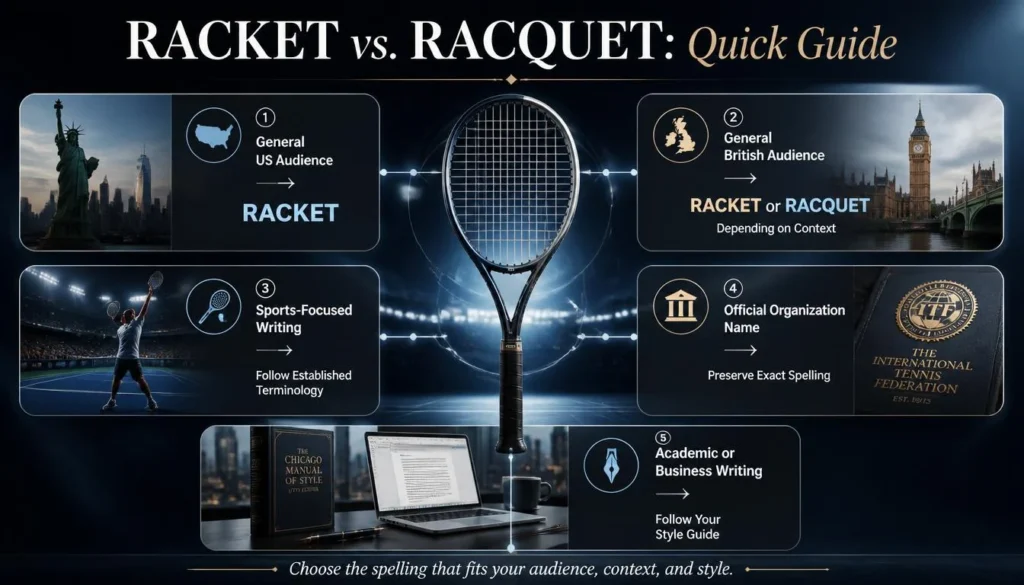
A Useful Regional Guide
| Audience | Practical choice |
| General US audience | Racket |
| General British audience | Racket or racquet, depending on context |
| Sports-focused writing | Follow the established terminology |
| Official organization name | Preserve its exact spelling |
| General academic or business writing | Follow your style guide |
This isn’t an absolute rulebook. English usage has more flexibility than that.
What Does Racket Mean Besides Sports?
Here’s where racket pulls away from racquet.
The word racket has several meanings that don’t involve sports.
Racket Meaning “Loud Noise”
A racket can mean a loud, unpleasant, or disorderly noise.
For example:
- The children were making a racket upstairs.
- What is that racket outside?
- The construction workers made a terrible racket.
- The barking dogs created quite a racket.
In this context, nobody is talking about tennis equipment.
If someone says:
“I can’t concentrate because of that racket.”
they’re complaining about noise.
Cambridge defines this sense as an unpleasant loud continuous noise. Merriam-Webster similarly connects the word with clamor and confused noise.
Racket Meaning “Dishonest Activity”
Racket can also describe a dishonest, fraudulent, or illegal way of making money.
For example:
- The police uncovered a protection racket.
- Investigators discovered an illegal gambling racket.
- The organization was accused of running a fraudulent racket.
- Authorities investigated a large smuggling racket.
This meaning appears frequently in phrases such as:
- protection racket
- criminal racket
- fraudulent racket
- illegal racket
Again, racquet doesn’t normally carry these meanings.
Different Contexts
The following examples make the distinction easier to see:
| Example | Meaning |
| I bought a new racket. | Sports equipment |
| I bought a new racquet. | Sports equipment |
| She plays tennis with a lightweight racket. | Sports equipment |
| He plays squash with a professional racquet. | Sports equipment |
| The neighbors are making a racket. | Loud noise |
| The criminals ran a protection racket. | Dishonest activity |
The sentence supplies the clues.
If you see racquet, sports will usually be the intended context. If you see racket, don’t jump to conclusions. The word has several possible meanings.
Word Origin and History
The history behind these spellings is more complicated than a simple “American versus British” explanation.
Merriam-Webster traces the sports sense of racket to Middle French raquette. It gives the first known use of the sports sense as approximately 1520.
Historical sources also connect the term with French forms and older words associated with the hand or wrist.
Etymonline traces racquet through historical French forms including rachette and requette. It also notes that the deeper origin isn’t completely settled.
That uncertainty matters.
Word origins often get presented online as if every stage has been proven beyond doubt. Historical linguistics rarely works that neatly.
The Connection With Early Hand Games
One proposed explanation connects the sports term with words associated with the palm or wrist.
That theory fits the history of early racket sports because players once struck balls with their hands before specialized equipment became widespread.
The French game jeu de paume, for example, involved striking a ball with the hand. Over time, players adopted equipment that made striking easier and more effective.
The exact etymological pathway remains debated, however. It’s better to acknowledge that uncertainty than to present a disputed theory as settled fact.
When Did Racket Start Meaning Noise?
The sports meaning isn’t the only old sense of the word.
Historical sources place the noise meaning of racket in the 16th century. Etymonline dates it to the 1560s, while Merriam-Webster gives a first known use of 1565.
The origin of this sense is generally associated with the idea of a noisy or clattering sound.
That creates an interesting vocabulary split:
- Racket for sports equipment
- Racket for loud noise
- Racket for dishonest activity
These meanings developed through different historical paths.
So while the spellings look simple, the word’s history is anything but simple.
When Did Racket Mean a Dishonest Scheme?
The dishonest-activity meaning appeared much later.
Etymonline dates the sense of racket meaning dishonest activity to approximately 1785.
That meaning eventually became connected with words such as:
- racketeer
- racketeering
- protection racket
A racketeer isn’t someone carrying a tennis racket. The word belongs to the criminal sense of racket.
This is a good example of how English vocabulary branches over time. One word can develop several meanings that have little connection in modern everyday use.
Common Mistakes
Assuming Racquet Is Wrong
This is the most common mistake.
Racquet is a legitimate spelling. Don’t automatically replace it with racket.
Assuming Racket Only Means Noise
That’s also incorrect.
Racket has a well-established sports meaning. It can describe equipment used in several court sports.
Assuming the Two Spellings Describe Different Equipment
Generally, they don’t.
A tennis racket and a tennis racquet refer to the same basic type of sports equipment.
Treating British and American English as Identical
Regional preferences matter.
A spelling that feels completely ordinary to an American reader may feel less natural to a British sports writer.
That doesn’t make either form inherently wrong.
Changing Official Names
Never “correct” a proper name simply because you prefer another spelling.
If an organization or product officially uses racquet, preserve that spelling when referring to the official name.
Mixing Spellings Without a Reason
Consistency matters.
If an article repeatedly uses racket, suddenly switching to racquet can make readers wonder whether there’s a technical difference.
Unless the context calls for the change, stick with one form.
Example Sentences
Sports Examples With Racket
- My tennis racket needs new strings.
- She bought a lightweight badminton racket.
- His squash racket broke during practice.
- The coach asked everyone to bring a racket.
- I forgot my racket at the tennis club.
Sports Examples With Racquet
- She bought a professional tennis racquet.
- His squash racquet has a carbon-fiber frame.
- The player carried two racquets to the tournament.
- He keeps his racquet inside a protective cover.
Racket Examples With Other Meanings
- The children were making a racket upstairs.
- The storm created a tremendous racket outside.
- The authorities investigated a protection racket.
- Police uncovered a fraudulent racket.
These examples show why context is king.
Racket or Racquet: Which One Should You Use?
If you’re writing for a US audience, racket is usually the easiest choice.
Use racket when:
- You want standard, straightforward US English.
- You’re referring generally to sports equipment.
- You’re writing about tennis, badminton, or squash.
- Your style guide doesn’t require racquet.
- You want the most familiar spelling for a broad American audience.
Use racquet when:
- A publication specifically prefers it.
- You’re following established British sports usage.
- An organization uses it in its official name.
- A product or brand uses that spelling.
- You need to maintain consistency with existing terminology.
A Simple Decision Rule
Think of the choice this way:
General US English → racket
Established sports terminology → follow the accepted form
Official name → preserve the official spelling
Loud noise → racket
Dishonest activity → racket
This rule handles most situations without making the issue more complicated than it needs to be.
Pronunciation
Both racket and racquet have essentially the same pronunciation.
They sound like:
RACK-it
The extra letters in racquet don’t create another syllable.
That means:
racket → RACK-it
racquet → RACK-it
The spelling changes. The basic pronunciation doesn’t.
English has plenty of examples where spelling and pronunciation refuse to play by the same rules. This pair is one of the easier ones.
Racket or Racquet in Formal Writing
Neither spelling is automatically more formal.
The right choice depends on style, audience, and context.
For general US English, racket is usually the cleanest option.
However, if you’re writing for a publication that consistently uses racquet, there’s no reason to replace it. Following an established style demonstrates editorial discipline.
For example, one publication might consistently use:
- tennis racket
- badminton racket
- squash racket
- racket sports
Another might use:
- tennis racquet
- badminton racquet
- squash racquet
- racquet sports
Both systems can work.
What matters is that the writing doesn’t bounce randomly between the two spellings.
My Personal Experience
As an English language specialist and teacher, I’ve noticed that small spelling choices can create surprisingly big doubts for learners. During my years of teaching, students have often paused over familiar terms because they’ve encountered different versions in textbooks, websites, conversations, or professional material.
I usually tell them not to judge a word by appearance alone. Instead, I encourage them to look at the audience, purpose, and surrounding English usage before deciding which form fits best. This approach has helped my students become more confident in formal writing, especially when they need to follow a particular style or maintain consistency throughout their work. I’ve also found that real examples work better than memorizing isolated rules.
Once learners see how a spelling functions naturally within a sentence, the confusion usually disappears. That’s why I focus on practical usage rather than simply labeling one form as right and another as wrong.
Key Insights
- Racket and racquet are both accepted spellings for sports equipment.
- Racket is generally the simpler and more common choice in US English.
- Racquet remains widely used in sports-related terminology, names, and specialized contexts.
- The two forms usually have the same pronunciation and meaning when referring to sports equipment.
- Racket has additional meanings, including a loud noise and a dishonest scheme.
- Racquet is generally limited to the sports-related meaning.
- Tennis racket, badminton racket, and squash racket are all standard expressions.
- Writers should follow an organization’s, publication’s, or brand’s established spelling when applicable.
- Consistency matters more than switching between spellings unnecessarily.
- For most English learners, choosing racket in everyday American writing is a practical approach.
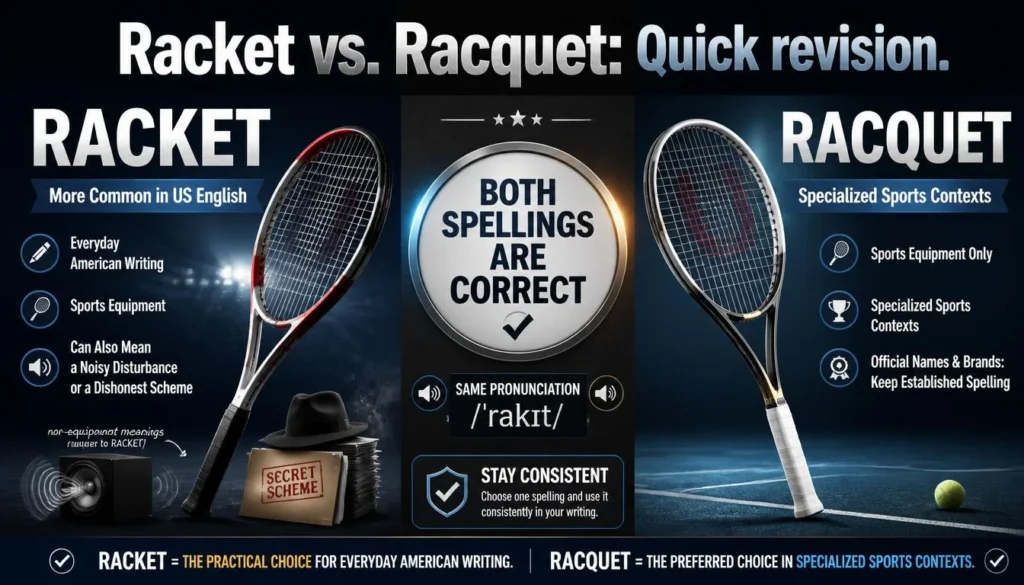
Quick Revision
- Racket and racquet are both correct spellings.
- Both can refer to sports equipment.
- Racket is generally more common in US English.
- Racquet is often used in specialized sports contexts.
- Both spellings have the same basic pronunciation.
- Racket can also mean a loud noise.
- Racket may also describe a dishonest scheme.
- Racquet generally refers only to sports equipment.
- Use racket as the practical choice in everyday American writing.
- Follow the established spelling for official names, brands, or organizations.
- Maintain consistency instead of switching between forms without a reason.
Read More: Dollars to Doughnuts: Meaning, Origin, Usage, and Examples
FAQs
1. Is racket or racquet the correct spelling?
Both racket and racquet are correct spellings. Racket is more common in general English, while racquet often appears in sports-related names and specific contexts.
2. Is racket the preferred spelling in tennis?
Yes. Racket is generally the preferred spelling for the equipment used in tennis. It’s also the more familiar form in everyday English.
3. Does racquet mean something different from racket?
When referring to sports equipment, the two words usually have the same meaning. The main difference is spelling and usage rather than the object itself.
4. Is racquet an incorrect spelling?
No. Racquet is a legitimate spelling, although it’s less common than racket in general English. You’ll often see it in names, clubs, and references to certain sports.
5. Which spelling should I use in American English?
In most everyday situations, racket is the safest choice. It’s widely recognized and commonly used in American English.
6. Is racket used for sports other than tennis?
Absolutely. Racket can describe equipment used for badminton, squash, and several other racket sports. The exact design can vary between sports.
7. Can racket have a meaning unrelated to sports?
Yes. Racket can describe a loud or unpleasant noise. It can also refer to a dishonest or profitable business scheme, depending on the context.
8. Does racquet have meanings outside sports?
Generally, no. Racquet is mainly associated with sports equipment, whereas racket has several additional meanings in English.
9. Why are there two spellings?
Racquet has a long history in English and is associated with an earlier spelling influenced by French. Over time, both forms remained in use, but racket became the more widespread spelling.
10. Which spelling should English learners choose?
For most everyday writing, racket is the better choice. If you’re writing an organization’s name or following a particular sports style, however, racquet may be the expected form.
Conclusion
Racket and racquet aren’t rivals in meaning. They’re two spellings that developed different patterns of use over time. If you’re talking about sports equipment in ordinary English, racket is usually the simplest and most widely accepted choice.
Racquet still has its place, especially in sports organizations, club names, and certain sports contexts. So, seeing racquet doesn’t mean you’ve spotted a spelling mistake. Context often explains why a writer chose one form over the other.
For English learners, the key point is easy to remember: use racket when you want the standard everyday spelling. Check the established spelling when you’re referring to a specific organization, brand, or formal sports name.
Once you understand that distinction, racket or racquet becomes much less confusing. You can choose the spelling confidently without worrying that one form is automatically wrong.

Mehwish Imtiaz is an English specialist and professional blog writer at ClearPhrasing.com. She specializes in grammar, spelling, vocabulary, punctuation, and writing improvement. With a strong passion for clear communication and language education, she creates reader-friendly articles that help students, professionals, and English learners understand complex language topics with ease.
Her writing focuses on accuracy, simplicity, and practical usage, ensuring that every article provides clear explanations and real-world examples. At ClearPhrasing.com, Mehwish is committed to publishing well-researched, original content that helps readers write more confidently and communicate more effectively in everyday and professional English.